Buyer Fit Snapshot
| Best fit | Custom Counter Display Boxes Supplier projects where brand print, material claims, artwork control, MOQ, and repeat-order consistency need to be specified before quoting. |
|---|---|
| Quote inputs | Share finished size, material target, print colors, finish, packing count, annual reorder estimate, ship-to region, and any compliance wording. |
| Proofing check | Approve dieline scale, logo placement, barcode or warning zones, color tolerance, closure strength, and carton packing before bulk production. |
| Main risk | Vague material claims, crowded artwork, missing packing details, or unclear freight terms can make a low unit price expensive after revisions. |
Fast answer: Custom Counter Display Boxes Supplier: Board, Finish, Dieline, and Unit Cost should be specified like a repeatable production item. The safest quote records material, print method, finish, artwork proof, packing count, and reorder notes in one written spec.
Production checks before approval
Compare the actual filled-product size with the drawing, then confirm tolerance on folds, seals, hang holes, label areas, and retail display edges. Reserve space for logos, QR codes, warning copy, and material claims before decorative graphics fill the panel.
Quote comparison points
Review material grade, print process, finish, sampling route, tooling charges, carton quantity, and freight assumptions side by side. A quote is only useful when the supplier can repeat the same color, closure quality, and packing count on the next order.
Choosing a custom counter Display Boxes Supplier is not about ordering a cute little carton and hoping the shelf gods do the rest. It is about building a small retail machine that sits on a crowded counter, survives constant handling, and still gets the product noticed when shoppers are moving fast. A good custom Counter Display Boxes supplier understands product weight, footprint, print, and brand presence well enough to turn all of that into packaging that actually moves units.
Counter displays get dismissed because they look simple. They are not. A compact display sits right where purchase decisions happen quickly, so the structure, artwork, and finish all need to pull in the same direction. If the unit is awkward to stock, wobbly on the counter, or expensive to refill, it stops being a sales tool and turns into decoration. That is a waste of space, and retail space is not cheap.
I have seen otherwise strong launches stumble because the display was a little too tall for the counter, or the board was too soft for the product weight. That stuff sounds minor. It is not. A display that looks fine on a screen can behave badly under store lighting, near register traffic, or in the hands of a cashier who has five seconds to restock it. This is where a real custom counter display boxes supplier earns the fee.
What a Custom Counter Display Boxes Supplier Actually Delivers
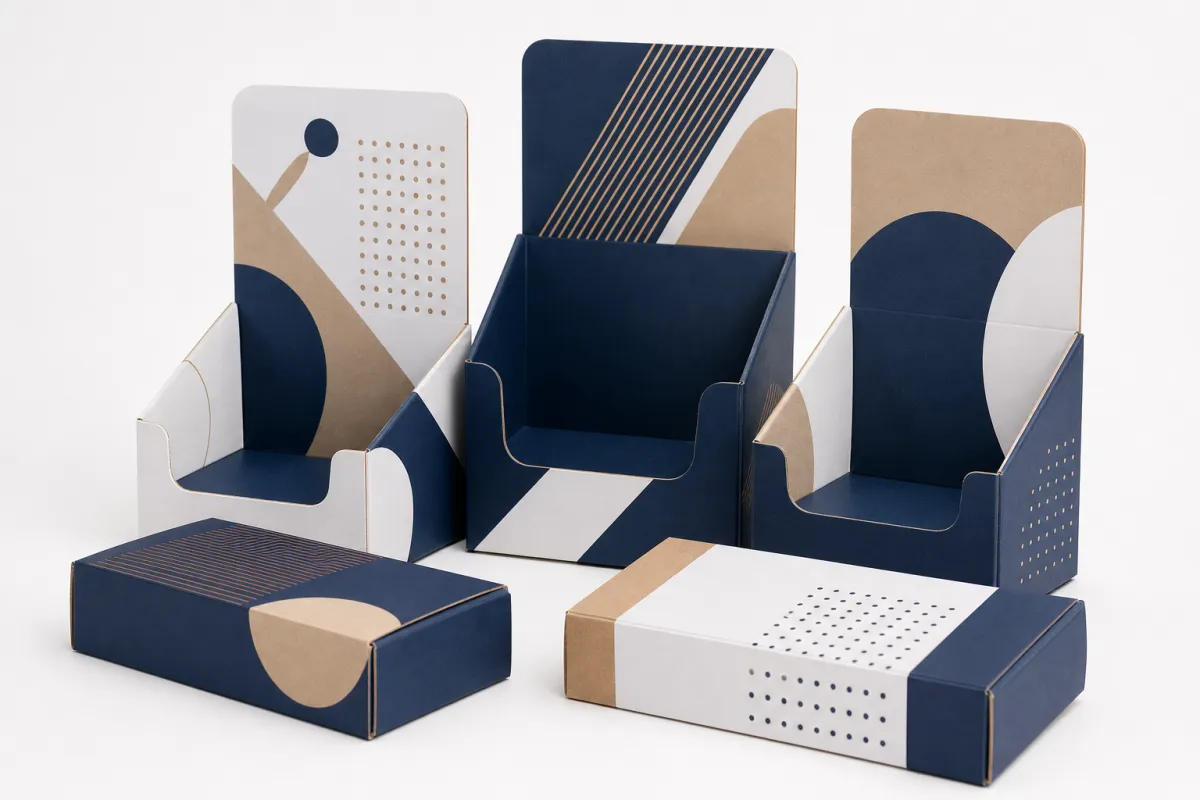
A custom counter display boxes supplier does a lot more than print a panel and fold some board. The real job is to turn a product brief into a display that fits the item, survives handling, and still looks sharp after it has been opened, stocked, and poked at all day near checkout. These units show up on reception counters, service desks, checkout lanes, shelf lips, and tabletop promotions, so the design has to stay compact without becoming unreadable.
Most buyers start with graphics. Fine. The first real decision is usually board choice. A custom counter display boxes supplier may recommend SBS for a cleaner print face, coated chipboard for a lighter-duty display, micro-flute for more stiffness, or corrugated when the product is heavier and the unit needs extra support. That choice affects fold behavior, edge quality, and cost in ways that show up quickly once production starts. There is no magic material that wins every time.
Structure matters just as much as print. Some counter units are simple self-locking trays with a header card. Others use a tear-away front so the product rises as items are removed. Some need dividers, insert cards, or a reinforced base so the front row does not bow out like a tired folding chair. A good custom counter display boxes supplier will ask how many SKUs need to fit, how much the product weighs, whether the display will be packed by hand or by machine, and whether it needs to ship flat or arrive pre-glued.
That last detail gets people in trouble. A flat-shipping display saves freight and warehouse space, but it may ask store staff to assemble it. A pre-glued display cuts setup time on site, but it takes more cubic space and can complicate packing. The right answer depends on labor, rollout speed, and how many locations are receiving the program. A real custom counter display boxes supplier explains those tradeoffs instead of pretending every job should work the same way.
Print and finishing are the visible layer, but they do not rescue a weak structure. A custom counter display boxes supplier should also think about bleed, fold tolerance, glue zones, and how the artwork wraps around the front lip or side panel. Put a logo too close to a crease and it starts looking sloppy. Park a callout where the board folds under pressure and the display loses polish. That is why Custom Printed Boxes for retail need structural decisions before the design gets locked.
What the supplier is really delivering is the whole package: board, dieline, print setup, finish, packing format, and assembly logic. If one of those pieces is off, the display may still exist, but it will not sell well. That is the gap between a box that merely holds product and a branded packaging unit that helps turn attention into revenue. Small difference. Huge result.
A counter display has a short life on the shopper’s radar. If it is hard to build, hard to refill, or hard to read, people walk past it and buy something else.
Buyers who are comparing formats usually get better results when they review broader Custom Packaging Products alongside counter displays. That makes it easier to line up structure, print style, and merchandising goals before production starts. A capable custom counter display boxes supplier should be able to place the counter unit inside your larger product packaging plan, not just quote the cheapest carton in the room.
How a Custom Counter Display Boxes Supplier Turns a Brief Into Samples
The sample process starts with better questions than “What size box do you want?” A seasoned custom counter display boxes supplier wants the product dimensions, the number of SKUs, the target load weight, the retail setting, and the launch date before recommending a structure. Those details tell the supplier whether the display needs a basic tray, a reinforced counter unit, or a more engineered layout with inserts and cutouts.
Once the brief is clear, the supplier usually builds a dieline or structural mockup. That is the map of panels, folds, tabs, and display openings. A good custom counter display boxes supplier will often send the structural drawing first so the buyer can confirm footprint and layout before the artwork is finalized. That order matters. Graphics are easy to adjust before the panel geometry is locked. After that, they get expensive.
Prototype samples are where the hidden problems show up. A flat file cannot tell you whether the display takes too long to assemble, whether the front wall bends under weight, or whether the product disappears when the shelf is half empty. The sample stage is also where buyers find out whether the footprint blocks register space, whether the header is too tall for the store, or whether a display that looked compact on screen feels oversized in real life. A careful custom counter display boxes supplier will treat those findings as useful information, not a nuisance.
Sample feedback works best when it stays focused. Change the tray depth if the product needs more support. Move the logo if a fold cuts through the artwork. Fix the structural issue before you start reworking the whole brand layout. Mixing structure edits with a brand refresh is how timelines get longer for no good reason. The cleaner the feedback, the faster the custom counter display boxes supplier can move toward a usable prototype.
Sample quality should match the risk of the launch. A small internal test might only need a digital mockup and a plain white sample. A national retail rollout deserves a fully printed prototype that behaves like the real thing. The more the display has to do on day one, the more useful it is to test it as a retail packaging asset instead of a paper exercise.
If the supplier knows what they are doing, sampling should cut uncertainty, not add more of it. Good suppliers tell you what is fixed, what can move, and what changes would trigger a new die, a different board grade, or another proof cycle. That kind of clarity is one of the strongest signs you have found a custom counter display boxes supplier who understands how print, structure, and retail use interact.
For teams focused on merchandising control, this is also where package branding stops being decorative. The sample should prove that the display communicates the offer, supports the product, and stays in shape without turning store staff into unpaid assembly labor. Nobody needs that.
Key Factors That Shape the Right Box Structure and Finish
Material choice is usually the first big lever a custom counter display boxes supplier will pull. Board behavior changes everything downstream. Solid bleached sulfate gives a clean print surface and sharp graphics. Coated chipboard keeps the job economical for lighter loads. Micro-flute adds stiffness without going straight to bulky board. Corrugated gives more muscle when the product is heavy and the display needs to hold its shape. A good custom counter display boxes supplier does not push one material for every program. They match the board to the product, the counter environment, and the expected life of the display.
Structure comes next. Self-locking trays are fast to assemble and work well for small cartons or blister packs. Tear-away fronts help the product rise as units sell through, which matters for impulse items and quick refill programs. Header cards create a stronger brand block above the product, while display sleeves can feel cleaner and more premium. Heavier products may need reinforced bottoms, glued corner supports, or internal dividers so the display does not spread under load. A practical custom counter display boxes supplier will explain those choices in handling terms, not sales fluff.
Finishing should support the sale, not distract from it. CMYK handles most artwork. Spot colors help protect a logo or keep a product line easy to read. Aqueous coating gives basic scuff resistance without heavy lamination. Gloss lamination adds shine and makes color jump under store lighting. Matte or soft-touch finishes feel quieter and often more premium. Foil, embossing, and spot UV can work, but only if they earn their place. A seasoned custom counter display boxes supplier knows where a finish adds value and where it just adds cost.
Retail reality should drive every one of those choices. A display that looks generous in a CAD file may be too wide for a crowded checkout lane. A tall header may work on a showroom table but fail on a low service desk. Humidity can soften certain boards, especially near store entrances or in warmer climates. Constant shopper handling exposes weak glue points faster than anyone wants. The supplier should ask about store type, refill frequency, and merchandising pattern before locking the design.
Here is a simple comparison that helps buyers sort through common options before they request quotes from a custom counter display boxes supplier:
| Material / Format | Best Use | Relative Strength | Typical 5,000-Unit Range | Notes |
|---|---|---|---|---|
| SBS board | Premium graphics, lighter products | Medium | $0.22-$0.40 per unit | Clean print surface, good for branded packaging |
| Coated chipboard | Budget-friendly retail displays | Light to medium | $0.18-$0.32 per unit | Useful when product weight is modest |
| Micro-flute | Higher stiffness with compact footprint | Medium to high | $0.28-$0.48 per unit | Good balance of structure and print quality |
| Corrugated | Heavier product loads, stronger counter units | High | $0.30-$0.55 per unit | Often chosen when durability matters more than ultra-fine print detail |
Those figures are estimates, not fixed quotes. Print coverage, finish, order volume, and assembly labor can move pricing quite a bit. Still, they give buyers a better starting point when they talk to a custom counter display boxes supplier and compare proposals for Custom Printed Boxes with real structure instead of a flat carton pretending to be a retail plan.
Sustainability deserves a straight answer, not a slogan. If recycled content, FSC-certified board, or easier recovery matters to the program, ask early and confirm it in writing. The Forest Stewardship Council explains certified sourcing clearly at fsc.org, which helps when branded packaging has to support procurement goals as well as sales goals. A responsible custom counter display boxes supplier should be able to talk about those options without turning them into fog.
For transit testing, the International Safe Transit Association is another useful reference at ista.org. Not every counter display needs formal transport validation, but if the unit will move through a rough distribution network, it helps to know whether the display should be designed with transit stress in mind. A thoughtful custom counter display boxes supplier will know when that discipline is worth the effort.
Custom Counter Display Boxes Supplier Process and Timeline
The production path is usually straightforward once the brief is complete, but every step carries risk. A reliable custom counter display boxes supplier will start with discovery, move into structural recommendation, build the dieline, proof the artwork, produce samples, get approval, run production, and pack the finished units for freight. It sounds simple on paper. In real life, the schedule depends on how fast the buyer answers questions and approves each stage.
New structures take longer than repeat orders. If the display needs a fresh cutting die, new glue points, or a different front opening, the supplier has to validate the geometry before the full run begins. A repeat build with the same specification can move much faster because the learning curve is already gone. That is one reason a custom counter display boxes supplier often asks whether the order is a reprint, a revision, or a new launch.
Lead times also shift with finishing. A basic matte printed tray can move quickly. Foil, embossing, spot UV, or hand-applied inserts can add days, sometimes a full week, especially if the job needs extra inspection or manual folding. If the display ships partially assembled, packing takes longer too, because the supplier has to protect the shape during transit and make sure store staff can open the carton without damage.
A typical custom path often looks like this:
- Discovery call or written brief, usually 1-2 business days.
- Dieline or structure recommendation, often 2-4 business days.
- Artwork proofing and adjustments, commonly 2-5 business days depending on feedback speed.
- Sample or prototype approval, which may take 3-7 business days if a physical sample is needed.
- Production, often 7-15 business days for standard runs after approval.
- Packing and freight booking, usually 1-3 business days before shipment leaves the plant.
That timeline can shrink for simple repeat work and stretch for complex retail packaging programs. A custom counter display boxes supplier who promises a fast turnaround without knowing artwork status, board availability, and the number of revisions is usually guessing. Better to hear a real date than a flattering one that slips later.
The usual schedule killers are familiar: missing dimensions, late artwork, unclear product weights, and feedback that arrives in fragments instead of one organized round. If you want to protect the launch, lock product measurements early, send print-ready files if possible, and keep decision-makers in the same review loop. The cleanest projects are usually the ones where the buyer treats the custom counter display boxes supplier like a technical partner, not a vendor waiting for a purchase order.
One habit helps a lot: ask the supplier to confirm what would change the timeline before work starts. If a color tweak is okay but a size change is not, get that in writing. If the job can survive one revision round but not three, know that before proofs go out. That kind of discipline keeps the retail packaging schedule honest and cuts out avoidable rework.
Custom Counter Display Boxes Supplier Pricing: What Actually Affects Cost
Pricing gets easier once you break it into pieces. A custom counter display boxes supplier usually prices by quantity, board grade, print coverage, finish, structure complexity, and the amount of manual labor needed. If two quotes look wildly different, one of those variables is almost always the reason. Buyers often compare the final number without checking whether the spec is actually the same. That is how people end up surprised later.
Quantity is the simplest lever. A 1,000-unit run normally costs more per piece than a 5,000-unit run because setup, cutting, and proofing are spread over fewer cartons. Print coverage also matters. A full-bleed design with heavy ink coverage, solid backgrounds, and multiple spot colors costs more than a cleaner layout with less coverage. A good custom counter display boxes supplier will show you where the dollars go instead of hiding setup charges inside a soft total.
One-time costs deserve their own line. Dieline development, cutting dies, print plates, sample builds, and custom inserts can all add upfront expense. That is normal. What catches many buyers off guard is that some of those costs are true one-time charges while others can return if the structure changes. Move a cutout, change the height, or add a new reinforcement feature, and the supplier may need to adjust tooling. That is not a trick. It is just physical packaging.
The hidden costs are usually where budgets drift. Multi-SKU displays need more layout work and sometimes more complex divider systems. Tight tolerances can increase sample rounds and inspection steps. Rush production may require overtime or priority scheduling. Special packing requests, such as custom shipper cartons or retail-ready shelf loading, add labor. Freight matters too. A heavier or larger display can cost more to move than the box price suggests. A careful custom counter display boxes supplier will talk through all of that before the order is approved.
To make quotes easier to compare, ask every supplier to price the same spec sheet. That sheet should include dimensions, board type, print sides, finish, load weight, pack format, and delivery location. If one quote includes a pre-glued structure and another assumes flat shipping, those are not the same price. Comparing them as if they were equal is how buyers end up with missed expectations and late change orders.
Here is a simple way to think about common cost drivers:
- Lower cost: standard board, one-color or simple CMYK print, flat shipment, no special finishes.
- Mid-range cost: full-color branded packaging, moderate board upgrade, aqueous coating, simple die-cut structure.
- Higher cost: reinforced display design, premium finish, multiple inserts, pre-assembled packing, shorter lead time.
The real question is not “What is the cheapest quote?” It is “Which quote gives the most reliable result for the retail use case?” A cheaper display that collapses, scuffs quickly, or burns store labor is not actually cheaper. That is why a strong custom counter display boxes supplier should be judged on clarity, engineering judgment, and fit for purpose as much as on unit price.
If you need a practical benchmark, a simple printed counter tray for a mid-volume run may sit around $0.18-$0.32 per unit, while a more engineered display with heavier board or special finishing can climb into the $0.30-$0.55 range or beyond. Those ranges move with order volume and setup, but they help buyers frame realistic expectations before they request custom packaging quotes. No drama. Just numbers.
The lowest number on the page is not always the smartest buy. In retail packaging, a few extra cents often pay for better structure, cleaner presentation, and fewer headaches in the store. That matters even more for custom printed boxes that have to carry both product and brand message in a very small space.
Common Mistakes and Expert Tips When Choosing a Supplier
The most common mistake is sending too little information. A product photo alone is not enough for a custom counter display boxes supplier to size the unit properly. Photos hide depth, weight, and pack arrangement. If you want an accurate quote and a useful structure recommendation, send dimensions, product weight, SKU count, and a rough idea of how the display will be loaded and restocked.
Another easy mistake is approving artwork before the structure is proven. If the dieline changes after the graphics are set, text can end up too close to a fold, brand marks can shift, and the finished display can look different from the proof. A disciplined custom counter display boxes supplier will usually ask for structural approval first, because packaging design should follow the geometry instead of fighting it. That order saves time and arguments.
There is also a habit of ignoring the real handling environment. A display that looks beautiful in a clean office can perform badly in a humid store entrance or a busy checkout lane where customers lean on it constantly. Ask how the board will react to moisture, whether the glue points are reinforced, and how much product stays visible as the front row sells down. That is the kind of practical question a good custom counter display boxes supplier should answer without hesitation.
Here are a few expert habits that make the order smoother:
- Test the sample with the actual product weight, not a guessed substitute.
- Ask for assembly guidance so store teams or warehouse staff are not guessing.
- Confirm whether the display will ship flat, pre-glued, or partially assembled.
- Review bleed, fold direction, and glue zones before artwork is frozen.
- Keep one person responsible for final feedback so revisions do not conflict.
That last item matters more than people think. When sales, marketing, and operations all send separate notes, the supplier can end up with three different priorities and no clear decision. A strong custom counter display boxes supplier usually appreciates one coordinated response because it shortens the revision loop and cuts rework. It also keeps everyone from pretending their pet change is the only change that matters.
It helps to choose a supplier that can speak plainly about board thickness, crease quality, and what the finish will do under store lighting. If a supplier explains why a heavier board may be needed or why a high-gloss finish might show scuffs faster, that is a good sign. It means they are thinking like a packaging production partner, not just a sales desk.
Honestly, the best buyers treat counter displays as part of package branding and retail execution at the same time. That mindset usually produces better decisions about structure, print, and unit economics. It also makes it easier to get useful proposals from a custom counter display boxes supplier because the brief is grounded in how the display will work, not just how it will look.
If you are comparing options across a broader range of custom printed boxes or trying to match a display style to a larger rollout, reviewing Custom Packaging Products can help you see where counter units sit in the wider system. The right supplier should be able to connect those pieces and recommend a display that supports both merchandising and production realities.
What to Do Next With a Custom Counter Display Boxes Supplier
The easiest way to get better quotes is to build a one-page brief before you contact a custom counter display boxes supplier. Include product dimensions, unit weight, number of SKUs, quantity needed, shipping destination, target launch date, artwork status, and any display limits such as counter depth or maximum height. That one page saves time, cuts back-and-forth, and gives the supplier a real basis for a structural recommendation.
Then ask each supplier for three things: a recommended structure, a sample plan, and a realistic lead time. If you are judging a custom counter display boxes supplier on price alone, you are probably missing the main decision factors. Clarity, engineering judgment, and response quality tell you a lot about how the project will go once production starts.
It also helps to compare the notes, not just the numbers. Did the supplier mention board grade? Did they flag assembly risk? Did they explain how the display will be packed for shipment? A good custom counter display boxes supplier usually points out those issues early because that is how rework gets avoided.
If the launch matters, lock the dieline first, review the sample, and only then approve final artwork. That order keeps the display consistent and reduces the chance of late changes. Once the specs are locked, confirm freight details, pack quantity, and receiving instructions so nothing gets held up at the end. A controlled order is usually the difference between a rollout that feels clean and one that turns into a mess.
From a buyer’s point of view, the strongest partners are the ones who make the process feel under control without pretending there is no complexity. A good custom counter display boxes supplier will be honest about tradeoffs, specific about timelines, and clear about what the display can and cannot do. That is the standard worth asking for, especially when the unit has to represent your retail packaging at the exact moment the shopper decides whether to buy.
If you are building a launch around branded packaging, keep the display brief tight, compare the same specification across quotes, and ask for a sample before full production whenever the stakes are high. That is the practical path with a custom counter display boxes supplier, and it is usually the path that leads to better shelf performance, fewer surprises, and a cleaner result for the brand.
One final filter: if a supplier cannot explain why a board grade, structure choice, or finish was recommended, keep moving. A good partner should be able to connect the spec to the retail job in plain language. If they cannot, you are probably buying a quote, not a solution.
What does a custom counter display boxes supplier usually handle?
They usually handle structure, dieline setup, print production, finishing, and packing format. Many also guide sample approval so the display fits the product and holds up at retail counters. Better suppliers spell out what is included in the quote so there are no surprises around tooling, setup, or packing labor.
How long does a custom counter display box supplier need for samples and production?
Simple repeat jobs can move quickly, while a new custom structure usually needs more time for dielines and prototypes. Sampling adds time because fit, strength, and appearance should be checked before the full run starts. Revisions, special finishes, and freight can all stretch the schedule, so it helps to approve details early.
What should I send to a counter display box supplier for an accurate quote?
Share product dimensions, weight, quantity, and how many items the display must hold. Include artwork files, preferred finish, retail use case, target date, and delivery location. If you only have a rough concept, add photos, sketches, or similar examples so the supplier can estimate more accurately.
Why do custom counter display boxes supplier quotes vary so much?
Quotes change with material grade, print coverage, coating, structure complexity, and order volume. Some prices include tooling, samples, or packing support, while others separate those costs. Always compare the same spec sheet so you are judging value, not just the lowest number.
Can a custom counter display boxes supplier help if I only have a rough concept?
Yes, a good supplier can turn a rough concept into a workable structure and dieline. Expect an extra round of questions and possibly a sample to confirm fit and assembly. Bring clear product details and a simple goal for the display so the design stays practical and retail-ready.

