Custom Cuffed Knit Beanies Bulk Order: Pricing & Proofs
Custom Cuffed Knit Beanies bulk order programs work because the product solves two problems at once: warmth and visibility. The cuff gives you two branding zones, so the logo can stay readable whether the wearer folds it low or wears it higher. That is why a custom cuffed knit beanies bulk order usually performs better than a one-off winter giveaway; people keep it, wear it, and put it back on for months.
From a buyer's point of view, the real value is not novelty. It is repeatable output. Teams, campus stores, fundraiser merch tables, retail add-ons, and seasonal client gifts all need the same thing: a clean spec, a reasonable minimum, and a re-order path that does not start from zero every time. In practice, that is where bulk ordering beats piecemeal buying. The per-piece cost drops, replenishment gets easier, and the product looks consistent across the whole run.
There is also a practical branding angle. A cuffed beanie sits in the same family as branded packaging and retail packaging: it has to be useful, presentable, and easy to reproduce. If the knit, color, and decoration are documented well, the item becomes part of the brand system instead of a one-time promo object.
Buyers usually regret one thing more than anything else: approving a winter item too quickly because it felt simple. The spec only looks simple until you are trying to match the cuff height, logo size, and yarn color across 500 pieces.
That is the difference between a product that disappears into the crowd and one that keeps showing up in photos, uniforms, and store shelves.
Choosing the Right Knit, Cuff, and Fit
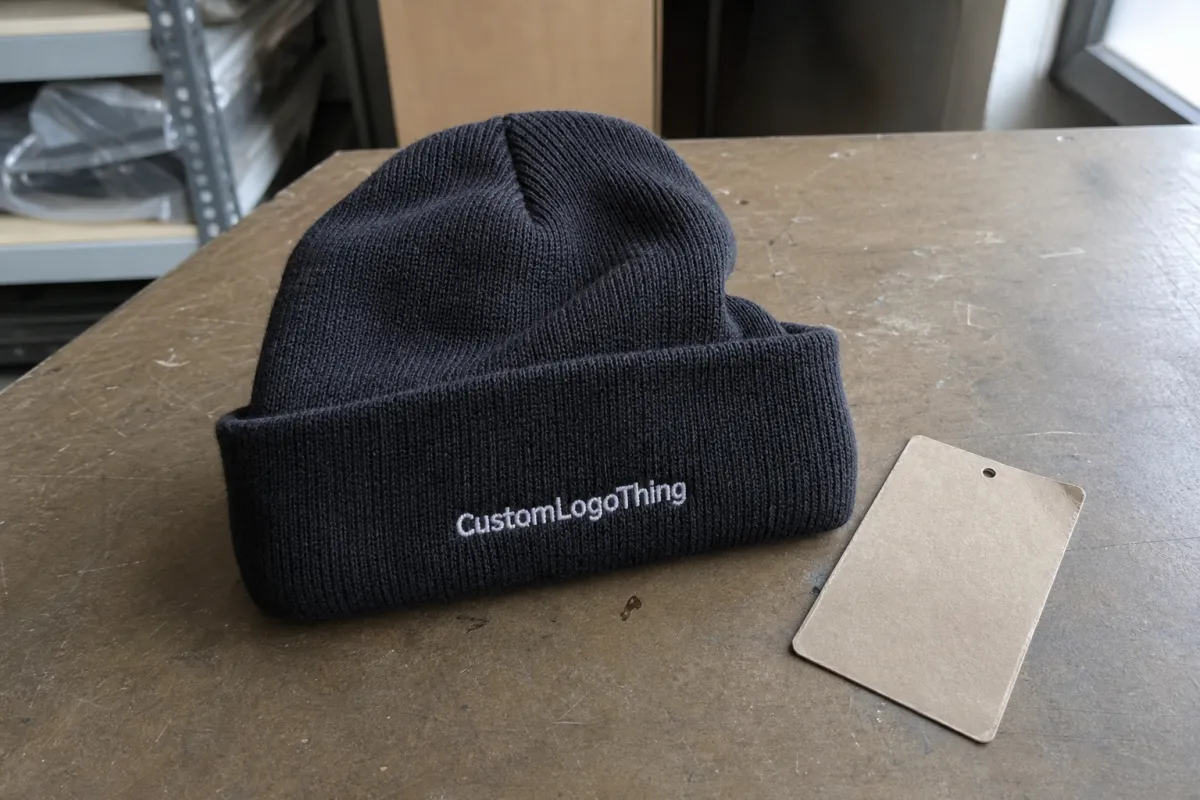
The construction choices matter more than most first-time buyers expect. Yarn type changes hand feel and warmth. Stitch density changes stretch and how tightly the beanie hugs the head. Cuff depth changes the usable decoration area. Fit profile changes who can wear it comfortably. A cheap-looking beanie is often not cheap because of the decoration; it is cheap because the body shape and knit quality were under-specified.
For most bulk programs, the common body is one-size-fits-most in acrylic or recycled acrylic with a 1x1 rib or similar stretch knit. That works for employee uniforms and retail merch because it travels well across head sizes. Youth sizing makes sense for school programs. A longer-body style helps in colder markets, where wearers want extra coverage over the ears and the back of the head. If the audience is mixed, the safe choice is the standard cuffed silhouette with enough vertical depth to avoid looking short once the cuff is folded.
- Cuff height: shorter cuffs look modern, but they reduce decoration room.
- Knit density: tighter knits usually hold shape better and show logos more cleanly.
- Yarn choice: acrylic is common for value; recycled blends help with sustainability claims.
- Fit profile: relaxed, snug, or long-body all change the finished look on the head.
If you are comparing custom cuffed beanies bulk order options, ask three questions before requesting quotes: Who will wear them? Where will they be worn? What matters most, comfort, structure, or logo visibility? Those answers save time because they tell the supplier whether to emphasize warmth, cuff space, or a cleaner retail look. If the same program also needs custom printed boxes or merch kits, aligning the apparel spec with package branding from the start keeps the whole launch cleaner.
Decoration Specs That Hold Up on a Cuffed Beanie
Decoration on a knit surface is not the same as decoration on a flat shirt. The fabric moves, stretches, and compresses, so the method has to survive that motion. Embroidery is usually the most durable choice because it keeps shape through wear and folding. Woven patches are better for fine detail and small type that would get lost in stitches. Appliques add texture, which can be a strong move for retail packaging-style presentation, but they need more care around edges and thickness.
Small text and thin lines are where buyers get into trouble. A logo that looks crisp on a screen may turn muddy on soft knit if it is too detailed. Gradients are especially risky. The production team may need to simplify the art, thicken lines, or enlarge the mark so it reads from a few feet away. That is not a defect; it is how soft goods behave. The same logic applies to custom cuffed knit beanies bulk order runs and other branded merchandise. Legibility beats complexity almost every time.
| Decoration method | Best use | Pros | Trade-offs | Typical setup impact |
|---|---|---|---|---|
| Embroidery | Simple logos, uniforms, giveaways | Durable, familiar, strong on cuff placements | Fine detail can blur if the art is too small | Lowest to moderate |
| Woven patch | Small text, thin lines, retail merch | Crisper detail, polished look, good for brand marks | Patch edges and attachment need approval | Moderate |
| Applique | Texture-forward fashion and retail programs | High visual impact, layered look | More labor, more variables, thicker finish | Moderate to higher |
Placement matters too. Centered on the cuff is the safest and most common. Offset on the cuff feels more modern. Above the fold can look sharper for premium retail packaging or package branding, but it can also shrink the visible logo area. If the artwork is close to a seam or cuff edge, ask for a proof that shows exact millimeters, not just a centered mockup. A clean artwork file in vector format, Pantone references where relevant, and a clear no-go zone around seams will save you from costly revisions later.
Custom Cuffed Knit Beanies Bulk Order Pricing and MOQ
Pricing usually moves in the same direction as most decorated merchandise: higher volume lowers unit cost, while extra colors, special placement, and complex packaging add cost back in. That means a custom cuffed knit beanies bulk order is rarely priced well by a single line item alone. The quote should separate the body cost, decoration, setup, sample charges, freight, and any retail packaging or labeling work.
MOQ stands for minimum order quantity, and it exists for a reason. Knit production requires setup. Dye matching requires planning. Decoration setup takes time whether you order 100 pieces or 500. If a supplier is willing to go lower on minimums, that usually works best when the design stays simple: one body color, one decoration location, and one proof path. Split the job across too many versions and the price rises fast.
| Run size | Typical unit price | What usually changes the price | Good fit for |
|---|---|---|---|
| 100-149 pieces | $6.25-$9.00 | Setup, sample handling, and lower production efficiency | Small teams, pilots, limited events |
| 250 pieces | $4.90-$7.20 | Decoration complexity, yarn choice, and color count | School stores, regional launches, employee gifts |
| 500+ pieces | $3.80-$6.10 | Special packaging, multiple placements, and rush timing | Retail programs, campus stores, repeated replenishment |
Those ranges are typical, not fixed. A one-color embroidered cuffed beanie in stock acrylic can land near the lower end. Add woven patches, custom labels, or premium yarn and the number climbs. A buyer comparing custom cuffed knit beanies Bulk Order Quotes should ask for tiered pricing at 100, 250, and 500 pieces so the real break point is obvious. A fair quote is easier to judge when it shows the economics instead of hiding them.
One more point that gets missed: freight can distort the whole comparison. A low unit price with expensive shipping is not a win. Ask for destination shipping or at least a realistic estimate to the final warehouse or event site. That is especially true if the beanies are part of a broader merchandise rollout that also includes product packaging, inserts, or branded packaging materials.
Production Process and Timeline From Art to Arrival
The cleanest production runs follow a predictable sequence. First comes artwork review. Then a digital proof. Then sample or swatch approval if needed. After that, knit production, decoration, packing, and shipment. If any of those steps blur together, delays tend to multiply. The buyer thinks the order is in motion, but the factory is waiting on a detail that was never fully approved.
- Artwork review: confirm logo size, placement, and acceptable file format.
- Digital proof: check color notes, cuff position, and any decoration limits.
- Sample or swatch: approve if the order is large or color-sensitive.
- Knit production: body construction begins after signoff.
- Decoration and packing: add labels, tags, folding, and carton prep.
- Shipment: move by air or sea depending on urgency and budget.
For standard custom cuffed knit beanies bulk order programs, a realistic schedule is often 12-15 business days after proof approval for straightforward runs, then additional transit time on top of that. If the order needs sampling, complex decoration, or holiday-season capacity, 18-25 business days is more believable. The difference between proof time and production time matters. Buyers who only hear one ship date usually lose track of the real calendar.
If the goods need to survive distribution across multiple stops, ask how the cartons are packed and whether the ship test is aligned to an ISTA transit profile. The point is not to turn a beanie order into a lab project. The point is to prevent crushed cartons, missing sizes, and sloppy arrival conditions that create rework at the receiving dock. That matters even more if the beanies are going straight into retail packaging or event kits.
Milestone dates are more useful than one big ship date. A production calendar that shows proof approval, sample approval, knit start, pack-out, and freight departure gives the buyer control. It also makes it easier to line up a launch, a team handout, or a seasonal store reset without guessing.
Color Matching, Proofs, and Sample Approval
Color is where buyers either feel calm or get nervous. Approximate matching is fine for some programs, but many brands need the beanie to sit beside uniforms, jackets, or retail packaging without looking off. In that case, Pantone-based references are better than vague color names. “Navy” can mean a dozen different things. A matched yarn sample gives everyone a shared target.
Do not trust a screen proof by itself. A digital mockup can hide stitch density, texture, and the real scale of the logo. It may also make the cuff look wider or tighter than it will in production. For small orders, a proof may be enough. For larger custom cuffed knit beanies bulk order runs, a physical swatch or pre-production sample is the safer call, especially if the logo sits close to the cuff edge or the brand color is sensitive.
Approve color, placement, scale, and spelling in one document. If those four items are separated, someone will eventually interpret the job differently than the rest of the team.
There is a bigger lesson here that applies to packaging design as much as apparel: the more the buyer assumes, the more the vendor has to guess. If the same launch includes hang tags, belly bands, or custom printed boxes, the paper stock and ink references should be written down beside the beanie spec. For paper components, a recycled-content or FSC-certified option can support sustainability claims; see the Forest Stewardship Council at fsc.org.
That is also why a shared approval sheet works well. It should show the yarn color, logo art, cuff position, decoration method, and packing instructions in one place. No one wants to discover, after production starts, that the logo was centered on the mockup but should have been 12 millimeters higher in real life.
Why Manufacturers Beat Marketplace Resellers on Reorders
Reorders are where direct control pays off. A manufacturer or specialist vendor can keep prior specs on file, which matters when a brand needs the second run to match the first one closely. Marketplace resellers often have to rebuild the job from scratch, chase old files, and translate the original request through another layer of communication. That is where inconsistency starts.
With direct production, the cuff depth, trim color, decoration placement, carton count, and even the way the beanies are folded can stay attached to the job record. That is useful for school stores, seasonal retail programs, workforce onboarding, and sponsor kits. The buyer is not asking for a new creative idea. The buyer is asking for the same item again, without a hidden deviation.
That same discipline matters in branded packaging and package branding. If your beanies ship with inserts, hang tags, or folded cards, the pack-out instructions should be documented just like the logo spec. For buyers managing a wider merch program, our Wholesale Programs page and Custom Packaging Products page help connect the apparel order to the rest of the presentation. If you need ordering basics, our FAQ is a useful place to sanity-check the process before you commit.
Honestly, the strongest reorders come from boring records. A clean spec sheet. One approved proof. One sample reference if needed. One carton plan. That is what keeps the next run from drifting. It also protects the budget, because every rebuild adds time and every revision adds cost. Buyers who treat a custom cuffed knit beanies bulk order as a repeatable production file, not a one-off idea, usually get the most stable pricing and the fewest surprises.
Next Steps Before You Place the Order
Before you request quotes, gather the essentials: quantity, target delivery date, logo file, preferred colors, decoration method, and any packaging or labeling requirements. If you already know the beanies will be sold through retail, add that note. If they are for employee uniforms, say that too. The use case changes how the supplier should approach fit, folding, and finish.
Ask every vendor to separate the numbers. Unit price, setup, sample cost, freight, and rush fees should not be buried in one line. The cleaner the quote, the easier it is to compare it against another supplier. A good quote also says what is included: is the proof free, is the sample refundable, are labels added, are cartons counted and marked by size or color?
A practical approval path is simple:
- Confirm the spec sheet in writing.
- Approve one proof with exact placement notes.
- Decide whether a sample or swatch is required.
- Lock the ship-to address and timing window.
- Keep the production calendar visible to everyone who depends on it.
That process is not complicated. It is disciplined. And discipline is what keeps a winter merch program profitable instead of messy. Compare like-for-like quotes, approve the sample criteria before production starts, and move the custom cuffed knit beanies bulk order into the schedule with a clean ship-to plan. That is the most reliable way to keep the run on budget, on time, and ready for the shelf.
Frequently Asked Questions
What is the minimum order for a custom cuffed knit beanies bulk order?
MOQ usually depends on yarn color count, decoration method, and whether the beanie is fully custom or based on a stock shape. Lower minimums are more realistic when you keep one body color and one logo placement instead of splitting the order across many versions. Ask for tiered quantity pricing so you can see the break point where the unit cost improves enough to justify the larger run.
Can I get color-matched custom cuffed knit beanies in bulk?
Yes, but the level of matching depends on the yarn and production method, so ask whether the vendor uses Pantone references or closest-match yarn stock. For critical brand colors, request a swatch or physical sample before approving the full production run. If the order includes multiple colors, confirm whether each color adds setup time or changes the minimum quantity.
How long does a custom cuffed knit beanies bulk order usually take?
The timeline usually has two parts: proof approval and production, then shipping time after the order is packed. Orders slow down when artwork needs revision, colors need confirmation, or the buyer waits to approve a sample. Ask for a dated production schedule with milestones so you can plan a launch, event, or store delivery around the actual ship date.
What decoration method lasts best on cuffed knit beanies ordered wholesale?
Embroidery is usually the most durable choice because it holds up well to wear, folding, and cold-weather use. Woven patches are a strong option when the design has fine detail that would be difficult to stitch clearly. The best method depends on logo complexity, texture, and how visible you want the branding to be on the cuff.
Should I approve a sample before placing a large custom cuffed knit beanies order?
Yes, especially when the logo is detailed, the color match is sensitive, or the order is large enough that mistakes would be expensive. A sample helps confirm fit, stitch quality, decoration placement, and how the cuff sits once the beanie is worn. If a full sample is not practical, ask for a swatch or pre-production proof with written approval notes, because that is usually the safest path for a custom cuffed knit beanies bulk order.

