Buyer Fit Snapshot
| Best fit | Custom Die Cut Hang Tags projects where brand print, material claims, artwork control, MOQ, and repeat-order consistency need to be specified before quoting. |
|---|---|
| Quote inputs | Share finished size, material target, print colors, finish, packing count, annual reorder estimate, ship-to region, and any compliance wording. |
| Proofing check | Approve dieline scale, logo placement, barcode or warning zones, color tolerance, closure strength, and carton packing before bulk production. |
| Main risk | Vague material claims, crowded artwork, missing packing details, or unclear freight terms can make a low unit price expensive after revisions. |
Fast answer: Custom Die Cut Hang Tags: Design, Cost, and Production should be specified like a repeatable production item. The safest quote records material, print method, finish, artwork proof, packing count, and reorder notes in one written spec.
Production checks before approval
Compare the actual filled-product size with the drawing, then confirm tolerance on folds, seals, hang holes, label areas, and retail display edges. Reserve space for logos, QR codes, warning copy, and material claims before decorative graphics fill the panel.
Quote comparison points
Review material grade, print process, finish, sampling route, tooling charges, carton quantity, and freight assumptions side by side. A quote is only useful when the supplier can repeat the same color, closure quality, and packing count on the next order.
Custom Die Cut hang tags do a lot of work before a shopper reads the first line. Shape, stock, and edge detail can signal premium value, craft, or playfulness in a second, which is exactly why custom Die Cut Hang Tags matter so much in branded packaging and retail packaging.
From a packaging buyer’s point of view, that small card is not a side note. It belongs to package branding, it belongs to product packaging, and it often becomes the first physical proof that the brand cares about details. A well-made tag can make a simple garment feel deliberate; a sloppy one can make a strong product look unfinished. That contrast is why Custom Die Cut hang tags deserve more planning than they usually get.
There is a practical side to the aesthetics as well. A smart silhouette can help a product stand out on a crowded fixture, while the wrong shape can create waste, add setup cost, and slow production. Custom Die Cut hang tags are a design choice and a manufacturing choice at the same time.
A good hang tag makes the product feel finished. A bad one makes the brand feel undecided.
What Custom Die Cut Hang Tags Say Before a Customer Reads Them
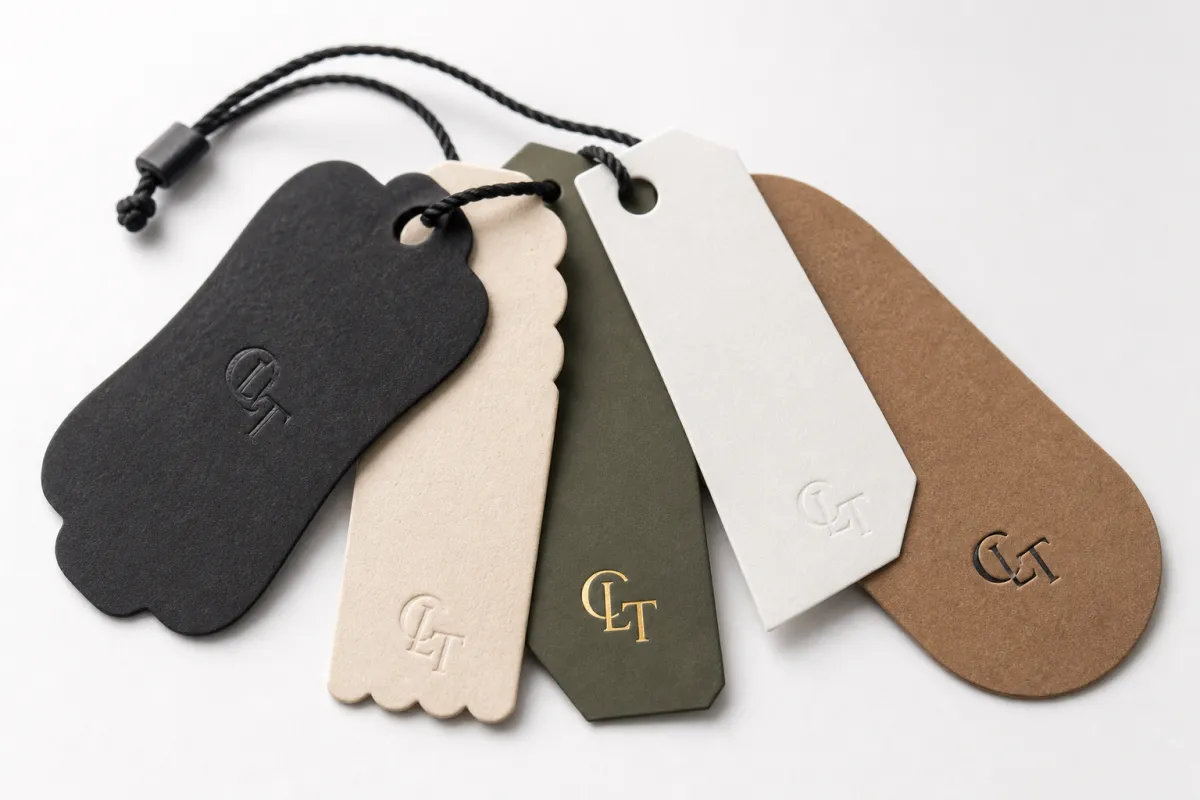
Shoppers do not scan a rack like proofreaders. They make quick visual decisions, often in the space of a blink. Custom die cut hang tags have an edge in that moment. A tag shaped like a logo, leaf, bottle, badge, or product outline can express a brand attitude before the copy gets any attention.
Put a plain rectangle next to a shaped tag and the difference shows immediately. The rectangle stays neutral. It does its job and disappears into the background. A shaped tag carries motion and intent. It suggests the brand thought past the default. That alone does not make it better, yet it often makes it more memorable. In retail packaging, memory matters because buyers see rows of similar products in a hurry.
Custom die cut hang tags often outperform standard square or rounded tags in perception even when the printed information stays the same. The emotional effect is subtle, but it is real. A clean contour can feel premium. A clever silhouette can feel ownable. A matte kraft shape can feel artisanal. A thick coated shape can feel polished and more fashion-forward. The shape is doing brand work long before the shopper reads the details.
The shape still has to earn its place. On the production side, the more custom the silhouette, the more control the printer needs over waste, edge quality, and cut precision. A tag that looks stunning on screen may be fragile on press or awkward at the hole. I have seen brands pay extra for a decorative outline only to discover the shape made the tag harder to stack, ship, and hang. That is not a design win. That is an expensive lesson.
Brands that already invest in custom printed boxes, inserts, or other custom packaging products should think of the hang tag as part of the same system instead of an afterthought. Coordinated custom die cut hang tags can tie together garment labels, tissue, sleeves, and shipping cartons so the whole package feels intentional.
A useful rule stays the same no matter the category: if the shape does not reinforce the story, it is decoration. Decoration alone rarely earns its cost.
How Custom Die Cut Hang Tags Are Made, From Dieline to Finish
The production path for custom die cut hang tags looks simple from the outside, but several checkpoints decide whether the final piece feels crisp or clumsy. The process usually begins with the concept, then moves into the dieline, artwork setup, proofing, cutting, finishing, and packing. Miss one step and the order can slip from controlled to chaotic very quickly.
The dieline acts as the technical blueprint. It tells the printer where to cut, where to score if needed, where the bleed extends, and where text must stay inside the safe area. For custom die cut hang tags, the dieline matters more than it does for a plain rectangle because every curve, notch, and point changes the way the artwork has to sit on the page. A safe zone of 2-3 mm from the cut path is common, and bleed is often set at 3 mm or 0.125 in, depending on the print workflow.
Three cutting methods come up most often, each with a different tradeoff:
- Digital cutting works well for short runs and prototypes because it avoids a physical die charge, which helps when the quantity is low or the design may still change.
- Steel rule dies usually make more sense for medium to large runs because setup is higher but the per-piece economics improve as volume rises.
- Laser or specialty cutting can be useful for samples or complex shapes, although heat-affected edges are not ideal for every stock.
Digital cutting often becomes the flexible option for 100 to 500 pieces, sometimes a little more if the workflow is efficient. Steel rule dies tend to become attractive once the order moves into the thousands and the shape will be reused. If a brand expects ongoing replenishment, custom die cut hang tags with a proper die can lower long-term cost even if the first run feels more expensive.
Finishing changes the story again. Matte lamination softens glare and adds rub resistance. Soft-touch coating gives a velvety feel that reads as premium, although it can show scuffing on sharp corners if the tag gets handled heavily. Foil stamping adds a metallic accent, but it needs clean vector art and usually raises cost. Embossing and debossing create depth, while spot UV can add contrast on select areas. Each choice changes both appearance and production time.
If sustainability is part of the brief, ask for FSC-certified paper guidance and confirm the paper grade, coating, and ink system before approving the job. FSC itself is not a finish; it is a certification framework. That distinction matters. A recycled-looking stock is not automatically certified, and a certified stock is not automatically the best option for every brand.
Quality control is the step most people underestimate. Good printers check trim, fold direction if relevant, hole placement, color consistency, and edge cleanliness before packing. For custom die cut hang tags, even a tiny misalignment near a curve can be visible from three feet away. On a retail rack, that is a big deal because the shopper’s eye moves quickly.
The practical takeaway is plain: the better the dieline, the fewer surprises later. Clean files save time, and time saves money.
Custom Die Cut Hang Tags Cost, MOQ, and Quote Drivers
Pricing for custom die cut hang tags is less mysterious than it first appears, but only if you know what actually moves the number. Quantity is usually the biggest factor. Shape complexity comes next. After that come paper stock, print coverage, finish, special effects, and extras like strings, eyelets, and packing inserts.
A simple shaped tag on standard cardstock is one thing. A multi-contour design with foil, embossing, and a custom ribbon tie is another. The second version may look strong on the shelf, but it also asks for more press time, more setup, and more handling. That adds cost. There is no way around it.
For a directional sense of the market, many buyers see ranges like these for custom die cut hang tags:
| Option | Typical Setup Complexity | Common Use Case | Unit Cost Tendency | Risk Level |
|---|---|---|---|---|
| Rounded rectangle with a single hole | Low | Core retail lines, reorder programs | Often the lowest, especially above 5,000 pieces | Low |
| Simple custom silhouette | Moderate | Seasonal drops, branded packaging tie-ins | Roughly 15%-30% above a basic shape | Moderate |
| Highly intricate contour with special finishes | High | Luxury retail, limited editions, package branding campaigns | Can run 30%-60% above a basic shape | Higher waste and more production checks |
Those figures are directional, not quotes. A 300-piece test run and a 10,000-piece reprint will not behave the same way. Still, the pattern holds: more complex custom die cut hang tags cost more because they need more care and create more opportunities for waste.
MOQ expectations vary as well. Some printers are comfortable with short runs of 100 to 250 pieces when digital cutting is available. Others prefer 500, 1,000, or more because their setup model is built around higher volume. If a supplier quotes a low number, check whether the price includes the die, the proof, the finish, and the freight. A quote that looks cheap on paper can become expensive after those pieces are added back in.
Before comparing suppliers, ask for a few basics:
- Spec sheet with exact dimensions, stock, coating, hole size, and finish.
- Dieline showing bleed, safe area, and cut path.
- Lead time from proof approval, not from the first email.
- Sample option so you can judge cut quality and color in real light.
- Freight terms so shipping does not surprise the budget.
Brands often compare custom die cut hang tags to other packaging items and assume the tag should be cheap because it is small. Production does not always work that way. Small items can be tricky because they are handled in bulk, die-cut in tight spaces, and judged at arm’s length. A fraction of a millimeter matters more than people expect.
If your tag order sits beside shelf labels, inserts, or Custom Labels & Tags, align the specs early. Matching paper tone, finish, and print method reduces the chance that one piece looks premium while the other looks budget.
One more practical point: the quote should always state whether tooling is reusable. If the shape will come back every season, a reusable die can lower the long-run cost. If the art is a one-time campaign, it may be smarter to avoid paying for extra tooling that never gets used again.
For buyers managing broader Custom Packaging Products, the real question is not simply “What is the cheapest tag?” It is “What gives the best presentation per dollar across the whole package?” That is a better way to think about branded packaging, especially when the tag is one piece of a larger retail system.
As a rough planning range, many standard custom die cut hang tags land near $0.08-$0.18 per unit at higher volumes with simple print and standard stock, while smaller runs or more complex finish stacks can move into $0.20-$0.60 per unit or more. Those numbers shift with paper, coverage, and labor, so treat them as a budgeting tool, not a promise.
Design Choices That Make Custom Die Cut Hang Tags Work Harder
Good custom die cut hang tags are not just shaped differently. They are designed differently. A smart shape reinforces the product story, and a smart layout respects the reality of print, cutting, and handling. That balance is where the best results happen.
Shape strategy comes first. If the brand is about clean utility, a simple silhouette may be enough. If the product celebrates craft, the outline can echo a logo mark, stitch line, or material source. If the collection is playful, a tag can become part of the visual language. Even then, the shape should solve a communication problem. “Interesting” is not a strategy by itself.
Material choice changes perception faster than most teams expect. A 14pt to 16pt uncoated kraft stock sends a very different message from an 18pt to 24pt coated artboard. Kraft reads earthy, tactile, and sometimes more sustainable. Coated stock reads sharp, crisp, and often more polished. Soft-touch stocks can feel elevated, but they also tend to show handling quirks if the design uses sharp points or narrow necks. For custom die cut hang tags, the stock and the shape should be chosen together, not separately.
Readability matters even more once the tag moves away from a rectangle. Non-rectangular edges can crowd the composition if the type is too small or too close to the contour. A common mistake is shrinking the logo until it fits the cute shape. The result is a tag that looks clever from a distance and cluttered up close. A better rule is to keep critical text at a size that can survive store lighting, not just a design mockup.
Attachment details are another hidden design choice. Hole position changes how the tag hangs. A hole too close to the edge can tear. A hole too low can make the tag swing awkwardly. Eyelets are worth considering for heavier garments or repeated handling because they reinforce the opening. Strings and ties also matter. Black cotton cord, natural twine, satin ribbon, and thin elastic all create different cues about price and brand personality.
Buyers should think about usability alongside looks. Custom die cut hang tags need to be easy to hang, scan, and remove without damaging the garment or package. If the tag interferes with barcode scanning, folds over itself, or tears when pulled, the aesthetic win turns into an operations problem. That happens more often than teams admit.
A useful comparison: custom printed boxes often carry the outer brand story, but the hang tag is the piece the shopper touches last before purchase. That makes the tag more intimate than a carton. It also means the design has to tolerate fingerprints, rubbing, and close inspection. There is no hiding place on a small surface.
These details usually help keep the design working:
- Keep the main logo at least 2-3 mm inside the safe area.
- Use strong contrast between type and background, especially on kraft or dark stocks.
- Choose one dominant focal point instead of stacking too many effects.
- Match the finish to the brand story, not the trend.
- Test how the tag hangs from the actual garment or package before approving the shape.
For brands balancing package branding across tags, sleeves, and cartons, consistency often beats novelty. A cohesive set of custom die cut hang tags can make the entire shelf presentation feel more expensive without forcing every surface to do something different.
Custom Die Cut Hang Tags Process and Timeline: What Happens When
A realistic timeline saves a lot of frustration. Custom die cut hang tags can move quickly once the file is approved, but the earliest stages matter more than many teams expect. If the brief is vague, revisions pile up. If the dieline is wrong, the proof stalls. If the finish stack is complex, production time stretches.
The usual flow looks like this:
- Brief and concept review — The supplier checks size, quantity, paper, finish, and target date.
- Dieline setup — The cut path is drawn, and artwork is aligned to the shape.
- Proofing — A digital proof or sample shows layout, colors, and cut placement.
- Printing and cutting — The job goes to press, then through digital cutting or a steel rule die.
- Finishing — Lamination, foil, spot UV, embossing, or hole drilling happens next.
- Quality check and packing — The tags are counted, bundled, and prepared for shipment.
For straightforward custom die cut hang tags, proof approval to finished production often lands in the 12-15 business day range. Simple digital-cut short runs can be quicker. Heavier finish stacks, custom dies, or large quantities can push the timeline longer. A rush request can compress the schedule, but only if the stock is on hand and the printer has capacity.
Revision count is one variable that slows everything down. Every time the dieline changes, the proof has to change. Every time the paper changes, the color can shift. Every time the finish changes, the production sequence may need to be rechecked. That is why the fastest jobs are usually the ones with the clearest specs. Custom die cut hang tags are not hard to produce when the instructions are clean.
Freight is another timing trap. A finished order can leave the press on time and still miss a launch if the ship method was chosen too late. Ground, air, and express can change both cost and delivery date. If the tags need to land before inventory, confirm the shipping cutoff before paying the deposit. That sounds basic, but it is one of the most common miss points in packaging design workflows.
If your line will be tested for transport resistance, the shipping side deserves attention too. For cartons and outer packaging, many teams refer to ISTA test methods to understand distribution stress. A hang tag itself is not a transit carton, of course, but the same discipline helps when tags are packed into polybags, cartons, or fulfillment kits.
Seasonal planning is where custom die cut hang tags either save the launch or slow it down. For holiday drops, promotional capsules, or limited-edition collections, I would plan backward from the warehouse date rather than the print date. That leaves room for proof changes, freight delays, and the occasional stock substitution.
These planning windows tend to work well:
- Prototype or sample run: allow 5-7 business days if the artwork is ready and the shape is simple.
- Standard production run: allow 2-3 weeks if you want room for proofing and shipping.
- Complex finish or custom die: allow 3-4 weeks or more, especially for higher quantities.
That window is not overcautious. It is realistic. Brands that treat custom die cut hang tags like a last-minute accessory often pay for it with expedited freight or rushed approvals. Brands that treat them as part of the packaging schedule usually get better pricing and cleaner execution.
Common Mistakes When Ordering Custom Die Cut Hang Tags
The most expensive mistakes with custom die cut hang tags are usually not dramatic. They are small, ordinary choices that compound. A shape gets too delicate. The file is built without a real dieline. The budget ignores the die charge. Then the schedule tightens, and every issue becomes more expensive to fix.
First mistake: choosing a shape that looks impressive on a mockup but behaves badly in production. Narrow necks, tiny points, and thin cut bridges can tear or warp. A designer may love the visual energy, but the cutter has to deal with real paper fibers, not a render. If the shape cannot survive stacking, packing, and hanging, it is not a production-ready shape for custom die cut hang tags.
Second mistake: skipping proper file preparation. The art file should separate the cut path from the print artwork. It should include bleed, safe area, and any hole or string placement marks. A printer can sometimes correct a small issue, but they should not have to rebuild a file from scratch. The best custom die cut hang tags jobs start with a clean vector dieline, usually in AI or PDF format, with layers labeled clearly.
Third mistake: crowding the design. A non-rectangular tag already has more visual energy than a rectangle. If the brand adds too much copy, too many badges, and too many finishes, the piece loses focus. I have seen tags that tried to explain everything: origin story, material details, sustainability claims, social handles, and a QR code. The result was a cramped surface that looked busy instead of premium. Strong custom die cut hang tags leave breathing room.
Fourth mistake: spending on effects that do not improve sales or presentation. Foil, embossing, spot UV, and specialty coatings can be useful, but they are not free style points. If a simple paper choice and a precise contour already tell the story, then adding four effects may just raise the price. A better approach is to spend on one standout detail and keep the rest disciplined.
Fifth mistake: ignoring the MOQ and reorder plan. A small first run may be fine for a launch, but what happens if the style sells through faster than expected? If the supplier needs a new die, a new proof, or a new shipping window for every reorder, the replenishment cycle becomes messy. That is why planning custom die cut hang tags should include not just the first order, but the next one too.
Some brands also forget the line between “tag” and “system.” If the hang tag must coordinate with Custom Labels & Tags, invoice inserts, or retail packaging sleeves, the whole spec should be reviewed together. Otherwise, the tag may look fine on its own but clash with the rest of the product packaging set.
A final mistake is emotional rather than technical. Teams fall in love with the shape and stop asking whether it supports the product story. In packaging design, that is a dangerous place to be. Custom die cut hang tags should help the product sell, not just help the designer win a mood board. Kinda obvious, sure, but it gets missed all the time.
Expert Tips and Next Steps Before You Place an Order
If you are about to spec custom die cut hang tags, start with the message, not the paper. Ask what the tag should communicate in one second. Premium? Natural? Playful? Minimal? That answer will narrow the shape, stock, and finish faster than any trend report.
A sample kit is worth the wait. In a screen mockup, many materials look similar. In hand, they do not. Thickness, coating feel, corner behavior, and color depth all change under real light. A printed proof or sample run lets you see whether the cut edge is clean and whether the finish matches the brand’s expectations. For custom die cut hang tags, that physical check is often the difference between confidence and guesswork.
One of the best habits is building a one-page spec sheet before asking for quotes. Keep it tight, clear, and consistent. Include:
- Finished size and shape
- Paper stock and thickness
- Print method and ink coverage
- Finish such as matte, soft-touch, foil, or spot UV
- Hole placement and attachment style
- Quantity and reorder estimate
- Target delivery date
That document keeps suppliers from quoting apples against oranges. It also protects the buyer. When the specs are fixed, the quote is real. When the specs drift, the price comparison becomes meaningless. This is especially true for custom die cut hang tags, where small design differences can shift tooling, waste, and labor.
Comparing at least two quotes is sensible, but compare the same thing. One printer may include setup and die charge in the first price. Another may list them separately. One may use digital cutting. Another may assume steel rule die production. If those differences are not normalized, the lower quote may not be the better quote.
For brands balancing branded packaging across multiple products, it can help to think in collections. A hang tag for denim may need a heavier uncoated stock. A hang tag for cosmetics may need a glossier, more polished finish. A hang tag for gift items may need a more decorative silhouette. The smartest custom die cut hang tags are not generic; they are tuned to the product and the shelf environment.
Here is the action plan I would use before placing the order:
- Write the story the tag needs to tell.
- Select two or three shape directions, not ten.
- Choose the stock based on handling and shelf impact.
- Request a proof or sample kit.
- Lock the dieline, quantity, and delivery date.
- Ask for a quote that clearly separates setup, production, and freight.
That process keeps custom die cut hang tags grounded in production reality instead of wishful thinking. It also makes it easier to coordinate with custom printed boxes, tissue, inserts, and the rest of the package branding system.
The best orders are often the boring ones during planning. The shape is chosen for a reason. The stock is selected for a reason. The finish has a job to do. When those decisions line up, custom die cut hang tags look effortless on the shelf, even though they were anything but effortless to plan.
Before you approve anything, ask one last question: does the tag improve the product, or just decorate it? If it improves the product, it is probably worth it. If it only adds noise, simplify. That is the clearest path to custom die cut hang tags that support retail packaging instead of competing with it.
What file do I need for custom die cut hang tags?
Use a vector file with a clearly labeled dieline so the printer can separate the cut path from the artwork. Include bleed, safe area, and any hole or string placement marks so critical elements do not get trimmed. Ask the supplier which format they prefer, because some want AI or PDF while others can work from EPS or layered source files for custom die cut hang tags.
How long do custom die cut hang tags usually take to produce?
Standard orders often move through proofing, cutting, and finishing in about one to two weeks after artwork approval. Complex shapes, premium finishes, or large quantities can stretch the schedule, especially if a custom die is needed. Build in extra time for revisions and shipping so custom die cut hang tags arrive before the launch or replenishment date.
What affects custom die cut hang tags pricing the most?
Quantity usually has the biggest effect on unit cost because setup fees get spread across more pieces. Shape complexity, paper stock, finishing, and special effects like foil or embossing also push pricing upward. Rush production and custom packaging add-ons can raise the final quote even when the tag itself looks simple, so custom die cut hang tags should always be quoted with full specs.
Which materials work best for premium custom die cut hang tags?
Heavy coated cardstock works well when you want crisp color, sharp edges, and a polished retail look. Uncoated or kraft stocks fit brands that want a natural, tactile, or more restrained impression. The best choice depends on how the tag will be handled, hung, and photographed in the final retail setting, which is why custom die cut hang tags should be tested in hand before final approval.
Do custom die cut hang tags require a minimum order?
Many suppliers set an MOQ because setup, cutting, and finishing take time whether you order 100 or 10,000 pieces. Smaller runs are often possible, but the unit cost is usually higher because setup is divided across fewer tags. If you only need a test batch, ask for a short-run option or a digital-cut sample before committing to volume for custom die cut hang tags.
For brands that want the tag to carry real weight, custom die cut hang tags are worth the extra planning. The shape can sharpen package branding, the material can elevate perception, and the production choices can keep the order on budget. When the brief is clear, the dieline is clean, and the timeline is realistic, custom die cut hang tags become one of the most efficient tools in retail packaging.
So the actionable move is simple: define the story, lock the dieline, and ask for a quote that separates setup, production, and freight before you approve the artwork. That sequence keeps the project grounded, and it gives custom die cut hang tags the best shot at looking intentional rather than improvised.

