Buyer Fit Snapshot
| Best fit | Custom Foil Stamped Boxes Bulk projects where brand print, material claims, artwork control, MOQ, and repeat-order consistency need to be specified before quoting. |
|---|---|
| Quote inputs | Share finished size, material target, print colors, finish, packing count, annual reorder estimate, ship-to region, and any compliance wording. |
| Proofing check | Approve dieline scale, logo placement, barcode or warning zones, color tolerance, closure strength, and carton packing before bulk production. |
| Main risk | Vague material claims, crowded artwork, missing packing details, or unclear freight terms can make a low unit price expensive after revisions. |
Fast answer: Custom Foil Stamped Boxes Bulk: Pricing, Specs, MOQ should be specified like a repeatable production item. The safest quote records material, print method, finish, artwork proof, packing count, and reorder notes in one written spec.
Production checks before approval
Compare the actual filled-product size with the drawing, then confirm tolerance on folds, seals, hang holes, label areas, and retail display edges. Reserve space for logos, QR codes, warning copy, and material claims before decorative graphics fill the panel.
Quote comparison points
Review material grade, print process, finish, sampling route, tooling charges, carton quantity, and freight assumptions side by side. A quote is only useful when the supplier can repeat the same color, closure quality, and packing count on the next order.
Custom Foil Stamped Boxes bulk orders do one job very well: they make packaging look expensive before anyone even touches the product inside. That matters on a shelf, in a gift set, and in any retail display where people decide fast. Foil catches the light first. The logo follows. The rest of the design gets a second look if it earned one. Custom foil stamped boxes bulk will not rescue weak structure or sloppy art, but when the box is built right, they give the whole package a cleaner, more valuable read.
For a packaging buyer, the real question is not whether foil looks good. It does. The real question is how much structure, material, and setup you need before custom foil stamped boxes bulk stop being a nice idea and start making business sense. Volume changes the math. Tooling, plate setup, and finishing labor get spread across more units, and the per-box price usually drops enough to make premium presentation practical. That is why brands use custom foil stamped boxes bulk for cosmetics, specialty food, gifts, electronics accessories, and retail packaging that has to sell before the customer opens anything.
There is a mistake buyers make all the time. They think foil can dress up a weak carton. It cannot. Bad fit still feels bad. Thin board still feels cheap. Muddy artwork still looks muddy, just shinier. Custom foil stamped boxes bulk work best when the structure, board grade, and finish all pull in the same direction. People skip that part because it is less exciting than picking gold foil and calling it a day.
Foil is an accent, not a patch. If the box does not fit the product or survive transit, the shine only makes the flaws easier to see.
From a package branding point of view, that is the real value of custom foil stamped boxes bulk: they make a product look deliberate. Not noisy. Deliberate. In crowded retail, that usually beats packaging that tries too hard.
Why custom foil stamped boxes bulk stand out fast
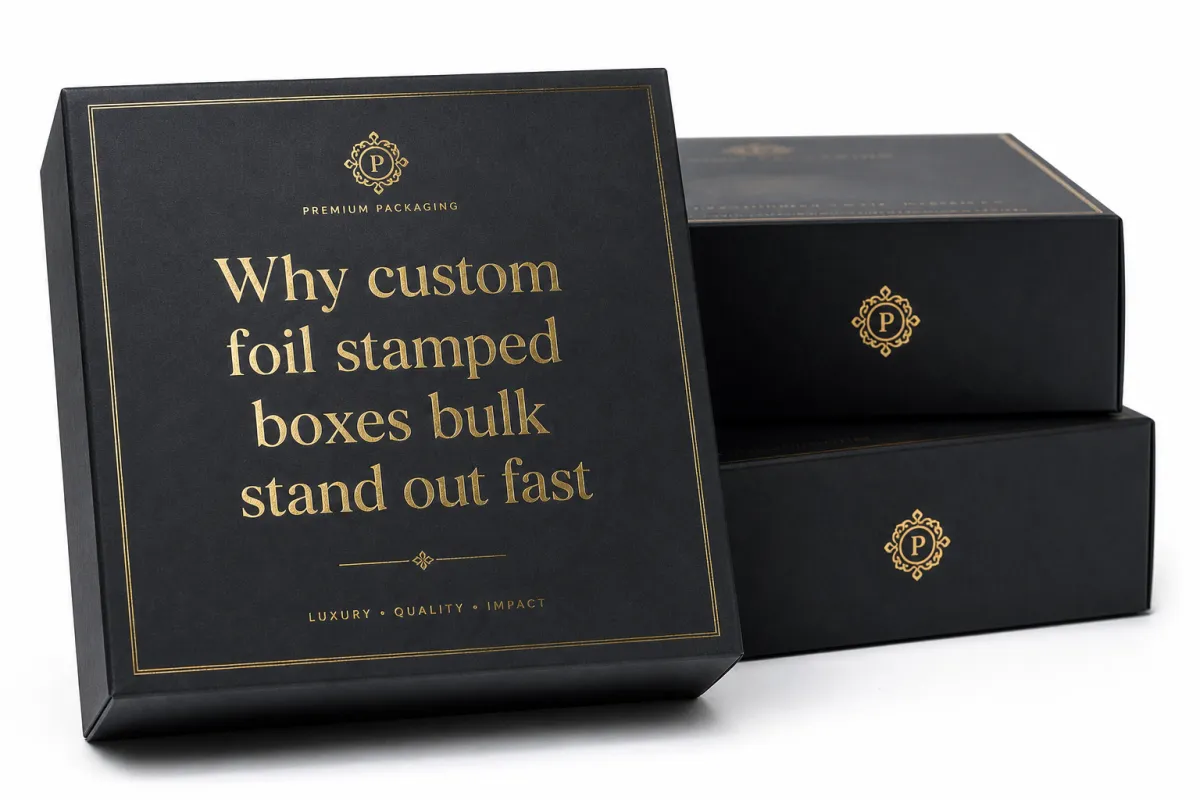
On a busy shelf, nobody reads every word. The eye grabs contrast, shine, and structure. That is why custom foil stamped boxes bulk get noticed so quickly. Foil creates a reflective break against matte paper, soft-touch lamination, or textured board, and that contrast makes the brand mark easier to spot from a distance. For gifts and premium retail, that matters more than people want to admit. A customer often decides whether a box feels worth picking up in a couple of seconds.
The buying logic is pretty simple. A small order carries the same setup burden as a large one, so the first few hundred units can feel painfully expensive. Scale changes that. Once the die line, foil plate, and press setup are in place, custom foil stamped boxes bulk can pull the unit cost down enough to make nicer packaging realistic for an actual launch. That is the difference between a good idea and a line item that survives the budget review.
The comparison buyers usually recognize right away is easy. A plain printed carton can work for everyday product packaging, but a foil-stamped version usually signals more margin, more care, or a stronger gifting intent. A skincare box with standard four-color print may communicate information clearly. The same box with a restrained silver foil logo, clean typography, and a matte finish reads as premium retail packaging without changing the formula inside. That is the whole point. Custom foil stamped boxes bulk help package branding do more with the same physical product.
Foil still has limits. If the box style does not fit the product, the result feels forced. If the artwork is crowded, the foil fights for attention and loses. If the structure is flimsy, the box may look decent in a product photo and cheap in a shipping carton. Custom foil stamped boxes bulk should be part of packaging design, not the last-minute decoration the team adds because the layout felt too plain.
In practice, the strongest uses are usually simple: a single logo hit, a border detail, a product name, or a small seal on a sleeve or rigid lid. That kind of controlled foil application keeps the design clean and the run manageable. Bigger coverage can work, but the cost rises quickly and the look can turn gaudy fast. The best custom foil stamped boxes bulk jobs look precise, not overloaded.
I have seen buyers spend extra money trying to "save" a weak layout with more foil. It usually backfires. The better move is to strip the design down, make the type stronger, and let one foil hit carry the premium cue. That is the kind of fix that actually sticks.
If you need a starting point for structures, our Custom Packaging Products page shows common box formats that can be adapted for foil work. For larger recurring programs, the planning on our Wholesale Programs page helps keep the cost conversation grounded in volume.
That is also why buyers usually ask for foil on Custom Printed Boxes only after they know the product footprint. The decoration should support the structure, not wrestle it. Good box style first. Foil second. The rest after that.
Custom foil stamped boxes bulk: box styles and foil options
Custom foil stamped boxes bulk can be built in several common styles, and the box style changes both the look and the cost. Tuck-end cartons are usually the most efficient option for lightweight retail items, supplements, cosmetics, and small accessories. They ship flat, stay economical at higher volume, and take foil cleanly on the front panel or flap. For products that need more presence, Rigid Setup Boxes create a heavier unboxing feel and keep their shape better on display. That extra structure costs more, but it also carries more perceived value.
Sleeve boxes are another practical choice. They work well for kits, candles, bars, and gift sets because the sleeve can carry the main branding while the inner tray handles product protection. Magnetic Closure Boxes sit higher on the premium end and are often used for luxury packaging, influencer sets, and presentation kits. They cost more, but they deliver a specific tactile effect that makes custom foil stamped boxes bulk feel like premium branded packaging instead of basic print dressed up for the camera.
Foil color matters more than many buyers expect. Gold is the default because it reads as premium in most settings. Silver feels cleaner and more technical. Rose gold tends to work well for beauty and gifting. Black foil can be effective on lighter stocks when the goal is a subtle, high-contrast logo hit. Holographic foil is louder and should be used with restraint. Custom tints are possible in some production setups, but they are not always the right move unless the design actually needs them. On matte stock, foil usually pops harder. On glossy stock, the reflection can flatten unless the design is managed carefully.
Most foil work should live where the eye naturally lands: logos, monograms, seals, product names, border lines, or a single graphic detail. That keeps the design readable and gives the foil enough breathing room. On custom foil stamped boxes bulk, overuse is a common failure. Too much foil makes the artwork noisy and raises cost without improving clarity. A single well-placed hit usually beats a crowded shiny layout.
Optional finishing changes the feel even more. Embossing raises the foil area or a separate design element for a tactile effect. Debossing presses it inward for a quieter, more restrained look. Spot UV adds contrast by making selected areas glossy against a matte base. Soft-touch lamination gives the box a velvety feel and makes foil look crisper. Textured paper can make the entire package feel less generic, especially for luxury packaging or artisanal product lines.
There is no single best combination for custom foil stamped boxes bulk. The right stack depends on product category, price point, and where the box will live. A mass retail item needs speed and consistency. A gift set may need more visual drama. A premium cosmetics line may want a matte base, soft-touch lamination, and a narrow gold foil hit. The job is to match the finish to the product’s selling job, not to stack every available upgrade because the menu looked impressive. That sounds obvious, but people still do it. Usually right before a quote goes sideways.
Here is a practical comparison that buyers can use as a rough starting point:
| Box style | Best use | Typical MOQ | Indicative unit cost impact | Notes |
|---|---|---|---|---|
| Tuck-end carton | Retail packaging, lightweight goods | 1,000-5,000 | Lower | Efficient for custom foil stamped boxes bulk with simple logo foil |
| Sleeve box | Kits, candles, gift sets | 1,000-3,000 | Moderate | Good balance of packaging design and cost |
| Rigid setup box | Luxury packaging, presentation sets | 500-2,000 | Higher | Strong shelf appeal, more labor, better unboxing feel |
| Magnetic closure box | Premium branded packaging, influencer kits | 500-1,500 | Highest | Good for high-value product packaging, not for tight budgets |
The table is a rough guide, not a promise. A simple tuck box with a small foil mark can be very efficient. A rigid box with embossing, spot UV, and full-wrap artwork can jump quickly in price. That is normal. Custom foil stamped boxes bulk are not priced by wishful thinking; they are priced by structure, finish, and how much labor the job takes to run cleanly.
For brands trying to keep retail packaging consistent across multiple SKUs, it helps to lock the core structure first and then change only the foil art or color between lines. That is one of the cleaner ways to build package branding without turning every product into a separate engineering project.
Specifications that affect fit, durability, and shelf appeal
Specifications decide whether custom foil stamped boxes bulk feel polished or annoying. Start with internal dimensions. Not the outside size. The inside. A box that looks correct on paper but leaves the product rattling around inside will feel cheap the moment it is handled. A box that is too tight can crush corners, wrinkle the board, or make the packer fight the fold lines. The right fit is usually the one that protects the product without wasting space or material.
Board choice matters just as much. For folding cartons, 300gsm to 400gsm artboard is common for lighter retail goods, while 350gsm C1S artboard is a frequent choice for cleaner print and foil registration. For rigid boxes, 1200gsm to 1500gsm grayboard is a common range, usually wrapped with printed paper or specialty paper. If the box needs to hold weight in shipping or sit in a display without buckling, those numbers start to matter fast. Pretty packaging that collapses under pressure is not pretty for long.
Coating choice changes both appearance and durability. Matte lamination gives a softer look and usually helps foil stand out. Gloss lamination boosts shine but can compete with the foil if the artwork is already busy. Soft-touch lamination creates a premium tactile feel, though it can show scuffs if the box is handled heavily in transit or stacked too tightly. If the product will move through distribution centers, retail shelves, or subscription fulfillment, scuff resistance deserves more attention than most buyers give it.
Artwork setup is another place where custom foil stamped boxes bulk can go sideways. Foil needs clean vector paths, sensible line weights, and enough spacing to register properly. Tiny serif details, hairline strokes, and crowded copy often print poorly in foil. In general, simple geometry performs better than decorative clutter. If the design uses embossing or debossing along with foil, the artwork needs even more room so the pressure and registration line up cleanly. A good production file looks a little less dramatic on screen and a lot better on press.
Transit is part of the spec, too. A box that survives on a desk may fail after a few days in a packed carton. That is why some buyers ask for testing similar to ISTA transit methods. The full test package at ISTA is useful if the product is shipping through multiple handling points. If you want sustainably sourced fiber, FSC certification is another practical specification to request when the paperboard source matters to the brand story. Those choices do not automatically make the box better, but they give procurement a cleaner standard to work from.
For custom foil stamped boxes bulk, a buyer should confirm these points before the quote is finalized:
- Internal dimensions so the product fits without movement or compression.
- Board thickness so the box carries its load properly.
- Insert type if the item needs a tray, divider, or molded support.
- Finish choice so foil, lamination, and texture work together.
- Artwork file format so the foil plate can be made without cleanup delays.
- Transit requirement if the box has to survive warehousing, palletizing, or direct-to-customer shipping.
That list is boring. Good. Boring specs save money. They prevent returns, rework, and those awkward moments where the first batch looks nice in a photo and wrong in real life. Custom foil stamped boxes bulk should be designed for the actual route the package takes, not for a fantasy version where every box is carried carefully in a velvet glove.
One more practical point: shelf appeal is not only about shine. It is also about proportion. A well-sized box with restrained foil reads cleaner than an oversized box with decorative excess. Buyers often focus on finish first, but the profile and fit are usually what make the box feel expensive in person.
And yes, the unboxing experience matters. I have watched two products with almost the same art direction perform very differently because one box opened with a clean reveal and the other fought the customer at every fold. Same brand tier. Same category. Totally different feel. That is the kind of thing people only notice once it is too late, which is annoying, but very real.
Custom foil stamped boxes bulk pricing, MOQ, and cost drivers
Custom foil stamped boxes bulk pricing comes down to a short list of variables, and none of them are mysterious. Box style. Material grade. Foil coverage. Number of foil colors. Finishing extras. Insert complexity. Order quantity. If a quote feels high, one of those lines is usually doing the damage. Sometimes two. Occasionally all of them at once, which is how buyers end up staring at a spreadsheet like it personally insulted them.
For simple folding cartons, a bulk price can land roughly in the range of $0.18-$0.45 per unit at higher quantities, depending on size, board, print coverage, and how much foil is used. If the order is smaller or the design is more complex, the same carton can easily move above that range. Rigid boxes are a different animal. Depending on size, wrap, insert, and finish, they might sit around $1.10-$3.50 per unit or higher. Those are planning ranges, not final quotes. They are still useful because they stop the guessing early.
MOQ is tied to setup efficiency. Foil stamping needs plates, press setup, alignment, and post-press handling. That is why very small runs are usually expensive per unit. Custom foil stamped boxes bulk make the most sense once the quantity is high enough to spread those setup costs. For many folding cartons, a workable minimum might start around 1,000 units. For rigid or multi-process boxes, 500 to 1,000 units is a common floor, though some projects push higher depending on the build. Lower minimums can happen, but the economics usually get less friendly and the unit price climbs fast.
Here is what pushes the price up most often:
- Full-panel foil coverage instead of a small logo or line detail.
- Multiple foil colors that require separate setup and alignment.
- Embossing or debossing paired with foil for added depth.
- Specialty papers with texture, metallic fibers, or heavier wraps.
- Custom inserts that must be cut, wrapped, or glued by hand.
- Small quantity runs that cannot spread setup across enough boxes.
And here is the tradeoff buyers care about most: the cheapest unit price is not always the cheapest decision. A lower quote can hide weak board, poor lamination, rough foil edges, or a high defect rate. If 8 percent of the run needs rework or replacement, the "cheap" price starts looking less clever. That is especially true for branded packaging that has to sit in front of a customer, a retailer, or a sales team that notices defects immediately. Custom foil stamped boxes bulk only work economically when the production is clean enough that the whole batch can be used.
There is also a difference between unit price and landed cost. Freight, packing, customs clearance, and replacement allowances all belong in the real number. If you are buying custom foil stamped boxes bulk for a product launch, ask for the landed cost by quantity tier instead of only the ex-factory rate. A quote that looks lower can become more expensive once shipping and handling are added back in.
Typical price drivers by format look something like this:
- Tuck-end carton: lower tooling burden, strong value for retail packaging.
- Sleeve box: moderate structure, good for layered package branding.
- Rigid setup: higher labor, better premium feel, better unboxing.
- Magnetic closure: highest cost, best reserved for products with strong perceived value.
Buyers who want predictable pricing usually get there faster by fixing the structure first and keeping the foil art restrained. That keeps custom foil stamped boxes bulk from turning into a never-ending design revision cycle. If the quote has to absorb every possible finish, the numbers get messy. If the box has one clear purpose and one clear focal point, the economics usually behave.
For brands with repeat orders, wholesale planning can help flatten the cost curve. A recurring run of custom foil stamped boxes bulk often prices better than isolated one-off batches because tooling and approval work are reused. That is where a supply plan starts paying real money back.
Custom foil stamped boxes bulk process and timeline
The order flow for custom foil stamped boxes bulk is not complicated, but each step matters. Quote request. Dieline review. Artwork prep. Proofing. Sample approval. Production. Finishing. Packing. Shipping. Skip one step or rush the wrong one, and the timeline drifts. Most delays happen before production starts, not after. That is the part people underestimate.
Once the dimensions and box style are confirmed, the supplier usually prepares or checks the dieline. That file is the foundation. If the dieline is wrong, everything built on top of it can shift: logo placement, foil area, panel wraps, and insert spacing. After that, the artwork gets checked for line thickness, color separations, and foil-safe regions. Vector files help here. If the logo is a low-resolution image, the foil edge will expose it immediately. Wishful thinking does not change that.
For custom foil stamped boxes bulk, the proofing stage is where buyers save time or lose it. Fast approval keeps the press moving. Endless revisions push the schedule back. The same thing happens with samples. A sample that gets approved quickly becomes a clean reference for the production run. A sample that sits in inbox limbo extends the calendar and raises the chance that the rest of the line gets delayed behind it.
Typical timing, assuming the artwork is ready, looks like this:
- Quote and structure review: 1-2 business days.
- Dieline and artwork adjustment: 2-5 business days.
- Sample or pre-production proof: 3-7 business days.
- Bulk production: often 12-18 business days for simple cartons, longer for rigid and multi-process boxes.
- Packing and freight prep: 2-4 business days.
Those ranges move with factory load, seasonality, and finish complexity. A plain carton with one foil hit moves faster than a rigid box with embossing, lamination, and a custom insert. That is just labor. Custom foil stamped boxes bulk are usually predictable once the exact build is known, but they are not instant. Buyers who want speed should send final dimensions early, approve the dieline quickly, and confirm foil placement before the proofing cycle starts.
There is also a simple schedule rule that saves trouble: lock the structure before polishing the art. If the box size changes after the foil layout is approved, the design has to be reworked. That resets the clock. Same for insert changes and board substitutions. The more decisions that are fixed early, the cleaner the timeline becomes. That is true for custom printed boxes in general, but it matters even more with foil because alignment is part of the look.
Practical buyers ask for a mockup or sample while the design is still under review, not after the production slot is already booked. That sounds obvious, but it saves a surprising amount of time. A sample can show whether the foil is too small, the logo sits too close to a fold, or the finish feels wrong in hand. Catching that early is cheap. Catching it late is not. Custom foil stamped boxes bulk reward disciplined approvals because the manufacturing process does not have much patience for second thoughts.
One final note on scheduling: if the boxes are part of a launch kit, give yourself buffer time. Freight can be reliable and still be late. Production can be clean and still need one extra day for packing. Real-world packaging programs usually go better when the plan has margin in it. That is not pessimism. That is experience talking.
Why choose us for bulk foil stamped packaging
Buyers do not need poetic language. They need boxes that register cleanly, finish evenly, and arrive looking like the proof. That is the real reason brands choose custom foil stamped boxes bulk with a supplier that understands the mechanics of the job, not just the sales pitch around it. Consistent foil registration matters. Clean lamination matters. Accurate die cutting matters. If any one of those slips, the packaging looks off, and the product pays for it.
Good bulk foil work is not loud behind the scenes. It is disciplined. The press setup is checked before the run starts. The artwork is reviewed for spacing and line thickness. The finish choice is matched to the stock, not guessed. That reduces waste, reduces color mismatch, and keeps embossing or foil alignment from drifting across the batch. Those are the quiet advantages buyers notice after the first reorder. The first order looks nice. The second order proves the process works.
We also help with the practical side of packaging design. That means dieline guidance, sample recommendations, and early artwork checks so the job does not get bogged down in preventable edits. A lot of packaging delays are self-inflicted. A logo file in the wrong format. An insert dimension that never got measured. A foil region that sits too close to a fold. Those are small problems on paper and expensive problems in production. Custom foil stamped boxes bulk get easier when someone catches those issues before they hit the press.
Different product categories need different handling. Beauty packaging tends to care more about finish and unboxing. Specialty food packaging needs clean structure and compliance-friendly materials. Gifts need presentation and strong shelf appeal. Retail packaging may need a balance of cost, speed, and display impact. Because the requirements shift by category, it helps to work with a supplier that has seen the same production logic across more than one market. The process should be repeatable, not improvised every time.
If you are comparing options for custom foil stamped boxes bulk, ask these questions:
- Will the foil hold registration across the full run?
- Does the finish support the product price point?
- Is the board strong enough for the shipping route?
- Can the design be reordered without rebuilding the whole file?
- Does the MOQ match the actual sales forecast?
Those questions are blunt on purpose. Branded packaging should not rely on hope. It should rely on repeatable production and clear specs. That is how package branding becomes useful instead of decorative. Custom foil stamped boxes bulk make sense only if the result is attractive, durable, and easy to reorder without drama.
If the project is still being scoped, our Custom Packaging Products page is a good place to narrow the box structure before you commit to decoration. If the order will repeat across multiple drops or seasonal launches, our Wholesale Programs page helps set the pricing expectation in a more realistic way.
Next steps for custom foil stamped boxes bulk orders
Before you request a quote for custom foil stamped boxes bulk, gather the basics: product dimensions, target quantity, box style, foil color, finish choice, insert needs, shipping destination, and whether the boxes need retail display strength or shipping strength. That sounds like a lot until you compare it with the cost of a wrong quote. Missing one of those details usually means the estimate has to be redone anyway, which wastes more time than getting it right the first time.
A simple decision order works best. Confirm the box structure first. Then choose the foil effect. Then lock the artwork. That sequence keeps the design grounded in the actual production method. Change the structure late, and the foil layout may need to move. Change the foil color late, and the visual balance may shift. Change the insert late, and the internal measurements might need to be rebuilt. None of that is dramatic. It is just the kind of drag that makes packaging timelines longer than they should be.
Request a sample or mockup while the design is still being reviewed. Not after production has started. That one habit saves a lot of money on custom foil stamped boxes bulk because it lets you inspect the look, fit, and finish before the whole run is locked in. If the sample shows a spacing issue or the foil feels too heavy, the adjustment is still manageable. If the full batch is already in motion, the correction gets expensive fast.
Here is the short version of what matters most:
- Fit first: the product should sit cleanly inside the box.
- Finish second: foil, lamination, and texture should support the design.
- Quantity third: volume affects unit cost more than most buyers expect.
- Approval fourth: fast proof approval keeps the production slot intact.
That order is boring in the best possible way. It keeps the work moving, and it keeps the quote honest. Custom foil stamped boxes bulk are not a gamble if the specs are clear and the artwork is ready. They are a controlled purchase with visible shelf impact.
Send a clean spec sheet and the first quote will be closer to reality. That means fewer revisions, fewer surprises, and a better chance that the packaging lands the way it should. If you want custom foil stamped boxes bulk that look premium without blowing up the budget, start with the structure, keep the foil focused, and let the production plan do its job. That is the practical path. Not flashy. Just effective.
If you are setting this up for the first time, the cleanest move is simple: finalize the internal dimensions, choose one foil color, and approve a sample before you lock the full run. That sequence keeps custom foil stamped boxes bulk from turning into a pile of avoidable revisions, and it usually gets you to press faster anyway.
What is the typical MOQ for custom foil stamped boxes bulk?
MOQ usually depends on box style, foil coverage, and whether the build is simple or fully custom. Simple folding cartons may start around 1,000 units, while rigid or specialty boxes often need 500-1,500 units or more. The cleanest comparison is by quantity tier, because custom foil stamped boxes bulk pricing changes sharply as setup gets spread across more units.
How much do custom foil stamped boxes in bulk usually cost?
Cost changes with material, box structure, foil area, number of foil colors, and finishing add-ons. A basic carton with a small foil hit can fall into a lower range, while rigid Boxes with Embossing and inserts rise quickly. The most honest way to compare custom foil stamped boxes bulk quotes is to review landed cost, not just the unit price.
Can I combine foil stamping with embossing on bulk packaging?
Yes. Foil stamping and embossing are often paired for a more tactile premium finish. The design has to leave enough line weight and spacing for both processes to register cleanly. That combination costs more, so it makes the most sense on products with stronger perceived value and a clear packaging design plan for custom foil stamped boxes bulk.
What files do you need for custom foil stamped boxes bulk orders?
Vector artwork is preferred because foil edges need clean paths and scalable detail. A dieline with exact dimensions helps prevent spacing mistakes and artwork shifts. If the art is not ready, send the logo, dimensions, and reference photos first so the layout can be built correctly for custom foil stamped boxes bulk.
How long does production take after approving the sample?
Production time depends on order size, materials, finish complexity, and current factory load. Simple bulk orders move faster than rigid boxes with multiple finishing steps. The clock usually starts after final approval, so prompt signoff matters if you want custom foil stamped boxes bulk delivered on a workable schedule.

