A custom foil stamped paper Bags Bulk Order does more than move products from point A to point B. It changes how the purchase feels the second it leaves the counter. Foil catches light, creates contrast, and gives plain paper a level of finish that customers read as more deliberate than a standard printed bag. That matters in retail, cosmetics, gifting, events, and food service, where the package often does half the branding work before anyone sees a product insert or tag.
The useful part is not the shine itself. It is the combination of appearance, structure, and repeatability. A bag has to hold weight, survive handling, and still look consistent across hundreds or thousands of units. If the stock is too light or the handle system is underbuilt, foil only draws attention to the flaw. Buyers notice that quickly.
Foil does not hide weak construction; it magnifies whatever the bag already is.
That is why volume buyers keep returning to this format. A plain kraft bag does the job. A foil stamped version does the job and signals value at the same time.
Why Foil Stamped Bags Still Lift Value at the Counter
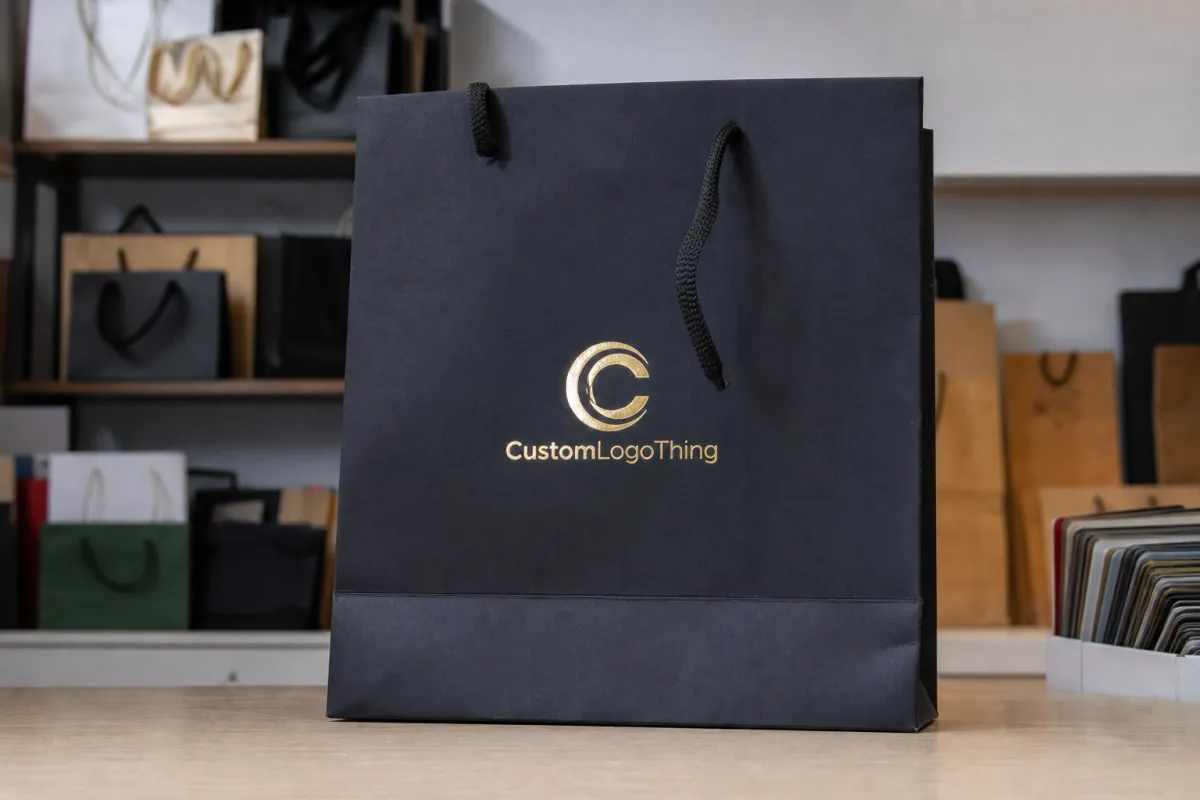
The checkout counter is a quick visual audit. A plain paper bag is functional, but it rarely lingers in memory. Foil changes that. Even a small stamped mark can pull the eye, especially under warm lighting or against matte stock. The result is subtle, not loud. That is usually the right level for premium retail.
There is a practical reason this keeps working. Customers often judge the purchase by the packaging before they ever use the product. In categories where margin depends on presentation, a better bag can support the sale of a higher-priced item without adding another insert, sleeve, or box. Compare that with a flyer or sticker: those are easily discarded. A bag leaves the store, rides in the car, and sometimes gets reused.
- Boutiques use foil to create a premium feel without moving to rigid boxes.
- Cosmetics and skincare use it to make the checkout moment feel more finished.
- Gift and event businesses use it because the bag continues advertising after the sale.
- Premium takeout brands use it when presentation needs to match the menu price.
There is also a retention effect that buyers sometimes underestimate. A nicer bag is more likely to be kept, reused, or carried past the store. That is not guaranteed, and it is not the whole strategy, but it improves the return on the packaging budget when the rest of the spec supports reuse.
What Goes Into a Durable Foil Stamped Paper Bag
Durability starts with the structure, not the decoration. Weight, fold integrity, bottom reinforcement, and handle attachment determine whether the bag behaves like packaging or like a short-lived promo item. Foil sits on top of that foundation. If the foundation is weak, the finish only makes the weakness more visible.
Paper weight usually falls between 150gsm and 300gsm for standard retail bags, with premium gift or apparel bags often climbing above that range. Heavier stock holds shape better and feels more substantial in hand, but it also changes stamping behavior. Dense boards can need more pressure. Soft or highly textured stocks can blur fine foil edges. There is no single stock that solves every use case.
Construction details matter in ways buyers only learn after a few production runs. The gusset depth affects how the bag loads. A reinforced base helps bottles and boxed sets sit flat. Handle anchoring determines whether the bag fails at the first awkward lift or survives a full shopping trip. For a bulk order, those details are not cosmetic. They are part of the product spec.
Foil terminology also causes avoidable confusion. Vendors may use foil stamping and hot stamping interchangeably, since both rely on heat and pressure to transfer foil onto the paper surface. That is different from metallic ink, which is printed rather than stamped and usually looks flatter. Metallic ink can work, but it does not deliver the same edge definition or tactile impression. If the artwork depends on crisp lines or a high-contrast finish, ask which process is actually being quoted.
For suppliers that also handle Custom Packaging Products, it helps to compare the bag spec with other branded packaging formats, including custom printed boxes. A box can hide more internal structure. A bag cannot. The paper, handles, and fold lines all carry real load.
Stock, Size, Handle, and Finish Specifications That Change the Result
Size errors cost money in a quiet way. A bag that is too large wastes material and makes the product look undersized. A bag that is too small compresses the contents and can wrinkle at the top once the customer picks it up. Matching the dimensions to the product is more important than matching a catalog category.
Most retail programs fall into three rough groups:
- Small bags for jewelry, cosmetics, gift cards, and compact accessories.
- Medium bags for apparel, boxed sets, and general retail use.
- Large bags for bottles, bundles, and heavier takeout or event packs.
Stock choice changes the look as much as the price. Kraft paper gives a natural, grounded appearance and tends to fit brands that want an organic or handmade feel. Coated white stock usually produces cleaner foil edges and stronger contrast. Matte boards make foil read more controlled and expensive. Glossy finishes can look bright under store lighting, but they also show scuffs and print flaws faster. That tradeoff should be part of the approval process, not a surprise in receiving.
Handle selection has a bigger effect on cost than many buyers expect. Twisted paper handles are economical and suitable for lighter loads. Rope handles feel more premium and handle repeated use better. Die-cut handles can keep the silhouette clean, but only if the paper board is strong enough to resist tearing. On a custom foil stamped Paper Bags Bulk Order, a handle change can move the MOQ, the labor time, and the final freight weight.
Finish choices should follow the design, not the other way around. Fine artwork on highly textured stock often loses detail. Tiny foil lines on a soft surface can break apart visually. Bold logos, simpler borders, and larger type sizes usually stamp more cleanly and age better in use. If the plan is to create a bag that gets carried outside the store, restraint is usually the safer design choice.
One more practical filter: if recycled fiber claims, FSC sourcing, or chain-of-custody documentation matter, request those details before artwork is final. Certification is easier to verify at the quoting stage than after production starts. For reference, FSC information is available at fsc.org.
Custom Foil Stamped Paper Bags Bulk Order: Cost, MOQ, and Quote Drivers
Pricing is not arbitrary, even if it can feel that way when two quotes for similar bags land far apart. For a custom foil stamped paper Bags Bulk Order, the main drivers are quantity, stock weight, bag size, handle style, foil coverage, and how much setup the artwork requires. Add lamination, custom inserts, interior printing, or special packaging, and the quote rises again.
Most buyers start seeing better unit economics once the order reaches roughly 1,000 to 3,000 pieces. Smaller runs can be done, but the setup cost is spread across fewer bags, which pushes the per-unit price up. Complex artwork, larger formats, or specialty papers often need a higher minimum because the press setup and spoilage risk are greater.
| Order profile | Typical MOQ | Ballpark unit price | What changes the quote |
|---|---|---|---|
| Small kraft bag, one foil hit, paper handle | 1,000-2,000 pcs | $0.60-$1.05 | Simple artwork, limited foil area, standard sizing |
| Midweight coated stock, front and back foil | 2,000-3,000 pcs | $0.88-$1.50 | Extra setup, tighter registration, more press time |
| Premium laminated bag, rope handle, larger format | 3,000-5,000 pcs | $1.15-$2.05 | Heavier board, finish work, more demanding packing |
| Specialty paper with high-detail foil coverage | 5,000+ pcs | $1.60-$2.90 | Fine detail, slower setup, higher spoilage risk |
Those numbers are directional, not a promise. A custom die size, a changed handle length, or a design with very fine line work can move pricing fast. The lowest quote often depends on thinner stock, a smaller foil area, or looser print tolerances. If those compromises fit the use case, fine. If not, the cheapest number is only cheap on paper.
A useful quote should clearly separate unit cost, setup or tooling, packaging method, freight estimate, and whether plates or dies stay on file for reorders. If a supplier cannot explain what happens on the second run, that is a signal to ask harder questions. Bulk buying only works well when the reorder is documented as carefully as the first order.
Proofing, Production Steps, and Lead Time Buyers Should Expect
A clean job usually follows a plain process: dieline review, artwork check, digital proof, sample approval if needed, foil stamping, bag conversion, inspection, and final carton packing. Skipping one of those steps rarely saves time. It usually just relocates the problem to production or receiving.
For a straightforward run, the schedule often looks like this:
- Proof stage: 1-3 business days if the dieline is standard and artwork is final.
- Sample approval: 2-5 business days when a physical sample is needed.
- Production: about 10-15 business days after approval for a simple bulk order.
- Freight: separate from production and dependent on destination and mode.
The most common delays are not mysterious. They usually come from incomplete files, uncertain foil color choices, unclear size requirements, or quantity changes after proof approval. The difficult version of the order is the one that keeps moving while the factory waits for direction. If the spec is still changing, the lead time is still changing too.
Inspection matters more than many buyers expect. Foil registration should be checked for clarity and consistency. Handle attachment needs a pull test, especially on larger bags. Corners should sit square, not twisted. Cartons should be packed so the bags do not crush in transit. For shipments that have to travel a long distance, disciplined pack-out is not excessive; it is a basic defense against receiving losses. If a supplier understands shipping checks similar to ISTA-style testing, see ista.org, that usually helps with heavier or higher-value runs.
Speed comes from decisions, not pressure. Final artwork, confirmed dimensions, approved foil color, and a firm destination do more than urgent follow-up messages. Buyers who lock those details early usually get the cleanest lead time.
How to Avoid the Mistakes That Raise Unit Cost on Repeat Orders
Repeat orders should get simpler. Instead, they often become more expensive because the spec drifts. One run uses coated white stock, the next switches to a different finish. One order has a single foil hit, the next adds a second mark. None of those changes is dramatic by itself, but together they erase the efficiencies that bulk buying is supposed to create.
The most expensive mistakes are usually the ones that look minor in a spreadsheet:
- Tiny foil details that stamp poorly on textured stock.
- Bag dimensions that leave too much empty space or squeeze the product.
- Handle choices that fail during real retail use.
- Overcrowded artwork that loses clarity once it is reduced to stamp size.
- Spec drift between reorders, which adds setup work and breaks consistency.
Standardizing the approved spec saves money and protects brand consistency. That matters because customers notice shifts faster than suppliers do. A bag that changes shape or foil tone from one season to the next makes the brand feel less settled. In package branding, consistency is part of the product.
Storage is another hidden cost. Flat-packed cartons, humidity, stacking weight, and warehouse handling all affect the bag after production. A design can look polished in proof and still become awkward if the cartons are too heavy, the bundles are difficult to count, or the board curls in poor storage conditions. Product packaging has to work in the warehouse as well as on the counter.
That is why buyers often compare bag programs with Custom Packaging Products and Wholesale Programs using the same checklist they apply to boxes and inserts. If the spec only works in the mockup, it is not ready for volume.
Why Buyers Stick With a Supplier That Can Match Reorders Cleanly
The best supplier is rarely the one with the flashiest sample. It is the one that can repeat the job without rebuilding the file, the tooling, and the assumptions every time. Clean reorders depend on archived proofs, stable material sourcing, recorded foil colors, and carton specs that do not change without a reason.
That reliability matters more as order volume rises. A single-store buyer can tolerate a small difference in handle length or foil tone. A multi-location rollout cannot. The mismatch becomes visible across multiple locations, and the packaging starts to look improvised rather than intentional.
Useful reorder support usually includes:
- Archived artwork that is easy to retrieve and reuse.
- Foil color notes that reduce tone drift across runs.
- Carton labeling that makes receiving straightforward.
- Shipping documentation that keeps the order readable for operations teams.
Sourcing documentation matters here too. If paper or board has to meet sustainability targets, ask for records, not assumptions. If a vendor cannot explain how the original spec is stored or how tooling is tracked, they are probably better suited to one-off orders than to a long-term packaging program.
For buyers who want to confirm the practical details before the first run, the supplier's FAQ page is often the fastest place to check what gets saved, what triggers a new setup, and how reorders are scheduled.
What to Send Before You Request a Fast Quote
A fast quote only helps if the quote is for the right thing. The cleaner the input, the less guessing on the back end. Send the complete spec once and you usually get a number that is actually usable.
Include these details:
- Exact bag size, including width, gusset, and height.
- Quantity, and whether this is a one-time run or a reorderable program.
- Paper stock or finish preference, such as kraft, coated white, or matte.
- Handle style, bottom reinforcement, and any special folding notes.
- Foil color and the approximate coverage area.
- Artwork file, ideally in vector format.
- Delivery destination and target receipt window.
- Packing requirements if cartons need special labeling or palletization.
Ask for proof, landed Cost, and Production schedule together. That makes comparison easier and avoids the common trap of lining up one price without freight against another that includes it. Packaging sourcing gets distorted quickly when the numbers are not built on the same assumptions.
The cleanest buying process is straightforward: lock the spec, approve the proof, confirm the shipping details, then place the order. That sequence matters more than any sales pitch. It is the difference between a bag that looks good once and a bag that can be reordered without friction.
What is the usual MOQ for a custom foil stamped paper bags bulk order?
MOQ depends on bag size, stock weight, handle type, and how much foil coverage the design uses. Smaller bags with simple foil marks can start lower than large premium bags because setup waste is easier to absorb. Ask for the MOQ against the exact spec, not a general estimate.
How much does foil stamping add to the unit cost of paper bags?
Foil stamping adds cost through setup, tooling, and the stamping pass itself. Unit price usually falls as quantity rises, but heavy coverage, fine detail, or specialty paper can keep the number higher. A cheap quote is not useful if the registration is loose or the stock is too light.
Which paper stock works best for foil stamped paper bags?
Kraft paper gives a natural look, while coated or smoother stocks usually produce sharper foil edges. Heavier stock improves shape retention and helps the bag feel premium in hand. The right choice depends on product weight, brand style, and how much handling the bag will see.
How long does production usually take after artwork approval?
Simple bulk orders often take about 10-15 business days after approval, with proofing and sampling adding time before production begins. Lead time can extend if artwork changes, a special finish is added, or the order requires a custom size. Freight should be counted separately from production.
Can I reorder the same custom foil stamped paper bags bulk order later?
Yes, if the supplier keeps the spec, tooling, and approved artwork on file. Reorders are faster when the paper, foil color, handle, and dimensions stay the same. Save the approved proof and packing notes so the next run matches the first one.
A strong custom foil stamped Paper Bags Bulk order is really a consistency exercise. Keep the structure sound, keep the artwork stampable, and keep the spec stable enough to reorder without surprises. That is what makes the packaging useful after the first delivery, which is where the real value usually begins.

