Buyer Fit Snapshot
| Best fit | Custom Folding Cartons MOQ projects where brand print, material claims, artwork control, MOQ, and repeat-order consistency need to be specified before quoting. |
|---|---|
| Quote inputs | Share finished size, material target, print colors, finish, packing count, annual reorder estimate, ship-to region, and any compliance wording. |
| Proofing check | Approve dieline scale, logo placement, barcode or warning zones, color tolerance, closure strength, and carton packing before bulk production. |
| Main risk | Vague material claims, crowded artwork, missing packing details, or unclear freight terms can make a low unit price expensive after revisions. |
Fast answer: Custom Folding Cartons MOQ: Pricing, Specs, and Setup should be specified like a repeatable production item. The safest quote records material, print method, finish, artwork proof, packing count, and reorder notes in one written spec.
Production checks before approval
Compare the actual filled-product size with the drawing, then confirm tolerance on folds, seals, hang holes, label areas, and retail display edges. Reserve space for logos, QR codes, warning copy, and material claims before decorative graphics fill the panel.
Quote comparison points
Review material grade, print process, finish, sampling route, tooling charges, carton quantity, and freight assumptions side by side. A quote is only useful when the supplier can repeat the same color, closure quality, and packing count on the next order.
Custom Folding Cartons MOQ: Pricing, Specs, and Setup
If you are comparing Custom Folding Cartons moq for a launch, the jump from 1,000 units to 5,000 can change far more than the invoice total. It can cut unit cost by double digits, change the pressure on cash flow, and decide whether the carton structure even fits the press plan. The minimum should be settled before artwork is frozen, because the box style, board choice, and print finish can open or close supplier options very quickly.
For a packaging buyer, the real question is not only how low the minimum can go. It is whether that minimum still supports product packaging, shelf presentation, and margin. That matters most in branded packaging and retail packaging, where the carton is doing several jobs at once. It has to hold the product, signal quality, help the SKU stand out, and protect the launch budget.
Why custom folding cartons moq matters early
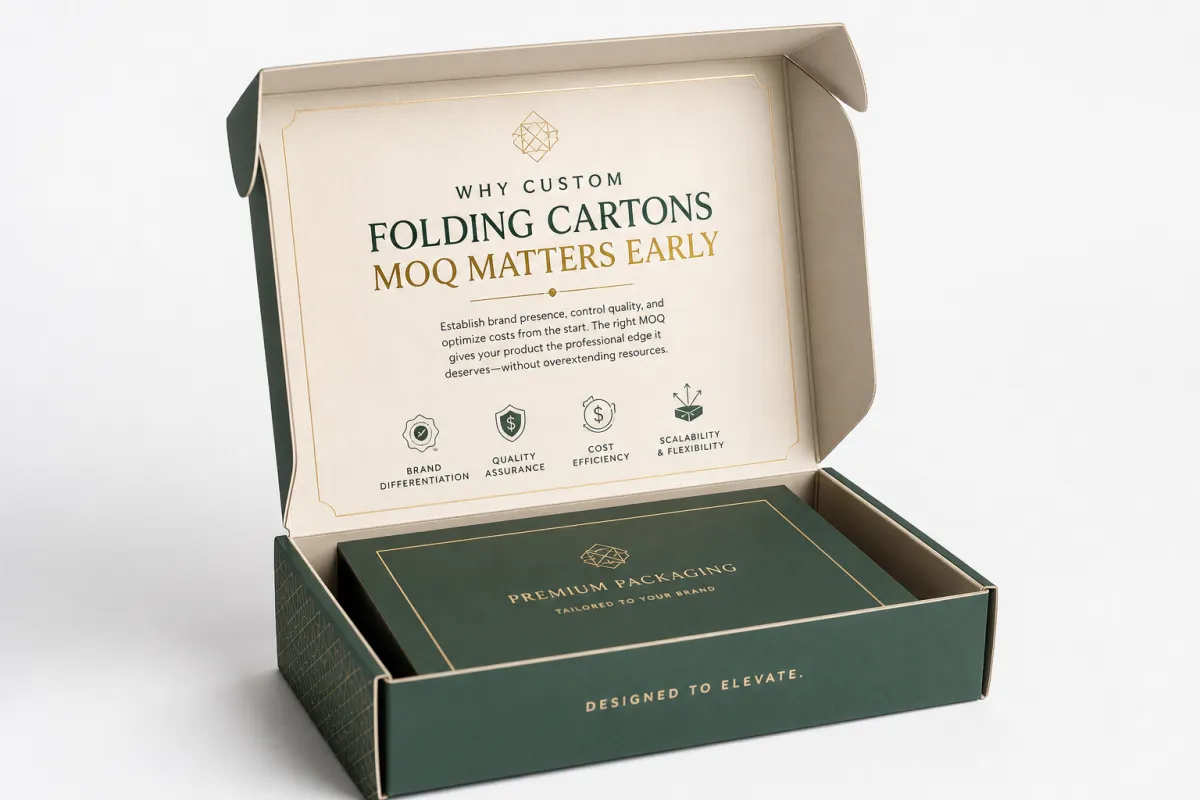
Custom Folding Cartons moq is not a late-stage detail. It is one of the first numbers that shapes the launch math. A brand that treats 1,000 cartons as a tiny order can end up with a unit cost that crushes margin, while a 5,000-piece run may lower the price enough to support a healthier retail strategy. That gap matters even more if the product is entering a crowded shelf, where packaging design and package branding have to carry more of the selling load.
The practical reason is simple: minimum quantity is tied to setup economics. Plates, prepress, die cutting, press make-ready, and finishing all carry fixed costs. Custom Folding Cartons moq is the point where those costs stop dominating every unit. On a small run, setup can eat a third or more of the total spend. On a larger run, the carton stock finally starts behaving like the main cost driver instead of the labor around it. If the run is too small, the paperboard itself is not the main cost problem. The setup is. If the run is too large, inventory risk grows and cash gets trapped in boxes before sales prove out.
I've had buyers freeze artwork only to discover later that a foil stamp, a window patch, and a thicker board pushed the job out of the supplier's sweet spot. That sounds small, but it kinda isn't. The minimum should be reviewed before artwork is finalized because structure and finishing choices can narrow the field fast. A reverse tuck carton on standard SBS board may be easy to quote. A custom printed box with foil, embossing, a window patch, and an insert can push the minimum much higher because each added step affects scheduling and waste. The minimum is not just about preference. It is about manufacturability.
For a launch team, the buying frame should look like this:
- Unit cost: how much each carton costs at the target quantity.
- Cash flow: how much money is tied up before sell-through begins.
- Timeline: whether the MOQ choice adds days or weeks to the schedule.
- Presentation: whether the carton still supports retail packaging goals.
Too many teams ask for the lowest possible custom folding cartons moq before they know what the carton must do. A better question is what minimum quantity still gives the product the right shelf presence, enough inventory to support the first sales cycle, and a unit cost that does not punish the margin. That turns the discussion from wishful to useful, and it usually leads to a better sourcing decision.
Product details for custom folding cartons moq
Different carton styles carry different production realities, and that is where custom folding cartons moq becomes more than a pricing line. Straight tuck, reverse tuck, auto-lock bottom, sleeve, insert-style pack, and crash-lock variations each bring their own setup demands. Some are friendly to smaller runs because they use standard die lines and simpler folding sequences. Others ask more of the line, especially if the product needs extra strength or premium finishing.
Common carton styles buyers compare
Straight tuck is usually the easiest place to start. It works well for lightweight cosmetics, supplements, and smaller retail items. Reverse tuck is similar, but the flap orientation changes how the box opens and closes. Both styles tend to support a lower custom folding cartons moq because the structure is familiar and the die patterns are standard.
Auto-lock bottom cartons are a different story. They save assembly time at packing, which matters for fulfillment, but they can add complexity in production. A higher board weight or a thicker insert may be needed if the product has more mass. That can push custom folding cartons moq higher, or at least make the pricing curve steeper.
Sleeves and insert-style packs often show up in promotional kits or premium product packaging. They create a stronger unboxing moment, but they also add parts, operations, and labor. If a buyer wants lower MOQ and more elaborate presentation at the same time, that is where the compromise usually shows up.
Crash-lock variations and specialty retail packaging structures are useful for heavier items or faster packing lines. They are efficient once dialed in, but they may not be the best fit for the smallest run sizes. Put differently, custom folding cartons moq is not just about quantity. It is about whether the carton style fits the production rhythm of the product.
Best fit by product category
Cosmetics often need shelf appeal first. Clean typography, high-quality print, and a carton that frames the product well matter more than a complicated structure. For that reason, many cosmetics buyers keep custom folding cartons moq lower by choosing a standard tuck style with one or two finish choices that actually earn their keep.
Supplements usually need clear labeling. Panel space matters because dosage instructions, ingredient statements, and regulatory text have to fit without looking cramped. A carton with a useful layout can protect the brand and keep custom folding cartons moq from climbing because the press plan stays simple.
Food cartons can bring compliance questions into the mix. Barrier needs, food-contact expectations, and language clarity all affect the spec. Even if the structure is simple, the documentation burden can influence custom folding cartons moq because every approval step has cost and time attached to it.
Retail sets and bundled products are often the hardest to standardize. Multiple pieces, inserts, and display requirements make these projects more sensitive to setup. If the package is doing both protection and presentation, custom folding cartons moq may rise, but the carton can also do more work on shelf and in transit.
Specifications that shape custom folding cartons moq
Specification control is where custom folding cartons moq gets real. A quote can look attractive until the buyer adds foil, a soft-touch coating, a window patch, or a heavier board grade. Then the production path changes. The best way to manage that risk is to lock the spec sheet early, even if the final art is still in progress.
What belongs on the spec sheet
Start with exact dimensions. Internal dimensions matter if the product fit is tight; external dimensions matter if the carton is going into a shipper or display tray. A small change in width or depth can alter the die line and affect custom folding cartons moq because the tool may need to be rebuilt or adjusted.
Next comes board caliper. Common paperboard choices include 14pt, 16pt, and 18pt SBS or C1S, plus kraft and CCNB options for certain programs. Heavier board can give better feel and better protection, but it can also make folding and gluing more demanding. That is one reason custom folding cartons moq rises on premium or structural jobs.
Print coverage matters too. A carton with a simple one-color run on a natural board is easier to schedule than a four-color process job with full flood coverage. If there is foil stamping, embossing, debossing, or spot UV, the number of production steps increases. More steps usually mean a higher custom folding cartons moq or a stronger setup charge.
Then there are coatings and finishing details. Gloss aqueous, matte aqueous, soft-touch lamination, and UV coating all change appearance and handling. Some finishes improve scuff resistance, which matters for e-commerce and warehouse handling. Others are about shelf perception. Either way, they influence custom folding cartons moq because the press and finishing schedule gets more specific.
Files and information that speed quoting
To get a clean quote, send the dieline file, exact measurements, bleed, preferred board stock, print sides, finish notes, and shipping destination. If the carton is still in development, send product dimensions and the target fit. That gives the packaging team room to suggest a structure that does not inflate custom folding cartons moq unnecessarily.
Also include any regulatory copy that must fit on the panel. Supplement facts, ingredient declarations, warning language, and country-of-origin notes can take more room than expected. A cramped panel can force a redesign, and redesigns are expensive because they can turn a simple custom folding cartons moq quote into a revised spec cycle.
For sustainability claims, paper sourcing should be treated with the same discipline as print. If you need documented fiber sourcing, the FSC chain-of-custody framework is the common reference point. That matters for branded packaging where the material story is part of the value proposition, but it is also worth checking whether the specific mill, converter, and label claim all match. Trust gets shaky fast if one link in that chain is vague.
A clean dieline, sensible board choice, and clear artwork file usually do more for the minimum than cosmetic tweaks alone. Buyers often ask for a cheaper package. What they really need is a package that prints, folds, and ships without friction. That difference shows up in custom folding cartons moq faster than most teams expect.
Short list of inputs that prevent rework:
- Finished size and product weight
- Dieline or structural sketch
- Artwork file with bleed and safe area
- Finish preferences and coating notes
- Target quantity tiers for custom folding cartons moq
Pricing and custom folding cartons moq
Pricing is where custom folding cartons moq gets translated into real budget decisions. The cost stack usually includes prepress, tooling, make-ready, board stock, ink coverage, finishing, packing configuration, and freight. On a short run, the setup costs can dominate. On a larger run, the per-unit cost starts to settle down because those fixed charges are spread across more cartons.
That is why one quote without context can mislead. A buyer may see a low setup fee and miss a high per-unit price. Another quote may look expensive at first glance, but if it includes better board, more reliable finishing, and cleaner packing, it can be the stronger value. custom folding cartons moq should always be read together with the price curve, not as a single number isolated from the rest of the proposal.
"The cheapest quote is rarely the cheapest project once setup, freight, and rework are counted."
Below is a simple comparison that shows how custom folding cartons moq often behaves across common carton types and quantity tiers. These are practical market-style ranges, not promises, because final pricing depends on board choice, coverage, and finish complexity.
| Carton style | Typical MOQ range | Approx. unit cost at 1,000 | Approx. unit cost at 5,000 | Best fit |
|---|---|---|---|---|
| Straight tuck | 500-2,000 | $0.42-$0.85 | $0.16-$0.31 | Cosmetics, supplements, light retail packaging |
| Reverse tuck | 500-2,500 | $0.44-$0.90 | $0.17-$0.33 | Standard product packaging with efficient folding |
| Auto-lock bottom | 1,000-3,000 | $0.58-$1.10 | $0.22-$0.41 | Heavier products, faster packing, stronger bottom support |
| Sleeve or insert-style pack | 1,500-5,000 | $0.65-$1.45 | $0.25-$0.55 | Premium branded packaging, gift sets, display-driven launches |
| Crash-lock variation | 2,000-5,000+ | $0.72-$1.35 | $0.28-$0.48 | Higher strength retail packaging and efficient fulfillment |
Those ranges show the pattern clearly. As custom folding cartons moq rises, unit cost usually falls. The rate of decline is not linear, though. A jump from 1,000 to 2,500 can save more per piece than a jump from 5,000 to 10,000 if the setup cost has already been absorbed. That is why buyers should ask for tiered pricing at two or three quantity points instead of stopping at a single quote.
It also helps to separate one-time and recurring charges. Tooling, plate setup, structural sampling, and prepress are usually one-time or near one-time costs. Board, print, and finishing are recurring. If a quote hides shipping, adds charges for color matching, or assumes a premium finish without saying so, custom folding cartons moq can look better than it really is.
For transit-heavy programs, shipping tests matter too. If the carton will move through distribution centers or direct-to-consumer fulfillment, many teams reference ISTA protocols or ASTM D4169 to reduce failure risk. The testing baseline at ISTA can be useful if the box needs to survive rough handling, not just look good on shelf. A carton that looks perfect in a photo but scuffs, splits, or crushes in a warehouse is not a bargain.
The quote is only half the story. The other half is how much packaging design work the carton saves later. A slightly more expensive carton that reduces damage, speeds packing, and keeps retail presentation consistent can beat the cheapest custom folding cartons moq option over the life of the SKU.
Process and timeline for custom folding cartons moq orders
A reliable process matters as much as a fair price. For custom folding cartons moq, the path from quote to delivery usually follows a predictable sequence: discovery, spec review, dieline confirmation, proofing, sampling, production, quality check, and freight booking. The smoother each step is, the more likely the project stays on schedule.
- Discovery: define the product, quantity tier, and packaging goals.
- Spec review: check size, board, finishing, and regulatory text.
- Dieline confirmation: lock the structure before artwork changes start.
- Proofing: verify layout, color, and content placement.
- Sampling: review fit and fold behavior before full production.
- Production: print, finish, cut, fold, and pack.
- Quality check: inspect dimensions, color, and glue performance.
- Freight booking: arrange shipping to the warehouse or fulfillment site.
Clean files shorten the cycle more than almost anything else. A standard custom folding cartons moq job with a proven structure and complete artwork can often move quickly. Rough timelines may look like this: quote in 24-48 hours, proof approval in 1-2 business days, sampling in 5-7 business days, and production in roughly 10-15 business days after approval. The exact schedule depends on the carton style, finish complexity, and paper availability.
Delays usually come from avoidable issues. Missing bleeds, unclear dimensions, late changes to print coverage, and uncertain finish selections are common culprits. If the team keeps revising the board grade or adds a window after proof approval, custom folding cartons moq can still be met, but the timeline stretches and the cost can rise. Buyers should assume that every revision has a supply-chain cost attached to it.
Approving the structure before the visual polish helps a great deal. A structure that fits the product safely is the foundation. Once that is set, the branding decisions can follow without creating new dieline work. That sequence is especially useful for custom printed boxes and launch programs with tight deadlines.
If you want a faster read on your options, our FAQ covers common setup questions, and our Custom Packaging Products page gives a broader view of what can be spec’d for different product formats. Both are helpful when custom folding cartons moq is still being narrowed.
Rush production can be possible, but only when the artwork is ready, the structure is familiar, and the press calendar has room. Speed is not random. It is earned through file readiness and a realistic custom folding cartons moq plan.
Why choose us for custom folding cartons moq projects
Buyers do not just need a printer. They need a partner who can explain what is driving the number, what can be changed, and what should stay fixed. That is where a direct, manufacturing-aware approach matters. For custom folding cartons moq, the value is clarity: clear minimums, clear pricing, clear files, and fewer surprises after approval.
There is a big difference between a broker-only conversation and a team that understands how a carton actually gets built. A broker may quote a quantity and a finish, but miss the small choices that affect production. Direct manufacturing support usually means faster answers on board grades, print coverage, die complexity, and which finishes are worth the cost. For buyers balancing branded packaging and margin, that information is not optional.
custom folding cartons moq projects also benefit from packaging guidance rather than pure printing talk. A carton can look good in a render and still be awkward to pack. It can also be cheap on paper and expensive once returns, damage, or rework appear. The best supplier conversation covers shelf appearance, packout speed, shipping behavior, and whether the carton aligns with the SKU’s unit cost target.
That is especially useful if you are comparing custom printed boxes across different suppliers. Ask each one to quote the same spec, the same board, and the same quantity tiers. Ask where the one-time charges sit. Ask whether a simple finish change would lower the minimum. Those questions reveal who actually understands custom folding cartons moq and who is just moving numbers around.
- Transparent minimums so you know where the real floor is.
- Spec feedback so the carton is manufacturable, not just attractive.
- Tiered pricing so unit cost can be compared at different volumes.
- Practical packaging design input so the structure supports the product.
For teams that need one place to compare structures, finishes, and branded packaging options, our Custom Packaging Products page is a useful starting point. The point is not to overload the buyer with choices. It is to narrow custom folding cartons moq to the version that fits the product, the schedule, and the budget.
Trust matters here. A solid supplier tells you when the minimum is real, when it can be improved, and when a better design choice will save money over the life of the SKU. That honesty matters more than a polished sales pitch.
Next steps for your custom folding cartons moq request
If you want a usable quote, send the details that change the number. Start with finished dimensions, product weight, target quantity, artwork status, finish preferences, and the ship-to location. That is enough for most quoting teams to give you a realistic first pass on custom folding cartons moq instead of a generic estimate that has to be rewritten later.
A useful next step is to ask for three quantity tiers. For example: 1,000, 2,500, and 5,000 units. That gives you a clean view of the unit cost curve and shows where the real break happens. It also helps you decide whether the current custom folding cartons moq is right for launch, or whether a slightly larger run would support better economics.
Do not send artwork in isolation if the structure is still being developed. Product dimensions and required internal fit matter just as much. A clean structural starting point often lowers custom folding cartons moq more effectively than cosmetic edits, because a simple, manufacturable box is easier to quote, proof, and schedule.
Fast request checklist:
- Box dimensions and product weight
- Preferred carton style, if known
- Print sides, finish, and coating notes
- Artwork file or layout draft
- Target MOQ tiers for comparison
- Ship-to address or warehouse location
If you are still deciding between standard tuck styles, sleeves, or more premium retail packaging, ask for feedback before you lock the file. That one conversation can save days of revision and help the custom folding cartons moq land in a more useful range.
The best carton decision is not the loudest one. It is the one that protects the product, fits the schedule, and keeps unit cost in line. Send a spec-based request, not a vague inquiry, and custom folding cartons moq becomes a workable sourcing decision instead of a guessing game.
Frequently Asked Questions
What is a typical custom folding cartons moq for new brands?
The minimum depends on carton style, print method, and finish complexity. A simple tuck-end box may start lower than a specialty carton with foil or an insert. New brands usually do better by asking for tiered pricing across several quantities instead of focusing on one number. In practice, the best custom folding cartons moq is the lowest run that still gives acceptable unit cost, stable color, and enough inventory for the first sales cycle.
How does custom folding cartons moq affect unit pricing?
Higher quantities usually lower unit cost because setup, prepress, and tooling are spread across more cartons. Specialty finishes and heavy customization reduce the pricing advantage of very small runs because the fixed production steps do not shrink much. The cheapest quote is not always the best value if it hides added charges for proofs, shipping, or rework. That is why custom folding cartons moq and unit cost should always be reviewed together.
Can I lower the custom folding cartons moq by simplifying the design?
Yes. Simpler structures, fewer print colors, and standard board stocks often make a lower MOQ more feasible. Removing foil, embossing, specialty coatings, or unusual die cuts can improve both pricing and production flexibility. A clean spec sheet usually helps more than cosmetic changes alone, because manufacturability Drives the Real minimum. If custom folding cartons moq is the constraint, simplification is usually the first lever to pull.
What files do I need to quote custom folding cartons moq accurately?
Provide a dieline, final artwork, exact finished dimensions, and any notes on coatings, windows, or inserts. If the carton is still being developed, share product dimensions and the required internal fit so the team can recommend a structure. The more complete the file set, the faster the quote and the lower the risk of expensive revisions later. That is especially true when custom folding cartons moq is being compared across multiple quantity tiers.
How long does it take to produce custom folding cartons moq orders?
Timelines vary by complexity, proofing speed, and material availability, but simple cartons usually move faster than specialty builds. Approvals are often the biggest schedule risk, not printing itself, so quick sign-off can shorten the overall timeline. Rush production is possible in some cases, but it depends on file readiness, press capacity, and whether the spec is already proven. For planning purposes, custom folding cartons moq orders can often move from proof approval to production in roughly 10-15 business days on straightforward runs.

