Buyer Fit Snapshot
| Best fit | Custom Folding Cartons Wholesale projects where brand print, material claims, artwork control, MOQ, and repeat-order consistency need to be specified before quoting. |
|---|---|
| Quote inputs | Share finished size, material target, print colors, finish, packing count, annual reorder estimate, ship-to region, and any compliance wording. |
| Proofing check | Approve dieline scale, logo placement, barcode or warning zones, color tolerance, closure strength, and carton packing before bulk production. |
| Main risk | Vague material claims, crowded artwork, missing packing details, or unclear freight terms can make a low unit price expensive after revisions. |
Fast answer: Custom Folding Cartons Wholesale: Pricing, Specs & More should be specified like a repeatable production item. The safest quote records material, print method, finish, artwork proof, packing count, and reorder notes in one written spec.
Production checks before approval
Compare the actual filled-product size with the drawing, then confirm tolerance on folds, seals, hang holes, label areas, and retail display edges. Reserve space for logos, QR codes, warning copy, and material claims before decorative graphics fill the panel.
Quote comparison points
Review material grade, print process, finish, sampling route, tooling charges, carton quantity, and freight assumptions side by side. A quote is only useful when the supplier can repeat the same color, closure quality, and packing count on the next order.
If a shelf carton looks polished in mockups but starts failing the moment it hits fulfillment, Custom Folding Cartons wholesale is usually where the fix begins. The failure is rarely dramatic. A tuck flap runs a little tight, board caliper shifts the fold line, or a glue zone steals a few seconds from every pack-out. Multiply that by 20,000 units and the “small” problem turns into labor overruns, damaged cartons, and missed outbound windows. I have watched a line lose nearly an hour because a reverse tuck was only a shade too snug. On paper, that seems tiny. On the floor, it is gonna matter.
For a packaging buyer, Custom Folding Cartons wholesale makes sense when replenishment has to be predictable, when several SKUs need a shared carton family, or when a seasonal launch cannot afford a redesign every time it comes back. The economics are easy to track: lower unit pricing at scale, steadier print results, cleaner warehouse handling, stronger shelf presentation, and fewer transit headaches. A rigid box may outperform a folding carton in crush resistance. A mailer may beat both on shipping protection. Still, for retail-facing packaging, folding cartons often hit the best intersection of print surface, structure, and freight efficiency.
There is a reason Custom Folding Cartons wholesale belongs in production planning, not just design planning. The carton has to open smoothly, fold consistently, survive vibration, and still look crisp under store lighting. When those requirements line up, packaging stops acting like decoration and starts behaving like a tool. That is the part buyers remember after the first pallet arrives clean and the second one does too.
A carton that photographs well but slows the line, scuffs in transit, or prints inconsistently is not a win. It is a disguised expense.
For brands comparing Wholesale Programs and broader Custom Packaging Products, the real question is not which option looks best on a render. The better question is which option performs best at your target volume, on your equipment, and inside your freight budget. That practical filter is where Custom Folding Cartons wholesale earns its place.
Why do custom folding cartons wholesale solve volume packaging problems?
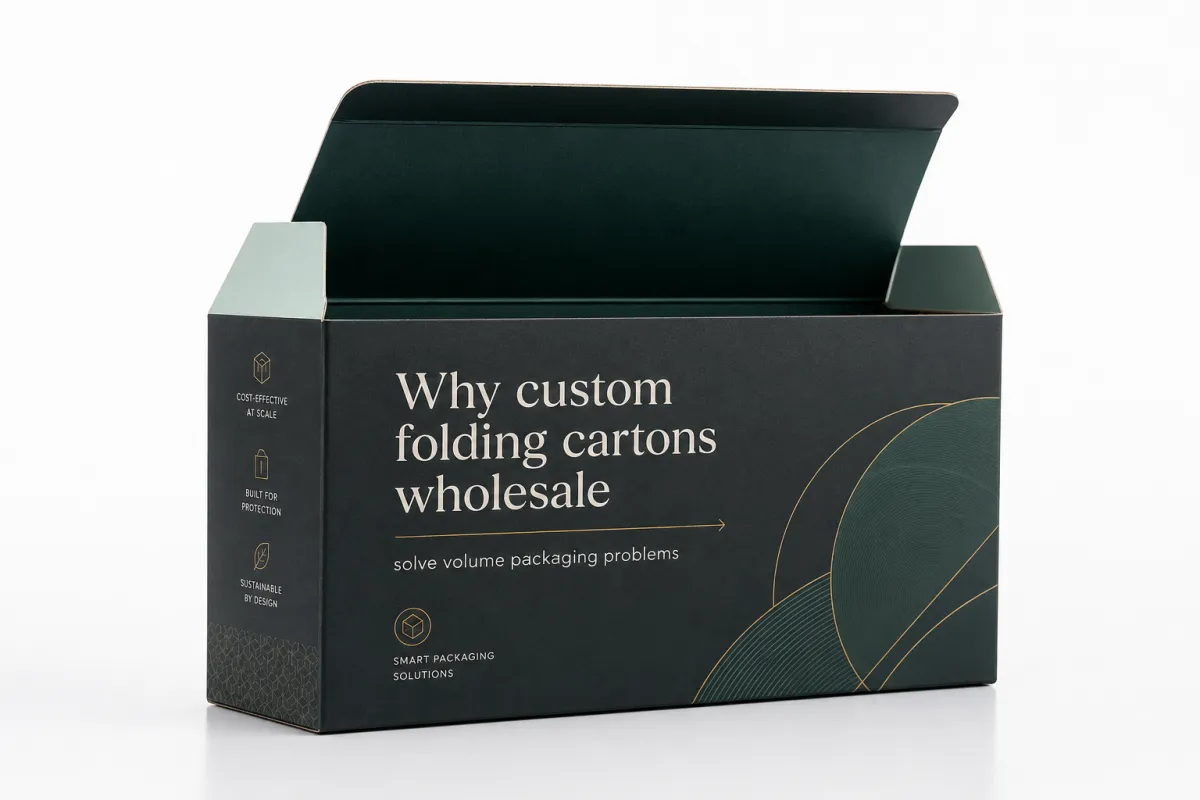
Custom folding cartons wholesale solves a narrow but expensive problem: packaging has to behave the same way every time. Retailers want clean shelf facings. Fulfillment teams want fast assembly. Warehouses want cartons that stack without crushed corners. One box has to satisfy all three, and the spec matters more than the hero mockup.
Most carton failures trace back to small misses, not giant design flaws. A tuck depth off by 2 mm can make a carton feel loose. A board grade that is a little too light can weaken crush resistance. The package still looks fine in prepress, then complaints start after the first shipment cycle. I have seen this happen with a cosmetic carton that printed beautifully but bowed in a humid dock area because the board choice did not match the route. That is why custom folding cartons wholesale should be treated as a measured production decision, not a graphics exercise with a price tag attached.
Wholesale also helps when one brand manages a family of products that need a consistent visual system. A single structure, a single board spec, and a single print standard can carry supplements, candles, cosmetics, or compact electronics across a line without reinventing the package every time. That repetition strengthens package branding because the shelf face, the unboxing moment, and the reorder cycle all speak the same visual language.
The cost side matters, too. With custom folding cartons wholesale, fixed setup costs spread across more units, which pulls the unit price down. The less visible gain is just as valuable: repeated runs stabilize color, trim, and folding tolerance. That matters in retail packaging because buyers notice when one batch feels heavier, glossier, or slightly off-register compared with the last. Even a 3% variance in appearance can feel bigger than that once the boxes sit side by side under fluorescent lighting.
Volume is where the math gets cleaner. If reorder patterns are steady, wholesale cartons let the team keep the same dieline, board weight, and print spec in place while only changing quantity. Products still in testing, or structures that change every other month, need a different approach. Custom folding cartons wholesale works best once the carton is settled enough to repeat without renegotiating the basics.
A simple comparison helps. If the product needs a premium shelf face and moderate protection, folding cartons usually make sense. If maximum crush resistance is the priority, rigid packaging may be the better fit. If the main job is shipping protection rather than shelf presence, corrugated mailers often win. That filter keeps custom folding cartons wholesale in the right lane and keeps sourcing teams from paying premium-box money for a carton that never needed it.
Custom folding cartons wholesale: structures, board grades, and finishes
The first comparison point is structure. Straight tuck end, reverse tuck end, auto-lock bottom, mailer-style folding cartons, and custom dieline variations all behave differently on the line. Custom folding cartons wholesale is not one box style; it is a set of structures built around insertion speed, display needs, and shipping demands.
Lightweight products often pair well with a straight tuck end because it keeps assembly simple and gives the carton a clean retail look. Reverse tuck end works well for many standard programs and can be efficient in converting. Auto-lock bottom cartons help when the base needs more security or when the line needs the carton to stand up quickly. Mailer-style folding cartons bring a more premium opening experience without moving into rigid-box territory. Each structure changes how wholesale carton programs perform in real production, not just on paper.
Board grade carries just as much weight as structure. SBS, or solid bleached sulfate, is a common choice when print clarity, bright type, and a clean white surface matter. CCNB, or clay-coated news back, often suits cost-conscious programs where appearance still matters but premium white fiber is unnecessary. Kraft-look substrates support a natural or earthy brand direction. Heavier stocks add stiffness, better stacking, and more confidence in transit. For many custom printed boxes, the board does half the performance work before the ink ever dries.
Finishes change both appearance and durability. Matte aqueous coating gives a softer look and modest scuff resistance. Gloss coating increases visual pop and can help a carton stand out on shelf. Soft-touch lamination creates a smoother tactile feel, though it usually adds cost and can change how the carton behaves during folding. Spot UV, foil, embossing, and debossing add depth, but only when they serve a clear purpose. A finish that slows production or raises reject rates without improving perception tends to be expensive noise.
Print method and ink coverage deserve the same attention. Heavy coverage can slow drying and affect fold memory, especially on lighter boards. Dense color builds can look rich, then reveal scuffing on corners and edges where handling is roughest. In custom folding cartons wholesale, a coating chosen well often protects print quality better than a decorative treatment that looks impressive for one afternoon and wears quickly after that. That tradeoff is easy to miss if you are only reviewing flat artwork on a monitor.
Product categories like cosmetics, supplements, candles, and small electronics often need insert work or special closures. Inserts keep fragile items centered. Dividers separate multi-packs. Hang tabs support retail display. Tear strips improve opening control. Security features help deter tampering. A carton spec should match the product, not force the product into a generic shape. That is one reason custom folding cartons wholesale needs technical review before pricing ever starts.
| Structure or board option | Best use | Typical cost effect | Practical note |
|---|---|---|---|
| Straight tuck end | Retail items, lightweight products, clean shelf presentation | Usually lower | Fast to assemble and common in custom folding cartons wholesale |
| Reverse tuck end | General retail packaging and repeat SKUs | Low to moderate | Good balance of structure and converting efficiency |
| Auto-lock bottom | Heavier fills, quicker assembly, better base security | Moderate | Useful when the line needs a box that stands quickly |
| SBS board | Premium print clarity and bright graphics | Moderate to higher | Popular for cosmetic and branded packaging programs |
| CCNB board | Cost-sensitive product packaging | Usually lower | Practical when budget matters and the front panel does the selling |
Some sourcing teams also reference FSC standards at fsc.org when recycled content or responsible sourcing is part of the brief. That does not change the carton geometry, but it can shape how a buyer frames custom folding cartons wholesale during supplier review. The same is true for regional recycling claims; they belong in the spec, not bolted on after approval.
Dimensions, dielines, and print specifications that affect fit
Internal dimensions are the first number to confirm because they tell you whether the product has enough clearance. A carton that is too tight slows insertion and can scuff the product. A carton that is too loose lets the product move, which hurts shelf presentation and transit performance. In custom folding cartons wholesale, fit is not a side note. Fit is the core of performance.
The dieline has to account for board thickness, fold memory, glue flap width, panel wrap, and any artwork crossing a panel edge. If a design runs across the front, side, and back panels, the artwork must be mapped to the real fold points rather than centered in a flat mockup. Strong packaging design keeps those transitions clean. That is why dieline review should happen before art files are locked. Skipping that step is how expensive corrections appear after proof approval. A 1 mm offset may sound harmless, but on a tight closure it can turn into a visible gap or a stubborn tuck.
Print-ready files need the basics handled properly: bleed, safe zone, image resolution, dieline overlays, and accurate spot color calls. If the package carries a barcode, ingredient panel, warning text, or country-of-origin statement, those elements should be verified during proofing, not after cartons arrive. Custom folding cartons wholesale often supports regulated product packaging, so the buyer needs to know exactly where required text sits and whether the barcode scans correctly on the finished board.
Many buyers check ISTA methods and related ASTM practices before approving a structure for shipping. That does not mean every carton needs a full lab program, but the design should still match the handling the product will face. You can review test standards and shipping guidance at ista.org if your team wants a shared reference point. That is especially useful when custom folding cartons wholesale supports an e-commerce or subscription model, where cartons have to survive more corners, more drops, and more conveyor time than a retail-only pack usually sees.
There is always a tradeoff between protection and efficiency. A slightly larger carton can give a fragile item more room and reduce damage, yet the same increase raises freight volume and can lower shelf density. A tighter fit saves space, but loading gets harder on the line. A strong spec balances those forces instead of trying to satisfy only one. For most buyers, the best custom folding cartons wholesale choice protects the product without creating waste in labor or shipping.
Before production begins, I recommend a plain checklist:
- Final internal dimensions with product clearance confirmed
- Approved dieline with fold and glue areas clearly marked
- Print file with bleed and safe area respected
- Barcode verified at the intended size and placement
- Compliance text checked by the right internal team
- Finish choice locked before proof approval
When those details are settled early, custom folding cartons wholesale moves faster and needs fewer revision loops. That usually separates a clean launch from a launch that keeps slipping because the carton is still being repaired after the art is already finished.
What does pricing look like for custom folding cartons wholesale?
Pricing for custom folding cartons wholesale depends on much more than quantity. Size, board grade, print coverage, number of colors, finishing steps, structural complexity, and whether the order requires special packaging or kitting all affect the final number. Two cartons can look almost identical on a product page and still price very differently because one uses a heavier board, a tighter cut tolerance, or an extra finish pass.
MOQ, or minimum order quantity, is often more flexible than buyers expect. A simple straight tuck carton in a standard board can sometimes run at a lower MOQ than a carton with foil, embossing, unusual closure features, or a custom insert. The reason is simple: setup costs have to be recovered somewhere. In custom folding cartons wholesale, larger runs usually improve the unit rate, but that does not automatically make them the right move for a new SKU or a seasonal launch.
Setup charges, die cutting, plate costs, proofing, and sampling all sit inside the math. One quote may look cheaper at first glance because tooling is spread over a larger quantity, while another may appear higher because it includes a pre-production sample, more waste allowance, or a different freight term. That is why comparing custom folding cartons wholesale quotes line by line matters more than comparing only the final total.
Here is how the major cost drivers usually behave:
- Carton size: Larger cartons use more board and take up more freight space.
- Print coverage: Full-coverage graphics and dark solids usually cost more than minimal coverage.
- Finishing: Aqueous coating is generally simpler than lamination, foil, or embossing.
- Structure: Auto-lock bottoms and custom inserts raise converting time.
- Quantity: Higher volume usually improves the unit rate, sometimes sharply.
For budget planning, the cleanest way to improve pricing is often not to ask for a cheaper carton. Standardize the size across related SKUs, simplify the finish, or consolidate multiple orders into one print run. That approach can make custom folding cartons wholesale more efficient without stripping away the branding work that supports the shelf. It also reduces the chance of discovering, too late, that three near-identical cartons required three different die lines.
Typical pricing ranges vary by specification, but a realistic planning range for simple retail folding cartons at medium volume looks like this: a basic uncoated or aqueous-coated carton may land around $0.18 to $0.28 per unit at 5,000 pieces, while more detailed print, heavier board, or premium finishes can push the range closer to $0.30 to $0.55 per unit or more. Smaller runs often carry a much higher unit price because setup is spread over fewer boxes. That is normal in custom folding cartons wholesale, and it is one reason quotes need context, not just a single line item.
For product teams managing launch budgets, a few moves help:
- Lock the carton size before asking for print revisions.
- Choose one finish that handles both protection and presentation.
- Share forecasted volume if a reorder is likely.
- Ask whether the quote includes overage, waste allowance, and freight.
- Compare the spec sheet, not just the unit price.
That last point matters most. A lower quote for custom folding cartons wholesale is no bargain if the board weight is wrong or if the line needs extra labor to make the cartons usable. I have seen buyers save a few cents per unit and then lose the savings in hand assembly because the carton would not lock cleanly.
Production process and timeline from sample to shipment
The production path for custom folding cartons wholesale is usually straightforward, but each step depends on the one before it. A brief becomes a dieline review, then artwork proofing, sampling, production, finishing, carton folding, carton packing, and final shipment. If one step is fuzzy, the schedule slips. Delays rarely belong only to the printer; more often they come from a late copy change or a finish decision that arrives after proof approval.
Buyers should separate three sample types. A structural sample checks fit and fold behavior. A digital proof checks artwork placement, text, and overall color direction. A pre-production sample comes closest to the final carton and offers the strongest check before a full run begins. In custom folding cartons wholesale, that distinction removes confusion because the structure can fit perfectly even while the printed proof still needs file corrections.
Simple reorder jobs move faster because the dieline, board, and print setup already exist. New custom structures take longer because tooling, cut lines, glue areas, and panel transitions need more review. Add foil, embossing, or complex insert work, and the timeline stretches again. For many standard programs, 12 to 15 business days from final proof approval to shipment is a reasonable planning point, while more involved custom folding cartons wholesale orders can take longer depending on quantity and finishing.
The approvals that slow jobs down most are easy to spot: artwork changes after proofing, missing dimensions, and uncertainty about coating or closure style. If the team is still deciding between matte and gloss, or between a tuck end and an auto-lock bottom, the schedule should not be treated as final. That is normal in packaging development, but it should be named early so nobody mistakes a moving target for a finished order.
A simple checkpoint list keeps the run on track:
- Final dimensions approved by the product team
- Final copy cleared by legal or compliance
- Dieline reviewed and signed off
- Finish choice confirmed
- Delivery address and contact details verified
- Target in-hand date communicated clearly
Warehouse planning deserves the same attention. If pallets need to fit a specific dock height or cartons must ship flat with a certain stack pattern, say that up front. Custom folding cartons wholesale works best when production and logistics are discussed together instead of treated as separate decisions. That is how a box becomes a reliable supply item rather than a recurring project.
Why manufacturers choose us for wholesale carton programs
Manufacturers and brand teams usually want the same thing: consistency. They want cartons that cut cleanly, score cleanly, fold cleanly, and stay consistent from batch to batch. That is where custom folding cartons wholesale delivers real value. A repeatable carton program reduces line interruptions, trim waste, and the tiny variations that can disrupt a hand-packed or semi-automated operation.
Quality control should be specific, not vague. Before cartons leave production, the team should check board performance, registration, fold integrity, adhesive areas, and print alignment. If the artwork is misregistered by even a small amount, the carton can still look fine in a photo and still feel off in the hand. Buyers of custom folding cartons wholesale should expect that level of inspection because a wholesale carton program is only as strong as the worst batch that ships.
Technical support is another clear dividing line between suppliers. Good packaging support is not just agreeing to every request. It means giving direct feedback on whether the structure will work, whether the artwork will scuff, and whether the board choice matches the product. That kind of guidance is especially useful for Product Packaging That has to balance appearance, protection, and speed. A supplier who can explain why a change helps, or why it creates risk, usually saves the buyer money later.
Supply reliability matters as much as design. Wholesale carton programs work best when forecasting is real, pallets are planned, and reorders are coordinated before inventory gets tight. That holds true for retail display, e-commerce fulfillment, and subscription packaging. The more the reorder process follows a steady rhythm, the easier it is to keep custom folding cartons wholesale on schedule and avoid emergency freight charges.
Most buyers do not need the fanciest carton on the table. They need the right balance of appearance, protection, cost, and production speed. That is why the better partner does not force every order into the same structure. The recommendation should shift with the product, quantity, and use case. One program may call for SBS board with a matte aqueous coating. Another may call for CCNB and a simpler print setup. Either way, custom folding cartons wholesale should serve the business first.
If you are comparing suppliers, ask for practical answers:
- Can they explain the board choice in plain terms?
- Will they review the dieline before printing?
- Do they check fold quality and glue zones?
- Can they support custom printed boxes across multiple SKUs without resetting the spec each time?
- Will they say plainly when a rigid box or mailer is the better choice?
That last question tells you a lot. A supplier who can reject the wrong carton is often the one you want for custom folding cartons wholesale.
What should you prepare next for a fast wholesale quote?
If you want a clean quote for custom folding cartons wholesale, send the practical details first. Product dimensions, target quantity, board preference, print colors, finish choice, packaging use case, and delivery destination all shape the estimate. Missing information slows the quote down or makes it too broad, and neither outcome helps a launch plan.
It also helps to define the stage of development. Do you need a prototype, a printed sample, or a production-ready dieline? Those are different requests, and they should be priced differently. A structural sample is useful when fit is still being tested. A printed proof confirms artwork direction. A pre-production sample is best when the project has tight tolerances and the carton has to be right before the full run begins. In custom folding cartons wholesale, clarity at the start keeps the estimate accurate.
Before submitting art, run one internal review. Check copy, barcode placement, product claims, and any regulatory text that needs approval. If legal, quality, or compliance teams are involved, bring them in early. That single step prevents the familiar frustration of discovering, after proofing starts, that warning copy needs to move or the ingredients panel is incomplete. No one wants to delay custom folding cartons wholesale because a finished file still carried an unresolved compliance note.
If you are managing several SKUs, rank them by launch date, forecasted volume, and whether they can share one structural platform. That is often the smartest way to build a packaging program. One master spec can support several variants, which simplifies ordering and can improve pricing. It also keeps the brand family visually connected across the line.
For a faster estimate, gather this list before you reach out:
- Product dimensions and fit requirements
- Desired quantity for the first run
- Board preference, if known
- Print colors and finish choices
- Need for inserts, dividers, hang tabs, or closures
- Shipping location and target in-hand date
- Any existing artwork or dieline files
If you already have a carton format in mind, ask whether the supplier can recommend a structure that improves line speed or freight efficiency without hurting shelf presence. That is where the most useful packaging conversations happen. A good sourcing discussion sounds less like a sales pitch and more like a stress test. If the carton does not survive the test, it should not go into production.
For brands that need repeatable custom folding cartons wholesale, the next move is simple: gather the specs, compare the structure, board, and finish choices, and confirm the sample type before the full run begins. That is the cleanest path from packaging concept to a carton program that performs on the line, in the warehouse, and on the shelf.
FAQ
What is the MOQ for custom folding cartons wholesale?
MOQ depends on carton size, board type, print complexity, and finishing requirements rather than one fixed number. Simple structures can sometimes run at lower quantities, while foil, embossing, special die cuts, or complex inserts usually need higher volume to stay economical. If you are launching a new SKU, ask whether a pilot run or shared tooling approach is possible for custom folding cartons wholesale.
How long does custom folding cartons wholesale production usually take?
Timeline depends on artwork approval, sampling needs, and production complexity. Simple reorder jobs usually move faster than new custom structures because the dieline and print setup already exist. A practical starting point for many programs is often 12 to 15 business days after final proof approval, although larger or more detailed custom folding cartons wholesale runs can take longer.
Which board is best for custom folding cartons wholesale orders?
SBS is common when you want strong print clarity and a clean retail appearance. CCNB can be a practical choice for cost-sensitive programs where the front panel still needs to sell the product. Heavier board may be the better option when the carton needs more stiffness, better stacking, or a more substantial hand feel. The best board for custom folding cartons wholesale depends on the product and the way it ships.
Can I get samples before placing a wholesale carton order?
Yes, and it is smart to confirm structure before committing to a full run. Ask for the right sample type, since a structural sample confirms fit while a printed proof confirms artwork and color direction. A pre-production sample is the closest match to the final carton and is especially useful when custom folding cartons wholesale has tight dimensional or compliance requirements.
What should I send for an accurate custom folding cartons wholesale quote?
Send product dimensions, quantity, board preference, print requirements, and finish details. Include the target delivery date, shipping location, and whether you need folds, inserts, or any special closure style. If you already have artwork or a dieline, sharing it early helps tighten pricing and reduce revision time for custom folding cartons wholesale.

