Buyer Fit Snapshot
| Best fit | Custom Folding Cartons for Branding projects where brand print, material claims, artwork control, MOQ, and repeat-order consistency need to be specified before quoting. |
|---|---|
| Quote inputs | Share finished size, material target, print colors, finish, packing count, annual reorder estimate, ship-to region, and any compliance wording. |
| Proofing check | Approve dieline scale, logo placement, barcode or warning zones, color tolerance, closure strength, and carton packing before bulk production. |
| Main risk | Vague material claims, crowded artwork, missing packing details, or unclear freight terms can make a low unit price expensive after revisions. |
Fast answer: Custom Folding Cartons for Branding: Board, Finish, Dieline, and Unit Cost should be specified like a repeatable production item. The safest quote records material, print method, finish, artwork proof, packing count, and reorder notes in one written spec.
Production checks before approval
Compare the actual filled-product size with the drawing, then confirm tolerance on folds, seals, hang holes, label areas, and retail display edges. Reserve space for logos, QR codes, warning copy, and material claims before decorative graphics fill the panel.
Quote comparison points
Review material grade, print process, finish, sampling route, tooling charges, carton quantity, and freight assumptions side by side. A quote is only useful when the supplier can repeat the same color, closure quality, and packing count on the next order.
Custom Folding Cartons for Branding: Shelf Impact Guide
A shelf gives you about two seconds. Sometimes less. If the aisle is crowded, if the lighting is bad, if the shopper is tired, it gets even shorter. In that tiny window, Custom Folding Cartons for branding either earn a second look or disappear into the noise. That judgment happens before anyone picks up the product, which is exactly why the carton has to do real work fast.
Custom Folding Cartons for branding are not just containers. They are the brand’s first sales pitch, folded into paperboard and sent into the wild. The buyer notices the structure, reads the label, feels the finish, and decides whether the product belongs in the cart. If the carton feels intentional, the brand looks sharper. If it feels generic, the whole package drops in value, even when the product inside is excellent.
I have seen this play out more times than I can count. A strong carton can make a mid-tier product look considered and credible. A weak one can make a good product feel oddly cheap. Packaging does not get a free pass just because the formula or contents are solid. Shoppers do not separate the two.
This guide stays practical. It covers how Custom Folding Cartons for branding are built, what drives cost, where timelines get messy, and which design decisions help or hurt retail packaging performance. Pretty packaging matters. Packaging that actually supports the product, the brand, and the channel matters more.
What custom folding cartons for branding really do
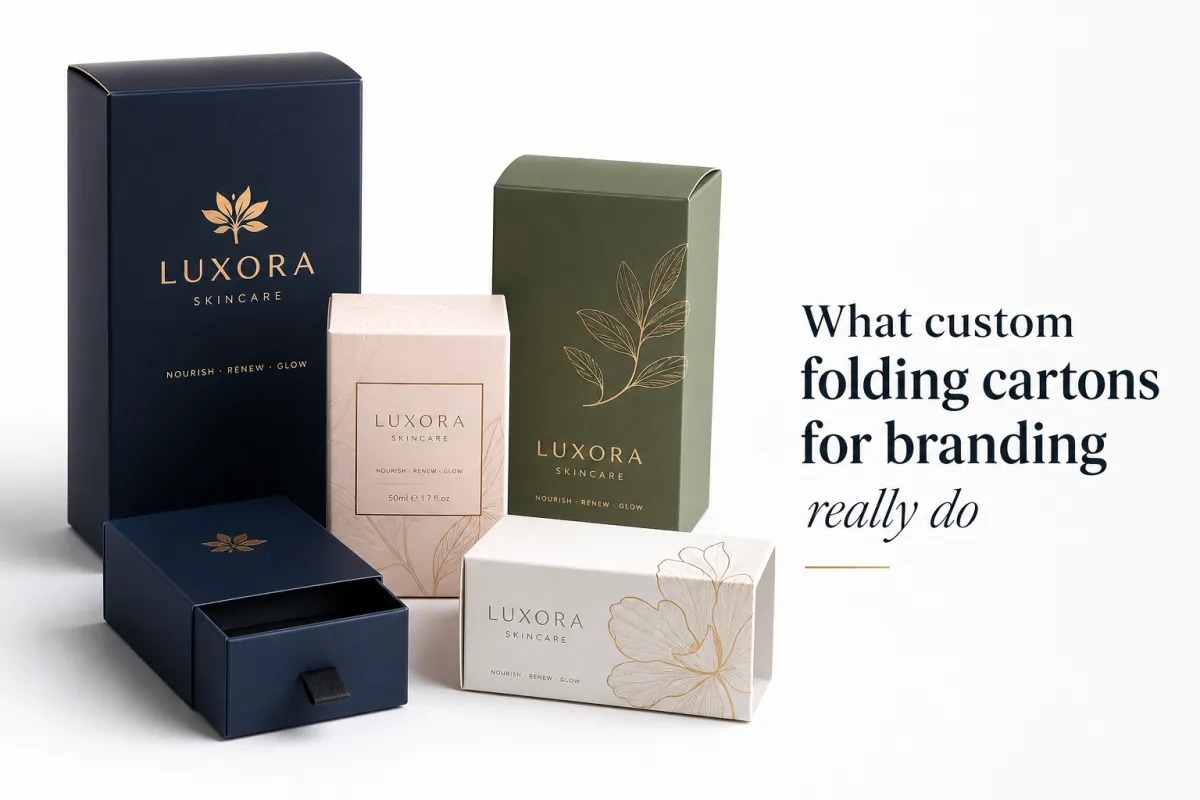
Custom Folding Cartons for branding usually become the first physical thing a buyer notices. That matters because the package is doing three jobs at once: protect the item, explain it quickly, and signal that the product belongs on the shelf. A plain box can protect. A well-designed carton can sell.
A folding carton is a lightweight paperboard box that ships flat, gets printed to match the brand, and is folded and glued during pack-out. Common boards include 14pt to 24pt SBS, C1S, and C2S, with 18pt and 20pt showing up often in retail packaging that needs a little more backbone. Board choice changes the feel, the fold, the crease, and the way the box holds up once it hits the line.
Custom folding cartons for branding carry the color, typography, claims, icons, and structure that make a package recognizable. That makes the carton part of the identity, not decoration. Buyers read it like a billboard and a product pitch at the same time. Clear hierarchy helps them spot the name, size, and benefit in one glance. A cluttered face sends them elsewhere.
Consistency matters too. A brand line that keeps the same visual cues, logo placement, and finish choices across SKUs starts to look established, even when the catalog is still small. That consistency carries through shelf presentation, ecommerce photos, and the unboxing moment. Random changes usually read as confusion. Brands rarely need more confusion.
For the buyer, the carton is also a decision tool. Good packaging tells them who the product is for, what makes it different, and whether the price feels justified. Bad packaging makes them work too hard. Shoppers have no interest in solving the puzzle for you.
Practical rule: if the box needs a paragraph to explain itself, the packaging design is probably trying to do too much in the wrong places.
That is why custom folding cartons for branding should be judged on more than artwork. Look at legibility, shelf blocking, product fit, and whether the structure supports the story. Attractive is fine. Attractive and useful is better. Attractive, useful, and repeatable across production runs is what earns shelf space.
How custom folding cartons are built and printed
Custom folding cartons for branding start with structure, not color. The anatomy is straightforward: board type, dieline, panels, tuck tabs, closures, glue flaps, coatings, and finishing details all shape the final result. A carton can look elegant on a flat proof and still fail once the folds land in the wrong place or the closure pops open too easily. That is not a style problem. That is a production problem, and it gets expensive fast.
The dieline is the map. It shows every cut, crease, glue area, and safe zone. Strong artwork starts there because the print file has to account for bleed, safe text margins, barcode placement, and any spot finishes. I have seen custom folding cartons for branding lose impact because a logo sat too close to a crease or because a bold color ran into an uncoated fold and cracked after scoring. Those mistakes are avoidable, which makes them more annoying.
The print workflow usually runs like this: define the concept, build the dieline, place the artwork, check color values, approve a digital proof, and confirm the finish before production starts. For custom printed boxes, offset printing is a smart choice when the job needs color consistency and a polished look at larger quantities. Digital printing makes more sense for shorter runs, quick tests, or lines with changing copy. Neither method wins in every case. Quantity, budget, and variation decide that.
Offset usually gives tighter color control and better economics at scale. Digital usually wins on speed and flexibility. If a brand needs custom folding cartons for branding with complex color, spot colors, or a large quantity of identical cartons, offset is often the safer route. If the goal is 500 to 2,000 units with a fast turnaround, digital can keep the project moving without forcing a huge minimum.
Finish selection matters just as much. Aqueous coating is common because it adds basic protection and keeps costs in check. Matte or soft-touch lamination changes the tactile feel, while gloss pushes brightness and contrast. Spot UV, embossing, foil, and textured coatings add depth, but each one adds setup, cost, or both. Use them because they support the brand identity, not because somebody wants “something extra” on the sample.
If sustainability is part of the brief, ask about board sources and certification early. FSC-certified paperboard is widely used in custom folding cartons for branding, especially for brands that want a clearer sourcing story on shelf. The FSC framework is documented at FSC, and it gives buyers a way to compare sourcing claims without vague green language that sounds nice and proves nothing.
Packaging teams that compare methods or specs can also look at resources like ISTA when thinking about transit and distribution stress, especially if the carton is part of a bigger shipping system. Folding cartons are not corrugated shippers, obviously, but they still need to survive handling, shelf stocking, and pack-out without getting beat up.
Strong custom folding cartons for branding also understand the relationship between print and structure. Large color fields create shelf blocking. Clean typography builds trust. Product storytelling can live on a side panel instead of fighting the front face. The best layouts make the brand feel deliberate without stuffing every panel with copy. Custom packaging works better when the design knows its job.
The key factors that make the branding work
Custom folding cartons for branding succeed or fail on fit first. A carton that hugs the product well feels intentional. A carton with too much empty space feels like waste. A carton that is too tight can crush edges, scuff artwork, or slow pack-out. In production terms, bad fit is not a cosmetic issue. It affects speed, quality, and sometimes returns.
Structure changes perception too. A straight tuck box reads differently from a reverse tuck, a crash-lock bottom, or a sleeve-style carton. The right choice depends on assembly speed, product weight, and whether the box needs to open with a more premium feel. For heavier items, a stronger bottom closure may matter more than another print effect. The box has to work before it gets to impress.
Visual hierarchy is the second major factor. Custom folding cartons for branding need layers of information. The brand name has to be visible. The product name needs to be clear. The variant, size, or flavor should be easy to scan. Required copy, warnings, or compliance text should be present without swallowing the front panel whole. When everything shouts, nothing reads.
Typography carries more weight than many buyers expect. A strong type system can make a carton feel more expensive than its material grade. Weak spacing, crowded lines, and low contrast do the opposite. If the front panel has room for one hero message and one supporting line, that usually beats three competing claims fighting for attention. The buyer should understand the point of the box immediately.
Tactile choices matter too. Matte lamination often signals restraint and a more modern premium feel. Gloss can make color pop and works well for beauty, snack, or promo products. Soft-touch adds a velvety feel that many brands use for high-end product packaging, though it can show scuffs if the carton gets handled a lot. Embossing and foil still work, but only when used with discipline. Too much shine starts to feel like a costume.
Channel context changes the brief. Retail packaging needs fast shelf visibility. Ecommerce boxes need sturdier handling and clearer opening moments. Subscription packaging often leans into the unboxing experience, so internal print, reveal layers, and messaging matter more. Counter display cartons need quick access and a tidy presentation. Custom folding cartons for branding should be designed for the channel they live in, not for a mood board.
Testing matters too. If the carton will move through a shipping chain with real stress, ask about transit testing against ISTA methods and, where relevant, ASTM D4169. That does not mean every carton needs a full lab program. It does mean the packaging should be checked against real handling conditions instead of approved because it looked nice on a monitor.
Here is a simple hierarchy I use when reviewing custom folding cartons for branding:
- Fit: the product sits correctly and the box closes properly.
- Clarity: the buyer understands the brand and product quickly.
- Finish: the tactile and visual choices support the story.
- Durability: the carton holds up through filling, shipping, and shelf handling.
- Consistency: the full line looks related, not random.
If one of those breaks, the branding weakens. A carton can still be beautiful, but custom folding cartons for branding are supposed to work in the real world, not just in a presentation deck.
Custom folding cartons for branding: what drives cost
Cost is where people get dreamy and then surprised. Custom folding cartons for branding can be efficient or expensive depending on a handful of variables, and the artwork itself usually is not the biggest one. Size, board grade, print coverage, finishing complexity, and order quantity do most of the heavy lifting on price.
As a rough range, simple cartons at 5,000 units might land around $0.16 to $0.28 per unit for standard 16pt to 18pt board with 4/0 CMYK and a basic aqueous coating. Move to soft-touch, foil, embossing, or heavier board, and the same carton can jump into the $0.30 to $0.70 range or higher, depending on setup and trim. Short runs push the per-unit cost up fast because setup gets spread across fewer pieces. The math is not impressed by the brand story.
Tooling and setup are real line items. Die-cut plates, press make-ready, color matching, and finishing setup all add to the first run. If the carton uses a custom structure, the tooling cost can be worth it, but only if the design actually needs it. A brand sometimes pays for a complicated shape that nobody notices after the product is filled. That is not premium. That is expensive self-expression.
Here is a practical comparison for custom folding cartons for branding:
| Option | Typical Unit Cost | Best For | Tradeoffs |
|---|---|---|---|
| Basic digital carton, no specialty finish | $0.22-$0.45 | Short runs, product tests, seasonal SKUs | Fast turnaround, but less cost-efficient at scale |
| Offset-printed carton with aqueous coating | $0.16-$0.28 | Mid-to-larger runs, stable product lines | Better unit economics, but setup takes longer |
| Premium carton with soft-touch, foil, or embossing | $0.32-$0.70+ | Prestige retail packaging, gift sets, hero SKUs | Strong shelf appeal, but higher setup and lower flexibility |
The biggest savings usually come from simplifying the structure, reducing the number of finishes, or increasing volume. Ask for three quote tiers and the differences become obvious fast. A basic version shows what the carton costs without extras. A mid-tier version shows where one premium finish starts to matter. A premium version shows the ceiling and forces the team to decide whether the shelf impact is worth the money.
There is always a tradeoff between visual richness and cost discipline. Heavy ink coverage, metallic effects, and specialty coatings can make custom folding cartons for branding look expensive in the right way. If the margin on the product is thin, that extra spend can wreck the economics. Better to spend where buyers will actually see it. Nobody hands out medals for the fanciest glue flap.
Another cost trap is over-specifying the board. A carton does not always need the thickest board available. If the item is lightweight and the carton is mostly selling surface, a lighter board may be enough. If the product is fragile, if the box needs to survive repeated handling, or if the carton is part of a premium kit, stronger board earns its keep. The right spec is the one that matches the product packaging function, not the loudest line on the quote.
For teams planning a line extension, custom folding cartons for branding can share common structures across SKUs while the graphics change. That usually keeps tooling simpler and helps the brand identity stay coherent. If the line also needs labels, neck tags, or secondary identifiers, it can help to compare against Custom Labels & Tags so the visual system stays aligned across packaging layers.
If you need a broader packaging system, comparing cartons with other formats can help too. Browsing Custom Packaging Products gives a faster read on whether the carton should be the main branded piece or just one part of a larger family. That choice affects cost, speed, and shelf presentation more than most teams expect.
Custom folding cartons for branding: process and timeline
The workflow looks simple on paper and messy in real life. Custom folding cartons for branding usually move through brief, structural concept, dieline, artwork, proof, sample, approval, production, finishing, and shipment. Each step seems manageable until somebody changes a dimension after the dieline is already approved. Then the clock resets and everyone starts pretending the delay came from nowhere.
Here is the process in a more useful order:
- Brief the carton: share product dimensions, quantity, target retail channel, and finish goals.
- Build the structure: choose the box style, board grade, and closure method.
- Set the dieline: map the panels, bleed, folds, and safe areas.
- Place the artwork: align graphics, typography, and required copy to the structure.
- Proof and sample: confirm color, fit, and finish before the run.
- Approve production: lock specs so the run can move without rework.
- Produce and finish: print, coat, cut, crease, glue, and pack.
Delays tend to show up in the same places. Unclear specs are the first problem. Slow proof approvals are the second. Repeated artwork edits are the third. Late decisions on coating, foil, or board choice are another common drag. Custom folding cartons for branding are not hard to produce, but they are easy to slow down if too many people treat the box like an afterthought.
Simple digital jobs can sometimes move in 7 to 10 business days after proof approval. More typical custom folding cartons with offset printing, standard coatings, and normal art approval often take 12 to 18 business days. Add a custom structure, specialty finishing, or a physical sample round, and the timeline stretches further. That is normal. Better to hear the real lead time now than to miss a launch later.
Planning backward from the launch date helps more than any pep talk ever will. If the product needs photography, retail delivery, or ecommerce prep, the carton should be approved first. Otherwise the packaging becomes the bottleneck, and the whole launch starts chasing a box. That gets old fast.
For brands with multiple products, it helps to treat custom folding cartons for branding as part of a broader packaging calendar. The box spec can influence labels, inserts, and outer shippers. The artwork can affect photo shoots and listing images. Even the folding sequence can shape pack-out labor. Packaging decisions belong early, not after the marketing team has already posted the launch schedule.
If you are comparing styles or asking a supplier for options, send real measurements, not guesses. Include height, width, depth, product weight, where the carton will be used, and whether it needs to withstand humidity, stack pressure, or shipping vibration. A good packaging partner can turn that into a usable quote quickly. A vague brief usually gives you a vague result.
Brands that keep things orderly often review a few past jobs first. Checking Case Studies can help the team see how different carton specs performed in the real world, especially when choosing between shelf impact and cost control. That step saves time because it replaces opinion with examples.
Common mistakes that weaken the brand or waste money
Overdesign is probably the biggest mistake in custom folding cartons for branding. Too many effects, too much copy, and too many colors can make the box feel loud instead of premium. A shopper does not reward effort just because the layout was busy. If the front panel has six messages competing for attention, the result is confusion, not persuasion.
Ignoring the product format is another common problem. If the carton does not support the contents, the branding cannot rescue the pack-out experience. A carton that crushes corners, rattles internally, or opens too easily will feel wrong even if the print looks gorgeous. Product packaging has to work as a system. The box, the insert, the product fit, and the opening sequence all matter.
File mistakes cause expensive headaches too. Wrong bleed, weak contrast, tiny type, and untested folds are classic problems. Small text can disappear once the carton is creased. A barcode placed too close to a seam may scan poorly. A dark background under a low-contrast logo may look fine on a screen and muddy on press. None of that is mysterious. It is just preventable.
Here are a few mistakes that show up again and again in custom folding cartons for branding:
- Choosing a finish because it looks nice in a mockup, not because it fits the retail environment.
- Buying the cheapest board even though the product is fragile or heavyweight.
- Putting too much copy on the front panel and losing shelf clarity.
- Skipping a physical sample when the structure is new.
- Changing the dimensions after artwork approval and triggering rework.
There is also a strategic mistake that gets ignored a lot: selecting finishes for the sample photo instead of the shelf. A carton can look great in a lit studio and underperform under store lighting. The reverse happens too. A bit of spot UV may pop beautifully on shelf while staying subtle in pictures. The point is to match the finish to the buying environment, not to a marketing deck.
Another waste pattern is paying for premium effects on low-margin products. If the economics are tight, a cleaner board, one finishing move, and stronger typography usually beat layering on foil, embossing, and multiple coatings. Custom folding cartons for branding should protect profit, not just aesthetics. Pretty packaging that loses money is a hobby, not a strategy.
The easiest way to avoid these mistakes is to review the carton like a buyer, a packer, and a customer. Does it stand out on shelf? Does it pack fast? Does it open cleanly? Does it fit the price point? That sequence catches more problems than a dozen internal opinions.
Custom folding cartons for branding: expert tips and next steps
Start simple. Build the carton around one clear message, one visual focus, and one finish that supports the brand personality. That sounds almost too basic, but custom folding cartons for branding work best when they know what not to say. Buyers already have enough clutter in front of them. The box should reduce friction, not add more.
If the product line is growing, create a repeatable system. Keep the front-panel hierarchy stable, reserve a consistent zone for claims, and use a shared structure where possible. That makes the brand feel more established and helps future SKUs move faster through production. Consistency is one of the cheapest ways to look organized.
Test the box in real conditions before approving the full run. Hold it. Stack it. Ship it. Photograph it on shelf. Watch how it opens. These are ordinary checks, but they uncover awkward issues that digital proofs cannot show. A carton that looks fine on screen may crush under a small load, scrape at the folds, or read too dark under retail lighting.
A practical review checklist keeps the team honest. Compare structure, board, finish, cost per unit, lead time, minimum order, and brand fit together. If one option looks great but costs too much, the team can see the tradeoff clearly. If another option is cheaper but weakens the brand identity, that is visible too. Good packaging design is rarely about one perfect choice. It is usually about enough good decisions pointing in the same direction.
For teams moving from concept to production, the next steps are straightforward:
- Measure the product accurately and note any inserts or accessories.
- Request a dieline before finalizing artwork.
- Ask for two or three quote tiers with different board and finish options.
- Confirm whether the carton needs digital speed or offset economics.
- Review a sample before approving the full production run.
That process keeps custom folding cartons for branding grounded in reality. It also helps the buyer avoid the classic trap of choosing a packaging format that looks impressive but does not fit the budget, the channel, or the product. That trap catches a lot of brands because the box is easy to romanticize. The numbers are less charming, but they are far more useful.
If you want the carton to support stronger brand identity across the full line, keep the packaging system connected. A carton can pair with inserts, wraps, labels, or tags without becoming visually crowded. Used well, branded packaging creates a cleaner transition from shelf to unboxing and makes the product feel more considered. That is why many teams review Custom Packaging Products alongside custom folding cartons for branding instead of treating the carton as a one-off decision.
Custom folding cartons for branding work best when they are treated as sales assets, not just shipping items. The cost stays manageable when the structure is sensible, the print method matches the run size, and the finish earns its place. The result is a package that supports product packaging, retail packaging, and the customer’s first impression at the same time. That is the standard worth aiming for.
My honest take: if you are early in the process, spend your time on structure, fit, and hierarchy before you chase fancy effects. Get those right and the carton does most of the heavy lifting for you. Get them wrong and no amount of foil is gonna save it.
What are custom folding cartons for branding used for?
They protect the product while turning the package into a branded selling surface. Custom folding cartons for branding are common for cosmetics, supplements, food, personal care, and retail products that need shelf appeal. They also help create a consistent look across product lines without jumping to more expensive rigid boxes.
How much do custom folding cartons for branding usually cost?
Cost depends on size, quantity, board type, print coverage, and finishing, not just the artwork. Simple cartons in larger runs cost far less per unit than short runs with specialty finishes. Ask for tiered quotes so you can compare a basic version, a mid-tier version, and a premium version before you commit.
How long does it take to produce custom folding cartons for branding?
Timeline depends on artwork readiness, sampling needs, and whether the carton needs custom tooling. Proofing and approval often cause more delay than actual production. Plan extra time if you want embossing, foil, or a structural change that needs testing before the full run.
What should I send to get a quote for custom folding cartons for branding?
Send product dimensions, target quantity, board preference if you have one, and where the carton will be used. Include artwork files or at least a rough layout, plus any required copy or compliance text. If you can, share a sample carton or photos of a competitor box to help define the structure.
What makes custom folding cartons for branding look premium without overspending?
A clean structure, good typography, and one well-chosen finish usually do more than piling on effects. Premium is often about fit and proportion, not just shiny extras. Small upgrades like matte lamination, spot UV on the logo, or crisp embossing can deliver strong impact without blowing the budget. Done well, custom folding cartons for branding can look expensive without acting expensive, and that is usually the sweet spot.

