Buyer Fit Snapshot
| Best fit | Custom Folding Cartons with Foil projects where brand print, material claims, artwork control, MOQ, and repeat-order consistency need to be specified before quoting. |
|---|---|
| Quote inputs | Share finished size, material target, print colors, finish, packing count, annual reorder estimate, ship-to region, and any compliance wording. |
| Proofing check | Approve dieline scale, logo placement, barcode or warning zones, color tolerance, closure strength, and carton packing before bulk production. |
| Main risk | Vague material claims, crowded artwork, missing packing details, or unclear freight terms can make a low unit price expensive after revisions. |
Fast answer: Custom Folding Cartons with Foil: Sustainable Packaging should be specified like a repeatable production item. The safest quote records material, print method, finish, artwork proof, packing count, and reorder notes in one written spec.
Production checks before approval
Compare the actual filled-product size with the drawing, then confirm tolerance on folds, seals, hang holes, label areas, and retail display edges. Reserve space for logos, QR codes, warning copy, and material claims before decorative graphics fill the panel.
Quote comparison points
Review material grade, print process, finish, sampling route, tooling charges, carton quantity, and freight assumptions side by side. A quote is only useful when the supplier can repeat the same color, closure quality, and packing count on the next order.
A plain carton and one built as Custom Folding Cartons with foil can sit on the same shelf and still tell very different stories before a shopper reads a single word. The eye catches shine fast, often before it registers typography, carton shape, or color balance, which is why custom folding Cartons with Foil can change shelf behavior so quickly even when the underlying structure stays exactly the same.
From a packaging buyer’s point of view, that speed is the appeal. The carton becomes part of packaging design, brand order, and product positioning instead of acting like a simple shell. Used with care, Custom Folding Cartons with foil can support branded packaging, improve recall, and make retail packaging feel more deliberate without turning the pack into a mirror.
The sustainability question shows up right away, and it should. Foil carries visual weight, but the environmental story changes with board choice, coating, coverage, adhesive layers, and how the carton is built for recycling. The smartest Custom Folding Cartons with foil usually rely on restraint. A small logo, a border, or a seal can do more work than a full metallic front panel ever will.
That balance runs through the rest of this piece: how foil works, what drives cost, what shapes production timing, and how to keep Custom Folding Cartons with foil useful for manufacturing, shelf appeal, and end-of-life decisions.
Why Custom Folding Cartons with Foil Stand Out on Shelf
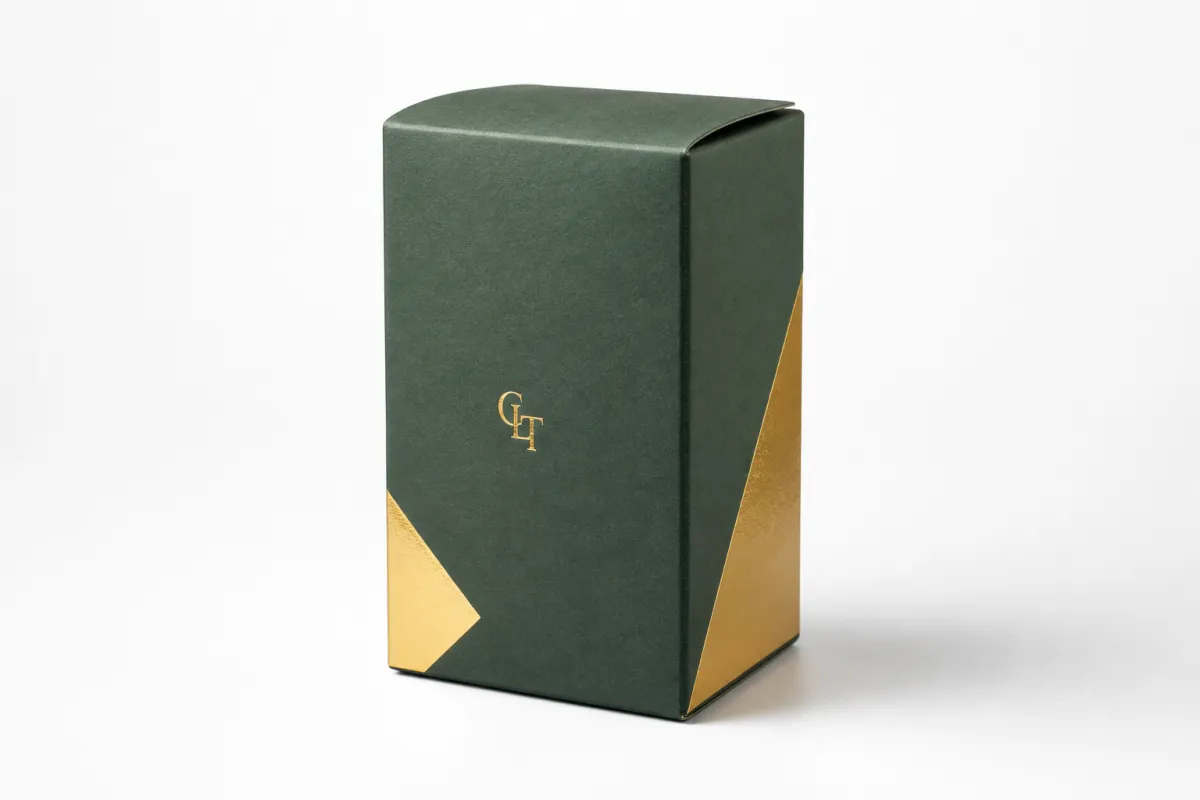
The shelf is crowded with cartons that look competent and forgettable. That is the problem. A huge share of product packaging does the job mechanically and disappears visually. Add a narrow foil logo, and the same carton can feel more premium, more current, and more intentional without changing the product inside. That is why custom folding cartons with foil show up so often in cosmetics, confectionery, supplements, fragrance, and specialty food packaging. The finish creates a pause.
What many brands miss is how little foil is needed. A 20 mm logo or a slim edge accent can catch enough light to guide attention. When the artwork stays calm and the structure is clean, custom folding cartons with foil feel restrained rather than loud. That restraint also photographs better, which matters for ecommerce thumbnails and marketplace listings where custom printed boxes and shelf-ready formats compete on tiny screens as much as they do in stores.
Foil also has a memory effect. Reflective elements help shoppers encode a brand faster because the eye builds contrast around the shine. In categories where five competitors use similar colors, custom folding cartons with foil can supply the distinction that plain ink cannot. A lot of packaging teams make the same mistake here: they ask foil to carry the whole identity instead of using it to underline a message that already has strength.
The mistake I see most often is treating foil as the design, not the accent. Once that happens, the rest of the pack starts doing too much.
That does not mean every carton needs foil. It means the choice should match position, channel, and sales context. Mass-market cartons may do better with sharper typography, a more considered paperboard, or a bolder color system. If the goal is to signal elevated value, custom folding cartons with foil often outperform heavier decoration because they direct attention instead of flooding it.
There is a sustainability angle here too. A selective foil mark on paperboard is a different environmental proposition from a full metallic wrap or a multi-layer lamination. The design decision is not just about appearance; it is about how much extra material and how many extra processing steps get added. When people say custom folding cartons with foil are less sustainable, the real question is usually, “Compared with what?”
For brands trying to improve package branding while keeping a cleaner footprint, a selective foil accent can sit in the middle ground. It gives the shelf signal of premium packaging while staying aligned with lighter structures, FSC-certified board, and simpler print builds. That combination often reads stronger than an overbuilt carton trying to look luxurious through weight alone.
What Custom Folding Cartons with Foil Are and How They Work
Custom folding cartons with foil are not just printed cartons with decoration added later. They combine structure, substrate, and finishing process. The carton is usually made from paperboard, then printed, finished, cut, folded, and glued. The foil is added as a separate effect, through hot foil stamping, cold foil, or in some cases digital foil workflows. The choice depends on artwork, run length, and the converter’s equipment.
Hot foil stamping uses heat, pressure, and a metal die to transfer the metallic layer from a carrier film onto the board. The result is crisp and classic, especially for logos, seals, and fine borders. Cold foil uses adhesive and inline curing to place a metallic layer in the print flow, which can fit certain volume ranges well. Digital foil can work for targeted effects when a project needs less tooling, though not every converter offers it. In all three cases, the logic of custom folding cartons with foil stays the same: place shine only where the artwork needs it.
That transfer depends heavily on registration. If the printed image, foil, and die line drift out of alignment, the effect can look muddy or uneven. Smooth board surfaces help. So do coatings that accept the finish properly. A carton printed on rough or highly absorbent stock can still work, but the foil may look less mirror-like and more textured. For some brands, that is exactly the right character. For others, it weakens the premium signal they wanted from custom folding cartons with foil.
Foil also deserves to be separated from other finishes. Embossing raises a shape without necessarily adding shine. Debossing presses it inward. Soft-touch coating changes the tactile feel. Metallized film is a different construction altogether, usually more complex and harder to recycle. Buyers comparing custom folding cartons with foil to those options should think in terms of visual effect, structural complexity, and end-of-life handling, not only whether the carton “looks shiny.”
Common applications include hero logos, product seals, tamper-style badges, narrow borders, and small shelf callouts. Those accents can help a carton behave more like premium retail packaging without becoming noisy. On a well-planned pack, foil supports hierarchy. It tells the shopper where to look first, second, and third, which is a surprisingly valuable part of packaging psychology.
For brands comparing formats, the simplest way to frame it is this: foil does not replace structure, color, or typography. It sharpens them. That is why custom folding cartons with foil can outperform more expensive-looking packages that rely on heavy decoration but weak design discipline.
Custom Folding Cartons with Foil: Cost, Pricing, and MOQ
Pricing is where the conversation gets real. Custom folding cartons with foil usually cost more than plain printed cartons because there is extra setup, more press time, and a tighter need for alignment control. The biggest cost drivers are tooling, foil coverage, number of passes, die-cut complexity, board selection, and the total quantity ordered. A selective foil logo is much cheaper than foil across an entire front panel, and that difference can be dramatic at lower volumes.
For smaller runs, the unit price rises because setup gets spread across fewer cartons. For larger runs, that overhead is diluted. A common planning range for simple custom folding cartons with foil at around 5,000 units might land somewhere near $0.18 to $0.28 per carton depending on size, print coverage, and finish complexity, while more elaborate or shorter-run projects can go materially higher. That is not a quote. It is a starting point for budgeting, and the real number depends on the converter, the board, and the exact foil footprint.
Minimum order quantities vary too. Some suppliers can handle lower MOQs if the artwork is simple and the finish stays limited to one area. Others want a higher threshold because tooling and setup do not make sense below a certain point. If you are sourcing custom folding cartons with foil, ask what the MOQ reflects: press efficiency, die cost, warehouse constraints, or a finishing-line limit. That answer tells you a lot about the vendor.
| Option | Typical Use | Relative Cost | Notes |
|---|---|---|---|
| Selective hot foil | Logos, seals, small accents | Moderate | Classic look; tooling needed; strong for custom folding cartons with foil |
| Cold foil inline | Higher-volume print runs | Moderate to higher setup | Good when production flow is already inline and artwork supports it |
| Full-panel foil coverage | Luxury-style presentation | Higher | More material use; more risk of visual clutter; harder sustainability story |
| Foil plus emboss | High-end branded packaging | Higher | Very effective, but adds tooling and press steps |
When you request a quote, ask for a line-item breakdown. A useful estimate should separate print, finishing, tooling, proofing, freight, and change-order fees. If those pieces are bundled together, it gets harder to compare one supplier against another. It also gets harder to spot where custom folding cartons with foil are becoming expensive because of design decisions rather than manufacturing reality.
There are design choices that keep cost under control without weakening the brand. Limiting foil to one hero panel, standardizing carton dimensions, reducing the number of finishing passes, and avoiding tiny foil detail can preserve the premium look while keeping the quote in range. In practice, the best custom folding cartons with foil are usually the ones where the design team edited hard before the supplier ever touched the artwork.
If your team already orders Custom Packaging Products, it helps to compare the foil carton spec against your current box structures. A small dimension change or a broader print area can swing cost more than the foil itself. That is why a quote should always be read as a system, not just a price per carton.
Production Process and Timeline for Custom Folding Cartons with Foil
The production path for custom folding cartons with foil is more disciplined than many buyers expect. It usually begins with a dieline review, then artwork prep, proofing, tooling approval, printing, foil application, die-cutting, folding, gluing, inspection, and shipping. Each step can be routine by itself, but the whole chain is only as fast as the slowest approval.
Late design changes create the main schedule risk. A foil element that shifts even a fraction of an inch can require recalibration on press. Stock shortages can delay the job. So can a spec that changes after sample approval. In a typical production run, plain cartons might move in 10 to 12 business days after approval, while custom folding cartons with foil often need 12 to 15 business days or more because of the extra setup and testing. Complex finishes or low-stock substrates can extend that further.
Sampling matters because a PDF cannot show everything. A digital proof may show the layout, but it will not tell you how the foil registers to the printed image, whether the sheen reads mirrored or brushed, or how the carton folds at score lines. A press sample or analog proof is the better check for custom folding cartons with foil, especially if the pack has fine type or tight artwork around the logo.
There are a few common bottlenecks to watch:
- Artwork lockup: finalizing copy, barcode placement, and dieline dimensions before production starts.
- Tooling approval: confirming the foil die or plate before scheduling press time.
- Substrate availability: making sure the chosen board is in stock or has a realistic replenishment window.
- Quality review: checking registration, scuff resistance, and fold performance on the actual carton.
Simple foil layouts move faster. Complex multicolor cartons with foil, embossing, and coating combinations usually need more buffer. That is not a flaw; it is just the nature of custom work. If a supplier promises custom folding cartons with foil in a very short window, make sure they are being straight with you about the proofing path and the level of customization actually included.
This is also where shipping standards matter. If the cartons will travel through rough distribution, ask whether the pack should be evaluated against an ISTA distribution test profile that fits the route. That is a practical way to connect packaging design to logistics reality. A beautiful carton that scuffs in transit is not a good carton.
Key Design and Sustainability Choices That Change the Result
Every decision on a carton changes two things at once: how it looks and what happens after use. That is especially true for custom folding cartons with foil. Paperboard choice matters first. Recycled content, brightness, caliper, and surface smoothness all influence how the foil reads. A bright, smooth board tends to produce a sharper finish, while a more recycled, less coated board may create a softer effect. Neither is automatically better. It depends on the brand’s visual goal and the sustainability claim it wants to support.
Foil coverage is also an environmental decision. The smaller the foil area, the easier it is to keep the pack visually strong without adding unnecessary decoration. Selective foil is often the sweet spot for brands that want the signal of luxury packaging without making the carton feel overworked. With custom folding cartons with foil, restraint often looks more expensive than coverage.
Coatings and adhesives deserve attention because they affect repulpability and scuff resistance. Some finishes protect the print but make the carton harder to recover in recycling streams. Others are lighter but less durable. Water-based coatings, low-migration inks for sensitive categories, and carefully chosen adhesives can keep the specification closer to a practical sustainability profile. If a carton needs a lamination just to survive handling, the design may need a second look.
There is a broader footprint issue too. A carton sized correctly, shipped flat, and built with fewer components may do more for the footprint than a dramatic finish ever will. That is why strong custom folding cartons with foil are usually part of a tighter structural system, not a stand-alone decoration exercise. Packaging buyers who understand that usually get better results because they are comparing the whole package, not just the front panel.
For sourcing and claim verification, FSC-certified paperboard can be a useful signal when the chain of custody is documented properly. See the standards and sourcing guidance at FSC. That does not make a carton automatically “green,” but it does add a more credible base for sustainability claims when the rest of the spec supports it.
From a packaging professional’s point of view, the better strategy is to treat custom folding cartons with foil as one part of a wider packaging system that may include custom printed boxes, insert trays, shelf-ready multipacks, and ecommerce outer packs. The material story should make sense across the chain. If the carton looks responsible but the outer shipper wastes space, the story breaks down quickly.
Step-by-Step: How to Specify Custom Folding Cartons with Foil
If you want better quotes and fewer surprises, start with a clean spec. For custom folding cartons with foil, that spec should include exact dimensions, fill weight, product sensitivity, storage conditions, retail channel, annual volume, target unit cost, and the finishes you actually want to test. Leaving those details vague usually creates vague estimates.
Define the visual hierarchy before discussing the finish. What deserves the first glance: logo, product name, seal, ingredient badge, or a border? Once that is clear, foil placement becomes a strategic choice instead of a decorative one. I have seen custom folding cartons with foil improve immediately just by moving the accent from the headline to the brand mark, or from a large panel to a single corner device.
After that, choose the foil process based on run conditions rather than preference alone. Hot foil stamping still carries a classic premium feel, especially for upscale package branding. Cold foil can fit inline production better for some volume profiles. A simplified accent pattern may be the better choice if your timeline is tight and the artwork needs to stay printable on multiple board grades. The right method is the one that matches your line, not the one that looks best on a mood board.
When you send a request for quote, include these items:
- Quantity and annual forecast
- Exact carton dimensions
- Board preference and recycled-content target
- Foil coverage area and color
- Print method and ink system
- Target ship date
- Any certification requirements, such as FSC chain of custody
- Whether the carton will sit in retail packaging, ecommerce, or both
Ask for a prototype path after that. A real sample is worth more than three polished emails. You want to see the registration, the fold, the scuff resistance, and the way the foil behaves on the exact stock. That matters especially for custom folding cartons with foil, because the finish can look excellent in a mockup and ordinary on press if the substrate or artwork is off.
Compare vendors on more than unit cost. Communication speed matters. So does quality control, rerun consistency, and whether they can explain the tradeoff between cost and finish without hiding behind jargon. The best suppliers of custom folding cartons with foil understand that buyers are not just buying a carton; they are buying a predictable outcome.
If you already source Custom Packaging Products for other SKUs, it helps to compare sample builds side by side. That makes the differences in board feel, fold performance, and finish behavior easier to judge than looking at a single quote in isolation.
Common Mistakes and Expert Tips for Custom Folding Cartons with Foil
The first mistake is overusing foil. Too much shine can flatten the design and make the carton feel less premium, not more. With custom folding cartons with foil, one hero element usually performs better than a full front-panel treatment. The eye needs contrast. If everything sparkles, nothing stands out.
The second mistake is typography that is too delicate for the process. Tiny foil text, hairline rules, and low-contrast art can fail on press or disappear once the carton is folded. Strong shapes print more reliably. Bold logos, open counters, and clean spacing usually hold up better. That matters whether you are building luxury product packaging or a more restrained line of custom printed boxes.
The third mistake is treating sustainability as an afterthought. If the design team chooses a finish first and asks about recycling later, the project can get boxed into a corner. Lamination, heavy ink coverage, and adhesive systems may matter more than the foil itself. That is why custom folding cartons with foil should be reviewed with the end-of-life scenario in mind from day one.
Another issue is skipping real board testing. A carton that looks excellent on screen can crack on a score, scuff in transit, or shift registration during finishing. That is not a theoretical risk. It happens often enough that a sample on the exact stock should be treated as a normal part of packaging design, not an optional upgrade.
Use the finish to reinforce the brand position. Do not ask it to fix weak structure, weak copy, or weak hierarchy.
Here are a few practical tips that consistently help:
- Keep foil to one hero area, usually the brand mark or product seal.
- Allow margin around the foil so the effect does not crowd folds or trims.
- Use strong shapes and avoid over-detailed line art.
- Ask for a sample on the exact stock, not a substitute board.
- Check whether the carton needs scuff protection before approving the finish.
Think about the carton as part of a wider shelf system. If your bottle, jar, or pouch has a complex shape, the carton should make that form easier to sell, not compete with it. The best custom folding cartons with foil tend to be the ones where the carton, the product, and the brand language all point in the same direction.
Next Steps for Custom Folding Cartons with Foil
If you are moving forward, start with a one-page spec before requesting quotes. For custom folding cartons with foil, that page should include product dimensions, annual volume, target unit cost, finish goals, sustainability requirements, and the retail environment the carton must survive. A clear brief saves time on both sides and usually produces more useful pricing.
Gather two or three reference cartons next. Note what you want to copy, what you want to avoid, and what you want to improve. That gives suppliers a sharper target than mood-board language alone. If you already order other custom folding cartons with foil or similar branded packaging, comparing the old and new specs side by side can expose unnecessary features fast.
Decide which sustainability claims matter enough to verify. Recycled content, FSC sourcing, and recycling compatibility are not interchangeable. They each require different evidence. If the carton is supposed to support cleaner package branding, the claim needs to be documented with the same care as the artwork.
Ask for a prototype path, and ask for a cost breakdown that separates setup, printing, finishing, freight, and change-order fees. That one request often makes the difference between a quote you can evaluate and one you cannot. It is also the easiest way to compare custom folding cartons with foil from different suppliers without getting trapped by hidden assumptions.
One final point: use foil only where it earns its keep. If the finish creates shelf impact, fits the production line, and stays practical for end-of-life handling, it is doing its job. If it is there only because it looks fancy in a presentation, the carton probably needs another pass. For most brands, the best results come from custom folding cartons with foil that are disciplined, selective, and easy to understand at a glance.
That is the standard worth aiming for: packaging that sells clearly, runs cleanly, and does not ask more of the supply chain than it gives back. In that sense, custom folding cartons with foil are not just a finish choice. They are a strategic decision about how much attention a product deserves, how much waste the pack creates, and how well the whole system holds together.
Are custom folding cartons with foil recyclable?
Often yes, but it depends on the board, coating, foil coverage, and any added lamination or adhesive layers. Selective foil on paperboard is usually easier to handle than heavy full-panel metallic effects. Before you make any sustainability claim about custom folding cartons with foil, check the recycler's guidance and the exact packaging specification.
What is the difference between foil stamping and cold foil on folding cartons?
Foil stamping uses heat and pressure to transfer foil through a die, which is ideal for a classic premium look. Cold foil applies metallic effect inline through adhesive and UV curing, which can work better for some high-volume print lines. The best choice for custom folding cartons with foil usually depends on run length, artwork complexity, and the equipment your converter uses.
How much do custom folding cartons with foil cost?
Pricing depends on setup, foil coverage, board selection, finishing steps, and quantity. Small runs usually have a higher unit cost because setup gets spread across fewer cartons. Ask suppliers to separate tooling, print, finishing, and freight so the quote for custom folding cartons with foil is easier to compare.
What affects turnaround time for folding cartons with foil?
Artwork approval, die creation, sample review, and stock availability are common timing bottlenecks. More complex foil coverage usually adds calibration time and can slow production. The fastest jobs are the ones where specs are locked early and revisions are limited, especially for custom folding cartons with foil.
What artwork works best for foil on folding cartons?
Bold logos, clean shapes, and larger type tend to reproduce more reliably than delicate detail. High-contrast layouts make foil read clearly on shelf and reduce the risk of a muddy finish. Keep critical elements away from folds, trims, and tight registration zones whenever possible when designing custom folding cartons with foil.

