Frosted Zipper Bags unit cost for corporate gifting is driven by a few controllable choices: size, film thickness, print coverage, closure type, insert material, and order quantity. That is useful because it means the number is not arbitrary. It changes for specific reasons that buyers can manage.
A frosted bag can make a modest item look deliberate without moving the program into rigid-box territory. In corporate gifting, that usually matters more than luxury effects. The packaging needs to look organized on a desk, survive shipping, and stay within budget.
Clear poly bags are usually cheaper, but they expose scuffs, bubbles, and fingerprints. Frosted film softens the look of the contents, which helps a simple kit feel more composed. A notebook, charging cable, sample set, or apparel accessory reads better in a frosted zip bag than in a plain sleeve.
Why frosted zipper bags make corporate gifts feel intentional
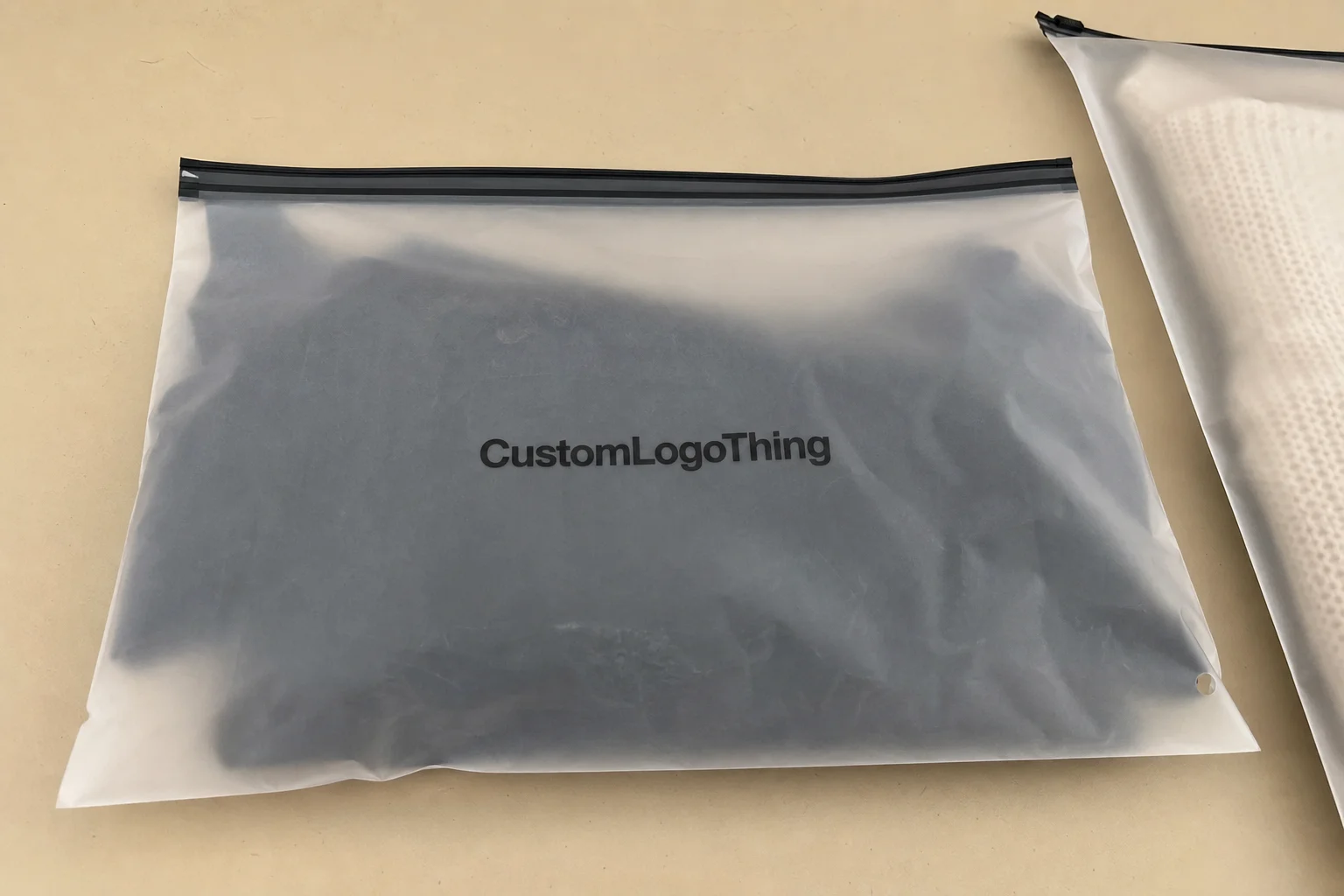
Packaging changes perception quickly. Two gifts with the same contents can land differently depending on presentation. A frosted zipper bag signals that someone planned the package, checked the fit, and cared about the final look. Compared with custom boxes, it does that at a lower cost.
The frosted finish helps in practical ways. It hides handling marks better than clear film, reduces visual clutter, and makes logo placement easier to read. On a crowded event table or inside a shipping carton, that calm look is usually more effective than a louder design.
For internal gifting, that restraint helps packages feel consistent across teams. For client-facing gifts, it lowers the risk of the package looking improvised. Neither case needs overdesign.
Packaging rarely gets credit when it works well, but it gets blamed quickly when it does not.
That is why Frosted Zipper Bags unit cost for corporate gifting should be evaluated alongside presentation quality. If a cheaper spec wrinkles, collapses, or lets contents shift, the savings are mostly theoretical. The bag has to hold shape, close cleanly, and leave enough room for the actual gift.
Finish, zipper style, and insert choices that change the feel
The frosted surface is usually the first decision, and it carries more weight than buyers expect. Matte or soft-focus film hides minor scratches and dust better than gloss. That becomes visible quickly once bags are packed by hand, repacked for distribution, or handled at an event.
Zipper choice matters too. A standard press-to-close zipper is the lowest-friction option for most corporate gifting runs. It is easy to source at scale and usually the most economical. A slider zipper feels more premium and is easier for some recipients to open, but it adds cost and can complicate the bag profile. If the package is going straight into a welcome kit or mailer, the basic zipper is often the better choice.
Tear notches help the first opening feel cleaner. Hang holes are useful if the bag will be displayed on a peg or merch wall, but they are unnecessary for most internal gifting programs. Those small features affect tooling, labor, and sometimes lead time.
Insert strategy that keeps the bag upright
Insert choice often decides whether the package looks tidy or collapsed. A light kit may only need tissue or a folded card. Heavier or uneven contents usually benefit from a rigid insert that keeps the bag square and stops the product from drifting into one corner.
For client gifts, card stock or FSC-certified board inserts are practical because they add structure without turning the package into a box. The bag feels more stable in hand, and the contents sit where the designer intended. If the insert is part of a sustainability brief, paperboard is easier to justify than mixed-material add-ons.
Ink adhesion and surface behavior also matter. Frosted polyethylene and similar films do not behave like coated paper. Fine lines, tiny reversed text, and overly detailed marks can soften during print. A simple logo with controlled spacing almost always reproduces better than artwork packed with thin strokes and gradients.
Sizes, thickness, and print specs that keep branding sharp
Start with the product dimensions, not a default catalog size. Measure the gift at its widest point, then add room for the zipper area, any insert, and a little compression. Too little space creates bulging. Too much space makes the package look underfilled and cheap.
Thickness is where the bag either feels controlled or flimsy. For small accessory kits, a lighter film may be enough. For heavier items or shipment-heavy programs, a mid-range thickness usually works better. A practical band is often around 0.12 mm to 0.18 mm, depending on item load and bag dimensions. Thicker than that can become stiff and harder to fold without adding much value.
Print area should be planned around how the bag will be filled. Artwork that crosses a stress point can distort after packing. A logo centered too close to the zipper track can also look cramped once the bag is closed. Keep the print zone clear, give the logo breathing room, and avoid crowding the top edge.
Print specs that survive real handling
One-color logo printing is still the best balance of cost and clarity for most programs. It keeps setup simpler and usually reproduces more cleanly on frosted film. Multi-color artwork can work, but it should be designed with the surface in mind. Thin lines, tiny type, and low-contrast details can disappear once the bag is filled and pressed into shape.
If color accuracy matters, ask for a proof that reflects the actual substrate, not only a screen mockup. Screens are useful for layout. They are not a reliable view of how the film will behave under ink. A supplier who can show a production reference or a comparable prior job is giving you more useful information than a polished digital rendering.
- Best for simple branding: one logo, one location, moderate contrast.
- Best for premium presentation: frosted finish, rigid insert, tidy fill height.
- Best for heavier kits: thicker film, squared dimensions, careful closure choice.
If the gift includes printed paper pieces, choosing FSC-certified paper for inserts or cards can keep the material story consistent without forcing a larger packaging change.
Unit pricing, MOQ, and quote drivers for bulk orders
Frosted Zipper Bags unit cost for corporate gifting comes down to a handful of predictable variables: quantity tier, bag size, thickness, print coverage, number of colors, insert requirements, and any special closure or cutout feature. Quotes that do not separate those pieces are hard to trust. One number without context is usually a starting point, not a usable cost.
Setup charges matter more on smaller runs. Artwork prep, plate or screen setup, proofing, and line changes do not scale down just because the order is small. That is why a bag can look expensive at 500 pieces and much more reasonable at 5,000. The material is not the only thing being paid for; the process is being spread across the order.
| Quantity tier | Typical cost per piece | Common spec | What changes the price |
|---|---|---|---|
| 500 to 999 | $0.42 to $0.68 | Standard frosted bag, one-color logo | Higher setup charges, smaller spread of fixed costs |
| 1,000 to 2,999 | $0.24 to $0.41 | Standard size, basic print, no insert | Quantity starts helping, but MOQ still shapes pricing |
| 3,000 to 4,999 | $0.18 to $0.30 | Controlled print area, mid-range thickness | Better unit cost if the artwork stays simple |
| 5,000+ | $0.14 to $0.24 | Repeatable spec, limited color count | Best bulk pricing when the spec stays stable |
Those ranges assume a straightforward job. Add a second print color, a custom insert, a different zipper style, or full assembly support and the cost moves. Freight also matters, especially on larger orders where packaging volume becomes part of the bill. Sample fees and tooling charges can make a quote look better than it actually is if they are hidden in the fine print.
MOQ is often where the conversation gets real. Many custom printed Frosted Zipper Bags can be ordered in a few hundred pieces, but the pricing usually turns more efficient once the run moves into the low thousands. If you are managing several corporate gifting programs in the same quarter, using one spec across them can lower the cost without creating a bland result.
The cheapest quote is not always the lowest total cost. A slightly higher unit price with fewer errors, cleaner proofs, and on-time delivery often beats a bargain run that needs reprints or rush freight.
Production steps, lead time, and proof approval
The production sequence is predictable: quote, spec check, artwork review, proof, approval, production, then shipping. Delays usually happen before production starts. Low-resolution logos, unclear dimensions, and late-stage design changes cause most of the friction. Once the proof is approved, the job moves much more cleanly.
Lead time depends on complexity. A simple order with one-color print and no insert often moves faster than a custom size with multiple ink colors and an internal card. A realistic planning range for a straightforward job is often 12 to 15 business days after proof approval. More complex orders can stretch to 18 to 25 business days or longer if the artwork needs revision or the bag structure is unusual. Shipping time sits on top of that.
That schedule is why buyers should work backward from the event date. If the kits need to arrive before a launch, conference, or holiday send, the deadline is not the day production starts. The deadline is the day the cartons need to be in hand, sorted, and ready to distribute.
If the package will travel far or be stacked tightly, it is reasonable to ask whether the overall pack-out has been considered against transit testing methods such as ISTA standards. The bags themselves may not need a formal certification, but the contents still need to survive normal handling without the presentation falling apart.
- Confirm finished dimensions and contents.
- Lock the quantity tier before comparing quotes.
- Approve logo placement and print colors.
- Review the proof carefully before production starts.
- Leave time for freight, not only manufacturing.
Proof approval is the real gate in the process. If the proof stalls, everything else stalls behind it. A supplier who asks clear questions early usually saves more time than one who gives a fast but vague answer.
Why repeat buyers stick with a controlled spec
Repeat buyers usually end up with one stable bag specification because consistency is worth more than novelty. Same size, same closure, same logo location, same insert. That makes reorders easier, reduces internal approvals, and prevents the common problem of different teams ordering almost the same thing with slightly different measurements.
Consistency also protects brand appearance. A bag that suddenly gets thinner, prints darker, or shifts dimensions between runs can make a program look careless. Recipients may not know why the package feels different, but they notice. The same is true for color drift. A logo that moves from sharp to muddy erodes the finish of the whole gift.
There is a hidden cost side too. Controlled specs reduce packing errors, assembly rework, and the need for rush replacement orders. That is not glamorous, but it is where corporate gifting budgets are often won or lost. A boring spec can be the right spec.
A controlled packaging spec is usually less exciting on paper and more reliable in the hand.
That reliability matters more as order volume grows. Once a company starts sending the same gift across teams, regions, or event cycles, the packaging needs to behave like a reusable system, not a one-off design experiment.
What to send for a fast, accurate quote
The best quotes come from clean inputs. Guesswork slows everything down and usually creates avoidable back-and-forth. If the bag size, print method, and delivery date are clear, the response will be more useful from the start.
- Bag dimensions: finished width, height, and any gusset or depth.
- Quantity: one target number and, if useful, a second tier for comparison.
- Artwork: vector file if possible, plus placement notes.
- Print spec: one-color, multi-color, front only, or multiple locations.
- Delivery: ship-to address, event date, and whether timing can move.
- Extras: samples, inserts, tissue, collating, or pack-out support.
If you are matching an existing program, send a photo or a previous spec sheet. That avoids the usual ambiguity where everyone thinks they are describing the same bag but is not. A reference is more useful than a paragraph of description.
For most buyers, the practical path is to compare two or three quantity tiers, verify the actual materials, and check the quote against the event timeline. That gives you a real procurement decision instead of a number that only looks cheap before freight and revisions are added.
What affects frosted zipper bags unit cost for corporate gifting the most?
Quantity is usually the biggest driver, followed by size, thickness, print coverage, and the number of print colors. Inserts, custom closures, and special cutouts can push the price up quickly. Freight, sample fees, and tooling charges should be checked separately so the unit cost stays honest.
What MOQ should I expect for frosted zipper bags with logo?
MOQ varies by size and print complexity, but pricing usually becomes more efficient once the order moves past the smallest test tier. If volume is limited, ask whether the supplier can combine sizes or simplify the spec. A quote without MOQ context is incomplete because the price can shift sharply at each tier.
How long does production usually take after proof approval?
Simple runs often take about 12 to 15 business days after proof approval. More complex jobs, including multi-color art or custom inserts, can take 18 to 25 business days or more. Freight time is separate, so the calendar should be built backward from the delivery date.
Can frosted zipper bags hold heavier corporate gift items?
Yes, if the film thickness, dimensions, and closure are matched to the load. Heavier or sharp-edged items may need a stronger spec or an internal insert to protect the bag and keep the contents from shifting. Testing one sample is better than assuming the first run will hold up.
What files do you need for a fast quote and proof?
Send vector artwork if possible, along with the bag size, quantity, print colors, and delivery destination. A reference photo or previous spec sheet helps if you are matching an existing corporate gift package. Clean input usually produces a cleaner proof and fewer rounds of revision.
Frosted Zipper Bags unit cost for corporate gifting is not mysterious once the variables are laid out clearly. The price follows the spec: dimensions, film, print, closure, insert, and quantity. Keep the design restrained, keep the measurements accurate, and keep the proof process tight. That is how the packaging stays presentable, the budget stays controlled, and the gift feels planned instead of improvised.


