Tea packaging does more than contain product. It frames how freshness, value, and brand care are perceived before the pouch is ever opened, which is why custom Frosted Zipper Bags for tea brands can influence shelf performance so quickly. A frosted pouch softens the visual field just enough to feel considered and premium, while still allowing the tea, label, or artwork to remain visible in a controlled way.
That balance matters in a crowded category. Tea often competes in small-format retail spaces, on café counters, and in e-commerce thumbnails where a package has only a second or two to communicate what it is. A frosted finish helps a brand look intentional without pushing the design into something overly glossy or opaque. It can make a loose leaf blend feel refined, a herbal mix look cleaner, and a sampler pack feel giftable.
The real question for buyers is not whether the pouch looks attractive in isolation. It is whether the bag supports the product story, protects the tea adequately, and fits the target price point without creating waste in material or inventory. That is where practical packaging decisions matter more than surface impressions.
Why frosted zipper bags change tea shelf perception fast
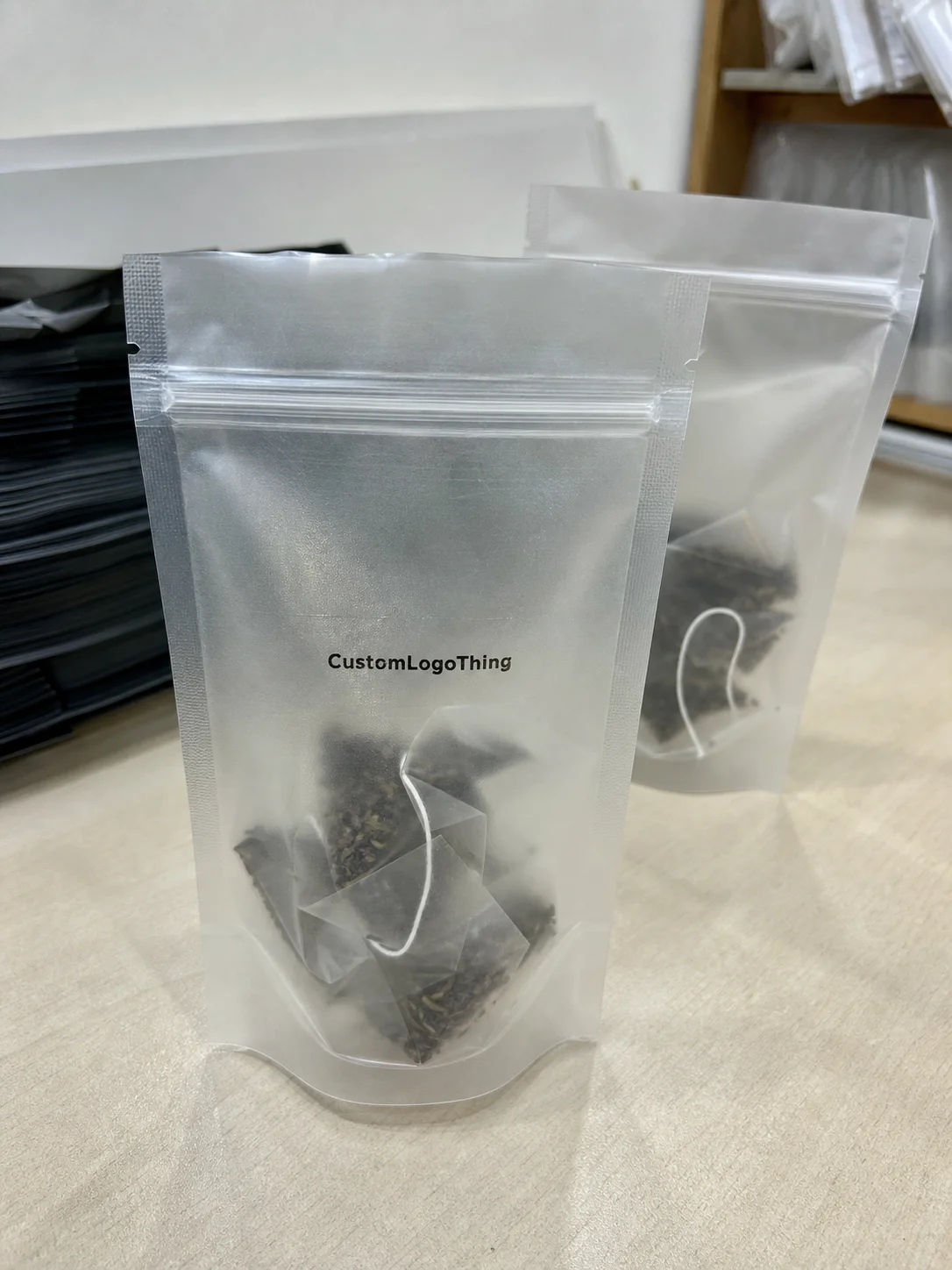
Frosted Zipper Bags sit in a useful middle ground. They are usually flexible pouches with a semi-opaque finish and a resealable zipper, and they are common for loose leaf tea, herbal blends, botanical mixes, and trial-size packs. The frosted appearance reduces the stark look of clear plastic while avoiding the heavy block-out effect of a fully opaque matte pouch.
That matters because tea buyers often read packaging as a shorthand for quality. A clear bag can work well for value lines or products with visually appealing botanicals, but it can also make a pack feel ordinary if the layout is not strong. A fully opaque pouch offers more design control, yet it may hide the tea completely, which is not always desirable for a category that benefits from visible leaf structure or natural color cues. Frosted film gives enough restraint to feel premium while still preserving some product visibility.
For branded tea, that visual restraint is useful. It can calm down busy graphics, create more contrast for labels, and help a line of different SKUs look consistent from one flavor to the next. When a brand is building a family of products, that consistency matters as much as the individual design itself.
“Tea packaging is judged long before the aroma is opened. If the pouch feels deliberate, the product starts with more credibility.”
There is also a practical retail reason these pouches work well. Frosted film can make ingredient copy, origin statements, icons, and tasting notes easier to organize visually. Instead of competing with a fully transparent background, the branding sits on a softer surface and reads more like a planned composition. That is especially helpful when the pack needs to carry a logo, flavor name, certification marks, barcodes, and compliance text without feeling crowded.
Still, frost is not automatically the right choice. A value-driven tea line may need simpler, clearer packaging to avoid looking overdesigned. For bulk-oriented products, too much visual styling can create a mismatch between the package and the price. The best pouch spec matches the market position, not just the mood board.
How the pouch structure and zipper closure protect tea
A tea pouch has to do more than present well. It needs to protect aroma, limit moisture exposure, and hold up through filling, shipping, retail handling, and repeated opening. Most custom Frosted Zipper Bags for tea brands use a multilayer laminate structure with a frosted exterior effect, an inner sealing layer, and a zipper closure that allows the customer to reseal the pack after opening. Depending on the format, the bag may also include a tear notch, a hang hole, rounded corners, or an outer heat seal above the zipper.
The structure matters because tea is sensitive to moisture, oxygen, and light. Those factors do not affect every tea in the same way. Whole-leaf tea often needs enough room to avoid compression, while finer herbal cuts and powders can settle more tightly and require a different fill profile. If the pouch is too large, it can look underfilled and loose on shelf. If it is too small, the tea can be compressed, the zipper area may become awkward, and the finished pack can appear strained.
The zipper is not a minor convenience feature. It supports repeat use, helps preserve aroma after opening, and improves the practical experience for the customer. A zipper that closes cleanly is one of the simplest ways to raise perceived quality without changing the exterior design. Buyers notice whether it feels secure, and so do repeat customers.
Frosted film does not necessarily mean weak protection. In many pouch constructions, the frosted look sits on top of a laminate that can still provide decent barrier properties. That is why it helps to ask for actual material specifications rather than judging from appearance alone. Moisture vapor transmission rate, oxygen transmission rate, and light shielding should be appropriate for the tea’s shelf life and distribution conditions. A premium-looking pouch with poor barrier performance is an expensive mistake.
For some tea products, extra features can make sense, but only when there is a real use case. Desiccants may be useful in humid environments, inner liners can help with aroma-sensitive blends, and one-way valves are occasionally relevant for freshly processed botanicals. Most tea brands do not need every option available. They need the combination that fits the product, the market, and the packing line.
It also helps to confirm food-contact suitability early, especially if the pouch will touch product directly. Waiting until artwork is approved to ask about material compliance often creates avoidable delays. A supplier should be able to discuss the film structure, closure type, and barrier expectations in plain terms, not only in technical shorthand.
Packaging references from industry organizations such as the Packaging School / packaging industry resources can help buyers compare materials and structures more confidently, while the International Safe Transit Association is useful when testing how packs behave in transit. For tea brands shipping into humid regions or through long distribution chains, these details become less theoretical very quickly.
Key specs that matter most: material, size, finish, and print
Material choice is where many tea buyers either overspec or underspec. Common pouch laminates often fall in the approximate range of 100 to 180 microns total thickness, although the right construction depends on fill weight, shipping environment, and whether the pack must stand upright on shelf. Thicker is not automatically better. If the pouch becomes too stiff, it can be harder to fill, more difficult to store, and costlier to ship. If it is too thin, it may wrinkle, collapse, or feel less substantial in hand.
Size planning should start with the actual fill weight and the density of the tea, not with a mockup that simply looks nice on screen. A 100g loose leaf product can need a very different pouch footprint than a 100g cut-and-sifted herbal blend. Headspace matters as well. Too much empty space makes the pack look light and unfinished, while too little can stress the zipper area or make the top seam look cramped.
Finish is where frosted bags stand apart from fully clear and fully opaque options. The semi-opaque surface gives the brand a softer, more curated presentation and can improve the readability of minimal designs. If the packaging depends on a restrained color palette, a simple logo, or elegant typography, the frosted finish can strengthen that story. If the layout is already highly detailed, the finish can help calm the design and keep it from feeling visually noisy.
| Option | Typical look | Best use | Relative cost |
|---|---|---|---|
| Clear zipper bag | Maximum product visibility | Value SKUs, visible botanicals | Lower |
| Frosted zipper bag | Semi-opaque, soft premium look | Boutique tea, gift sets, branded lines | Mid-range |
| Fully opaque matte pouch | Strong branding surface, no product view | Premium or design-heavy retail packs | Mid to higher |
Print behavior deserves just as much attention as material. Logos, flavor names, and origin details need sufficient contrast and enough breathing room to read at shelf distance. Thin fonts can disappear on frosted film if the contrast is weak or the background is too busy. A proof should show line weight, spacing, and legibility, not just a color swatch. What looks refined on a monitor can look faint in real lighting.
Functional details should be chosen with the same discipline. Zipper style, tear notch, hang hole, matte window, rounded corners, and any special sealing feature should all serve a purpose. For tea, a simple and reliable zipper often carries more value than a long list of decorative upgrades. If the pouch also needs barcode space, ingredient declaration space, and certification marks, that should be built into the dieline before artwork is finalized.
If your tea line is part of a larger packaging system, keep the pouch aligned with your other Custom Packaging Products. Brands that also use custom printed boxes or secondary cartons should plan color consistency, icon language, and logo hierarchy together. Packaging looks more polished when the pouch and the outer box feel like part of one system instead of separate purchases.
Custom frosted zipper bags for tea brands: process and lead time
The production path for Custom Frosted Zipper Bags for tea brands usually follows the same sequence: brief, specification review, artwork, proofing, sampling, production, quality control, and shipping. It sounds straightforward, but most delays happen before the run starts. Once the file is approved and the material is confirmed, the process tends to move faster than people expect.
The cleanest order briefs include dimensions, fill weight, pouch style, zipper preference, finish, artwork files, and any compliance requirements. If you already know barcode placement, case pack expectations, and whether the packs need retail hanging holes or shelf-ready features, include that information early. A vague brief creates more back-and-forth and usually produces a less accurate quote.
Sampling is worth the time. A digital mockup can confirm layout, but it cannot fully show how frosted film behaves under light or how the zipper feels after repeated use. The physical sample reveals whether the pouch stands as intended, whether the print has enough contrast, and whether the headspace looks balanced. It also helps identify whether the zipper is too stiff, too loose, or difficult to close cleanly after filling.
Lead time depends on several factors: print complexity, order quantity, whether the film structure is standard or custom, and how many revision rounds happen during approval. A straightforward run may move in roughly 12 to 15 business days after proof approval, but special finishes, artwork changes, or multiple SKU variations can extend the timeline. Freight adds another layer, especially if the launch date depends on a seasonal rollout or a retail reset.
The fastest way to keep a project moving is to approve the dieline first, then the copy, then the visual design. If those three elements are changing at the same time, the schedule tends to slip. Production teams can move quickly, but not if the files are still being rewritten.
Quality control should include more than a basic visual check. Buyers should ask how the supplier verifies seal integrity, zipper function, print accuracy, and bag dimensions. For food packaging, even small inconsistencies can become obvious once the product is filled and boxed. A good sample stage catches those issues before they become inventory.
For brands managing broader packaging programs, examples from a Case Studies page can be useful for seeing how construction decisions, artwork limits, and practical production details tend to interact across different product types.
Cost, pricing, MOQ, and unit cost: what changes the quote
Pricing for custom pouches is driven by a handful of variables: material grade, bag size, print colors, zipper type, finish, and order quantity. If the brief is clear, the quote is usually clearer too. If the specification changes halfway through, pricing changes with it.
Unit cost typically drops as quantity rises, but total spend can still climb quickly once custom features are added. A frosted finish may only add a small amount per bag, yet that extra amount becomes noticeable when multiplied across several SKUs or repeated seasonal runs. For brands carrying both core products and limited editions, that difference can matter more than the per-unit number suggests.
MOQ is a real constraint for emerging tea brands. Smaller brands often accept a higher per-bag price so they can test demand without carrying too much inventory. Larger brands can usually optimize cost by ordering more, provided they have the storage space and distribution plan to support it. The lowest unit price is not always the best buying decision if it creates excess stock or locks the brand into a spec that is too rigid.
Hidden costs deserve attention. Setup charges, plate costs, sample shipping, freight, and special add-ons such as matte windows or custom shapes can alter landed cost more than the pouch itself. That is why a quote should be read as project cost, not simply pack cost. If a supplier only quotes the bag and leaves the rest vague, the real total may be higher than expected.
| Order profile | Likely unit cost behavior | Best fit | Main trade-off |
|---|---|---|---|
| Low quantity test run | Higher per unit | New flavors, pilot launches | Less inventory risk |
| Mid-volume branded run | Moderate per unit | Core SKUs, e-commerce | Balanced cost and flexibility |
| High-volume program | Lower per unit | Seasonal staples, retail rollouts | More cash tied up in stock |
A practical budgeting rule helps. Decide what share of the retail price you can tolerate for packaging, then work backward from there. Tea packaging often has to carry both containment and branding, so the pack may justify a slightly higher share than a commodity product. The better question is not “What is the cheapest pouch?” but “Which pouch protects margin and supports sell-through?”
Common ordering mistakes that make tea packaging look cheap
The first mistake is choosing the wrong size. If the tea sits too low in the bag, the pack looks empty and undervalued. If the fill is forced too high, the top seam can look tight and the zipper area can feel awkward. Either way, the product loses visual confidence.
Second, low-contrast artwork on frosted film can disappear quickly. Pale tones, thin logos, and tiny copy may look elegant on a design screen, then fade into the background once the bag is printed. The fix is not always a larger logo. Often it is stronger contrast, simpler spacing, or a cleaner composition.
Third, some brands ignore zipper feel. That may sound minor until a customer tries to reseal the pouch more than once. If the closure does not inspire confidence, the perceived quality of the entire package drops. A well-designed label cannot fully compensate for a zipper that feels flimsy or inconsistent.
Fourth, it is easy to over-spec decorative features that do not improve the product. Extra windows, unusual shapes, heavy metalized layers, and multiple finish effects can raise cost quickly. If a feature does not help freshness, shelf impact, or brand clarity, it is worth questioning whether it belongs in the final run.
Finally, skipping a physical proof is costly. Color shifts happen. Seal lines behave differently than a mockup suggests. The space available for barcodes, ingredients, and legal copy can shrink once the actual pouch is made. A sample is the simplest way to catch those problems before bulk production starts.
Expert tips for selecting the right bag for your tea line
Match the pouch to the product’s position in the market. Giftable blends usually benefit from a softer frosted look and more restrained graphics. Value lines may work better with clearer product visibility and simpler branding. The most effective packaging reinforces the price point instead of arguing with it.
Use frosted film deliberately. A clean logo, a controlled color palette, and one or two strong brand marks often work better than a dense layout that tries to say everything at once. The goal is not to cover every inch of the pouch. The goal is to make the package feel deliberate and readable.
Request material samples before committing to a full production spec. Compare handfeel, opacity, zipper action, and print behavior side by side. If you are launching multiple flavors, standardize dimensions and core construction where possible. That keeps procurement simpler, reduces the chance of mismatched shelf presentation, and makes reordering easier later.
Test the pack in real conditions. Retail lighting is unforgiving, shipping cartons compress pouches, humidity can change how tea behaves, and online thumbnails flatten visual detail. A pouch that looks polished on a white background may read very differently on a shelf or in a product photo.
Packaging now has to work in two places at once: physical retail and digital commerce. The pouch needs to look credible in hand, but it also needs to read clearly as a thumbnail. That is a harder brief than it used to be, which is why practical packaging choices matter so much.
If sustainability is part of the buying brief, compare the pouch structure against the rest of the pack system rather than treating it as a standalone decision. For example, FSC-certified cartons from the Forest Stewardship Council can support a consistent environmental message when the tea pouch is paired with outer cartons. The message should feel coherent across the full package set.
Next steps for sourcing the right pouch specification
Start by auditing the tea SKUs. Rank them by volume, margin, and packaging pain points. The fastest improvement usually comes from the products that sell enough to justify better presentation but still need tighter cost control. Those are the SKUs where a better pouch spec can improve both appearance and commercial performance.
Then define the minimum must-have specifications: size, zipper type, barrier level, and print coverage. Leave room for trade-offs, but not for guesswork. If the fill weight or required headspace is still unknown, the quote will be vague and the sample may not reflect how the finished pack will actually behave.
Request two or three sample structures with different frosted effects if possible. Side-by-side comparison usually reveals more than a single sample ever could. One option may handle print better, another may look cleaner in natural light, and another may land closer to the target price. That comparison is often the easiest way to narrow the decision.
Prepare a complete packaging brief before asking for pricing. Include artwork, dimensions, target quantity, compliance copy, barcode requirements, and delivery deadline. The tighter the brief, the cleaner the quote. That applies to custom frosted zipper bags for tea brands just as much as it does to any other product packaging decision.
Used well, these pouches can protect aroma, support repeat use, improve shelf appeal, and make a tea line feel worth the price. Used poorly, they become just another bag. The smartest approach is to build the spec around the product first, then the branding, then the budget. That order keeps the packaging useful instead of merely decorative.
Bottom line: custom frosted zipper bags for tea brands work best when the pouch is treated as part of the selling strategy, not just as a container. Get the size right, protect the tea properly, keep the artwork readable, and insist on samples before production. Those steps usually matter more than any single finish choice.
Are custom frosted zipper bags for tea brands good for loose leaf tea?
Yes. They work well for loose leaf tea because the zipper supports resealing after opening, and the frosted finish gives the pack a more premium appearance. The key is choosing the right barrier and size so the tea is protected and the pouch does not look underfilled.
What size custom frosted zipper bag should I use for tea samples?
Match the pouch to the fill weight and leaf density rather than guessing by appearance. Ask for sample fills so you can check headspace, seal position, and retail presentation before you commit to production.
Do frosted zipper bags increase unit cost for tea packaging?
Usually yes compared with basic stock packaging, because customization, print, and finish add cost. Higher quantities often reduce unit cost, so the best price depends heavily on your order volume and the exact specification.
How long does the production timeline usually take for tea pouches?
Timeline depends on artwork approval, sampling, quantity, and material availability. A straightforward run may move in roughly 12 to 15 business days after proof approval, but custom structures, special finishes, or multiple revisions can extend that.
What should I send when requesting a quote for custom frosted zipper bags for tea brands?
Provide dimensions, fill weight, print artwork, zipper preference, quantity, and any compliance or barcode requirements. A tighter brief usually produces a more accurate price and lead time estimate.


