For a brand that needs to look polished without overbuilding the package, a Custom Frosted Zipper Bags private label supplier can be one of the most practical sourcing partners in the mix. The frosted finish changes the first impression right away: it softens what the customer sees, adds a quiet layer of texture, and makes even a modest product feel more intentional on shelf or in a shipping box.
That matters because packaging buyers are usually being judged on margin, speed, and repeatability, not on how much decoration they can pile onto a product. Frosted Zipper Bags sit in a useful middle ground. They can deliver a premium look and still stay far below the cost of rigid containers, elaborate cartons, or heavier printed packaging systems.
They also work across a wide range of products. Beauty items, small accessories, supplements, sample kits, refills, and lightweight consumer goods all benefit from packaging that protects the product while leaving enough visibility to help the buyer understand what is inside.
Why frosted zipper bags matter for private label packaging
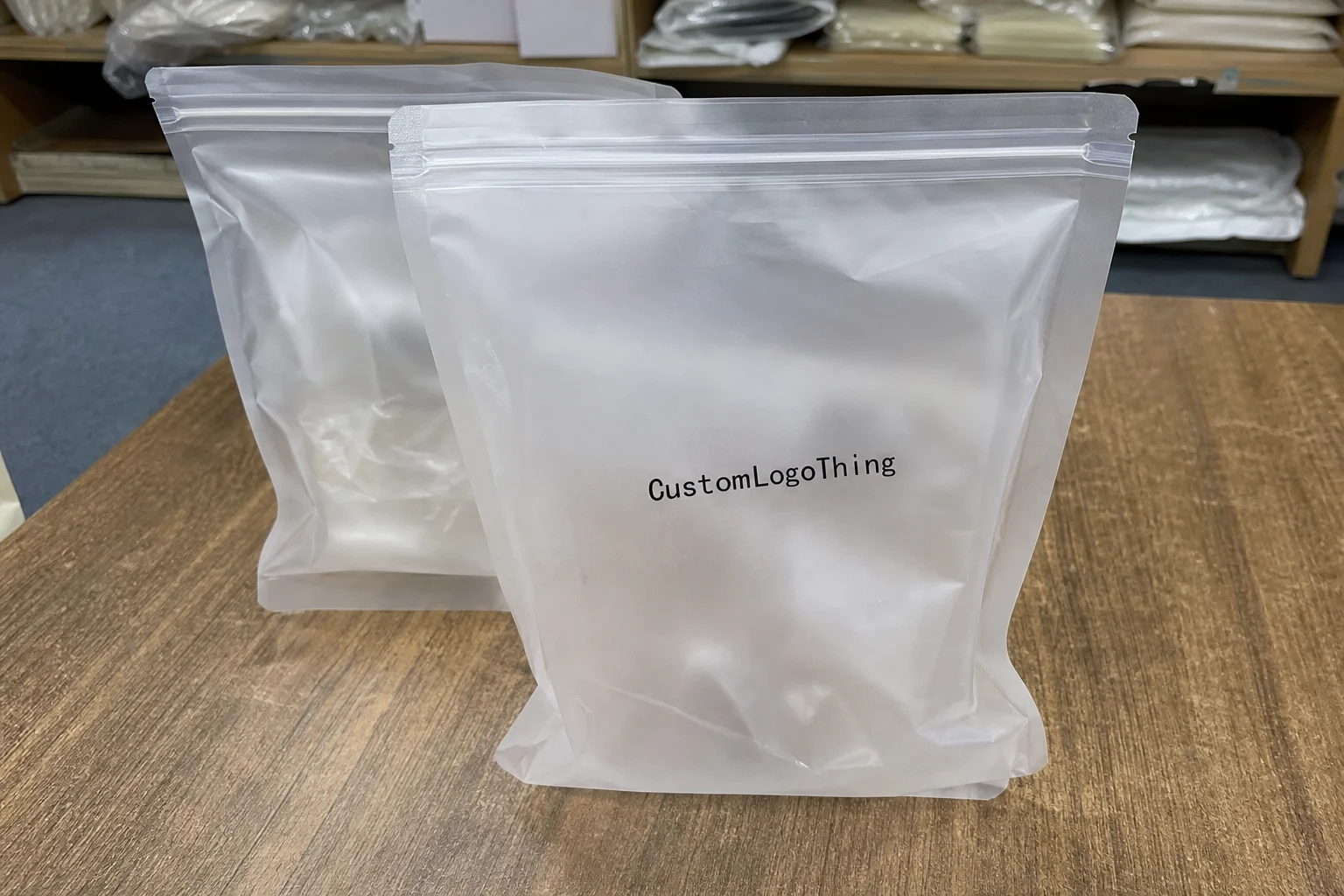
A frosted zipper bag is doing more than holding a product. It is creating a visual filter, offering a tactile cue, and giving the brand a surface that can carry logos or simple graphics without feeling overloaded. That is one reason these bags show up so often in private label programs where presentation matters, but the packaging budget still has to make sense.
The frosted surface also hides small imperfections better than a fully clear pouch. That is useful when the product has mixed textures, uneven edges, mixed colors, or a fill level that changes from lot to lot. A crystal-clear bag can expose every inconsistency. A frosted finish gives a little forgiveness without making the contents disappear completely.
From a shopper’s point of view, the package reads as more deliberate. The consumer can still see shape, color, and volume, but not every detail. That slight reveal adds curiosity, and in retail that can be enough to slow the eye long enough for the brand to earn attention.
Buyers sometimes focus too much on thickness and forget how much perceived quality comes from texture and closure feel. A bag that has a clean matte look, a zipper that opens and closes predictably, and edges that sit neatly tends to outperform a thicker but awkward alternative. The customer notices what the hand feels first.
“If the package feels intentional in the hand, the product starts with an advantage before the customer even evaluates what’s inside.”
For brands building a family of products, Frosted Zipper Bags can also standardize the look across multiple SKUs. One bag style can hold several variants without forcing each item into its own custom structure. That kind of consistency helps merchandising and simplifies reorders.
How custom frosted zipper bags private label suppliers work
A good Custom Frosted Zipper Bags private label supplier usually follows a fairly predictable process: brief, quote, artwork review, sample, revision, production, inspection, and shipment. The sequence sounds simple, but the details are where timing and quality are won or lost.
Private label here usually means the bag is built around your brand requirements. That may include your logo, your SKU, your color targets, barcode placement, carton labeling, or insert instructions. Some buyers only need a printed stock bag. Others need a custom size, a specific zipper behavior, and a very precise print location.
There is a real difference between decorating an existing stock pouch and building a pouch from the ground up. Stock-based printing can be quicker and cheaper because the base format is already available. Fully custom construction gives tighter control over size, seal performance, and appearance, but it also adds setup time and usually a higher upfront cost.
Here is the basic workflow most suppliers follow:
- Specs inquiry: dimensions, film thickness, zipper style, quantity, and artwork are collected.
- Quote review: the supplier prices material, print method, and any setup or tooling.
- Artwork check: files are reviewed for resolution, color accuracy, and placement.
- Sampling: a prototype or print proof is produced.
- Approval: the buyer confirms the sample or requests revisions.
- Production: the order runs at scale.
- Inspection and shipment: counts, seals, finish, and cartons are checked before dispatch.
The supplier translates brand requirements into production specs using dielines, print-ready files, and color references. Pantone numbers help, but they are not a guarantee. Frosted film changes how ink reads, especially with pale colors, fine lines, and small text. A logo that looks crisp on screen can look softer once it is printed on matte or translucent film.
That is why packaging buyers should ask for sample proofs on the actual material, not just a digital mockup. A screen render can be useful for structure and placement, but it cannot show how a logo will behave on a frosted surface.
If the bag is part of a larger packaging system, it helps to align it with labels, inserts, and any secondary packaging that ships with the product. A pouch that feels too formal or too plain compared with the rest of the set can make the brand look less settled than it really is.
Compliance should be discussed early, especially for food-contact applications, cosmetics, supplements, or moisture-sensitive goods. If you need material claims, recycled content statements, region-specific labeling, or other documentation, those requirements belong in the brief before sampling begins. Late compliance questions tend to cost time and money.
Key specs that affect quality, durability, and shelf appeal
Packaging buyers usually start with size and print, which is fair enough. But the details that decide whether a frosted zipper bag feels dependable are often less visible: film gauge, zipper quality, opacity level, and print durability. Miss one of those, and the package can look underbuilt even if the artwork is strong.
Material thickness is usually measured in mil or microns, and the difference is not trivial. A thinner film may work for lightweight samples or accessories that are not handled often. A heavier gauge gives better puncture resistance, more structure, and a firmer feel in the hand. The right choice depends on the product’s weight, shape, and whether it has any sharp edges.
The zipper deserves just as much attention. If the closure feels inconsistent, the customer notices almost immediately. For a pouch that will be opened and resealed several times, the zipper line has to stay dependable. A weak closure can create the impression that the whole package is cheap, even when the product inside is not.
Print quality can be another trap. Small logos, fine type, and edge-to-edge decoration require tighter registration than a simple one-color mark. On frosted film, delicate details can soften, especially if the artwork is too light or too thin. That does not always mean the supplier made a mistake. Sometimes the design needs to be adjusted to suit the substrate.
Fit matters too. A product that is soft, oddly shaped, or packed in multiples may need more room than the buyer first expects. Some items need a gusset to help the bag hold shape. Others need a slightly wider mouth so the product slides in without stressing the seams. Beauty refills, accessories, and mixed-component kits all behave differently in production and in use.
Sustainability claims need discipline. Recycled content, downgauging, and mono-material structures can be real advantages, but only if the claim matches the construction. If you are referencing certified materials nearby in the pack, check the documentation standards through FSC and keep the chain of custody clear. Do not treat a marketing statement as proof.
For distribution performance, it is reasonable to ask whether the supplier validates to common shipping standards such as ISTA methods. Not every pouch needs full lab qualification, but packaging that only survives on a desk is not ready for retail handling. A package should survive packing, freight, stocking, and repeated customer touch.
| Spec choice | What it changes | Best fit |
|---|---|---|
| Light-gauge frosted film | Lower cost, softer feel, less puncture resistance | Samples, lightweight accessories, short display runs |
| Medium-gauge frosted film | Better structure, improved shelf appearance, stronger handling | Beauty items, refill packs, retail-ready private label goods |
| Heavier-gauge custom pouch | Higher protection, firmer hand feel, stronger perceived value | Heavier contents, repeated resealing, premium branded packaging |
| Simple one-color print | Lower setup complexity, cleaner artwork execution | Budget-conscious product packaging |
| Multi-color full print | Higher decoration impact, tighter registration requirements | Retail packaging where brand recognition matters |
Custom frosted zipper bags private label supplier pricing and MOQ
Pricing from a custom frosted zipper bags private label supplier usually comes down to five variables: bag size, film gauge, zipper style, print complexity, and quantity. Secondary packing also matters, as do freight, carton specs, and whether the project is a stock bag with decoration or a fully custom build.
For small and mid-size runs, setup costs can make the unit price look higher than buyers expect. That is normal. A simple one-color bag and a fully customized pouch are not really comparable if one includes thicker film, more decoration, and more production setup. The MOQ exists because setup has to be spread across the run.
As a rough buyer benchmark, lower-volume orders of frosted zipper bags might land around $0.22 to $0.45 per unit depending on size and print coverage, while larger runs can come down meaningfully if the construction is standard and the artwork is simple. Those numbers are directional only. If you request a larger zipper, thicker film, custom dimensions, or more complex printing, the price changes quickly.
Sample pricing is often separate from mass production. Some suppliers credit the sample fee against the final order. Others do not. Ask directly so there is no confusion later. Prototype cost can also rise if you request multiple revisions, because a revised proof is not the same thing as a final production sample.
Hidden cost variables are where quotes can become misleading. Freight, customs, plate or cylinder fees, carton configuration, and poly-bundling all add up. A quote that looks good on paper can become less attractive once landed cost is calculated. That happens with bags, labels, and custom printed boxes all the time.
Use a simple internal check before approving pricing: compare like for like. If one quote includes a thicker film and the other does not, or one includes print setup and the other separates it out, the comparison is incomplete. Buyers often save time by requesting a quote template with the same fields from every supplier.
| Quote type | Typical strengths | Typical risk |
|---|---|---|
| Lowest unit price | Looks economical at first glance | May include thinner film, slower turnaround, or extra fees later |
| Mid-range quote | Usually balanced on material, print, and lead time | Needs careful review of included services |
| Higher quote | May include better control, more consistent print, or stronger construction | Could be overpriced unless specs justify it |
Packaging should not be bought like office supplies. It sits much closer to merchandising than simple procurement. If the packaging undercuts perceived value, the few cents saved per unit can disappear quickly in lower conversion, more complaints, or inconsistent shelf presentation.
Production steps and timeline: from artwork to delivery
A standard order starts with a one-page brief and ends with cartons arriving at a dock. The timeline depends heavily on how fast the buyer responds to questions. Vague dimensions, missing logo files, and unclear color targets are common delays. Not usually the factory. The paperwork.
For a simple stock-based print job, production is often faster than for a fully custom pouch. A straightforward order can often be completed in roughly 12 to 15 business days after proof approval, though that still depends on plant capacity and shipment method. A fully custom construction may take longer because film sourcing, setup, and sampling are more involved.
Delays usually show up in one of four places:
- Artwork corrections when the file resolution is too low or the dieline is wrong.
- Sample revisions when the logo looks faint or the zipper feel is off.
- Material sourcing if the target gauge or zipper type is not in stock.
- Late changes after approval, which can restart part of the process.
Lead time should be planned around the real launch schedule, not the optimistic one. If the product needs to hit distributor intake windows, retailer ship dates, or promotional bundles, build in buffer stock. Even a well-run packaging order can lose time in freight or final inspection.
A stock bag with logo printing is usually quicker, but it may not fit the product as precisely. A fully custom bag takes more planning, yet it can support cleaner branding and more consistent shelf presentation. In practice, brands often choose based on whether the packaging is supporting a one-time launch or a repeatable SKU family.
Common mistakes buyers make when ordering private label bags
The first mistake is sizing the bag on paper instead of against the actual product. A dimension can look right in a spreadsheet and still fail once the item needs insertion margin, headspace, or a wider opening. That happens often with soft goods, multi-piece sets, and products that are not perfectly rectangular.
The second mistake is approving artwork only on screen. On frosted film, thin logos and pale tones can disappear more than buyers expect. A light gray brand mark may look refined in a design deck and underwhelming in hand. If visibility matters, ask for a print proof or sample on the actual film.
Third, buyers underestimate zipper performance. If customers will reseal the bag repeatedly, the closure needs to behave accordingly. A weak zipper can make a good product feel less trustworthy, which is really a packaging failure more than a product one.
Fourth, compliance gets pushed too late. If the bag needs to support food contact, fragrance-sensitive goods, or region-specific labeling, that belongs in the specification sheet from the beginning. Claims about recycled content or certified materials should be backed by documents, not assumptions.
Fifth, buyers compare only unit price. That is the fastest route to missing freight, setup, testing, and packaging configuration fees. Total landed cost is the number that matters. Not the headline quote.
“The cheapest packaging is often the most expensive one once rework, freight, and customer complaints are counted.”
Expert tips for better sourcing, testing, and reorder planning
Ask for a sample at the exact target size. A similar bag is not enough. Scale changes how frosted surfaces read, and it also changes how the product sits inside the pouch. A package can look premium at one size and awkward at another.
Test the pouch with the actual product under realistic handling conditions. Drop it. Pack it. Unpack it. Open and reseal it several times if that is how the customer will use it. If the bag is for shelf display only, then appearance, seal integrity, and storage behavior matter more than repeated opening cycles.
Request print samples against the exact film finish you plan to use. Matte-like frosted materials can shift color in ways that surprise first-time buyers. A bright red may read slightly muted on one film and stronger on another. That is not necessarily a defect. It is the interaction between ink, opacity, and substrate.
Keep reorder records clean. Save the approved spec sheet, artwork files, and sample photos in one place. Then set a realistic stock level based on actual sales velocity. Reorders move faster when the supplier does not have to reconstruct your requirements from scattered email threads.
It also helps to treat the bag as part of the broader packaging system, not as a standalone piece. If your line uses labels, inserts, and pouches together, keep the visual language aligned. That is where packaging design starts to compound value. The bag becomes one part of a coherent brand presentation instead of a disconnected component.
When buyers plan reorder timing, the safest approach is to order before inventory gets tight. Packaging lead times can look short right up until a revision, a freight delay, or a material shortage adds a week. A little cushion is usually cheaper than an urgent reorder.
Next steps for sourcing and approving your first order
Start with a one-page spec sheet. Include bag dimensions, quantity, artwork details, zipper preference, target finish, and any compliance notes. A clean brief produces a cleaner quote and usually fewer follow-up questions. That one document can save more time than chasing five separate clarification emails.
Then compare at least three quotes using the same specification. If the bags are not priced against the same dimensions, film thickness, print method, and packaging requirements, the comparison is not reliable. One supplier may be quoting a stock bag while another is quoting a fully custom build. Those are not interchangeable options.
Request one sample round and a proof review before final approval. That is where logo scale, zipper feel, and color drift tend to show up. Once those are locked, confirm the order and set receiving inspection rules internally so cartons are checked against the approved sample.
If the launch date is fixed, add buffer time. Freight can run longer than planned, and changes after approval can push the schedule back. The cleanest packaging programs usually assume reality may be less convenient than the spreadsheet.
For brands ready to move from research to sourcing, a custom frosted zipper bags private label supplier should be evaluated on more than price alone. Film quality, print consistency, lead time, sample process, and documentation all matter. That is how you end up with packaging that supports sales instead of creating avoidable headaches.
Frequently asked questions
What should I ask a custom frosted zipper bags private label supplier before ordering?
Ask about available sizes, film thickness, zipper type, print options, MOQ, sample cost, and estimated lead time. Confirm whether the quote includes freight, artwork setup, and any tooling or plate charges. Request a spec sheet and a physical sample if possible.
How do I compare pricing from different frosted zipper bag suppliers?
Use the same dimensions, quantity, material thickness, print method, and packaging requirements for every quote. Compare total landed cost, not just unit price, because freight and setup fees can change the final number significantly. Check whether the supplier is quoting a stock bag with print or a fully custom-made bag.
What MOQ is typical for private label frosted zipper bags?
MOQ varies by construction, printing complexity, and whether the bag is stock-based or fully custom. Lower quantities are usually possible, but the per-unit price rises because setup costs are spread across fewer pieces. If your volume is uncertain, ask for tiered pricing at different order levels.
How long does production usually take for custom frosted zipper bags?
Lead time depends on sampling, artwork approval, material sourcing, and production capacity. Simple stock-print jobs are usually faster than fully custom construction. Build extra buffer time for revisions, freight, and final inspection.
Can frosted zipper bags be used for food or beauty products?
Yes, but the bag must match the product's safety and performance requirements. Confirm whether the construction is suitable for food contact, odor control, moisture sensitivity, or ingredient protection. Ask for compliance documentation before you approve the order.


