Order a polybag that looks fine on a sample bench, and it can still fail once garments, hangtags, barcode labels, and carton packing are added. That is the exact problem this Custom Garment Polybags buyer sourcing checklist is meant to avoid. A bag that works by width alone may still be too tight at the seal, too shallow for the fold, or too slick to pack efficiently on a busy line.
Garment polybags are not just plastic sleeves. They sit at the intersection of product packaging, retail presentation, and warehouse handling, which means they need to survive more than one use case. If the spec is loose, the result is usually wrinkled presentation, burst seams, or cartons that waste space because the packed unit was never tested as a full system.
That is why experienced buyers start with the real packed garment, not a generic bag size. The fold profile, seal area, film thickness, print placement, and carton count all need to work together. Miss one of them, and the cheapest quote can turn into the most expensive order.
Why Garment Polybag Specs Fail at the Carton Stage
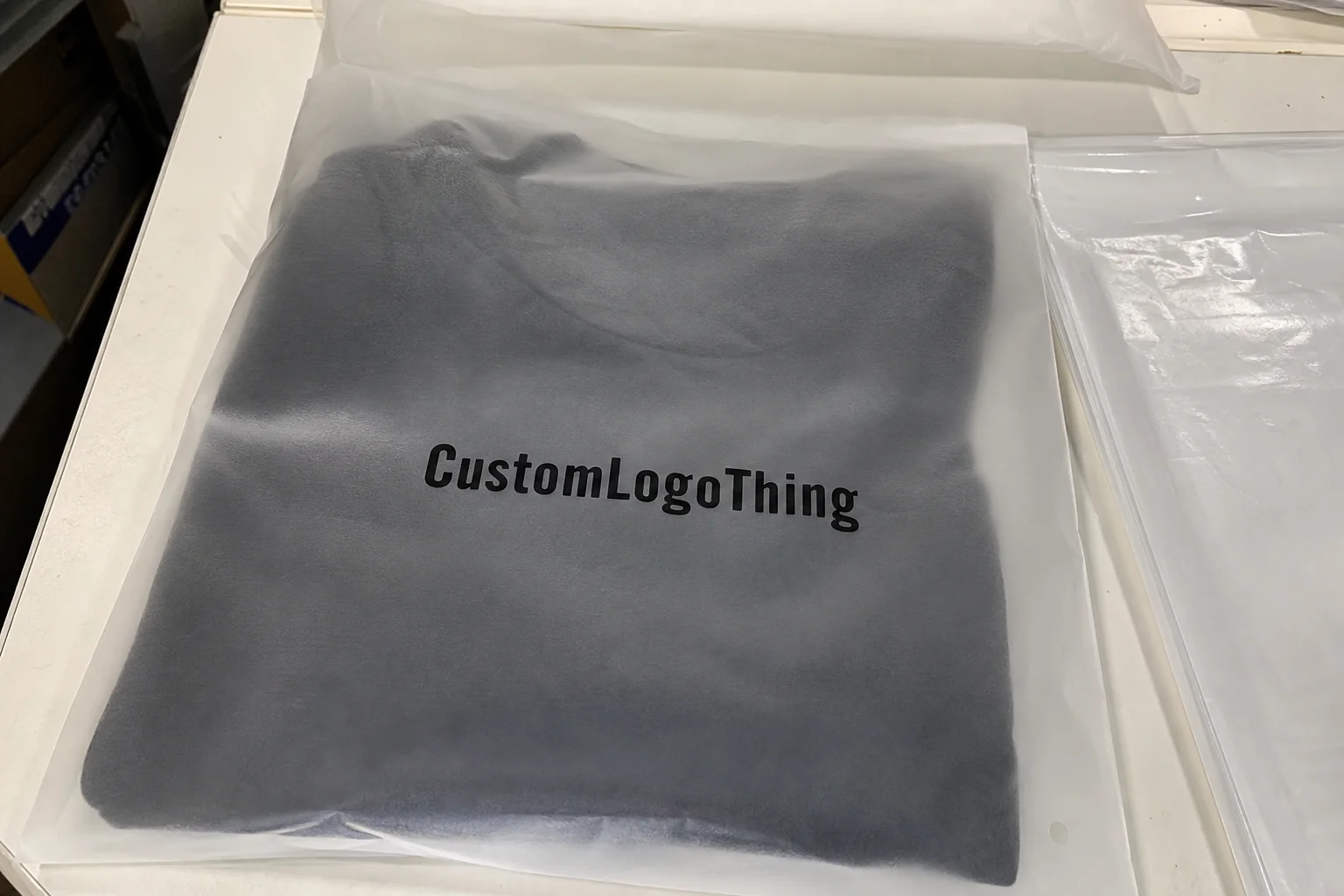
The most common mistake is ordering by bag width only. That can work for a loose sample, but once the actual folded garment, hangtag, and barcode label are inside the bag, the usable space shrinks quickly. Then the bag pulls at the seal line, the fold wrinkles, or the pack count per carton falls because the units no longer stack neatly.
A single garment sample can also be misleading. One folded tee in a roomy bag tells you very little about how the same size behaves with production packing, especially if the real order includes tissue, stickers, or a second inner piece. A hoodie, a denim shirt, and a lightweight tee do not behave the same way inside film. The bulk profile changes the entire packing dynamic.
The carton stage is where weak specifications usually show themselves. If the gusset is too shallow, the bag may close but not load well. If the seal margin is too small, the top edge can split under pressure. If the film is too soft, the bag may look fine but crush during storage or transit. Those are ordinary production problems, not rare ones.
Before asking for quotes, verify the following:
- Garment type — tees, knitwear, denim, underwear, kidswear, or multi-piece sets
- Fold size — actual finished width, length, and thickness after folding
- Pack count per bag — single piece, two-piece set, or mixed inner pack
- Destination climate — heat, humidity, or long transit storage can affect clarity and static
- Warehouse handling — manual packing, automated bagging, or carton-level distribution
- Retail presentation needs — clear front, warning print, barcode visibility, header area
When those basics are clear, the spec becomes much easier to quote correctly. That is the practical starting point for any Custom Garment Polybags buyer sourcing checklist: not the artwork, not the price, but the packed unit that must actually fit and ship.
Choose the Right Polybag Construction for Your Garments
Most garment polybags are made from a small group of films, but the differences matter more than buyers expect. LDPE is the most common choice because it is flexible, clear, and forgiving during packing. It folds well, resists cracking better than many rigid films, and handles the repeated touch points of apparel packing without becoming brittle. HDPE is thinner and crisper for the same weight, which can help with cost, but it is usually noisier and less premium in hand. PP gives a sharper visual finish and better stiffness, which some brands prefer for retail presentation.
Format matters just as much as resin choice. Flat bags are the simplest and often the most economical. Side-gusseted bags create room for bulkier garments and improve loading for thicker folds. Resealable adhesive flap bags are useful when the garment needs to be reopened, checked, or returned without replacing the outer pack. Perforated bags make it easier to open cleanly in a controlled workflow. Bottom-seal bags are often chosen when the open edge needs a cleaner finish.
| Bag Style | Best For | Main Benefit | Typical Tradeoff |
|---|---|---|---|
| Flat LDPE bag | Folded tees, basics, lightweight tops | Low cost, clear presentation, easy packing | Limited room for bulky folds |
| Side-gusseted bag | Sweaters, hoodies, denim, thicker sets | Extra volume, better carton fill | Slightly higher cost |
| Resealable flap bag | Retail-ready apparel, returns, inspection packs | Reusable closure, neat finish | More labor and material cost |
| Perforated bag | High-volume distribution, controlled opening | Fast access, clean tear line | Not ideal for premium shelf display |
| Bottom-seal bag | Merchandising-focused garment packing | Cleaner visual presentation | Can cost more than basic flat bags |
Add-on features should be specified with care. Suffocation warnings are required in many retail programs, but the wording, font size, and placement can vary by buyer and market. Vent holes help reduce ballooning and can improve handling in warm storage. Resealable strips are worth paying for only when repeated opening is part of the workflow. Euro slots make sense for hang display, although they add a production step.
Pick the format based on the garment rather than habit. Folded tees usually fit well in flat LDPE. Sweaters and hoodies often need gusseted room. Denim typically benefits from stronger film and a more forgiving seal. Kidswear and underwear can use lighter structures, but retail presentation rules may call for better clarity or a firmer feel. That is where many buyers save money on the wrong detail and then spend it twice on revisions.
Critical Size, Thickness, and Print Specs to Lock In
If the dimensions are vague, the quote will be vague too. The buyer should lock in bag width, bag length, gusset depth, film thickness, and seal margin before requesting pricing. A bag described only as “12 x 16 inches” is not really specified if the gusset, open mouth allowance, and seal area are missing. Those missing numbers are exactly where packing failures start.
Thickness is usually listed in microns or mil. For light garment applications, roughly 30–40 microns is often enough. Standard apparel packing commonly lands in the 40–60 micron range. Thicker knitwear, denim, or bags that will see rough warehouse handling can move into the 60–80 micron range or higher, depending on the film type and the retailer’s requirements. The right number depends on the load, the packing method, and how much abuse the carton will take in transit.
Garment thickness changes the usable bag size more than many buyers expect. A neatly folded tee with a thin profile may fit in a slim bag, while a hoodie can expand beyond the same footprint once the fabric and air pockets are accounted for. That is why size should be based on the real packed volume, not only the garment’s flat dimensions. Leave room for the seal and for any barcode label or hangtag that sits near the top edge.
Printing also needs to be treated as a specification, not a decoration. Common setups include one-color suffocation warnings, small logo marks in the header area, or retail branding for package consistency. Confirm whether the print is on the inside or outside of the film. Inside print protects the ink from scuffing, while outside print can be easier to inspect during packing. If the design uses more than one color, registration tolerance matters because poor alignment looks rough quickly.
Write down acceptable tolerances on the purchase order. For mass-produced polybags, a width variation of about ±3 mm to ±5 mm and similar length variation is common, but the exact range depends on the factory, film type, and cutting method. Buyers who need tighter control should ask for it before production starts, not after the first shipment is already moving. The same logic applies to print placement and seal consistency.
“A garment bag that misses by 5 mm can still pass a visual check. It usually fails when the pack line loads full cartons.”
For general packaging guidance, buyers can review resources from the Packaging Machinery Manufacturers Institute and material or environmental claims guidance from the U.S. Environmental Protection Agency. If a broader packaging program includes paper-based components or fiber claims, FSC is relevant for those items, although not for polyethylene film itself.
Custom Garment Polybags Buyer Sourcing Checklist: What to Verify Before Quoting
Here is the practical Custom Garment Polybags buyer sourcing checklist I would use before asking any supplier for a formal quote.
- Garment type — what item is going inside, and how is it folded?
- Pack style — single piece, twin pack, or set pack?
- Exact dimensions — width, length, gusset, and seal area.
- Film thickness — in microns or mil.
- Print needs — warning text, logo, color count, and placement.
- Compliance language — suffocation warning, retailer wording, recycled-content claims if any.
- Quantity — total run plus any split shipments.
- Delivery location — warehouse, port, or factory destination.
- Carton pack — bags per inner pack and per master carton.
- Packing method — loose packed, stack packed, or machine-fed.
That list looks basic, but buyers skip several of those points all the time. Then the quote comes back with assumptions built in, and the first production sample reveals the gap. The supplier usually is not being difficult; they are pricing the information they were given.
Compliance can make or break a run. Some retailers require specific suffocation warnings, minimum font sizes, or wording in more than one language. Others have packaging policies that govern the placement of barcode windows, warning text, and recycled-content claims. If the bags will sit in storage for a while, ask about anti-static behavior, slip performance, and whether the film needs extra clarity for barcode scanning.
Logistics details matter too. Tell the supplier your preferred master carton size, inner pack count, and pallet pattern. If your warehouse uses automatic bagging equipment, say so early. Some films feed cleanly through machines; others stick, crease, or snag in exactly the wrong way. A bag that saves a cent on resin can cost far more if it slows the line.
Always request a pre-production sample or an approved proof before mass production. A sample should match the real specification, not a close version of it. If the sample differs in thickness, print position, seal style, or carton pack, it is not an approval piece. It is only a reference.
Cost, MOQ, and Unit Price: What Actually Moves the Quote
Pricing for garment polybags usually comes down to six things: material grade, thickness, size, bag style, print complexity, and volume. There is no mystery in the math. The quote reflects material usage, setup time, waste allowance, and how much work the factory must do to finish the order.
MOQ is tied to production efficiency. Stock-size customization can sometimes move at lower volumes, while fully custom dimensions and printed bags usually need higher minimums because the factory has to set up tooling, printing plates or screens, and cutting or sealing adjustments. If you want a retail-specific format, expect a higher minimum than for plain clear bags.
Setup charges are where buyers are most often surprised. Some suppliers quote a low unit price and then add print setup, plate costs, artwork conversion, or special packing charges later. Ask early whether the quote already includes those items. Also ask whether inner packs, master cartons, or palletization are included or billed separately. Hidden line items are common enough to be treated as normal, not exceptional.
Here is a practical price guide for common apparel polybag buying scenarios. These are broad ranges only, because resin price, thickness, print method, and order size can shift the total quickly.
| Order Type | Typical MOQ | Approx. Unit Price Range | Notes |
|---|---|---|---|
| Plain stock-size LDPE bag | 5,000–10,000 pcs | $0.02–$0.05 | Lowest cost; least customization |
| Custom size, no print | 10,000–20,000 pcs | $0.03–$0.08 | Depends heavily on film thickness and dimensions |
| Printed garment polybag | 20,000–50,000 pcs | $0.05–$0.14 | One-color warning print is usually cheaper than branded multi-color print |
| Resealable or specialty bag | 20,000+ pcs | $0.08–$0.22 | Adhesive flap, venting, or premium finish increases cost |
Higher volume usually lowers unit cost. That part is predictable. But oversized film, thicker gauge, resealable features, or multi-color print can erase those savings quickly. Buyers who chase the lowest quote without checking the construction often pay more later through rework, repacking, or inefficient freight.
If your broader program includes other branded packaging, keeping the spec logic aligned across Custom Packaging Products helps reduce mismatches between inner and outer formats. For apparel programs that also use shipping packaging, it can be helpful to coordinate with Custom Poly Mailers so the film weights, branding, and packing standards do not drift apart from one item to the next.
Production Steps, Lead Time, and Approval Milestones
A reliable order flow usually runs through RFQ, spec confirmation, artwork check, sample approval, mass production, inspection, and shipment. If one of those steps is vague, the schedule slips. Usually it is not dramatic; it just moves one day at a time until the deadline is gone.
Lead time depends on whether the order is a plain clear bag or a printed, custom-size bag with compliance text and special packing instructions. A simple run may finish in 7–12 business days after approval. Printed jobs often need 12–20 business days, and complex or high-volume orders can take longer. Sample turnaround is often 3–7 business days, though that depends on print method and current factory load.
The most common delays are ordinary and avoidable:
- Missing artwork files or poor resolution
- Unclear size specifications or no gusset detail
- Slow internal approval on proofs
- Last-minute changes to print text or language
- Quantity changes after tooling and pricing are already set
Buyers should confirm QC checkpoints before production begins. Ask whether the factory checks film thickness, seal strength, print alignment, and carton counts. If the order is shipping by sea, confirm pallet pattern, carton labeling, and moisture protection. If it is moving by air, packaging has to be compressed and protected properly so freight weight does not rise because of loose cartons or poorly stacked cases.
For repeat programs, the approved version should be documented clearly. Same bag, same film, same print, same carton pack. If the supplier cannot explain revision history in plain language, repeat production becomes guesswork rather than process control.
What a Reliable Polybag Supplier Should Deliver
A good supplier is not just selling film. They are managing a specification. That means clear communication, readable spec sheets, sample consistency, stable lead times, and tolerance documentation that can survive procurement review without being translated three times.
Ask for garment-specific packaging examples, not just generic film samples. A roll of clear polyethylene tells you little about how the supplier handles apparel applications, header print, fold behavior, or carton discipline. You want proof that resembles the actual order, because garment packaging failures usually hide in the details that generic samples do not show.
Pay attention to print control and material consistency. In-house print control often helps with logo placement, warning text, and registration. Material testing matters too, especially if you need a certain clarity level, slip performance, or strength target. For buyers managing retail packaging across several SKUs, repeatability is usually more valuable than a one-time low price.
The better suppliers tend to flag issues before production starts. They may suggest a wider mouth opening, a different gusset depth, or a longer seal margin when the packed garment needs more room. That kind of feedback saves time and avoids the awkward moment when the “approved” bag does not actually pack the garment.
Look for these signs when comparing vendors:
- They provide a full spec sheet, not a vague quote
- They can explain tolerances in plain language
- They send proofs or samples before full production
- They understand apparel packing, not just plastic extrusion
- They can support repeat orders without rework on every run
Trust signal: a reliable polybag supplier does not wait until after shipment to mention a problem. If something is off, it gets raised early.
Use this Custom Garment Polybags buyer sourcing checklist to compare suppliers on the things that actually affect a finished order: fit, compliance, price, MOQ, lead time, and packing behavior. If those parts line up, the bags will do their job in cartons, on shelves, and through the middle stages where most packaging failures really happen.
What should I include in a custom garment polybags buyer sourcing checklist?
Include bag dimensions, thickness, garment type, print needs, MOQ, compliance language, carton count, and required lead time. Add sample approval and shipping details so the quote reflects the real order instead of a guessed version of it.
How do I choose the right thickness for garment polybags?
Use lighter film for basic tees and inner packs. Choose thicker LDPE or a reinforced structure for hoodies, denim, or bags that will be handled repeatedly. If the bag will move through rough warehouse handling, increase the gauge and verify seal strength.
What affects custom garment polybag pricing the most?
Material type, size, thickness, print colors, and order quantity drive most of the cost. Special features like resealable flaps, venting, or retailer compliance printing can raise the unit price. Oversized film also pushes cost up faster than many buyers expect.
What is a typical MOQ for custom garment polybags?
MOQ varies by size, print method, and whether the bag is stock-based or fully custom. Lower volumes are possible for simpler runs, but custom dimensions and printed bags usually need higher minimums because of setup and tooling requirements.
How long does production usually take for custom garment polybags?
Timeline depends on artwork approval, sample approval, and order volume. Simple runs move faster; new sizes or printed designs usually add setup and approval time before mass production. A realistic planning window is often one to three weeks after final approval, depending on complexity.


