Custom Logo Patch Beanies Bulk Order for Wholesale Buyers
A custom logo patch Beanies Bulk Order works because it keeps the decision set tight. One body style, one main decoration zone, and a logo format that is easy to see in winter all make the program simpler to source than many apparel items. The patch gives the brand a clean frame, which is often better for readability than trying to force fine details directly into knit construction.
The buyer's real job is to make sure the run stays consistent after approval. The first sample is usually straightforward; the challenge is whether the 300th or 3,000th unit matches it. Patch size, cuff height, yarn shade, and placement all affect how the beanie looks in the hand and in photos. When those specs are loose, the order can still ship, but it may not feel like one coherent program.
That is why experienced wholesale buyers look at more than price. They check the decoration method, material, minimum order, production time, and inspection process before they commit. A winter promo or retail test run can work well with a modest quantity, but only if the spec is clear enough to repeat later.
Patch beanies are small products, so small spec changes show up fast. A little drift in size or placement can change the whole order.
Why custom logo patch beanies bulk order works for winter promos
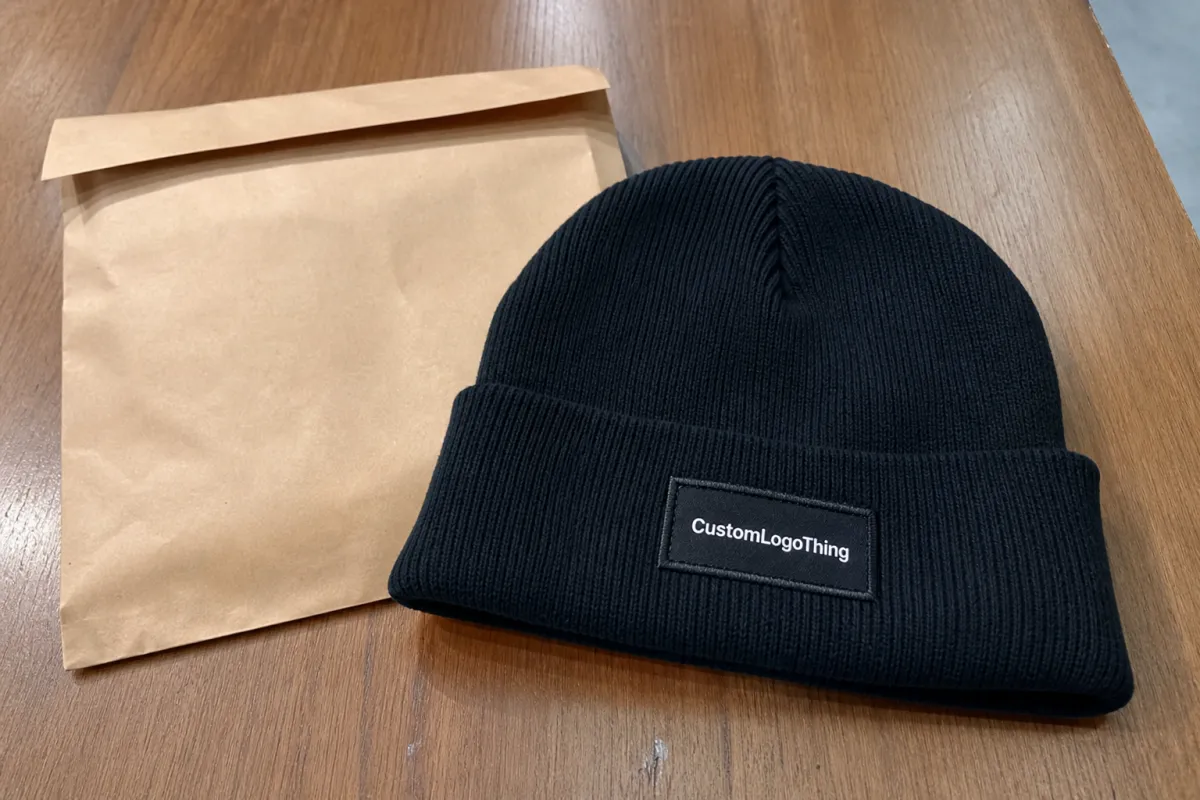
Beanies are easy to explain to a buyer because they solve multiple problems at once. They are useful in cold weather, they fit a wide range of head sizes, and they provide a visible branding surface without requiring complicated sizing. That makes them a practical option for employee gifting, event merchandise, team uniforms, and small retail tests.
A patch usually performs better than dense embroidery on knit fabric when the logo has thin lines or small text. The patch creates a clearer boundary, so the mark reads better from a distance and holds its shape more consistently. For brands that care about legibility, that matters more than adding extra texture.
Bulk ordering also keeps inventory simpler. Unlike apparel programs that split into multiple sizes, a beanie order can often stay inside one style and a few colors. That reduces SKU sprawl, simplifies receiving, and makes reorders easier to manage. For a seasonal launch, that simplicity has real value.
There is also a merchandising benefit. A beanie can be paired with Custom Packaging Products or other branded inserts so the item feels more complete when it reaches the end user. That helps when the order is part of a corporate kit or a retail-ready bundle. If the program is larger, the same logic applies to Wholesale Programs that need repeatable specs across multiple shipments.
Patch styles and knit builds that change the final look
Patch type is one of the biggest drivers of appearance and cost. Woven patches are usually the best choice when the logo has fine text or small details, because the surface stays flatter and the edges remain crisp. Embroidered patches add a more traditional texture. Leather patches push the look toward premium gift or lifestyle positioning. PVC patches are a better fit when durability and bold contrast matter more than softness.
The knit body changes how the patch sits on the cuff. A taller cuff gives the logo more room and usually makes the beanie look cleaner. A shallow cuff can squeeze the art and make the design feel crowded. Dense knit bodies tend to hold a patch flatter, while looser knits can ripple around the edges. That ripple may not show in a mockup, but it often appears on the finished product.
Shape and placement matter as much as patch type. A simple rectangle is usually the most efficient choice and often looks more balanced than a highly custom outline. Merrowed edges read classic and familiar. Die-cut or laser-cut edges feel more modern. Centered cuff placement is the safest option for most buyers, while slightly higher placement can make the style feel more fashion-forward.
Brand tone should guide the build. For giveaways, a standard acrylic body and a simple embroidered or woven patch may be enough. For retail or resale, it is worth paying for tighter finishing, better yarn, and more precise edge work. The quote should show where those upgrades affect cost.
| Patch type | Best use | Look and feel | Typical cost impact |
|---|---|---|---|
| Woven | Small text, detailed logos | Flat, crisp, highly readable | Usually a modest premium |
| Embroidered | Classic branding, textured logos | Raised stitch texture | Often the baseline option |
| Leather | Lifestyle, retail, premium gifts | Warm, understated, upscale | Generally higher than woven |
| PVC | Bold marks, outdoor use | Dimensional, durable, strong contrast | Usually higher, especially with custom tooling |
Materials, fit, and sizing specs to approve before production
Acrylic is still the most common body material because it is cost-effective, easy to source, and available in many colors. Acrylic-wool blends usually feel warmer and more premium, but they increase cost and can require more attention to shade consistency. Recycled yarns are a good option when the material story matters, though the available color range may be narrower.
Fit approval should focus on measurable details. Cuff depth controls how much room the patch has. Crown depth affects how the beanie sits on the head. Stretch determines whether it works across a broad range of wearers without feeling loose or distorting the logo. For a unisex bulk run, the goal is not perfect fit for every person; it is a shape that feels consistent and does not buckle the cuff.
Before approving production, buyers should confirm the color match, logo scale, and patch placement on the actual beanie size. Those three checks catch most avoidable mistakes. If hang tags or inserts are included, paper stock and finish should be approved too so the packaging does not conflict with the product presentation.
Inspection matters as much as the spec sheet. Ask how the supplier checks stitch tightness, loose thread tails, patch attachment, and color drift across the lot. If the product will be shipped in cartons that need to hold up in transit, it is reasonable to ask whether packaging follows ISTA shipment testing guidance. Better cartons reduce damage and rework.
The sample stage is where expensive mistakes become cheap. Once the color, patch size, and fold are approved, production usually moves faster.
Pricing, MOQ, and unit cost drivers for bulk beanies
Price is usually driven by quantity, patch complexity, yarn type, packaging, and any custom labeling. A basic embroidered patch on an acrylic beanie is often the lowest-cost route. Add woven detail, recycled yarn, hang tags, polybagging, or retail labeling, and the cost rises because setup, labor, and handling all increase.
MOQ varies by supplier, but the pattern is consistent: lower quantities cost more per unit because the setup is spread over fewer pieces. Larger tiers usually improve price if the artwork and specs stay fixed. Buyers should ask for pricing at several breakpoints, not just the minimum. A quote at 500, 1,000, and 5,000 units reveals far more about the supplier's cost structure than a single starting number.
These ranges are typical for standard wholesale runs. They are directional, not fixed, and freight or packaging can move the final number.
| Run size | Typical unit price range | What usually changes |
|---|---|---|
| 300-499 pcs | $5.25-$8.75 each | Setup cost is spread across fewer pieces, so the unit price stays higher. |
| 500-999 pcs | $4.10-$6.50 each | Better spread on labor, with more room for standard packaging. |
| 1,000-2,499 pcs | $3.15-$5.25 each | Common wholesale tier for teams and retail pilots. |
| 5,000+ pcs | $2.40-$4.10 each | Best pricing usually appears here if the art and specs stay fixed. |
Compare quotes line by line. Product cost is one line, setup is another, and freight should be separate. Rush charges, packaging upgrades, and proof revisions should also be visible. If a quote looks much cheaper than the others, check whether it excludes freight or assumes a simpler spec. Hidden add-ons usually appear late.
For larger Wholesale Programs orders, repeatability is often more valuable than the cheapest first run. A clean spec sheet keeps the second order aligned with the first and makes seasonal reorders easier to manage.
Process, lead time, and production steps from proof to ship
The order flow is usually straightforward: inquiry, quote, artwork review, mockup, proof or sample approval, production, packing, and shipment. Buyers control the first half of that process through file quality and response speed. Suppliers control the manufacturing and fulfillment stages. Delays often start before production, not during it.
Most problems come from the artwork side. A logo that needs redrawing, missing Pantone references, a patch size that was never stated, or a file that is not vector-based can all slow the proof. Late design changes do the same. If the order is time-sensitive, it helps to send the logo file, beanie color, patch dimensions, quantity, and packaging notes together so the first proof is close to final.
Typical lead times depend on stock availability and approval speed, but many buyers plan for one to two business days for an initial quote, two to four business days for proof work, and roughly 12 to 18 business days for production after approval. Freight is separate and can add significant time if the shipment is moving internationally or through multiple distribution points.
For the buyer, the main leverage points are simple:
- You control artwork quality, color confirmation, quantity, and approval speed.
- The supplier controls sampling, knitting, decoration, pack-out, and dispatch timing.
If the team needs to move quickly, the FAQ is a useful place to confirm file requirements before the quote goes out. That small step often saves a proof round later.
Packaging, labeling, and kitting options for retail-ready delivery
Packaging affects cost, presentation, and handling. Bulk cartons are the least expensive option and usually make sense for internal distribution. Individual polybags help when the order needs added protection or staged distribution. Hang tags and barcode labels support retail workflows where receiving has to be quick and standardized.
Custom printed boxes raise perceived value and are worth considering when the beanie is part of a gift set or e-commerce shipment. In those cases, packaging becomes part of the product experience instead of a shipping afterthought. If the rest of the kit is premium, weak packaging can drag down the presentation.
Kitting is useful for employee welcome packs, seasonal swag, and corporate gifts. A beanie can be paired with a card, notebook, or drinkware item as long as the pack-out plan is clear before production starts. The supplier needs item counts, insertion order, and label logic up front to avoid rework.
Packaging options to review early:
- Bulk cartons for the lowest handling cost.
- Individual polybags for added protection and cleaner distribution.
- Hang tags and barcode labels for retail packaging.
- Custom printed boxes for premium gifting and stronger product packaging.
When paper components are part of the build, FSC stock is a sensible request. When cartons move through several distribution points, ask how they are packed for transit. That is where branded packaging starts affecting operational results, not just appearance.
What separates a reliable bulk supplier from a cheap quote
The lowest quote is not always the safest one. Reliable suppliers explain the tradeoffs clearly, show proofs that match the actual beanie shape, and state lead times in a way that still works if one approval round takes longer than expected. That kind of clarity reduces the risk of later charges and missed dates.
There are a few warning signs that matter quickly. Vague specs are one. A quote that does not clearly separate freight is another. No sample path is a bigger concern on a first-time custom Logo Patch Beanies bulk order. If the supplier cannot explain how revisions are handled, the buyer may end up paying for changes that should have been disclosed upfront.
Repeat-order stability is just as important. Seasonal programs often need the same patch size, cuff height, and placement across multiple runs. If the supplier does not keep clean records of the approved spec, the second order can drift enough to look different beside older inventory.
A dependable partner usually does four things well:
- Quotes transparently with product, setup, and freight separated.
- Shows clear proofs before production starts.
- Communicates revisions quickly and in writing.
- Protects repeat specs so future runs stay consistent.
The best sourcing questions are direct: Can the patch be repeated later without color drift? What changes if the run is split across colors? Which packaging choice affects unit cost most? A supplier that understands product packaging as well as the beanie itself is usually easier to work with over time. Gather the logo file, patch preference, beanie color, quantity, packaging needs, and target delivery date before requesting a quote.
Frequently Asked Questions
What is the typical MOQ for a custom logo patch beanies bulk order?
MOQ depends on supplier, patch type, and whether the order is split across multiple colors. Smaller runs are possible, but the unit price usually improves as the quantity moves into the mid-hundreds and above. Ask whether the minimum applies per color or per design, because that changes the real entry point.
Which patch type is best for bulk patch beanies with logos?
Woven patches work well for fine detail and small text, while embroidered patches give more texture and a classic feel. Leather and PVC are often chosen for premium positioning or stronger visual contrast. The right choice depends on logo complexity, brand tone, and budget.
How long does a bulk custom patch beanie order usually take?
Lead time depends on proof approval speed, patch complexity, order size, and whether the beanies are stock or made to a custom spec. A realistic schedule includes artwork review, mockup approval, production, and freight. Most delays happen during proofing, not manufacturing.
Can I mix colors in one custom logo patch beanie bulk order?
Often yes, though some suppliers set minimums per color or price the order differently if it is split across several shades. Color mixing helps with retail assortment and team ordering, but it can complicate inventory and packing. Ask for the price difference before deciding.
What files do I need for a fast quote on custom logo patch beanies?
A vector file such as AI, EPS, or PDF is best because it keeps the logo edges clean and makes patch sizing more accurate. Include Pantone references, patch dimensions, beanie color, quantity, and any packaging notes. Clear input usually shortens both the quote and proof stage for a custom logo patch Beanies Bulk Order.

