Custom Matte Laminated Paper Bags for skincare gift sets change the first read of a product fast. Before a customer opens the carton, lifts the tissue, or notices the scent inside, the bag has already done some of the selling. It signals calm, price discipline, and attention to detail. That matters more in skincare than in categories that can hide behind louder graphics or heavier structure.
Matte lamination softens reflection, which sounds cosmetic until you see the difference under retail lighting. Gloss can throw glare across a logo and flatten typography. Matte behaves more like an editorial surface: quieter, cleaner, and easier on the eye. For gift sets built around serums, creams, and glass jars, that tone is usually the better fit.
There is also a practical reason brands keep moving in this direction. Matte laminated bags hold print better than plain paper in day-to-day handling, and they resist scuffing more than many buyers expect. That does not mean they are indestructible. It means they survive the real journey from packing table to shelf to customer hand better than a decorative bag with no surface protection.
What custom matte laminated paper bags do for skincare gift sets
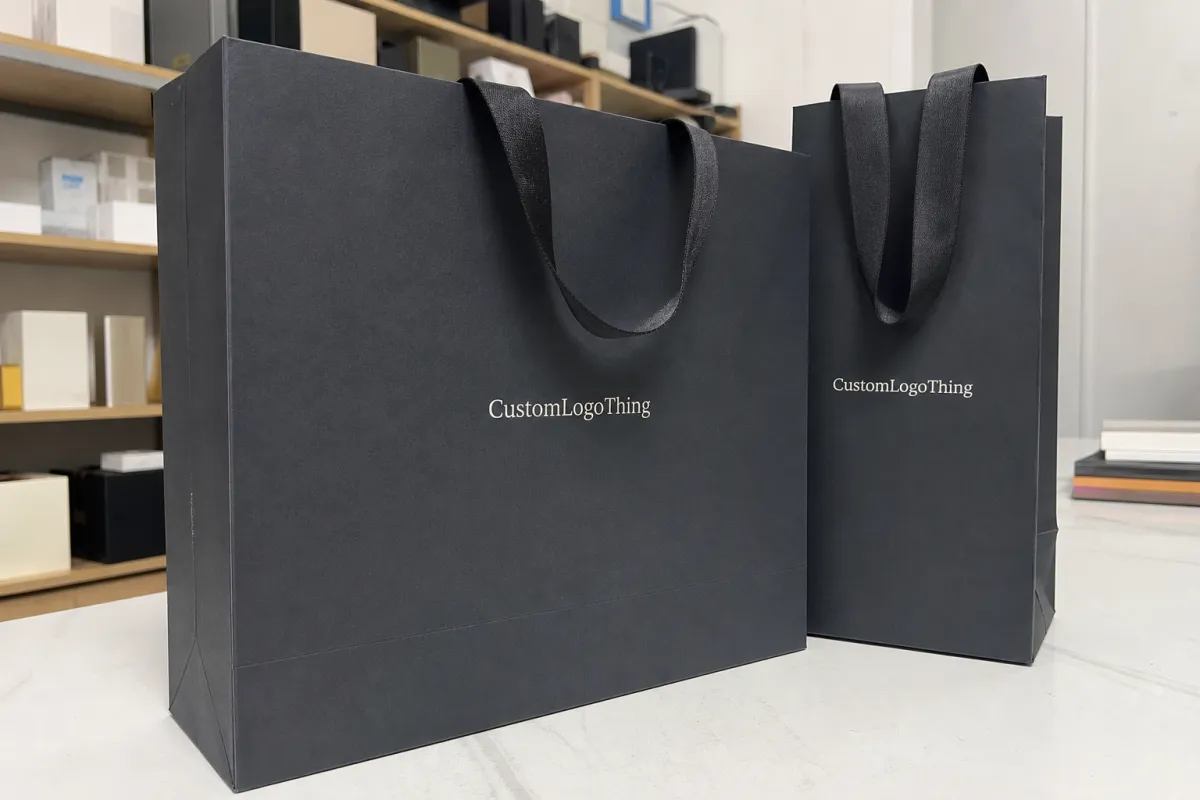
From a buying perspective, Custom Matte Laminated Paper Bags for skincare gift sets do three jobs at once: they frame the brand, protect the print, and make the gift feel intentional. If one of those jobs fails, the bag stops being part of the product and starts being a cost line with a handle.
Skincare sits in a strange place between utility and ritual. A cleanser is functional. A gift set is not. It is a small stage set for care, and the outer bag is the first cue that tells the customer how to read it. Matte finishes fit that cue better than high-shine surfaces because they feel more measured, more private, and less promotional.
That same finish also helps in visual merchandising. Under bright store LEDs or near windows, glossy carriers can wash out a logo or reveal every finger mark. Matte keeps the brand mark legible and the surface calmer. It is a simple comparison, but it matters: one bag reads like a holiday giveaway, the other reads like a retail package built to stay on shelf.
There is a shipping angle too. Lamination gives a printed paper bag a better chance against abrasion, light moisture, and repeated handling. No one mistakes it for a waterproof structure, and it should never be used that way. But a laminated surface buys time and reduces the small damage that quietly makes premium packaging look tired before it reaches the customer.
Matte is not just a finish. For skincare, it changes how the bag is interpreted before the product is even seen.
That interpretive shift is why brands pay for it. The bag supports the set instead of competing with it. It can make a modest bundle look polished, or make an expensive bundle look credible. Those are not the same outcome, and buyers usually know the difference within a few seconds.
How the lamination, board, and handles work together
A good bag is not one material. It is a system. The board gives the bag body, the lamination protects the print, and the handle decides whether the customer trusts the bag with weight. If any one part is weak, the rest of the build starts looking improvised.
For skincare gift sets, common paperboard ranges usually sit around 250gsm to 350gsm for lighter retail sets. Once the contents include glass, multiple boxes, or a rigid inner tray, heavier construction becomes the safer choice. Some buyers push the board thicker without changing the handle or bottom reinforcement, then wonder why the bag still fails in use. Stiffness alone is not strength.
Laminate choice is where the feel changes most quickly:
- Standard matte gives a clean, quiet finish at lower cost.
- Thicker matte film improves rub resistance and helps with high-contact retail handling.
- Soft-touch adds a velvety hand feel and usually pushes the bag into a higher price tier.
Handle selection should be based on weight, not just appearance. Rope handles carry more load and tend to look more premium. Ribbon handles feel giftable but need careful attachment. Twisted paper handles are efficient and familiar. Die-cut handles can work on lighter sets, though they usually read more minimal than luxurious. If the bag is meant to hold a heavy serum set or multiple jars, the handle attachment point deserves more attention than the graphic front panel.
A reinforced top fold, a proper board insert, and crisp creasing matter as much as print quality. These are the things customers do not talk about, which is exactly why they matter. A premium package should feel stable in the hand, not just photogenic on a white background.
Spec choices that affect cost, pricing, and unit value
Pricing for custom matte Laminated Paper Bags for skincare gift sets usually comes down to a small number of variables: size, board weight, lamination type, print coverage, handle style, and finishing. Everything else matters later. These six determine whether the quote feels sensible or inflated.
MOQ affects the math just as much as the materials do. A larger order spreads setup, die cutting, and assembly across more units. Smaller runs carry the same fixed work over fewer bags, so the per-unit cost climbs quickly. That is why a 1,000-piece order can look surprisingly expensive beside a 5,000-piece run, even if the bag design barely changes.
For rough planning, a simple matte laminated bag in a standard size may land around $0.28 to $0.65 per unit at 5,000 pieces. A 1,000-piece order can sit closer to $0.70 to $1.80 per unit, depending on size, finish, and handle choice. Add soft-touch, foil, embossing, or spot UV and the number moves up. That is not a supplier trick. It is just the cost of extra process steps.
| Build choice | Typical unit price impact | What it changes |
|---|---|---|
| Standard matte, twisted paper handle | Lowest | Simple retail gifting, lower weight sets, efficient production |
| Heavier matte film, rope handle | Moderate | Better scuff resistance, stronger hand feel, improved load carrying |
| Soft-touch, ribbon handle | Higher | Luxury feel, stronger gift appeal, more careful handling needed |
| Matte plus foil or spot UV | Highest | Sharper shelf impact, extra setup, tighter proofing needed |
Hidden cost traps are usually ordinary. Oversized dimensions increase carton size. Extra white space inside shipping cases adds freight. Artwork revisions after proof approval can trigger rework. Even a 10 mm increase in bag width or depth can ripple through packing efficiency and transport cost. That is a small design change with a large operational shadow.
The better question is not whether the bag is cheap or expensive. It is whether the unit value matches the job. If the set is sold as an elevated gift, the packaging must defend that position. If the bag protects the contents, reinforces the brand, and holds up in transit, it has done enough to justify its place in the budget.
Production process and timeline from quote to delivery
Production gets easier when the buyer arrives with a clear brief. It gets slower when the order starts with adjectives and ends with redesigns. Packaging teams know this pattern well: vague input leads to extra proof cycles, and extra proof cycles add time that nobody planned for.
The usual workflow is quote, spec confirmation, artwork prep, proofing, sampling, mass production, inspection, packing, and shipment. The real schedule depends on how quickly the buyer locks the details. A confirmed dimension and handle choice can save days. A changing finish, missing product weight, or uncertain delivery window can add them back just as fast.
A practical timeline for a straightforward order often looks like this:
- 1 to 2 days for quoting and spec alignment.
- 2 to 5 days for artwork setup and digital proofing.
- 5 to 10 days for physical sampling if a sample is required.
- 12 to 20 business days for mass production after approval, depending on quantity and finishing.
- 5 to 25 days for shipping, depending on route and method.
That range is wide for a reason. A simple matte bag with a standard handle and limited ink coverage moves more quickly than a bag with soft-touch film, foil detail, or custom inserts. Seasonal schedules also matter. A holiday launch, for example, can turn a normal lead time into a bottleneck if the order is placed after artwork has already been delayed elsewhere.
One useful checkpoint is final proof approval with real dimensions, actual finish, and confirmed handle attachment. Another is transit planning. If the bag will be shipped by itself, it needs different reinforcement than a bag handed over at retail. For those who care about packaging validation, recognized transit testing guidance from groups like ISTA can help frame the load and handling expectations. If sustainability claims are part of the brief, sourcing should be traceable enough to support them, such as certified board from FSC.
Fast production is possible, but only when the brief is frozen. Once the spec starts moving, the calendar moves with it.
How to size, structure, and pack skincare gift sets correctly
Bag sizing should begin with the packed set, not the individual product labels. Measure the filled arrangement: bottles, jars, rigid boxes, inserts, tissue, cards, and any decorative filler. Then build around the final footprint. This sounds obvious until a set arrives with one wide cream jar that was never accounted for.
Skincare gift sets often combine shapes that fight one another. A tall bottle can clear the opening, but a broad jar can push the side walls outward. A tray can solve one problem and create another if it increases height too much. The goal is balance, not maximum fill. A good bag holds the set upright and still leaves enough room for a neat handoff.
Weight distribution matters almost as much as size. If the load sits low and shifts during movement, the handles take more stress and the bottom panel bows earlier. That is where a premium bag starts looking tired. Customers rarely articulate the issue. They just sense that something in the package feels underbuilt.
For fragile products, internal support is worth the extra work. Tissue, a rigid insert, a tray, or even a simple stabilization card can reduce movement dramatically. The outer bag can be attractive and still fail if the interior is loose. The two layers should be designed together.
Retail and e-commerce use cases diverge in ways that matter:
- Retail bags can prioritize display and quick handoff.
- Shipped gift sets need more clearance, stronger handles, and better internal restraint.
- Hybrid sets need a middle ground: polished on shelf, dependable in transit.
That compromise usually means a little extra internal space for tissue or a card, but not enough for the products to rattle. Too much room makes the set feel loose. Too little room causes creasing and edge wear. Either way, the package loses the sense of care that skincare buyers are paying for.
For teams managing multiple gift formats, standardizing one or two bag structures can reduce future reorder friction. It also makes it easier to coordinate with Custom Packaging Products when the outer bag, inner carton, and printed inserts need to feel like one packaging system.
Common mistakes that make premium bags feel cheap
Most premium packaging does not fail loudly. It slips. The shape feels wrong, the surface looks too busy, the handle feels flimsy, or the color prints with less depth than expected. Customers may not identify the flaw, but they notice the effect immediately.
Overprinting is a common problem. Matte lamination already quiets the surface. If the layout is overloaded with copy, icons, texture, and multiple competing type sizes, the bag loses the restraint that made matte a good choice in the first place. Clean composition usually works better for skincare because it creates room for the brand to breathe. Negative space is not wasted space.
Color control is another weak point. Matte film changes the way some tones read, especially deep reds, warm neutrals, and blush shades. If proofing is rushed, the final bag can shift from refined to muddy. That is why a sample viewed under the actual finish matters more than a digital mockup. Screen color and printed color are not close enough to trust by instinct.
Other failures show up in handling:
- Handles that look attractive but cannot support the load.
- Bags that are too large and feel slack.
- Bags that are too tight and crease early.
- Bottoms that bow because reinforcement was too light.
- Openings that make the gift feel awkward to remove or present.
That last point is underrated. A premium bag should make the handoff feel smooth. If the set catches on tissue, tips sideways, or requires the customer to work too hard to access the products, the ritual breaks. Good packaging does not create friction at the moment the brand wants delight.
Low-grade artwork can also drag the whole package down. Matte lamination does not rescue fuzzy files, weak contrast, or a design that was built for screen display instead of print production. It exposes those problems faster. That is useful, but only if the files are prepared honestly.
Expert specs for a sharper retail look and better margins
If the aim is a sharper retail look without pushing the budget into luxury territory, restraint usually wins. That is especially true for custom Matte Laminated Paper bags for skincare gift sets, because the finish already does a lot of the visual work.
A centered logo, a clean panel layout, and one controlled accent color can outperform a design that tries to fill every surface. Skincare buyers often read that as more trustworthy. Loud packaging can still sell, but it can also feel promotional in a category that depends heavily on calm and credibility.
Special finishes should be used with intent. Spot UV on a logo can create a subtle contrast without turning the whole bag glossy. Foil works when the brand language supports it and the budget can absorb the setup cost. Debossing tends to feel more considered than a heavy metallic effect. Each of these changes the visual hierarchy, so they should be chosen for the product story, not because the sample library had room for one more embellishment.
Standardizing sizes across a set of gift bundles can improve margins in a very unglamorous way. Reusing a structural format cuts down tooling variation, simplifies replenishment, and makes reorder forecasting easier. That matters more than most people realize, especially when launch calendars stack up and procurement wants one less variable to chase.
Color proofing deserves its own discipline. Skin-tone neutrals, blush colors, and brand reds should be checked under the actual matte finish before mass production. Ideally, the sample should include the real products, not just an empty shell. A beautiful empty sample can still fail when the jar sizes are added. A package that only works without product is not finished.
If sustainability is part of the positioning, keep the claim narrow and supportable. FSC-certified board, recycled content where appropriate, and inks that match the production plan are all sensible. Broad environmental language without sourcing evidence creates risk. Buyers and retailers notice that gap quickly, especially now that packaging claims are compared as carefully as product claims.
Useful working range: 300gsm to 350gsm board, standard matte lamination, reinforced top fold, and rope or twisted paper handles will cover a large share of skincare gift set use cases without forcing the build into unnecessary luxury spec. That combination is often strong enough, presentable enough, and price-conscious enough to hold up across a product line.
What to do next before requesting a quote
Before asking for pricing on custom matte laminated paper bags for skincare gift sets, gather the brief in one place. The cleaner the input, the more accurate the quote. It also reduces back-and-forth on details that should have been fixed earlier.
At minimum, include bag dimensions, product weight, handle preference, print colors, finish choice, quantity, delivery location, and the launch date. If the bag must serve retail display, gifting, or shipping, say so explicitly. Those uses overlap, but the structure choices are not identical.
Reference images help more than vague adjectives. Send examples you like and examples you want to avoid. If the brand wants the bag to feel soft, premium, and giftable, that should be visible in the references, not hidden inside the word "elegant," which can mean almost anything.
If the set includes glass, multi-piece skincare, or a rigid insert, ask for a sample or mockup with the actual products inside. That is the quickest way to check whether the handles, bottom support, and internal clearance are doing their jobs. Renderings are useful. Real packed samples are better.
- Confirm the final packed size of the gift set.
- Choose the finish based on handling and shelf conditions.
- Check whether the MOQ fits the launch plan.
- Approve color against the actual brand palette.
- Ask for reinforcement details if the set is heavy.
A short, specific brief usually gets a better quote than a long one full of abstract language. In packaging, clarity saves money. It also saves time, which is usually the scarcer resource.
FAQs
What paper weight works best for custom matte laminated paper bags for skincare gift sets?
A mid-to-heavy board is usually the safest range because it keeps the bag upright and supports glass jars or boxed serums without collapsing. Light sets can use a thinner stock, but heavier or fragile sets should move up to stronger board with reinforced bottoms. The final packed sample matters more than a spec sheet alone.
Are matte laminated paper bags better than gloss for skincare gift sets?
Matte usually fits skincare better when the goal is a softer, more premium, spa-like presentation. Gloss reflects more light and can look brighter or more promotional, but it also shows fingerprints and surface wear more quickly. For gift sets, matte often reads as calmer and more refined.
What MOQ should I expect for custom matte laminated paper bags for skincare gift sets?
MOQ depends on size, handle style, print coverage, and finishing. Smaller runs are possible, but unit cost rises because setup is spread across fewer bags. If you need several sizes, ask whether a shared structure can reduce the minimum order pressure.
How long does production usually take for custom skincare gift bags?
Simple orders can move quickly once artwork is approved. More complex work, specialty finishes, and sampling add time. A typical project can run from a few weeks to more than a month depending on revision cycles and freight. Launch timing should be built backward from the delivery date, not guessed at the end.
Can these paper bags safely hold glass skincare jars and bottles?
Yes, if the bag is sized correctly and the board, handle, and bottom reinforcement match the actual load. Fragile items should be tested in the final packed configuration, not just checked in isolation. Inserts, tissue, or inner boxes help when the set includes heavier glass or multiple products.
For skincare brands that care about presentation, handling, and margin discipline, custom matte laminated paper bags for skincare gift sets are a strong packaging choice. The best results usually come from simple decisions made well: the right board, a calm finish, and a structure that can actually carry the set. That combination keeps the bag aligned with the product instead of dragging it off course.

