Buyer Fit Snapshot
| Best fit | Custom Offset Printed Kraft Boxes projects where brand print, material claims, artwork control, MOQ, and repeat-order consistency need to be specified before quoting. |
|---|---|
| Quote inputs | Share finished size, material target, print colors, finish, packing count, annual reorder estimate, ship-to region, and any compliance wording. |
| Proofing check | Approve dieline scale, logo placement, barcode or warning zones, color tolerance, closure strength, and carton packing before bulk production. |
| Main risk | Vague material claims, crowded artwork, missing packing details, or unclear freight terms can make a low unit price expensive after revisions. |
Fast answer: Custom Offset Printed Kraft Boxes: Design, Cost, Timeline should be specified like a repeatable production item. The safest quote records material, print method, finish, artwork proof, packing count, and reorder notes in one written spec.
Production checks before approval
Compare the actual filled-product size with the drawing, then confirm tolerance on folds, seals, hang holes, label areas, and retail display edges. Reserve space for logos, QR codes, warning copy, and material claims before decorative graphics fill the panel.
Quote comparison points
Review material grade, print process, finish, sampling route, tooling charges, carton quantity, and freight assumptions side by side. A quote is only useful when the supplier can repeat the same color, closure quality, and packing count on the next order.
A kraft box can look plain on a screen and feel surprisingly premium in a buyer's hand. That gap is the whole point. Custom Offset Printed kraft boxes turn a natural brown substrate into branded packaging with clean registration, sharp type, and a finish that feels considered instead of slapped together because someone checked the eco box and called it a day.
From a packaging buyer's point of view, the appeal is practical. You get the warmth of kraft, the repeatability of offset printing, and a format that can work for retail packaging, ecommerce, subscription kits, and launch-ready product packaging without drifting into a glossy, overworked look. The result fits brands that want restrained, modern package branding rather than loud decoration that screams for attention and then gets ignored.
At Custom Packaging Products, the first question usually sounds simple: what needs to happen after the box lands on the table? If the answer is "show the brand clearly, protect the product, and stay within a sensible unit cost," Custom Offset Printed kraft boxes usually make the shortlist. The hard part is knowing where they shine, where they fall short, and which details move the quote more than buyers expect.
What Custom Offset Printed Kraft Boxes Really Are
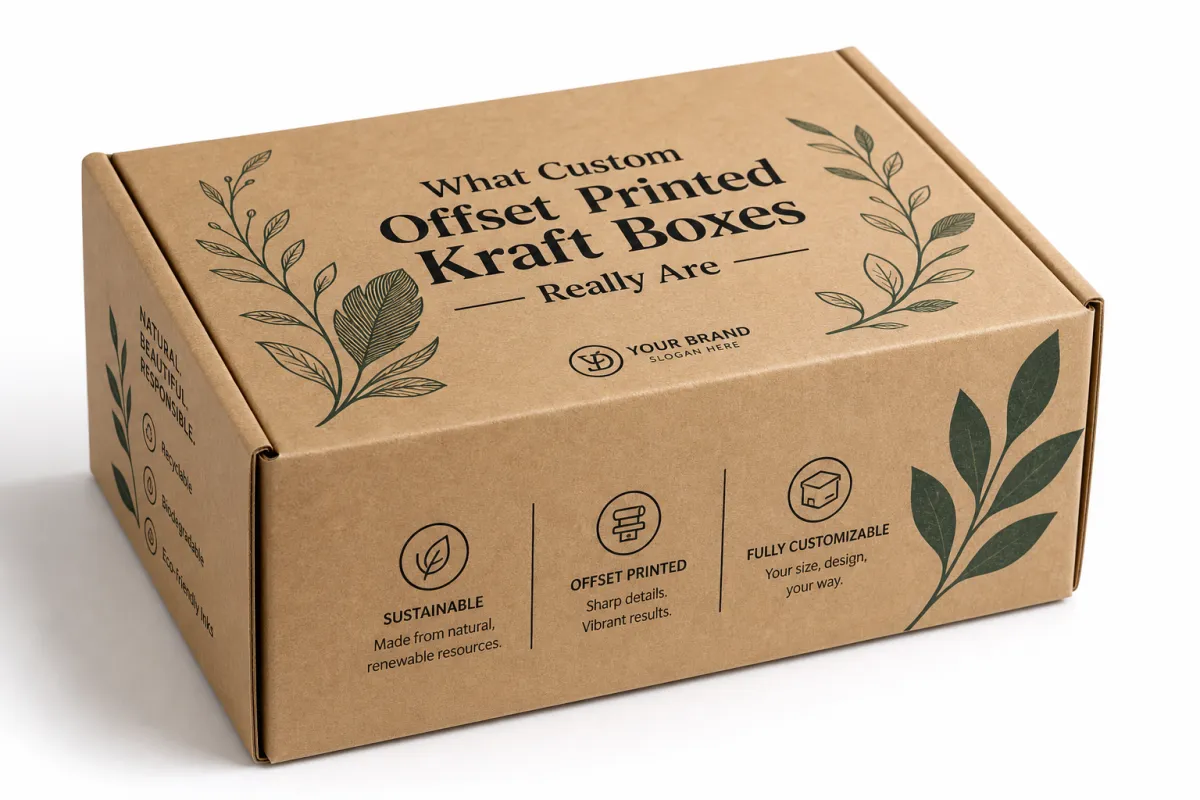
Custom Offset Printed Kraft boxes are kraft-based folding cartons or mailers printed on an offset press so the artwork comes out sharp, repeatable, and easy to manage across larger runs. The kraft stock gives you the natural fiber look. Offset printing handles tight type, crisp logo edges, and consistent color across thousands of units. That combination is why many brands use Custom Printed Boxes when they want an earthy feel without giving up presentation.
Kraft is not as plain as it looks. Put the same artwork on white board and then on brown kraft, and the design behaves differently. Creams quiet down. Bright blues deepen. Reds lose some punch. That is not a defect. It is the substrate doing what substrate does. Good packaging design plans for that before the file gets anywhere near the pressroom.
These boxes make the most sense where the outer package is part of the sales story. Retail displays benefit because the natural surface reads as restrained and thoughtful. Subscription kits use them because the material feels intentional without becoming fragile. Ecommerce shipping boxes use them when the brand wants the unboxing moment to feel designed rather than generic. For launches, custom offset printed kraft boxes can do two jobs at once: protect the product and give the brand a visual anchor in a crowded market.
Sustainability is never just about the word "kraft" on a spec sheet. Coatings, laminations, adhesives, metallic foils, and heavy ink coverage all affect how the finished box behaves in local recycling streams. The better question is not whether it is kraft, but what the full construction includes. That is the part where a supplier with real material knowledge matters, especially if the packaging has to align with FSC sourcing or local recycling guidance.
Buyers also underestimate how much board choice changes perception. A 16pt kraft carton with a matte aqueous coating feels very different from a 24pt kraft mailer with no coating and a solid black logo. Same family. Very different read. That is why custom offset printed kraft boxes work best as a system: board, print, structure, and finish all pulling in the same direction.
If you want to compare formats, start with the wider Manufacturing Capabilities before narrowing the box style. A folding carton, a mailer, and a two-piece set-up are all boxes. They do not behave the same in production or in the hand, and pretending they do is how budgets get weird.
For industry context, print quality and packaging handling are covered well by groups like ISTA, while fiber sourcing and responsible paper use are addressed by the FSC. Those references are useful when the packaging needs to look good and still make technical sense.
How Custom Offset Printed Kraft Boxes Are Printed
Offset printing is a transfer process. The artwork is separated into plates, each plate carries one color, the ink moves to a blanket cylinder, and the blanket lays the image onto the kraft sheet. That indirect transfer is what gives custom offset printed kraft boxes their clean edges and stable repeatability. When the setup is right, the thousandth box can look very close to the first.
Prepress does a lot of the heavy lifting. Die-lines need to be accurate. Bleeds need room. Text needs to stay inside safe margins. Color builds need to be checked against the brown base of the board. A logo that looked balanced on a white mockup can feel too thin once it sits on kraft. The art file is only the starting point. The print-ready file is where the real packaging design work happens.
The process usually begins with a dieline from the printer or converter. That dieline shows where folds, scores, flaps, and glue areas sit. Then the artwork is built around it, often with a spot color system or CMYK process build depending on the brand. For custom offset printed kraft boxes, the smartest move is to simplify wherever possible. Fewer color conflicts mean fewer surprises on press.
Offset works best when the artwork is stable and the run is substantial. It handles consistent graphics, repeated logos, and full-coverage layouts efficiently. Digital printing tends to be better for shorter runs, rapid changes, or variable data. A brand testing three SKU variants might start with digital. Once demand settles, offset often becomes the better economic choice for custom offset printed kraft boxes.
Kraft changes print behavior. The stock can absorb more ink than coated white board, and its texture can soften tiny detail. Fine hairline rules, tiny reversed type, and delicate gradients can disappear if they are not adjusted. Darker colors usually perform better. White ink or a white underprint can help logos stay legible, though that adds a production step and cost. This is one of those places where an honest sample matters more than a bright monitor.
Proofing should never be skipped. A screen proof helps with layout, but it is not a color guarantee. Ask for a printed proof or, when the order justifies it, a press-approved sample. That is the cleanest way to see how the board, ink, and finish interact. On custom offset printed kraft boxes, the gap between "looks fine online" and "looks right in hand" can be huge.
If the artwork is complicated, proof earlier than you think you need to. A logo tweak is cheap at the proof stage and expensive after plates are made. That logic applies to retail packaging, mailers, and any Product Packaging That has to launch on a fixed date.
A good kraft box is not just brown paper with a logo on it. It is a controlled printing system, and the press can only be as clean as the file in front of it.
Key Factors That Shape Look, Strength, and Shelf Impact
Board choice comes first. Kraft grade, thickness, and any surface treatment influence how sturdy the box feels, how clean the print appears, and how much scuff resistance it has in transit. For folding cartons, specs often sit in the 14pt to 24pt range. For mailer-style constructions, E-flute or similar corrugated options may make more sense. With custom offset printed kraft boxes, the board is never just a substrate; it is part of the brand signal.
Color strategy follows close behind. Brown stock rewards contrast. Dark brand tones, bold lines, and clear typography read better than washed-out pastels. If a brand needs bright accents, white ink or a printed underlayer can help create separation from the kraft base. That step is common in premium product packaging, but it should be costed before the design is approved. Plenty of first-time buyers are surprised by how much cleaner the art looks with a small white foundation under it.
Structure matters just as much as color. A tuck-end carton gives a very different user experience from a mailer or a two-piece setup. Inserts can hold fragile items in place, but they also add die-cut complexity and assembly time. Sleeves can improve presentation and reduce total board usage, though they do not always offer the same protection. The right format for custom offset printed kraft boxes depends on the weight, fragility, and perceived value of the item inside.
A useful rule: if the box will be stacked, shipped, or handled many times, strength comes first. If it sits on a shelf and competes for attention, visual impact matters more. Many brands need both, which is why the best spec often lands in the middle. The thickest board does not always win. The box that survives the route and still looks deliberate usually does.
Finishing options shift the story again. Matte aqueous coating gives a calm, modern look. Spot varnish can lift a logo or pattern without turning the whole box glossy. Embossing adds tactile depth. Foil can deliver a premium accent, though it also complicates recycling claims and can push the budget upward. On custom offset printed kraft boxes, finishes should be chosen with care; more finish is not the same thing as more value.
Performance should match the product. A fragile item may need an insert, a heavier item may need thicker board, and a premium accessory may benefit from a more structured carton with cleaner presentation. The packaging should protect the item without shouting over it. That balance is where good branded packaging earns its keep.
There is also a buyer-side issue that gets overlooked: what happens during the first handling test? Does the flap hold after repeated opening? Does the box crease neatly or crack along the score? Does the printed surface scuff when rubbed against another carton? Those are not small questions. They tell you whether the chosen spec supports the brand over the full life of the box, not just in a photographed mockup.
A solid spec sheet for custom offset printed kraft boxes should include:
- Exact outer dimensions and product clearance
- Board type and thickness
- Print method and number of inks
- Coating or lamination choice
- Structural features such as inserts, windows, or tuck style
- Target use case: retail, shipping, subscription, or launch kit
That list looks basic. It is not. Missing one of those details is how a clean concept turns into a box that is hard to run or expensive to ship.
Cost Factors for Custom Offset Printed Kraft Boxes
Offset pricing has a familiar shape: setup costs are higher at the beginning, then unit cost drops as the run gets larger. That means custom offset printed kraft boxes can look expensive on a small order and efficient on a bigger one. The break point depends on artwork coverage, press time, finishing, and how many pieces you need to spread the setup across.
The main pricing levers are easy to list and easy to underestimate. Box size affects material usage. Board thickness affects both material cost and production behavior. Number of inks matters. Coatings and finishes matter. Inserts matter. Special folding or windowing matters. If the box uses white underprint, that is another layer of labor and sometimes another plate. A clean quote on custom offset printed kraft boxes should break out those variables instead of hiding them inside one tidy number that tells you almost nothing.
Artwork complexity can raise cost faster than many buyers expect. A simple one-color logo on kraft is relatively efficient. Full-bleed coverage, multiple spot colors, fine detail, or large reverse-out text adds prepress work and can increase waste during setup. Even the choice between CMYK and Pantone spot colors can change the pricing profile. Exact brand colors often benefit from spot inks, but they are not always the cheapest path.
It helps to compare build types before deciding on a direction. The same brand may need different specs for different products. A clean comparison usually makes the tradeoffs obvious.
| Box Type | Typical Use | Relative Setup Cost | Typical Unit Cost at 5,000 Pieces | Notes |
|---|---|---|---|---|
| Simple kraft mailer | Ecommerce and subscription shipping | Moderate | $0.18-$0.32 | Good for strong branding with limited finishing |
| Tuck-end retail carton | Shelf display and lightweight products | Moderate to high | $0.22-$0.40 | Best when print clarity and presentation matter |
| Two-piece box with insert | Premium gifting and fragile items | High | $0.45-$0.90 | More material and labor, stronger unboxing value |
Those ranges are directional, not universal. A box that uses minimal ink and a standard die can land on the low end. A premium carton with foil, embossing, or a custom insert can move far above it. The table still makes one thing clear: custom offset printed kraft boxes become more efficient as quantity rises, especially once the artwork and structure are locked.
Ask for quotes at several break points, such as 1,000, 3,000, 5,000, and 10,000 units. That shows where the real efficiency begins. Sometimes the jump from 3,000 to 5,000 lowers unit cost enough to justify the extra inventory. Sometimes it does not. You need the actual numbers, not the headline price alone.
Watch the cheapest quote. A low price can hide thinner board, a weaker coating, or an assumption that color matching will not need much attention. I have seen packaging programs get into trouble because the buyer chased the first invoice and ignored the total lifecycle cost. The best custom offset printed kraft boxes are the ones that survive production, transit, and storage without creating hidden rework.
Plan for freight, packing, inspection, and possible spoilage too. That may not sound dramatic, but it matters when margins are tight. A 2%-5% overage is not unusual for planning. Depending on the supplier, rush slots, special finishes, or tighter color requirements can push that higher.
If the supplier offers only one price with no quantity breaks, ask for more detail. Good converters should be able to show where the cost curve changes. If they cannot, the quote is incomplete.
Step-by-Step Process and Timeline
The cleanest projects start with a sharp brief. Before anything is designed, define the product dimensions, shipping method, retail goals, target quantity, desired finish, and any sustainability requirements such as FSC paper or a recyclable-only construction. For custom offset printed kraft boxes, that brief is not busywork. It is the difference between a smooth production run and a stack of revisions.
Next comes the dieline review. This is where the structural outline is checked against the product and the assembly method. Does the item fit with enough clearance? Are the glue flaps sized correctly? Will the box fold cleanly? Are the barcode and legal copy positioned where they will survive the fold? Small errors here can ripple into expensive corrections later.
Then the artwork is built and reviewed. The designer should work in vector format where possible, keep text outlined or otherwise print-ready, and use images at 300 dpi. If the box needs a white underprint, that layer should be clearly separated and labeled. For custom offset printed kraft boxes, this is also the stage to check how the brown board changes color. Screen accuracy is not enough. Material accuracy is the real test.
Proof approval is one of the most important gates in the process. Dieline sign-off locks the structure. Color proof approval locks the visual direction. Structural sample approval confirms that the box folds and holds the product correctly. Skip any one of those and the odds of rework go up. Rework rarely stays cheap, which is a charming little truth nobody enjoys paying for.
A typical timeline, once the details are settled, often looks like this:
- Brief and spec confirmation: 1-3 business days
- Dieline and artwork prep: 3-7 business days
- Proofing and revision: 2-5 business days
- Printing and drying: 5-10 business days
- Cutting, finishing, and assembly: 3-7 business days
- Packing and freight: depends on destination and shipment mode
That sequence is realistic for many runs, but it changes with volume and complexity. A simple carton may move faster. A specialty finish can slow things down. Late artwork can slow everything down. The press is rarely the real bottleneck. Approvals are. If the logo is still changing, the schedule is still moving.
Many projects land around 12-15 business days after proof approval for production alone, though some orders need less and some need more. Freight adds another layer. International shipping can add a meaningful delay. Brands with a fixed launch date should build margin into the schedule rather than trusting the most optimistic estimate.
Handled well, the sequence is almost boring: brief the vendor, confirm specs, approve proof, lock production, inspect samples, and plan inventory arrival. That is how custom offset printed kraft boxes stay on time. Not through luck. Through sequence discipline.
Common Mistakes to Avoid Before You Order
The first mistake is trusting the screen. A monitor does not behave like kraft board. Brown stock lowers brightness, changes contrast, and can mute lighter colors. If a design depends on pale pink, pale gray, or delicate pastel fills, it may lose force on the actual box. This is where physical proofing earns its place. Custom offset printed kraft boxes need to be judged on the real substrate, not just in a PDF.
The second mistake is overcrowding the layout. Tiny type, thin lines, and decorative details can look refined on a white screen and vanish on kraft. That is especially true when the box will be viewed quickly in retail packaging or unpacked under low light. Strong brands often do less, not more. Clear logos, enough white space, and a few well-placed accents usually outperform crowded artwork.
The third mistake is ignoring structure. A mockup can hide folding problems. A box may seem perfect until it is scored, glued, filled, stacked, and shipped. If the spec is wrong, the printed surface will not save it. I have seen beautiful custom offset printed kraft boxes fail because the tuck was too loose, the insert was undersized, or the board cracked at the score line.
The fourth mistake is assuming "kraft" automatically means recyclable. It does not. Laminations, heavy coatings, foil, mixed materials, and some adhesives can complicate recovery. That does not make the box bad. It just means the sustainability story needs to be honest. If your brand is making claims, the construction should support them. Many buyers check that against local recycling guidance and, where relevant, FSC chain-of-custody documentation.
The fifth mistake is buying the wrong quantity. Underordering can create stockouts and emergency reprints. Overordering can leave you holding boxes that no longer match a refreshed logo, a new SKU, or a different regulatory label. The answer is not always "order more to be safe." Sometimes the smarter move is a shorter run, especially for a new line or a first-time launch.
There is a hidden mistake too: failing to coordinate packaging with product changes. If the product dimensions are still moving, lock the box later or expect revisions. If the barcode is not final, wait. If the brand is still choosing finishes, do not approve plates. Custom offset printed kraft boxes reward clarity. They punish indecision.
Practical buyers usually avoid these issues by checking three things early:
- Exact product size and insert needs
- Realistic color expectations on kraft stock
- How the box will ship, display, and be stored
That may sound simple, but it prevents a surprising share of the common problems.
Expert Tips and Next Steps for Better Results
If you want stronger results from custom offset printed kraft boxes, start with a checklist instead of a mood board. Lock the product dimensions, target run length, color targets, finish preferences, and recycling requirements before design revision begins. The more of those choices you settle early, the fewer expensive surprises you will face later.
Order a physical proof when the project has real business value. A printed sample lets you judge color, legibility, fold performance, and the overall feel in natural light. That one step often reveals issues that no screen mockup can catch. For brands shipping at scale, it is cheap insurance.
Compare at least two or three vendors using the same spec sheet. Do not ask each supplier to quote a different version of the box and then compare the totals as if they mean the same thing. They do not. One may be quoting a heavier board, another may be leaving out a finish, and a third may be assuming looser tolerances. Fair comparison is the only way to separate real value from attractive headline pricing.
Match the format to the business stage. Early-stage SKUs often benefit from shorter runs so the brand can test the market without tying up cash in inventory. Once demand stabilizes, offset printing usually becomes more attractive because unit cost falls and consistency improves. That is why many buyers move into custom offset printed kraft boxes after the first sales cycle rather than starting there on day one.
Do not ignore the role of product category. A beauty accessory, a food item, a fragrance sample, and a premium tech gadget may all use kraft, but they do not need the same board, structure, or finish. Good packaging design is not just visual; it is operational. It has to fit the item, the shipping path, the retail shelf, and the brand promise.
If you are still deciding, ask a simple set of questions:
- Does this box need to sell the product, protect it, or both?
- Will the brown kraft base help or hurt color clarity?
- Is the order large enough for offset economics to make sense?
- Do we need white underprint, special finishes, or inserts?
- Does the final construction support our sustainability claims?
Those answers usually point you toward the right structure faster than a long design debate. If you are comparing suppliers, that is where custom offset printed kraft boxes start to split into "nice idea" and "solid program."
For brands that want to move from concept to quote, the practical next step is to gather a clean spec sheet, review available custom printed boxes, and then request pricing based on the same dimensions, materials, and finishes across each vendor. That is how you get a meaningful number instead of a marketing estimate.
One last thing: do not lock the run until you have the dieline, the exact board spec, and a printed proof in hand. That sounds simple because it is simple, and it saves a lot of regret later. If you want the boxes to pull their weight, make the spec boring, make the proof honest, and make the final approval happen only after the sample tells the truth.
FAQ
Are custom offset printed kraft boxes better than digital printing for large runs?
Usually, yes. Offset tends to win on unit cost and print consistency once quantities rise, especially for custom offset printed kraft boxes with repeated artwork. Digital printing is often the better fit for short runs, quick changes, or variable data. The real comparison is total setup cost plus per-box price at your actual order quantity.
Can custom offset printed kraft boxes still be recyclable?
Often they can, but the final answer depends on coatings, laminations, inks, adhesives, and any added materials. Minimal finishes and fiber-friendly construction usually make recovery easier. Ask the supplier how the finished build aligns with local recycling rules before you approve the spec.
What files do I need for custom offset printed kraft boxes?
Use the printer's dieline and submit vector artwork with outlined fonts when requested. Keep images at 300 dpi, include bleed anywhere art reaches the edge, and confirm spot colors, white underprint needs, and safe text margins before approval. For custom offset printed kraft boxes, clean prepress files save both time and money.
How long do custom offset printed kraft boxes usually take?
Proofing and prepress can take several days if revisions are involved. Production often runs about one to three weeks after approval, depending on volume and finishes. Shipping adds extra time, and rush orders may raise cost or limit finishing options.
How do I keep colors from looking muddy on kraft stock?
Use stronger contrast, darker brand tones, and simpler palettes where possible. Test the design on the exact kraft sheet so you can see the real color shift, not a monitor version. White ink or an underprint layer can help logos, fine text, and brighter brand colors stand out.

