Buyer Fit Snapshot
| Best fit | Offset Printed Kraft Cartons projects where brand print, material claims, artwork control, MOQ, and repeat-order consistency need to be specified before quoting. |
|---|---|
| Quote inputs | Share finished size, material target, print colors, finish, packing count, annual reorder estimate, ship-to region, and any compliance wording. |
| Proofing check | Approve dieline scale, logo placement, barcode or warning zones, color tolerance, closure strength, and carton packing before bulk production. |
| Main risk | Vague material claims, crowded artwork, missing packing details, or unclear freight terms can make a low unit price expensive after revisions. |
Fast answer: Offset Printed Kraft Cartons: Board, Finish, Dieline, and Unit Cost should be specified like a repeatable production item. The safest quote records material, print method, finish, artwork proof, packing count, and reorder notes in one written spec.
Production checks before approval
Compare the actual filled-product size with the drawing, then confirm tolerance on folds, seals, hang holes, label areas, and retail display edges. Reserve space for logos, QR codes, warning copy, and material claims before decorative graphics fill the panel.
Quote comparison points
Review material grade, print process, finish, sampling route, tooling charges, carton quantity, and freight assumptions side by side. A quote is only useful when the supplier can repeat the same color, closure quality, and packing count on the next order.
Offset Printed Kraft Cartons: A Practical Packaging Guide
Offset Printed Kraft cartons sit in a useful middle ground. They keep the natural kraft look brands want, but they give you sharper logos, cleaner type, and tighter color control than plain brown board ever will. If you want earthy without looking sloppy, that matters. A lot.
From a packaging buyer's point of view, offset Printed Kraft Cartons solve a very specific headache: the brand wants recycled-looking packaging, but the shelf still demands crisp graphics and a controlled color story. A sticker on a kraft box can work for a tiny launch. For a real retail program, it usually looks improvised. Nobody gets points for that.
Offset Printed Kraft Cartons: Why They Punch Above Their Weight
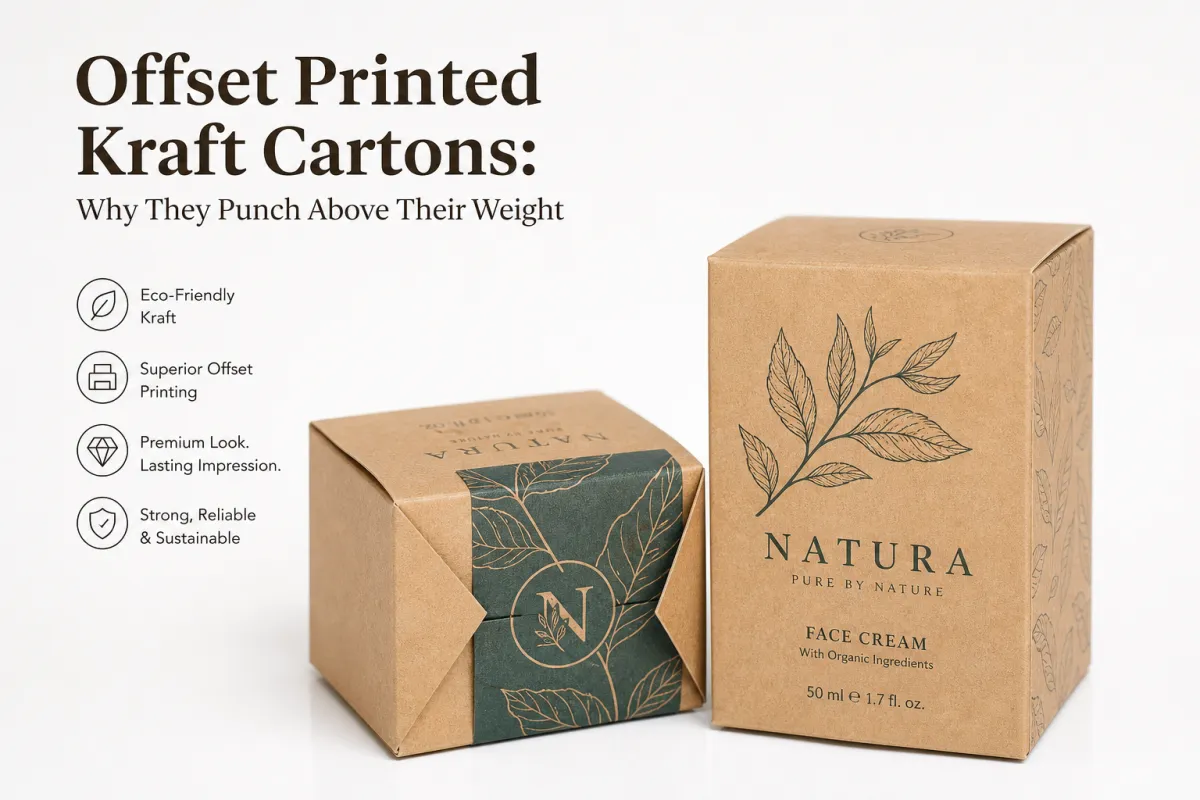
The first thing people notice about Offset Printed Kraft cartons is the contradiction they solve. Kraft stock brings the warm, organic, recycled-paper feel. Offset printing brings the detail, registration, and consistency that make the carton look deliberate instead of homemade in the awkward sense.
That is the appeal. Offset printed kraft cartons can make a natural brand feel premium without shoving it into a glossy white-box look. You still get the brown fiber tone, the visible paper character, and the honest material story. You just do not sacrifice logo sharpness or fine type to get there.
In practical terms, offset printed kraft cartons are folding cartons made from kraft or kraft-faced paperboard, printed on an offset press, then converted into finished cartons. They are used for products that need retail presence, consistent brand color, and a more finished look than a label-only pack can deliver. I have seen this choice save a launch more than once, mostly because the box stops looking like an afterthought the second it hits the shelf.
People often miss the contradiction on purpose: kraft is usually associated with rustic branding, but offset printing lets it look clean, controlled, and premium without losing the material story. That is why offset printed kraft cartons show up so often in specialty food, cosmetics, wellness, and subscription packaging. The box has to say "natural," not "unfinished."
Here is the part most brands get wrong. Kraft is not a free sustainability badge, and it is not automatically the cheapest route. Offset printed kraft cartons make sense when presentation, repeatability, and brand perception matter enough to justify the setup. If the run is tiny or the art is extremely simple, there may be smarter ways to spend the money. No drama, just math.
Brown kraft is a substrate choice, not a moral victory. The rest depends on board source, ink system, coating, adhesive, and how much material you use.
If you need a box that looks natural but still behaves like a proper sales tool, offset printed kraft cartons are hard to beat. They are not for every SKU. They are for the jobs where the carton needs to work as packaging and as brand theater.
How Offset Printed Kraft Cartons Are Made
The production path for offset printed kraft cartons is straightforward, but every stage affects the final result. It starts with artwork setup and dielines, moves into plate making, then runs through the press, drying or curing, finishing, die-cutting, folding, gluing, and packing. If any one step is sloppy, the carton shows it. Kraft does not hide much. That is part of the charm and part of the headache.
Offset printing works differently from digital in one important way: the image transfers from plate to blanket before it reaches the sheet. That extra step gives better control over solids, fine detail, and repeatability on larger runs. For offset printed kraft cartons, that matters because brand colors need to stay consistent from the first sheet to the last bundle.
Kraft behaves differently on press than coated white board. The natural fiber tone absorbs and darkens color a bit, so whites, pastels, and very bright brand colors do not look the same as they do on a bright coated substrate. Designers who proof offset printed kraft cartons on white stock and call it done usually regret the shortcut later. The box is not a screen, and it is not gonna pretend to be one.
Common print setups include one-color line work, two-color spot combinations, four-color CMYK, or CMYK plus spot colors when brand matching matters. For offset printed kraft cartons, spot colors are often worth the extra setup if the brand has a specific green, orange, or black that cannot drift. A soft beige background is one thing. Off-brand logo red is another. That one gets noticed fast.
Finishing options still exist on kraft, but each one changes the feel and the cost. Aqueous coating can help with rub resistance while keeping the pack relatively paper-friendly. Soft-touch lamination gives a velvety feel, though it adds film and can mute the natural texture. Embossing, foil, spot UV, and window patches are all possible on offset printed kraft cartons, but every added finish should answer a real brand need, not just a designer's urge to stack effects.
For brands comparing suppliers, the production range matters as much as the artwork. If you need custom carton styles, inserts, or structural tweaks, the Manufacturing Capabilities page is the place to check what formats the shop can actually produce before anyone gets attached to a sketch.
Key Factors That Change Quality, Sustainability, and Cost
The material choice is where offset printed kraft cartons either feel smart or start getting expensive for the wrong reasons. Virgin kraft, recycled kraft, kraft-faced paperboard, and different caliper levels all change the carton's look, strength, print surface, and price. A thicker board may support a heavier product, but it can also make the carton harder to fold cleanly and harder to ship efficiently.
Print complexity is the next obvious cost driver. More colors, tighter registration, metallic inks, large solid areas, and special finishes all increase setup time and waste. On offset printed kraft cartons, that waste matters because the press operator has to compensate for the paper tone and the absorbency of the substrate. Every extra color pass is another point where the run can drift.
A lot of sustainability talk around offset printed kraft cartons gets lazy fast. Kraft is not automatically "eco" just because it is brown. Inks, adhesives, coatings, and lamination all matter. A carton with a heavy plastic film wrap and a foil badge is not magically clean because the base sheet looked rustic. The spec tells the truth, even if the marketing copy does not.
Structural requirements matter too. A carton for a lightweight soap bar does not need the same board caliper or crush resistance as a carton for glass bottles or a multi-pack of supplements. Offset printed kraft cartons can be display pieces, but they also have to survive transit, shelf stocking, and handling. If the structure is weak, the brand ends up paying twice: once for the box and again for the customer complaints.
Compliance can change the spec quickly. Food-contact rules may affect inks and coatings. Recycled-content claims need support. FSC or PEFC sourcing can be required by retailers, and many brands now ask for transit validation as part of the approval process. For distribution testing, ISTA methods like 3A are common references, and ASTM D4169 is another standard buyers use when they want shipping performance to be more than a hope.
For fiber sourcing and chain-of-custody claims, the FSC system is the cleanest public reference point. It does not solve every sustainability issue, but it does help separate real sourcing claims from marketing fluff. That alone is useful.
Offset printed kraft cartons tend to perform best when the spec is honest from the start: the right board, the right print system, the right finish, and the right structure for the product weight. Anything else is just expensive optimism.
Offset Printed Kraft Cartons Cost and Pricing Breakdown
The biggest pricing drivers for offset printed kraft cartons are quantity, print colors, carton size, board grade, special finishes, and whether the job needs custom tooling. Setup costs exist whether you order 1,000 units or 10,000. That is why short runs can feel expensive fast. The press still has to be set, plates still have to be made, and spoilage still has to be absorbed.
MOQ reality is simple: offset printing usually favors larger runs because the fixed costs need somewhere to land. For offset printed kraft cartons, a practical floor is often somewhere around 2,500 to 5,000 units, depending on size and complexity. Below that, digital printing may be a better fit, especially if the artwork is straightforward and the launch is still unproven.
Here is a practical comparison that buyers can actually use instead of vague "affordable" talk.
| Option | Typical Run Size | Approx. Unit Cost | Best For | Main Tradeoff |
|---|---|---|---|---|
| Digital printed kraft cartons | 250-1,000 units | $0.45-$1.40 | Samples, pilot launches, tight test markets | Lower setup cost, but less efficient at scale |
| Offset printed kraft cartons | 2,500-10,000 units | $0.12-$0.55 | Retail programs, repeat SKUs, brand launches with volume | Higher setup and plate costs, but better unit economics |
| Offset with premium finishes | 5,000+ units | $0.25-$0.90 | High-visibility shelf packaging, gifting, premium positioning | Foil, embossing, or lamination add cost and can affect recyclability |
Those numbers are not magic. They are just realistic ranges. A small carton with simple one- or two-color art will sit lower in the range. A larger carton with foil, embossing, a window patch, or soft-touch lamination will move higher. Offset printed kraft cartons are economical when the run is large enough to spread those setup charges across enough units. Otherwise, the per-piece price starts looking a little rude.
Hidden costs are where budgets get bruised. Die charges, plate charges, proofing, prepress corrections, freight, and storage if the cartons ship in batches can all add real money. Custom tooling is especially easy to ignore during quoting, then impossible to ignore during approval. If you are comparing suppliers, ask for a line-item quote so offset printed kraft cartons do not surprise you later.
The tradeoff against digital is straightforward. Digital printing can be cheaper for very small runs and faster for one-off tests. Offset usually wins when you need stronger shelf presence, more consistent color, and volume that justifies setup. For offset printed kraft cartons, the math usually improves as the order gets bigger, which is exactly why volume planning matters before you approve the art.
One more practical point: storage and release planning can save money. If you do not have room to receive all the cartons at once, ask about split shipments or scheduled releases. Otherwise, the cartons show up, the warehouse fills up, and everyone acts surprised. It is packaging, not a mystery novel.
Step-by-Step Timeline for Ordering Offset Printed Kraft Cartons
A clean ordering process keeps offset printed kraft cartons from stalling halfway through production. The best projects start with a clear brief, a confirmed carton style, and artwork that fits the dieline without drama. The worst projects start with "we sort of know the size" and a logo file that was built for a social post.
- Define the product - Know the exact fill weight, dimensions, and whether the carton is cosmetic, food-safe, or transit-facing. Offset printed kraft cartons cannot be designed well without the actual product size.
- Choose the carton style - Straight tuck end, reverse tuck end, auto-bottom, sleeve, or a custom structure. If the box needs to open a certain way or survive stacking, say that early.
- Lock artwork and dielines - Good file prep saves days. Keep bleeds at 3 mm where possible, convert key fonts to outlines, and leave enough quiet space around type so the kraft texture does not chew up the message.
- Approve proofs - Color proof sign-off is usually where offset printed kraft cartons slow down. Proofs on white stock are not the same as proofs on kraft, so insist on substrate-relevant samples when color matters.
- Move into plate making and printing - Once plates are made, changes get expensive. This is the moment to catch errors, not after 8,000 sheets have been printed.
- Finish, die-cut, and glue - Any coating, foil, emboss, or window patch is added here. Then the sheets are cut, scored, folded, and glued into finished cartons.
- Pack and ship - Bundled cartons are counted, boxed, and sent out. If the release schedule matters, confirm it before the run begins.
Timing depends on the job, but a realistic range for straightforward offset printed kraft cartons is often 12-20 business days from proof approval. Add more time if there are multiple finishes, structural samples, retailer compliance checks, or a crowded production calendar. Complex cartons can stretch to 4-6 weeks without anyone doing anything wrong. They just take longer.
The approval bottlenecks are usually predictable. Color proof sign-off, structural sample approval, and compliance review are the three places projects lose momentum. If a brand wants speed, it should move those decisions early instead of pretending the schedule will bend by itself.
For custom formats, inserts, or carton engineering questions, the carton production capabilities page is useful before final artwork is built. It is easier to build around real production limits than to redesign a beautiful box after somebody discovers the glue flap does not fit the machine.
Offset printed kraft cartons are not slow by nature. They are only slow when the brief is fuzzy, the files are messy, or the approvals drift. Clean inputs usually get clean output. Funny how that works.
Common Mistakes With Offset Printed Kraft Cartons
The classic color mistake is expecting kraft to behave like white stock. It will not. Bright colors warm up, pale colors dull down, and small type can lose some edge if the contrast is weak. Designers who skip substrate proofing on offset printed kraft cartons tend to discover that their "clean beige" is actually a kind of sleepy tan once it hits the press.
Over-designing is another common mistake. Too many finishes, too much copy, and too many tiny graphic elements can make the carton feel expensive in the wrong way. Offset printed kraft cartons usually look strongest when the layout lets the paper do some of the work. If the board already carries character, the art does not need to shout.
Weak structural planning is the easiest way to waste money. A beautiful carton that scuffs in transit, collapses under product weight, or opens too easily is not premium. It is just fragile. For offset printed kraft cartons, the internal dimensions, score depth, board caliper, and closure style all matter more than most teams think at first glance.
Sustainability claims are where brands can get themselves in trouble. Saying the pack is eco-friendly while using heavy lamination, mixed materials, or unnecessary foil is asking for criticism. Brown kraft does not erase the rest of the spec. If a brand wants credible claims, the better move is to specify offset printed kraft cartons with the minimum material and finish needed to protect the product and satisfy the retailer.
Communication gaps cause expensive rework. Missing dielines, vague dimensions, unconfirmed fill weights, and files that do not match the physical carton are the kind of problems that show up late and cost extra. It is much easier to spend fifteen minutes clarifying the spec than to explain why 10,000 cartons are slightly wrong.
Two practical habits help more than fancy software. First, share the actual product before artwork is finalized. Second, ask for a real sample on the intended board before signing off on color. That simple step catches most of the ugly surprises in offset printed kraft cartons before they become inventory.
If your team needs a production range, confirm it early with the supplier instead of assuming every carton style is possible on every line. For brands that want to compare structure options against their packaging goals, the production capabilities overview is a useful starting point.
Expert Tips and Next Steps for Better Results
Test before you commit. If the budget allows it, compare two or three versions of offset printed kraft cartons: a standard CMYK proof, a spot-color version, and an actual substrate sample on kraft. Seeing the difference in hand is a lot more useful than arguing over a PDF on a monitor.
Define the priority before you ask for pricing. Is the goal lower cost, stronger shelf impact, more recycled content, better shipping durability, or a cleaner unboxing experience? Offset printed kraft cartons can do several of those things well, but not all at the same time without tradeoffs. A clear priority keeps the spec from turning into a wish list.
Use design rules that respect the material. Bold typography usually reads better than thin hairlines. High contrast matters. White knockout text can work, but not if the font is tiny. Finishes should be used where they earn their keep, not because someone wants "something special" and cannot explain what special means.
Brief the supplier properly. Send product dimensions, target quantity, artwork files, desired finish, sustainability requirements, and any retail or food-contact standards. If your project includes transit testing or compliance review, say that upfront. Offset printed kraft cartons move faster when the supplier is not forced to guess what the brand actually needs.
One practical rule: if the product is selling on shelf, the box should be tested in hand, under store lighting, and in a shipping carton. Offset printed kraft cartons can look excellent in a mockup and still fail in a real aisle if the contrast is too soft or the closure is too weak. Packaging is physical. It does not care about presentation software.
My usual order of operations is simple: choose the carton style, request a material sample, compare at least two quotes, and decide whether the run size justifies offset. If it does, offset printed kraft cartons can give you better consistency and a stronger premium feel than people expect from brown board. If it does not, digital or a simpler construction may be the smarter spend.
For buyers trying to map the project to a real production line, keep the conversation grounded in the actual carton format and the supplier's range. A good packaging partner should be able to explain what fits, what costs more, and what tradeoff is hiding under the nice-looking mockup.
That is the real value of offset printed kraft cartons: they let a brand keep the natural kraft story while still looking like it knows exactly what it is doing. When the spec is clean and the volume makes sense, they are one of the most practical premium packaging choices around. When they are rushed, under-specified, or dressed up with the wrong finishes, they can look a little off. Kinda obvious, but people still do it.
If you are about to spec a run, the most useful next move is not to chase fancy effects. Lock the product dimensions, choose the board, request a proof on the actual kraft stock, and get a line-item quote that separates print, tooling, finishing, and freight. That is the quickest way to tell whether offset printed kraft cartons fit the job or whether you are trying to make the box do more than it should.
Frequently Asked Questions
Are offset printed kraft cartons better than digital for short runs?
For very small runs, digital is usually the better fit because setup costs are lower and you do not need to absorb plate charges. Offset printed kraft cartons start to make more sense once the run size grows and color consistency matters more. If you can meet a decent MOQ and you want sharper print quality on kraft, offset is often the stronger choice.
Do offset printed kraft cartons still look brown after printing?
Yes, unless you flood the box with heavy coverage or use white ink, the kraft tone will show through. That base color will warm up some colors and dull others, which is why proofing on the actual substrate matters. Designers who approve offset printed kraft cartons on white stock and hope for the best usually end up rethinking the palette later.
What makes offset printed kraft cartons more expensive?
The biggest cost drivers are quantity, number of print colors, special finishes, and tooling. Short runs usually have higher unit costs because the setup is spread across fewer cartons. Complex finishing like foil, embossing, or spot UV adds labor, waste, and often more approval time to offset printed kraft cartons.
How long does it take to produce offset printed kraft cartons?
Simple projects can move quickly if artwork is ready and approvals are fast. A realistic lead time usually includes prepress, proofing, printing, finishing, die-cutting, and gluing. For offset printed kraft cartons, 12-20 business days from proof approval is a fair expectation for straightforward work, while more complex jobs can take longer.
Are offset printed kraft cartons sustainable?
They can be, but the answer depends on the whole spec, not just the word kraft. Board sourcing, ink system, coatings, adhesives, and whether extra lamination is truly necessary all matter. The most sustainable version of offset printed kraft cartons is usually the one that uses the least material while still protecting the product and meeting the brief.


