For cosmetics brands, the Custom Padded Mailers for cosmetics brands material thickness guide is not a packaging trivia exercise. It is a damage-rate decision. A serum bottle can arrive looking fine in a delivery photo and still have failed because the mailer flexed at the seam under stack pressure, not because anything pierced the wall.
Thickness matters in three directions at once: crush resistance, surface protection, and brand presentation. A mailer that feels too thin signals fragility before it leaves the warehouse. One that is too heavy can push postage up, waste material, and create awkward pack-out. The right choice depends on the SKU, the route, and how much movement the product has inside the pack.
From a buyer's point of view, this is a shipping spec problem first and a design decision second. Lip gloss, glass skincare, compacts, and gift sets all stress a mailer differently. If you are comparing options across Custom Packaging Products, or deciding whether a mailer can do the job instead of a small carton, the useful question is simple: what thickness protects the product without adding avoidable cost?
The best mailer is usually the thinnest one that still survives a real shipment test with the actual product inside.
Custom padded mailers for cosmetics brands material thickness guide: what thickness actually changes
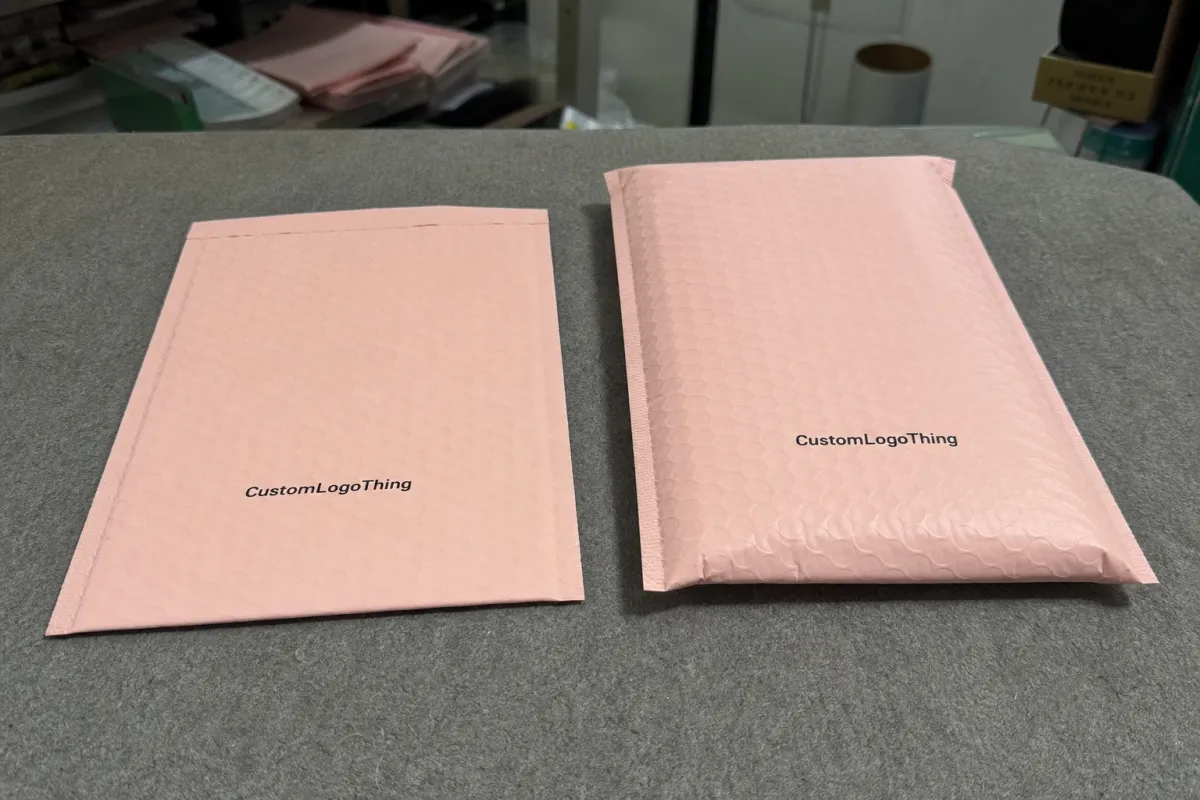
Thickness changes more than most teams expect. It affects how the mailer resists edge crush in a carton, how much the face stock scuffs during transit, how securely the closure holds, and how premium the pack feels when the customer opens it. Cosmetics are judged twice: once by the carrier system and again by the person opening the parcel beside a mirror or phone camera.
This is why thickness should be read as a performance metric, not just a tactile one. A thicker liner or outer shell can reduce flex and help keep a compact from rubbing through a corner, but thickness alone does not fix poor fit. A snug pack often outperforms a bulky one with extra air around the product.
In practice, buyers should separate three numbers that are often mixed together: caliper, material weight, and perceived stiffness. A paper face can have solid print quality at a modest weight, while the cushioning layer may carry most of the impact resistance. Bubble depth, pad loft, and seam construction matter too. A mailer can feel “strong” in hand and still fail once it is loaded and stacked.
That is why real protection only shows up in drop tests, compression tests, and fit checks with the exact product. If the item shifts, the mailer takes repeated impact. If the closure is overstressed, the flap starts to creep open. If the face stock is too soft, print scuffs become visible before the parcel reaches the customer.
For cosmetic packaging, the goal is not to buy the thickest option. It is to buy the right construction for the route and the product.
How mailer construction turns gauge and cushioning into protection
Not every padded mailer uses the same build, so “thickness” can hide a lot of detail. A kraft paper mailer with paper-based cushioning behaves differently from a poly bubble mailer or a hybrid pack with a recycled liner. The outer face, the cushion, the adhesive, and the closure all contribute differently to the end result.
Many spec sheets flatten those differences into one line item, which is where mistakes start. A heavier face stock may improve print sharpness and tear resistance. A denser cushion may matter more for impact protection. The same applies to closures: a better adhesive or wider seal can do more for transit performance than another fraction of a millimeter in overall thickness.
For buyers comparing Custom Poly Mailers with paper-based formats, the useful comparison is not “which feels thicker?” It is “which build protects the SKU better once it is packed, stacked, and sorted?” A poly mailer may resist moisture and abrasion better. A paper padded mailer may present better for some premium cosmetics and still be fully adequate if the product is boxed or carded inside.
Testing standards help keep the decision grounded. Many teams borrow the logic of ISTA procedures or ASTM-style shipment testing to see how a loaded mailer behaves under drop, vibration, and compression. That kind of testing matters because a pack that survives a desk test may still fail once it sits under other parcels for several hours.
One practical rule holds up well across categories: add thickness only where the failure happens. If the issue is corner scuffing, the face stock may need to change. If the product moves, the internal fit needs attention. If the closure opens under pressure, the seal design is the problem. Thickness is part of the answer, not the whole answer.
Choose thickness by product fit and risk
The smartest way to use the Custom Padded Mailers for cosmetics brands material thickness guide is to start with the product, then work backward to the mailer. A lightweight lip product in a rigid tube does not need the same build as a glass serum bottle or a multi-piece holiday bundle. Fit matters as much as weight. Too loose, and the item shifts. Too tight, and the corners or closure take more load than they should.
Here is a practical way to think about it:
- Lightweight lip products and small accessories: a mid-range cushion is usually enough if the item is boxed, carded, or otherwise stabilized.
- Glass skincare and refillable bottles: thicker cushioning, stronger seams, and a tighter fit become more important.
- Compacts, palettes, and pressed powders: surface scuff resistance matters as much as impact resistance, especially on printed lids.
- Gift sets and multi-SKU bundles: internal movement is the main risk, so insert design can matter as much as the mailer spec.
Shipping risk changes the answer too. Long-zone transit, humid climates, and warehouse stacking all expose weak mailers faster than a short local route. If your parcels move through retail distribution rather than direct-to-consumer, you may need a heavier spec because the pack will be handled more often and stored in tighter stacks.
That is also where a mailer stops being the right tool. A small box with a corrugated insert can outperform a thicker mailer for fragile or irregularly shaped cosmetics. In some cases, moving from mailer to box is cheaper than overbuilding the mailer itself. A package should protect the product without forcing the product to adapt to the packaging.
One useful habit: test the filled mailer in the same orientation it will travel. Flat, edge-down, and corner-down tests can produce different failure patterns. Cosmetics with glossy surfaces show scuffs quickly, and thin closures often reveal stress before the pack actually opens.
For teams reviewing Case Studies, the pattern is consistent. The strongest packaging choice usually reflects route risk and product fit, not the premium feel of the material alone. A slimmer, better-fitted mailer can outperform a thicker one if the product is controlled inside the pack.
Cost, pricing, MOQ, and unit cost trade-offs
Thicker materials usually raise unit cost, but that is only the visible part. The hidden cost is damage: replacements, support tickets, refund processing, and the loss of confidence that follows a bad delivery. A mailer that adds a few cents can save far more if it prevents breakage on glass or high-end items.
MOQ changes the economics too. Lower volumes carry more setup cost per piece, especially if you want custom print coverage, specialty closures, or a specific recycled paper face. At larger quantities, the difference between thickness options can narrow because setup is spread across more units. For a brand ordering 5,000 pieces, a mid-range spec might land around $0.18-$0.28 per unit, while a heavier or more customized construction can move into the $0.24-$0.38 range, depending on material, print coverage, and finish.
| Spec tier | Typical protection level | Common cosmetic use | Indicative unit cost at 5,000 pcs |
|---|---|---|---|
| Light build | Basic scuff and flex protection | Lip color, sample kits, small accessories | $0.16-$0.24 |
| Mid-range build | Balanced cushioning and seam strength | Compacts, creams, boxed skincare | $0.18-$0.28 |
| Heavy-duty build | Better crush resistance and load stability | Glass bottles, bundles, premium kits | $0.24-$0.38 |
Compare those numbers on a landed-cost basis, not just by piece price. Freight, storage space, waste, and return risk all belong in the math. A slightly more expensive pack can be the lower-cost choice if it trims damage by even a small amount. That matters most for branded packaging built to support premium retail expectations.
Smaller test orders can be much pricier per unit. A 500- or 1,000-piece run often carries a noticeably higher rate because the tooling, print setup, and material handling are spread across fewer pieces. That is normal. It is also a reason to validate the spec with samples before committing to a large order.
Process and lead time: from sample approval to production steps
Most delays happen before production starts. The cleanest projects usually follow the same path: gather specifications, request a sample, test the fit with the real product, review print and closure, approve the final version, then move into production. A sample tested empty is only useful for shape and print placement. A filled sample tells you whether the product shifts, rubs, or overloads the seal.
- Define the SKU: list dimensions, packed weight, inserts, and any fragile parts.
- Choose a starting spec: select a face material, cushioning type, and closure style.
- Request samples: test one version for protection and one for presentation if needed.
- Approve artwork: check color accuracy, logo placement, and barcode or label space.
- Run a pilot: ship a small batch before committing to full volume.
Lead time depends on material availability, print complexity, and whether tooling is needed for a new format. A straightforward run may move in about 12-15 business days after approval. More complex projects can take longer if the factory needs to source a specific paper face, recycled liner, or custom closure. Seasonal peaks stretch schedules fast, especially near holiday shipping windows and retail promotions.
Build in time for the first round of feedback. A one-day delay in artwork approval can become a week if the change affects print layout, closure placement, or the carton count for fulfillment. A small pilot order is usually worth the time because it exposes issues before they scale.
One more practical point: assign one decision-maker early. Marketing wants the logo larger, operations wants easier pack-out, and finance wants a lower landed cost. That tension is normal. It is also where many mailer projects stall. A clear owner keeps the spec moving.
For brands that already use kraft paper cartons or recycled fill, a padded mailer can fit the same language without copying the box structure. The mailer and the carton do different jobs. Sometimes the mailer is the cleaner solution for a narrower ship set, and sometimes the carton is still the right call.
Common thickness mistakes that trigger returns
The most common error is choosing by feel. A thicker mailer can seem safer in hand and still fail once it is packed with real cosmetics. Drop tests, compression tests, and corner-load checks tell a different story. A slightly slimmer pack that fits the SKU tightly may outperform a heavier one with too much empty space.
Oversizing is another expensive mistake. If the product moves, the mailer must absorb the motion. That is how corner wear, scuffed print, and closure creep start. Overstuffing causes the opposite problem. It stretches seals, warps the pack, and makes a premium brand look careless. Neither problem is solved by simply adding more thickness.
Seam weakness deserves more attention than it gets. Buyers often focus on the front panel or the cushioning layer and ignore the folded edges, which are where many failures begin. This is especially true for glass skincare, metal tins, and packs with inserts that can shift during transit.
Humidity and abrasion can also expose weak specs. Paper faces that look clean in the warehouse may soften in damp conditions, while glossy prints can pick up rub marks from conveyor contact or shelf stacking. If your pack spends time in mixed-temperature facilities, test for that environment rather than assuming a dry-room sample is enough.
There is a presentation trap too. Thicker does not always read as more premium. A slimmer, better-fitted mailer can sit flatter in the parcel stream, open more cleanly, and look more intentional. In many cases, that creates a better brand impression than a bulky pack that feels wasteful.
For that reason, do not skip real-world testing. Send samples through the actual route. Record breakage, scuffing, and customer feedback. Use those notes to decide whether thickness should go up, down, or stay where it is. Data tells the story better than a sample table.
Expert tips for balancing protection, branding, and sustainability
Do not standardize one heavy spec for everything. Cosmetics brands usually have more than one product family, and each family needs a different level of protection. A sample kit can ship in a lighter pack. A serum with glass should not. Segmentation lowers waste and keeps postage under control while still protecting fragile items.
Print and finish choices matter too. Full-coverage ink, soft-touch coatings, and metallic effects can support the brand story, but they should not force unnecessary weight into the structure. A cleaner build with strong graphics often performs better than a heavier pack trying to do too much. If recycled content matters to your sourcing story, paper-based options can often support that claim without pushing thickness higher than needed.
For brands tracking certifications, FSC-certified fibers may matter if the paper supply chain needs to be documented. See FSC for the certification framework. The point is not to collect labels; it is to make sure the material choice matches the sustainability claim.
The smartest comparison is not “paper versus plastic” in the abstract. It is “which material and thickness reduce damage, freight waste, and replacements for this SKU?” That question becomes easier to answer if you compare the mailer against a small-box option, a paper envelope, or another format already used across the line. A brand that ships in corrugated cardboard may still need padded mailers for lighter kits. A brand that uses kraft sleeves may find a mailer useful as secondary protection rather than primary containment.
Data settles the argument faster than preference. Track return rates, scuff complaints, and transit damage by SKU and route. Then compare the numbers by season. Packaging decisions get clearer once the conversation moves from opinion to shipment performance.
Next steps: build a quote-ready spec and test plan
If you want a useful quote, give the supplier enough information to price the actual job. Include product dimensions, packed weight, quantity, print coverage, preferred material, target timeline, and any drop-test expectations. The more precise the brief, the less room there is for a spec that looks fine on paper but fails in use. That is the practical core of the Custom Padded Mailers for Cosmetics brands material thickness guide.
A solid request should also ask for sample options and a quote spread across volume tiers. Ask what changes at 1,000, 5,000, and 10,000 units. Ask whether the quoted thickness affects freight or folding efficiency. If the mailer has to sit in a fulfillment line, ask how it stacks, how it stores, and whether it will interfere with other branded packaging components already in use.
Before you place the full order, run a small pilot with live products. Ship the exact items you plan to sell. Monitor returns, damage, and customer comments for the first batch. That pilot gives you a cleaner read than a sample alone. If your team needs a comparison point, review your existing Case Studies and compare them with the pack you are about to specify.
Use the Custom Padded Mailers for cosmetics brands material thickness guide as a spec-building tool, not a slogan. The right thickness is the one that protects the product, supports the brand, and survives the route. Everything else is material cost without control.
Frequently asked questions
How thick should custom padded mailers be for cosmetics brands shipping lip gloss and compacts?
Start with a mid-range build that resists flex without adding unnecessary bulk. Move thicker only if the pack includes glass, metal tins, or loose inserts that can shift in transit. Test the filled mailer, not the empty one, because fit changes the real protection level.
Is a thicker padded mailer always better for cosmetic shipments?
No. Excess thickness can create a bulky package that stresses closures and raises postage. The better choice is usually the thinnest spec that passes your drop, crush, and fit tests for the actual SKU. A well-fitted mailer often protects better than a heavier one with too much empty space.
What should I include when requesting a quote for padded mailers?
Include product dimensions, packed weight, quantity, print coverage, and target material thickness. Ask for MOQ, unit price at multiple volume tiers, and estimated lead time for samples and production. If protection matters, request performance notes or testing data, not just artwork and pricing.
How do I compare pricing between different thickness options?
Compare landed cost, not just piece price, because freight and waste can erase a small savings. Add the cost of replacements, customer complaints, and damaged goods to see the full picture. Use the same order quantity and print spec across options so the comparison stays clean.
How long does production usually take after sample approval?
Lead time depends on material availability, print complexity, and current factory queue. A clean approval process is faster than a rush job with multiple artwork changes or unclear specs. Build in extra time for the first order so you can test samples before committing to a full run.

