Buyer Fit Snapshot
| Best fit | Custom Poly Mailers for T-Shirts projects where brand print, material claims, artwork control, MOQ, and repeat-order consistency need to be specified before quoting. |
|---|---|
| Quote inputs | Share finished size, material target, print colors, finish, packing count, annual reorder estimate, ship-to region, and any compliance wording. |
| Proofing check | Approve dieline scale, logo placement, barcode or warning zones, color tolerance, closure strength, and carton packing before bulk production. |
| Main risk | Vague material claims, crowded artwork, missing packing details, or unclear freight terms can make a low unit price expensive after revisions. |
Fast answer: Custom Poly Mailers for T-Shirts: Sizing, Cost, and Design should be specified like a repeatable production item. The safest quote records material, print method, finish, artwork proof, packing count, and reorder notes in one written spec.
Production checks before approval
Compare the actual filled-product size with the drawing, then confirm tolerance on folds, seals, hang holes, label areas, and retail display edges. Reserve space for logos, QR codes, warning copy, and material claims before decorative graphics fill the panel.
Quote comparison points
Review material grade, print process, finish, sampling route, tooling charges, carton quantity, and freight assumptions side by side. A quote is only useful when the supplier can repeat the same color, closure quality, and packing count on the next order.
Custom Poly Mailers for T-Shirts: Sizing, Cost, and Design
Learn how Custom Poly Mailers for t-shirts protect garments, reduce shipping weight, and balance branding, cost, and packing speed for small brands and larger apparel runs.
For a folded tee, Custom Poly Mailers for t-shirts can do more than a plain shipping bag ever will: they keep the garment clean, trim parcel weight, and turn the outside of the package into part of the brand experience before the customer even opens the seal. That matters for launch drops, daily DTC orders, event merch, and replenishment runs, where every second at the packing table and every cent in postage shows up in the margin.
From a packaging buyer's point of view, the appeal is pretty straightforward. A shirt does not need a rigid box for every shipment, and a lighter mailer can lower both material cost and dimensional bulk. If you want a broader look at packaging formats while you compare options, our Custom Packaging Products page is a helpful place to start, and our Custom Poly Mailers options are built around apparel use cases that need speed, branding, and a clean presentation.
What Custom Poly Mailers for T-Shirts Are and Why They Matter
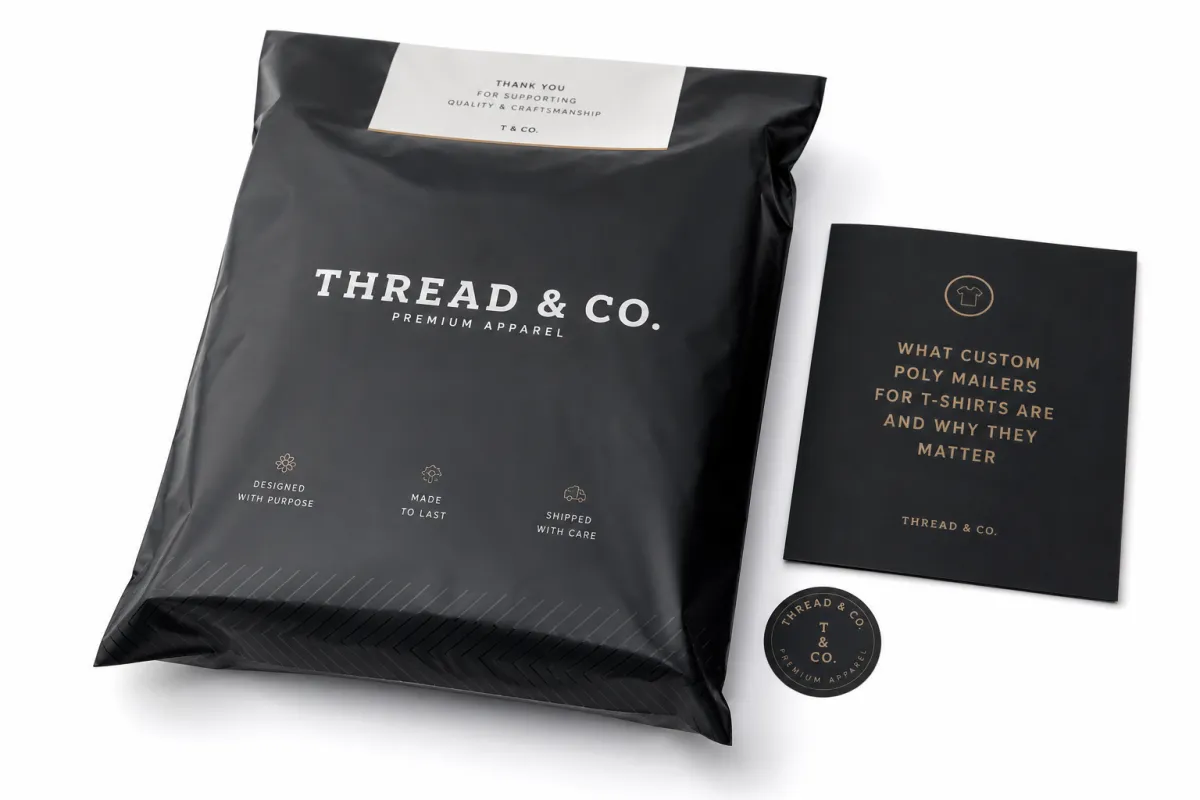
Custom poly mailers for t-shirts are printed plastic shipping bags made for flat-folded apparel, usually with a peel-and-seal adhesive strip, enough film strength to resist tearing, and a flexible body that wraps around a shirt without adding much weight. In practice, they are one of the simplest forms of product packaging for apparel because they do not fight the item; they hold it securely and send it out the door with very little fuss.
A plain poly mailer handles the basic shipping job. A custom version adds package branding. That can mean a one-color logo, a full-coverage pattern, a tone-on-tone design, or a color-matched exterior that ties into a product launch. For brands selling direct to consumer, that outer shell is often the first physical touchpoint, which is why custom poly mailers for t-shirts show up so often in retail packaging programs, merch drops, and seasonal promotions.
They also make practical sense for shirts because a tee is soft, foldable, and forgiving. A box can still be the right choice for bundled apparel, fragile inserts, or premium sets, but for a single garment, the box may add unnecessary cost and warehouse volume. I have watched plenty of apparel teams over-spec a carton because it felt safer on paper, only to find the extra structure slowed the pack line and bumped freight for no real gain. The tee was never the problem; the container was.
Good packaging should match the product, not overpower it. For custom poly mailers for t-shirts, the aim is to protect a soft good, keep the carton line moving quickly, and make the brand feel intentional without paying for structure you do not need.
One more practical point: these mailers work best for dry, flexible goods. They are not the right call for framed prints, ceramics, electronics, or anything that needs crush protection. For transit abuse, packaging teams often refer to standards such as ISTA test methods to think through vibration, drop, and compression risk, even when the shipment itself is simple.
Custom poly mailers for t-shirts are especially useful when you need to pack hundreds of orders quickly, because the fold, insert, seal, and label flow can be very consistent. That consistency matters. A shirt in a well-sized mailer usually arrives cleaner, faster, and cheaper than the same shirt packed in a box with too much air inside it.
There is also a trust piece here that gets overlooked. A mailer that arrives with the seam intact, the print readable, and the shirt protected tells the buyer that somebody paid attention. That signal is small, but small signals stack up fast in apparel.
How Custom Poly Mailers for T-Shirts Work in Shipping
The packing sequence is simple, and that simplicity is a big part of the appeal of custom poly mailers for t-shirts. The shirt gets folded to a standard size, a tissue sheet or insert card may be added, the garment slides into the mailer, and the operator peels the adhesive strip and presses the flap closed. That clean flow can shave valuable seconds from each pack-out, which adds up fast once the order count climbs.
The film thickness and seam construction are what keep that easy process from turning into a weak point. A mailer in the 2.5 to 3.0 mil range is common for standard apparel, while thicker constructions around 3.0 to 4.0 mil can give a little more puncture resistance for sharp hang tags, heavier cotton, or multi-piece orders. Strong side seams matter too, because a weak seam can split when the parcel flexes in a tote, a cage, or a delivery bin.
The printed surface usually sits on the outside, so the package itself becomes a small billboard for the brand. That is where custom poly mailers for t-shirts earn their keep in package branding. The customer sees the logo, the color system, the pattern, or the slogan before they ever touch the shirt. That first impression can be quiet or loud, but it should feel deliberate. A sloppy print layout, a blurry logo, or a color that disappears against dark film undercuts the whole point.
Mailers are also designed to stay flat. That helps with dimensional weight pricing in many lanes, because the parcel is not forced to occupy the cubic space of a box full of air. It is not a magic trick, and carriers still price by actual weight, zone, and size rules, but for a single tee the difference can be real enough to matter on a monthly shipping report. Many brands using custom poly mailers for t-shirts find that even a small postage delta improves margin once it is multiplied across a full launch.
Optional features can make the package more useful. Dual adhesive strips help with returns, tear strips make opening easier, opaque film protects privacy, and clear return-address windows can simplify cross-docking or warehouse sorting. If your custom poly mailers for t-shirts will be used in a returns-heavy channel, that second seal strip is not a luxury; it is a small operational insurance policy.
There is also a sustainability angle worth handling carefully. A mailer is not automatically greener than a carton, but a right-sized mailer can reduce material use and shipping weight. That is why many teams look at the EPA's recycling basics guidance and then ask the harder question: what is the lightest, safest package that still protects the shirt and fits the lane? The answer is often a well-sized mailer rather than an oversized box.
And yes, the customer notices. Even if they never say it out loud, a package that opens cleanly and does not come in looking like it fought its way through the belt room tends to feel better. That part is kinda hard to fake.
Choosing Size, Material, and Print for Custom Poly Mailers for T-Shirts
Size is the first decision, and it is where many buyers make an expensive mistake. Custom poly mailers for t-shirts should fit the folded shirt with a little breathing room, not with a lot of empty space. For a single standard tee, common starting points include 9 x 12 inches or 10 x 13 inches, while 12 x 15 inches often works better for heavier blanks, thicker folds, or a tee paired with a card insert. If the mailer is too small, the seam can strain and the fold can look crushed; if it is too large, the package looks sloppy and wastes film.
A good rule of thumb is to measure the folded shirt the way it is actually packed, not the way it looks on a table. A shirt folded by hand in a merchandising room can be slightly wider than the same shirt folded on a board at a fulfillment center. That difference is why sample packs matter. A size that looks fine on a spec sheet can feel awkward once tissue, a thank-you card, or a sticker pack is added. If you are narrowing down formats, the product details on our Custom Poly Mailers page can help you compare actual dimensions and build a cleaner fit.
Material choice is the next layer. Low-density polyethylene, often called LDPE, remains common because it gives a good balance of flex, sealability, and puncture resistance. Recycled-content blends are increasingly common too, especially for brands that want to reduce virgin plastic use. In that case, ask whether the blend contains post-consumer recycled content, post-industrial content, or a mix of both, and confirm that the film still holds up in your shipping lanes. A greener claim is only useful if the mailer still survives a rough tote ride and a few corners in transit.
Print decisions shape the visual feel. A one-color logo on a solid bag is economical and clean. A full-bleed graphic can feel more expressive, especially for streetwear, event merch, or subscription apparel. Dark films need stronger contrast, and tiny text can disappear faster than buyers expect. When a brand uses custom poly mailers for t-shirts as part of broader packaging design, the print should read at arm's length, in warehouse light, and on a moving truck floor, not just in a digital mockup.
Finish and opacity matter too. Gloss film gives a brighter, more reflective look, while matte film feels calmer and often photographs better in social posts. Solid-color opaque mailers keep the contents private and can hide light wrinkles more effectively than translucent stock. If privacy is a concern, especially for apparel shipped through mixed-use buildings, opaque custom poly mailers for t-shirts are usually the safer choice.
Sustainability tradeoffs deserve a direct answer. Downgauging the film from 3.0 mil to 2.5 mil can save material if the shipment still passes your drop tests. Right-sizing saves more waste than oversizing. Recycled content can help, but not every blended film performs the same way, so test before you order deep. The most credible sustainability conversation is the one that includes actual pack-out performance, not just a green tint in the artwork.
For brands comparing options across the broader line, it can help to review both mailers and other packaging formats in one pass. Some shipments still call for custom printed boxes, especially when the order includes premium inserts or fragile add-ons, but for most tee-only orders, custom poly mailers for t-shirts stay lighter, simpler, and easier to handle.
Finally, print coverage should match the role of the package. Full coverage often looks impressive, but a restrained logo layout can age better and leave more room for shipping labels, barcodes, or a handwritten note. The best custom poly mailers for t-shirts do not shout just to be noticed; they support the product and make the order feel finished.
If you are working through the material side of the decision, the EPA's recycling guidance at EPA recycling resources is useful for understanding how collection and local access vary by region. That context matters because a packaging choice is only truly sustainable if the customer can realistically dispose of it in the system available to them.
Cost and Pricing Factors for Custom Poly Mailers for T-Shirts
Price for custom poly mailers for t-shirts usually comes down to a handful of variables: size, film thickness, print colors, ink coverage, order quantity, and any extras like dual seals or tear strips. A simple one-color logo on a standard opaque mailer may land in a lower cost band than a full-bleed print on thicker film, and the spread can be meaningful once a brand starts moving past a few thousand units.
Volume is the biggest cost lever. At low quantities, setup and print prep absorb more of the total. At higher quantities, the unit price drops because the setup gets spread across more pieces. Small brands testing a new drop often care about minimum order quantities as much as they care about unit cost, because the wrong MOQ can tie up cash in packaging they will not use for months. That is especially true when custom poly mailers for t-shirts are one piece of a larger launch budget that also includes hang tags, labels, and insert cards.
| Option | Typical Unit Cost at 5,000 Pieces | Best Fit | Notes |
|---|---|---|---|
| Plain opaque mailer | $0.06-$0.12 | Low-risk replenishment orders | Fastest to source, but no package branding |
| One-color custom mailer | $0.12-$0.20 | Core apparel launches | Good balance of cost, speed, and brand visibility |
| Full-coverage custom mailer with extra features | $0.20-$0.35 | Premium drops, subscription programs, and return-friendly programs | Higher visual impact; dual strip or tear strip may add cost |
That table is only a starting point, because real quotes move with film market conditions, print coverage, freight distance, carton pack-outs, and whether the design uses one side or both sides of the bag. A mailer that looks cheap on paper can become less attractive once inland freight, warehouse storage, and labor are added. For that reason, ask for landed cost, not just printed-bag cost. Custom poly mailers for t-shirts often look better on a quote sheet than a box, but the real comparison should include everything from inbound freight to packing speed.
Storage and shipping also matter. A large mailer ordered in bulky cartons can take more space than a smaller, tighter-packed size, and less efficient case pack can raise freight cost. If a fulfillment center bills by pallet position or square footage, that difference can show up every month. Then there is labor: if a custom poly mailer for t-shirts speeds up the packing flow by even a few seconds per order, the labor savings can offset a higher unit price. That is why the cheapest mailer is not always the cheapest package.
Custom versus plain is another honest comparison. A plain bag costs less and can be bought quickly, but it does nothing for recall or presentation. A custom printed bag may cost more, yet it can eliminate the need for extra stickers or branded tape and still make the package feel intentional. For some brands, that trade is worth it because it turns a basic shipment into a more polished product packaging moment. For others, the plain bag is enough until volume justifies a branded upgrade. There is no single right answer, only the option that fits your margins and your customer experience.
When you request quotes, ask for at least three combinations: one smaller size, one core size, and one premium version with a feature upgrade. That comparison makes it easier to see how custom poly mailers for t-shirts change total cost as you move between SKUs. It also keeps you from falling into the trap of quoting only the size you already know, which can hide a better option that uses less film and ships more efficiently.
Brands that sell both apparel and accessories sometimes compare mailers with other branded formats such as retail boxes, inserts, or even custom printed boxes. That comparison is useful, because the right package is not always the most decorated one. Often it is the one that fits the garment, the route, and the packing floor with the least friction.
A lot of teams also miss a hidden cost: rework. If the bag is just a little too tight, packing slows down. If the print sits too close to the seal, staff start handling it gingerly and the line loses rhythm. That kind of friction is hard to see in a quote, but it shows up in labor pretty quickly.
Step-by-Step Process and Timeline for Custom Poly Mailers for T-Shirts
The production path for custom poly mailers for t-shirts usually starts with artwork and ends with a packed pallet at your dock. The smoothest projects move in a steady line: submit logo files, confirm dimensions, review a digital proof or printed sample, approve the final version, run production, inspect quality, and ship. The more complete your input is at the start, the less likely you are to lose time in revision loops later.
Here is the practical sequence most teams follow:
- Step 1: Gather logo files, Pantone references, print area, desired film color, and return-address copy.
- Step 2: Confirm the folded shirt size so the mailer dimensions make sense in real packing conditions.
- Step 3: Review a proof for layout, spelling, ink placement, and barcode or label space.
- Step 4: Approve a sample or pre-production proof if the project needs one.
- Step 5: Run production, inspect random cartons, and release the shipment only after key checks pass.
Lead time depends on the print method, the size of the run, and the freight lane. A simple order of custom poly mailers for t-shirts may move in roughly 12 to 15 business days after final proof approval, while more complex full-coverage work can take longer, especially if you need a sample round first. Add transit time on top of that, and first orders should always be scheduled with a buffer. Reorders usually move faster because the art and setup are already established.
That buffer is not optional. Small adjustments often show up during the first round of testing: the logo looks too close to the flap, the mailer is 10 percent too narrow for the fold style, or the return strip sits where the packing team does not want it. Fixing that before mass production is much cheaper than discovering it after a full pallet has landed. In other words, custom poly mailers for t-shirts are easy to get right once, but not always easy to correct after the fact.
Tracking reorder points is another part of the process that gets overlooked. If your monthly sell-through is predictable, set a threshold that leaves enough time for proofing and freight. For example, a brand that burns through 10,000 mailers a month should not wait until the last carton is open before placing the next order. A two- to four-week cushion is often healthier, especially when launch calendars, promotions, or holiday traffic can spike unexpectedly. That is true whether the package is a mailer or part of a more complex line of Custom Packaging Products.
The packing team should also be part of the timeline. If the warehouse uses a fold board, a tissue insert, or a thank-you card, those components need to be locked before the mailer is finalized. Otherwise the package spec changes under pressure, and the result is a bag that looked perfect on paper but does not pack smoothly at speed. Good custom poly mailers for t-shirts are a system choice, not a one-line item choice.
One useful habit is to keep a simple production checklist for each reorder: approved art, size, film thickness, print count, seal style, delivery address, and receiving contact. That may sound basic, but basic is what keeps the order from stalling in procurement. A packaging order that is missing one detail can sit for days while someone hunts down the final logo file or the correct ship-to pallet label.
I also like to keep one sample from each run in a cabinet or a labeled drawer. It sounds low-tech, but it saves time later when somebody asks whether the 10 x 13 bag from spring had a matte finish or the dual seal version.
Common Mistakes to Avoid with Custom Poly Mailers for T-Shirts
The first mistake is choosing the wrong size. Custom poly mailers for t-shirts that are too small stress the seams, wrinkle the garment, and make sealing awkward. Too much pressure on the flap can also weaken adhesion over time, especially if the bag is packed quickly or the shirt has a thick front print. A bag that is too large creates the opposite problem: wasted material, a loose look, and a parcel that can shift around more than it should.
The second mistake is treating artwork like it lives in a vacuum. Tiny text, low-contrast logos, and colors that disappear on dark film all create a weak brand impression. A good print can still look flat if the art was not designed for the actual bag color. This is where packaging design and production reality have to meet. A mockup on a screen is not enough. The real custom poly mailers for t-shirts need to be readable in warehouse light, on a moving belt, and under the glare of a delivery scanner.
The third mistake is skipping real-world testing. A folded shirt in a spec sheet behaves differently from a folded shirt with a neck tag, tissue wrap, or card insert. If you are shipping to hot, humid, or rainy lanes, test a few sample parcels and see how the film handles moisture, scuffing, and handling marks. If the mailer is supposed to protect against light dampness, send it through a lane that actually creates that stress. Then adjust before ordering deep.
The spec sheet does not pack the order. Your warehouse team, your fold style, and your actual shipping lanes tell the truth about whether custom poly mailers for t-shirts are the right fit.
Another common error is underestimating adhesive quality. Weak closure habits can lead to popped flaps, returns that open in transit, or visibly tired presentation when the parcel has been handled more than once. For custom poly mailers for t-shirts, adhesive is not a tiny detail; it is one of the main things keeping the package intact. If the mailer includes a return strip, make sure the packing team understands exactly how the first seal and second seal work.
Some brands also forget that a mailer is not the only answer. If a shirt is paired with a fragile pin set, a premium booklet, or a rigid insert, a mailer may not be enough. In those cases, a box or padded mailer may be the more honest choice. That is not a failure of custom poly mailers for t-shirts; it is simply the package matching the shipment. The best packaging decision is the one that keeps the order safe without overspending on materials that the shipment does not need.
Finally, do not approve an order just because the print looks good on the proof. Ask to see how the mailer folds, how the flap closes, and how the finished bag feels in the hand. A beautiful graphic that interferes with sealing or labeling is not a good package, no matter how strong the render looks on a screen.
One more thing I see a lot: teams approve a mailer before they decide on the fold standard. That usually means the final bag is workable, but not quite ideal. Fix the fold first, then size the bag to the fold.
Expert Tips and Next Steps for Better Custom Poly Mailers for T-Shirts
If you want custom poly mailers for t-shirts to work well at scale, start by ordering samples in the exact fold style your team will use every day. That sounds obvious, but it is the fastest way to confirm fit, sealing speed, and shelf presentation. A shirt folded with a template board will not behave exactly like one folded by hand, and the difference shows up the moment packing starts.
Next, create a simple packing standard. That can mean a consistent fold, the same tissue size, a fixed card insert, and one seal method for every order. The more repeatable the pack-out, the more repeatable the customer experience. A disciplined process also makes custom poly mailers for t-shirts look better because the garment sits in the bag the same way every time. Consistency is a quiet form of branding, and it matters more than many teams realize.
Test a few lanes with real parcels before you commit the full volume. Send packages through the routes that matter most to your brand and look for scuffing, corner wear, label adhesion, and moisture behavior. Also check the unboxing photo. If the package photographs well when it arrives, that is a sign the presentation is holding together under real pressure. If you sell apparel that lives on social media as much as on a shelf, that visual check is worth doing.
For launch planning, line up production with your inventory calendar instead of waiting for a packaging emergency. Confirm art early, lock the size, and place the reorder before stock gets thin. A launch can stall if the garment is ready but the packaging is not. That is especially true for seasonal collections, influencer drops, and event merch, where a few missing cartons of custom poly mailers for t-shirts can slow the entire fulfillment flow.
It also helps to look at packaging through the lens of the whole order, not just the mailer. If the tee is going into a premium bundle, you may want a box, a belly band, or a folded insert card alongside the mailer or instead of it. That broader view keeps the package aligned with the brand promise. Sometimes custom poly mailers for t-shirts are the best answer. Sometimes a mailer plus a branded insert does the job. Sometimes the order really does need custom printed boxes. The right call depends on the product mix, not on habit.
One practical habit I recommend is to keep a running sample archive. Save one approved mailer from each print run, note the size and film spec, and write down any issues the packing team noticed. Over time, that archive becomes a reference library that saves time on reorders and helps new staff learn what "good" looks like. It also makes vendor conversations easier because you can point to an actual previous run instead of trying to describe a memory.
Another small but useful step is to have the pack line run ten or twenty test orders before a launch. That gives you a real read on speed, appearance, and seal behavior. If anything feels off, you can adjust without burning through a full batch.
If you are just getting started, audit your current packaging, measure your folded shirts, request quotes in two or three sizes, and compare sample runs before you place a full order of custom poly mailers for t-shirts. That sequence keeps the decision practical, protects your margins, and gives your brand a cleaner unboxing without overcomplicating the packing floor. For many apparel sellers, custom poly mailers for t-shirts are the sweet spot between branded packaging, shipping efficiency, and everyday warehouse speed.
Frequently Asked Questions
What size custom poly mailers for t-shirts should I choose?
Measure the folded shirt first, then choose a mailer that gives a clean slip-in fit without a lot of empty space. For many single-tee orders, 9 x 12 inches or 10 x 13 inches is a practical starting point, while thicker folds or bundled orders may need a larger size. If you sell both single tees and two-piece packs, test at least two sizes so your custom poly mailers for t-shirts cover both use cases without forcing the shirt or leaving the package loose.
Are custom poly mailers for t-shirts waterproof?
They are water-resistant, not fully waterproof. That means they help protect shirts from light rain, handling moisture, and normal transit exposure, but they are not meant to sit in standing water. If your lane is exposed to weather, add an inner poly bag, tissue wrap, or a folded insert before sealing the outer mailer. That extra layer gives custom poly mailers for t-shirts a better chance of arriving clean and presentable.
How much do custom poly mailers for t-shirts usually cost?
Pricing depends on size, film thickness, print coverage, quantity, and add-on features like dual strips or tear notches. At volume, a plain mailer may be far less expensive than a fully printed version, while custom branding can still pay back through better presentation and less reliance on stickers or tape. Ask for landed pricing, not just unit price, so you can compare freight, setup, and any other hidden costs tied to custom poly mailers for t-shirts.
Can I use custom poly mailers for t-shirts with returns?
Yes, if you choose a mailer with a second adhesive strip or design a return-friendly sealing method. That second seal gives the customer a clean way to repack the garment without needing a new bag. For returns-heavy programs, keep the opening neat and include a simple return instruction card inside. Done well, custom poly mailers for t-shirts can support both outbound shipping and returns handling.
How long does it take to produce custom poly mailers for t-shirts?
Lead time depends on art approval, print method, order size, and freight distance, so the first order usually takes longer than a reorder. A straightforward run may move in roughly 12 to 15 business days after proof approval, while more complex work can take longer. Build in extra buffer before a launch so sampling and production do not collide with your ship date, especially if the custom poly mailers for t-shirts need a sample round first.
If you are choosing a package this week, start with the shirt fold you actually ship, not the one you wish you shipped, then test two sizes, check the seal, and price the landed cost before you place the order. That simple sequence will usually tell you whether custom poly mailers for t-shirts are the right fit, and it keeps you from paying for film, labor, or freight you do not need.

