Buyer Fit Snapshot
| Best fit | Custom Poly Mailers With Logo projects where brand print, material claims, artwork control, MOQ, and repeat-order consistency need to be specified before quoting. |
|---|---|
| Quote inputs | Share finished size, material target, print colors, finish, packing count, annual reorder estimate, ship-to region, and any compliance wording. |
| Proofing check | Approve dieline scale, logo placement, barcode or warning zones, color tolerance, closure strength, and carton packing before bulk production. |
| Main risk | Vague material claims, crowded artwork, missing packing details, or unclear freight terms can make a low unit price expensive after revisions. |
Fast answer: Custom Poly Mailers With Logo: Branding, Cost, and Use should be specified like a repeatable production item. The safest quote records material, print method, finish, artwork proof, packing count, and reorder notes in one written spec.
Production checks before approval
Compare the actual filled-product size with the drawing, then confirm tolerance on folds, seals, hang holes, label areas, and retail display edges. Reserve space for logos, QR codes, warning copy, and material claims before decorative graphics fill the panel.
Quote comparison points
Review material grade, print process, finish, sampling route, tooling charges, carton quantity, and freight assumptions side by side. A quote is only useful when the supplier can repeat the same color, closure quality, and packing count on the next order.
Custom Poly Mailers With Logo: Branding, Cost, and Use
Learn how custom poly mailers with logo work, what they cost, and how to Choose the Right material, print method, and timeline for your brand.
The outer package often gets judged before the product does, and Custom Poly Mailers with logo are built to shape that first reaction in your favor. A customer may never think twice about the carton sitting on a warehouse shelf, yet the mailer is what lands in their hands, what sits on the kitchen table, and what gets opened in front of a friend, a roommate, or a camera lens. That moment carries real weight. Custom poly mailers with logo turn a shipping envelope into part of the brand experience while staying light, practical, and cost-conscious.
From a packaging buyer's point of view, this format solves three problems at once. It keeps shipping weight low, it gives the brand a clean surface for print, and it often costs less than moving every order into printed cartons. Apparel labels, beauty brands, subscription programs, and resale operations all rely on Custom Poly Mailers with logo because they protect soft goods without forcing every shipment into a rigid box. The question is not whether branded mailers look better than plain ones. The question is whether they improve the total mailing program enough to justify the spend.
That answer depends on size, thickness, print method, lead time, and the way the mailer fits into the rest of the packaging system. In practice, the strongest custom poly mailers with logo are not the loudest or most decorated. They are the ones that close properly, hold up in transit, and make the first impression feel deliberate rather than improvised.
Custom Poly Mailers With Logo: The Packaging Signal Customers See First
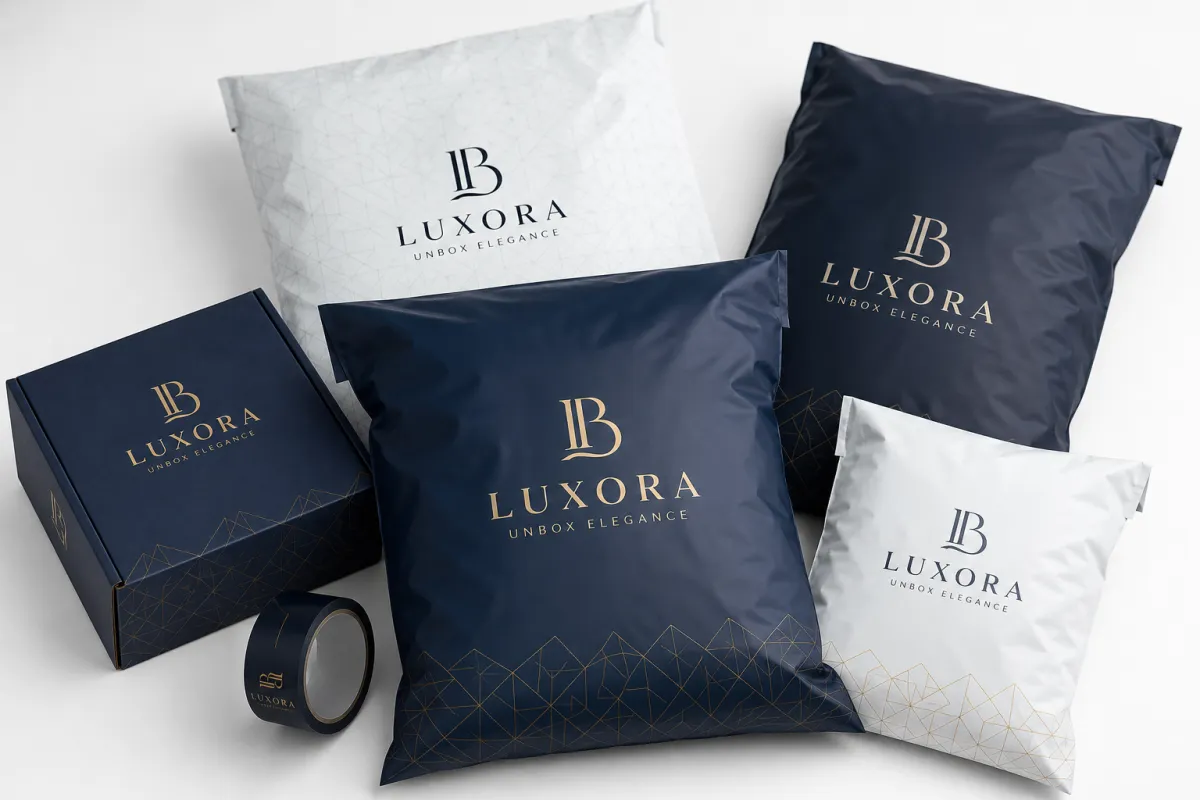
Here is the packaging reality that often gets missed: the shipping outer usually speaks before the product, the tissue, or the site experience does. A plain mailer says function. A branded one says the brand paid attention. That difference matters for e-commerce companies that depend on repeat purchases, social sharing, and a polished first touch. Custom poly mailers with logo may be small, but they carry a strong visual signal.
They are lightweight plastic mailing envelopes made for shipping soft or flexible products. Most use polyethylene film with a self-seal adhesive strip, and many include a tear strip for easy opening. Some are simple single-wall mailers. Others include dual-seal closures for outbound and return use. In every case, custom poly mailers with logo combine protection, brand visibility, and lower postage weight than a box usually requires.
That is why they show up across apparel, accessories, subscription kits, and return programs. A folded T-shirt does not need a rigid carton. A scarf, a hat, a pair of leggings, or a lightweight beauty bundle often travels better in a properly sized mailer. The format also works well for brands that want to keep opening friction low. One clean peel strip and one clean seal. No extra tape. No wasted motion.
Decoration alone is not the point. A mailer can look great and still be wrong for the job. If it tears before it reaches the customer, the branding did not help. If it is oversized, the package looks loose and wasteful. If the adhesive fails, the best artwork in the world will not rescue the shipment. That is why custom poly mailers with logo should be judged as part of a shipping system, not as a standalone design piece.
For brands building out broader Custom Packaging Products, the mailer often becomes the first visible layer of a package branding strategy. It can echo color, logo placement, and typography used in Custom Poly Mailers or even mirror the feel of custom printed boxes when those are reserved for higher-value orders. That kind of consistency matters. Customers do not separate the mailer from the brand experience. They remember the whole package as one story.
"A branded mailer is not just a shipping shell. It is a cue that tells the buyer how much care to expect from the brand behind it."
The better comparison is not plain versus printed. It is intentional versus accidental. A thoughtful mailer can elevate branded packaging, reinforce retail packaging standards for direct-to-consumer shipments, and reduce the need for extra inserts or overpacking. I have seen brands spend more on inserts than they needed to simply because the outer packaging never got sorted out. A cleaner mailer spec often fixes that without much drama, which is kinda the point. That is where custom poly mailers with logo start earning their keep.
How Custom Poly Mailers With Logo Are Produced
Most buyers only see the finished bag, but the production sequence determines how it performs. A typical run for custom poly mailers with logo starts with film extrusion. Resin pellets are melted and formed into a continuous polyethylene film, which is then printed, cooled, cut, folded, sealed, and packed for shipment. The exact process changes by supplier, but the logic stays the same: make the film, decorate the film, convert it into a mailer, then verify that it ships cleanly.
Printing is where a lot of the value is won or lost. Flexographic printing is common for larger runs because it handles repeatable artwork efficiently and keeps unit pricing more predictable as quantity rises. Digital methods can help with shorter runs, complex art, or faster proofing, although they may not always match the economics of long production runs. If your logo uses a bold solid fill, a spot-color approach may be enough. If the artwork includes gradients, detailed patterns, or multiple panels, the cost and setup complexity can rise quickly. That is why custom poly mailers with logo should be designed with the print process in mind, not just appearance.
Coverage area matters too. A small front logo and a one-color repeat print are easier to produce than full-bag art with reverse-side printing. Color count matters because each extra color can add setup work and increase the chance of misregistration. In practical terms, a one- or two-color design often gives the cleanest balance of cost and appearance for custom poly mailers with logo. More color is not automatically better. Clear contrast and smart placement usually beat busy decoration.
Proofing is the safety net. A proper proof should show logo placement, Pantone or CMYK references, print boundaries, and bag dimensions. This is where brands catch issues like a logo sitting too close to the seal, text that becomes too small after scaling, or a color that looks muddy against the film. Good suppliers also provide a sample or press proof before the full run, which is especially useful if brand color consistency matters across product packaging and shipping materials.
Small functional details matter just as much as artwork. Adhesive quality affects how well the bag closes under dust, humidity, or repeated handling. Tear strips help the end customer open the package without scissors. Gussets can add a little more packing room, which helps when a folded garment needs breathing space. Dual-seal options create a return path, which can be valuable for apparel and accessories brands that handle exchanges. These are not flashy features, but they affect day-to-day shipping performance more than many buyers expect.
If you want to benchmark quality claims, transit performance is often tested against distribution standards rather than guesswork. Many packaging teams look at resources from the ISTA for shipping test methods and from the Packaging Machinery Manufacturers Institute for broader packaging context. That kind of reference point helps brands compare claims to real-world handling rather than assuming every printed mailer is equal.
For brands that also use paper-based components or recycled paper inserts, certification questions can come up too. The FSC system matters for paper sourcing, while the EPA's recycling guidance at epa.gov/recycle is a useful reality check on what actually gets recovered in the waste stream. Those references do not make a mailer automatically sustainable, but they do help separate marketing language from packaging facts.
Choosing Size, Thickness, and Finish for the Right Fit
Size is where many buyers make the first costly mistake. They measure the product itself, not the packed product. That sounds minor, but it can create a badly fitting mailer that stretches at the seams, bulges at the seal, or wastes material because the bag is too large. For custom poly mailers with logo, the better method is to measure the finished shipping unit: product, tissue, insert card, protective wrap, and any closure slack needed for a clean seal.
Thickness is usually discussed in mils, and that number tells you more about durability than most buyers realize. A thinner mailer can work for soft, low-risk items, but sharper-edged products, dense bundles, and higher-volume shipping routes often need a sturdier film. A common buying range is around 2.5 to 3 mil for light apparel and 4 mil or higher for heavier or more abuse-prone items. That is not a hard rule. It depends on product shape, carrier handling, and how often the brand sees corner punctures. Still, thickness is one of the biggest predictors of whether custom poly mailers with logo hold up in transit.
Finish affects both appearance and handling. Matte tends to look more controlled and less reflective. Gloss reflects more light and can make colors pop, but it also shows scuffs and fingerprints more easily. If the goal is premium shelf presence, matte often feels more restrained. If the goal is bright impact in transit photos or social content, gloss can do more visual work. Either way, print sharpness and color contrast need to match the finish. A soft matte surface can make small text harder to read if the artwork is not designed carefully.
Opacity is another practical feature, especially for apparel, beauty, and subscription shipments. Most brands do not want customers seeing shapes through the film, and carriers do not need to know what is inside. Better opacity also improves perceived quality. A flimsy translucent bag can make the shipment look underbuilt even when the product inside is fine. With custom poly mailers with logo, opacity is part of the brand signal, not just a privacy setting.
Sustainability deserves a sober look. Recycled-content mailers can reduce dependence on virgin resin, and reusable return structures can extend the life of the package. But recycled plastic is not a magic answer. Performance can vary, local recycling options are inconsistent, and some recycled-content films may print differently or feel less crisp. If the brand message is eco-conscious, ask for test data, material composition, and realistic guidance on disposal. Do not assume a green label equals better real-world outcomes.
| Mailer Option | Typical Use | Common Spec | What It Usually Does Well | Tradeoff |
|---|---|---|---|---|
| Standard matte poly mailer | Apparel, accessories | 2.5-3 mil, one-color print | Clean look, low weight, easy branding | Less abrasion sheen than gloss |
| Gloss poly mailer | Promo drops, bright branding | 2.5-3 mil, spot colors | Strong color pop, high visual contrast | Shows scuffs and fingerprints faster |
| Heavy-duty mailer | Dense or sharp-edged goods | 4 mil+, reinforced seal | Better puncture resistance and seal confidence | Higher cost and slightly more material use |
| Recycled-content mailer | Brands with sustainability targets | Varies by supplier and resin mix | Supports recycled material goals | Performance and print feel can vary |
That table is a useful reminder that material choice should track the product, not the mood board. The most successful custom poly mailers with logo usually balance appearance, seal strength, and enough film thickness to survive the route the parcel actually takes.
Custom Poly Mailers With Logo Pricing: What Changes the Quote
Pricing for custom poly mailers with logo is driven by a few variables that matter far more than hype. Quantity is the biggest one. Size comes next. Then film thickness, print colors, and the amount of artwork coverage. If a supplier has to set up plates, prepare more ink stations, or manage a more complex print layout, the quote rises. If the order volume is large enough to spread setup costs across thousands of pieces, unit pricing usually drops in a noticeable way.
For planning purposes, many brands see starter runs land in the neighborhood of $0.18-$0.35 per unit for smaller quantities, while larger orders can move closer to $0.06-$0.18 per unit depending on size, thickness, and print coverage. Those are working ranges, not promises. A bag with a single logo hit will cost less than a full-coverage pattern. A heavy-duty bag costs more than a basic garment mailer. And custom shapes or extra features can move the number quickly. The useful question is not "What is the cheapest option?" It is "What does the full mailing program cost once print, freight, and damage risk are included?"
Freight matters more than many buyers expect. On small orders, shipping can add a meaningful amount to the landed cost. In some cases, the freight bill and the packaging bill are close enough that the comparison becomes distorted if you only look at the unit price. Storage also matters. A large order can lower unit cost but create space pressure if the brand does not have a proper inventory system. Rush fees, sample revisions, and artwork changes can also creep in. Those are the hidden line items that make custom poly mailers with logo more expensive than the first quote suggests.
Here is a simple way to think about value. If branded mailers reduce damage complaints by even a small amount, the savings can offset part of the premium. If they improve repeat purchase behavior, they may pay back through customer retention rather than direct packaging savings. If they simply look better but do not help shipping or brand recall, the math gets weaker. Operators should treat custom poly mailers with logo as part of total packaging cost, not a cosmetic line item.
There is also a real tradeoff between custom printed boxes and mailers. Boxes can feel more premium and provide more structure, but they usually carry higher material and freight costs. Mailers are lighter, faster to pack, and often better for soft goods. For many brands, the best answer is not one format forever. It is using custom mailers for the majority of orders and saving heavier custom printed boxes for higher-value products, gift sets, or fragile items. That is a more disciplined use of branded packaging than trying to make every shipment do the same job.
One more comparison helps. Think about unit price versus total value. A cheaper plain mailer might look efficient until you account for labor, second seals, damaged goods, and weaker package branding. A slightly more expensive custom poly mailers with logo order can actually lower the true cost per shipment if it improves speed and consistency at the packing table.
Custom Poly Mailers With Logo Process and Timeline
Timing is where many brands get surprised. The process for custom poly mailers with logo is not just "place order, receive packages." It usually runs through quote review, artwork submission, proof approval, production, quality check, and freight. If any one of those steps stalls, the delivery date moves. That is why smart packaging planners build slack into the schedule before a launch or seasonal peak.
A typical timeline might look like this: 1 to 3 business days for quote and spec alignment, 1 to 4 days for artwork proofing depending on how ready the files are, 7 to 15 business days for production after approval, then transit time on top of that. Complex print jobs, larger runs, custom film specs, or unusually busy manufacturing windows can extend the schedule. Smaller or simpler custom poly mailers with logo orders may move faster, but only if the artwork is clean and the supplier has capacity.
The biggest timing mistake is waiting until launch week. Another common error is assuming every vendor can rush a print run without cost or compromise. If the artwork has to be corrected, the logo is low resolution, or the color references are vague, the proof cycle stretches. If the brand expects exact color matching, more rounds of sampling may be needed. That is normal. It is also why lead time should be planned as part of packaging design, not handled as an afterthought.
Seasonal drops deserve extra caution. Holiday peaks, back-to-school runs, and subscription launches can all create a squeeze on production and freight. A brand that wants custom poly mailers with logo ready for a specific date should work backward from the ship date, not the order date. Build in time for sample review, internal approvals, and a buffer for freight delays. If the run is replenishing a fast-moving item, keep safety stock so that one late shipment does not stop the packing line.
For brands operating in multiple channels, the timing question becomes even more important. A mailer used for DTC orders may need to arrive before a retail packaging campaign, a promotional insert, or a broader product packaging refresh. In those cases, coordination matters as much as production speed. A smart rollout keeps the mailer, inserts, and labels aligned so the customer sees one coherent story instead of three separate branding decisions.
Step-by-Step Guide to Ordering Custom Poly Mailers With Logo
The ordering process goes more smoothly when the buyer thinks like an operator, not just a designer. Start with a packaging audit. What products are shipping? How often? What is failing now? If the current mailers tear, overfill, or create a sloppy unboxing, that is the problem the new spec must solve. Custom poly mailers with logo should fix a shipping issue or strengthen a brand outcome, preferably both.
Next, choose the specs in a sensible order. Size comes first. Thickness comes second. Finish comes third. Seal style, print area, and quantity follow. That sequence matters because the print decision should fit the bag, not the other way around. For instance, if the mailer needs to hold a folded hoodie plus a return insert, the size cannot be guessed from the hoodie alone. The bag has to accommodate the real packed thickness and still seal cleanly.
Artwork prep is where a lot of avoidable problems happen. Logos should be supplied in vector format when possible. Raster files need enough resolution to avoid soft edges. Colors should be specified clearly, and if the brand has a Pantone standard, it should be shared early. Safe margins matter because text near a seal line or fold can disappear. When the artwork is crowded, the final result can look generic instead of premium. Strong custom poly mailers with logo layouts tend to use fewer elements and stronger contrast.
Request a digital proof, and if the order is large enough or the color match is critical, ask for a physical sample. That extra step is often worth the delay. It catches issues that a screen cannot show well, such as opacity, finish feel, and how the logo behaves under light. If the brand has multiple pack sizes or a wide SKU range, test the heaviest item first, not the easiest one. The goal is to validate the hardest case.
Once the order lands, inspect the first cartons carefully. Check count, print quality, seam strength, adhesive closure, and color consistency across a few random units. If the first run performs well, it becomes the baseline for future replenishment. That makes later buying faster and easier, because the team already knows what good custom poly mailers with logo look and feel like.
Here is the sequence in plain terms:
- Measure the packed product, not just the product alone.
- Select size, thickness, finish, and seal style.
- Prepare clean artwork and color references.
- Review a proof or sample before full production.
- Inspect the first shipment and record the approved spec.
Common Mistakes to Avoid With Custom Poly Mailers
The most obvious mistake is buying a mailer that is too small. A tight fit stresses seams, slows packing, and can make sealing unreliable. It may also leave the brand with an awkward-looking package that appears stuffed rather than designed. Custom poly mailers with logo should fit the product with just enough slack to close cleanly and protect the edges.
Another error is under-specifying thickness. This is especially risky for sharp-edged goods, bundled apparel, boxed accessories, or any product that sees rougher carrier handling. A mailer that looks fine on a desk can fail once it meets conveyor belts, corners, and stack pressure. The difference between acceptable and problematic often comes down to a fraction of a mil and the quality of the seal. Thin material might save a little money, but it can create losses through damage or replacement shipments.
Artwork can fail quietly too. A logo with weak contrast may vanish against the film. A crowded design may look busy instead of polished. A print layout that ignores fold lines can hide the most important part of the brand mark. That is why custom poly mailers with logo should be reviewed at actual size, not just as a thumbnail on a laptop. Design files that look sharp on screen can behave very differently on a moving substrate.
Price-only buying causes trouble as well. A low quote is easy to celebrate until the buyer adds freight, reorders, rush fees, and damage rates. A higher-quality mailer may cost more upfront and less over time if it reduces labor and replacements. That is not theory. It is ordinary operations math. The best packaging teams compare landed cost, not headline price.
Do not skip real-world testing. Put the actual product in the actual mailer. Add inserts. Tape the seal. Shake it. Stack it. Ship a few units through the normal route. That simple test reveals more than a spec sheet will. A mailer can look great in isolation and still fail under normal use. With custom poly mailers with logo, field testing is not optional if the product mix is varied or the shipping environment is rough.
Another mistake is treating sustainability claims too casually. If a supplier says a bag contains recycled content, ask what percentage, what resin type, and how that material performs. If the brand wants lower-impact packaging, the answer may be to reduce size, cut excess print coverage, or standardize mailer inventory before chasing a marketing label. Good package branding should stand up to scrutiny, not just a sales deck.
Expert Tips and Next Steps for a Better Mailing Program
If a packaging program has gotten messy, the fix is usually not a new trend. It is a better spec sheet. Create one page that lists product dimensions, packed weight, mailer size, thickness, finish, seal style, print colors, and acceptable reorder tolerance. That document makes future quotes faster and much easier to compare. It also prevents the common problem of a buyer describing the same custom poly mailers with logo order three different ways to three different suppliers.
Test two or three options side by side if the budget allows. Send actual product through each version and track damage, customer comments, and packing time. Small operational gains matter. If one mailer saves ten seconds per pack line and eliminates a few returns per hundred shipments, that may be worth more than a slightly cheaper bag. Brands often focus on unit price and ignore labor, but labor is where the hidden savings usually live.
Standardization helps too. Too many sizes create inventory clutter, purchase order noise, and packing confusion. Fewer sizes make forecasting easier. They also reduce the chance of using the wrong bag on the wrong product, which is more common than teams admit. A leaner packaging system is usually a more reliable one. That is true for custom poly mailers with logo, and it is equally true for inserts, labels, and secondary packaging.
A pilot run is worth considering before a full rollout, especially for new product lines or seasonal changes. A pilot gives the team a chance to find fit issues, color issues, or handling issues before the main order lands. It also helps customer service teams answer questions with confidence. If a brand plans to use the same package branding across e-commerce, returns, and promotional drops, the pilot can show whether one spec really works across all of them.
Three practical next steps usually make the biggest difference: measure the current shipments, collect the artwork files, and request sample quotes with landed cost included. Once those numbers are in hand, it becomes much easier to decide whether custom poly mailers with logo should replace plain mailers on the most visible orders, or whether they belong only on selected SKUs. In many cases, the answer is selective rollout first, then broader adoption if the performance and brand impact justify it.
My honest take: custom poly mailers with logo work best when they are treated as part of the operating model, not as decoration. If the size is right, the print is clean, the seal is dependable, and the cost is measured against total shipment value, they can improve both branding and efficiency. If the order is rushed, overdesigned, or chosen only on price, they can become an expensive version of the same old shipping problem. The smartest brands use custom poly mailers with logo to make the package feel intentional, reduce friction at pack-out, and support a packaging system that actually holds up in the real world. The next move is simple: measure one packed order, order one proof, and run one live shipping test before you approve the full production spec.
FAQ
What size custom poly mailers with logo should I use for folded apparel?
Measure the folded product plus any tissue, inserts, or marketing cards before choosing a size. Leave enough slack for a flat fit so the seal closes cleanly without stressing the seams. Test with your heaviest or bulkiest item first, not your smallest SKU.
How much do custom poly mailers with logo usually cost per unit?
Price depends mainly on quantity, size, thickness, print coverage, and number of colors. Setup costs are spread across the run, so larger orders usually lower the per-piece price. Freight and rush charges can matter as much as the mailer itself on smaller orders.
Are custom poly mailers with logo waterproof enough for shipping?
Poly mailers are typically water-resistant and protect against rain, splashes, and damp handling. They are not meant for full submersion, so fragile items may still need inner protection. If weather exposure is a concern, ask for stronger film and a reliable adhesive seal.
How long does it take to produce custom poly mailers with logo?
Timing usually includes proofing, production, quality checks, and transit time. Small or simple runs can move faster than highly customized or large-volume orders. Approvals are often the biggest delay, so having artwork ready speeds up the process.
Can I use recycled material for custom poly mailers with logo?
Yes, many suppliers offer recycled-content or lower-waste options. The best choice depends on your brand goals, local recycling realities, and performance needs. Ask how the material behaves in real shipping conditions before treating it as an eco upgrade.

