Buyer Fit Snapshot
| Best fit | Custom Poly Mailers for Dropshipping projects where brand print, material claims, artwork control, MOQ, and repeat-order consistency need to be specified before quoting. |
|---|---|
| Quote inputs | Share finished size, material target, print colors, finish, packing count, annual reorder estimate, ship-to region, and any compliance wording. |
| Proofing check | Approve dieline scale, logo placement, barcode or warning zones, color tolerance, closure strength, and carton packing before bulk production. |
| Main risk | Vague material claims, crowded artwork, missing packing details, or unclear freight terms can make a low unit price expensive after revisions. |
Fast answer: Custom Poly Mailers for Dropshipping: Film, Print, MOQ, and Carton Packing should be specified like a repeatable production item. The safest quote records material, print method, finish, artwork proof, packing count, and reorder notes in one written spec.
Production checks before approval
Compare the actual filled-product size with the drawing, then confirm tolerance on folds, seals, hang holes, label areas, and retail display edges. Reserve space for logos, QR codes, warning copy, and material claims before decorative graphics fill the panel.
Quote comparison points
Review material grade, print process, finish, sampling route, tooling charges, carton quantity, and freight assumptions side by side. A quote is only useful when the supplier can repeat the same color, closure quality, and packing count on the next order.
Custom Poly Mailers for Dropshipping: Practical Tips
A folded T-shirt can ship in something surprisingly small, yet the packaging choice still affects postage, pack-out speed, and the first impression the customer gets at the doorstep. That is the everyday value of Custom Poly Mailers for dropshipping: they keep soft goods compact, they reduce dead space, and they put the brand in front of the buyer before the product is even touched. In practice, that little parcel has a bigger job than most store owners expect.
From a packaging buyer’s point of view, these mailers are not just plastic sleeves with a logo printed on them. They are purpose-built shipping formats for low-bulk ecommerce, shaped around film strength, print quality, closure style, and the real-world size of the item going inside. Many teams start by reviewing Custom Packaging Products, then narrow the shortlist into Custom Poly Mailers or Custom Shipping Boxes based on the product mix they actually ship week after week.
That choice has consequences. A generic mailer can move an order through the carrier network, sure, but Custom Poly Mailers for dropshipping also carry branding, keep the packing routine consistent, and give the shipment a cleaner finish when it lands. Apparel basics, accessories, subscription items, and small bundled products often fit this format well, which is why the mailer becomes part of the fulfillment system rather than a last-minute shipping decision.
The sweet spot is easy to picture: a lightweight order leaves the warehouse in a compact parcel that looks deliberate, travels efficiently, and still feels branded. Practical shipping and packaging presentation are not fighting each other there; they are working together.
What custom poly mailers for dropshipping actually solve
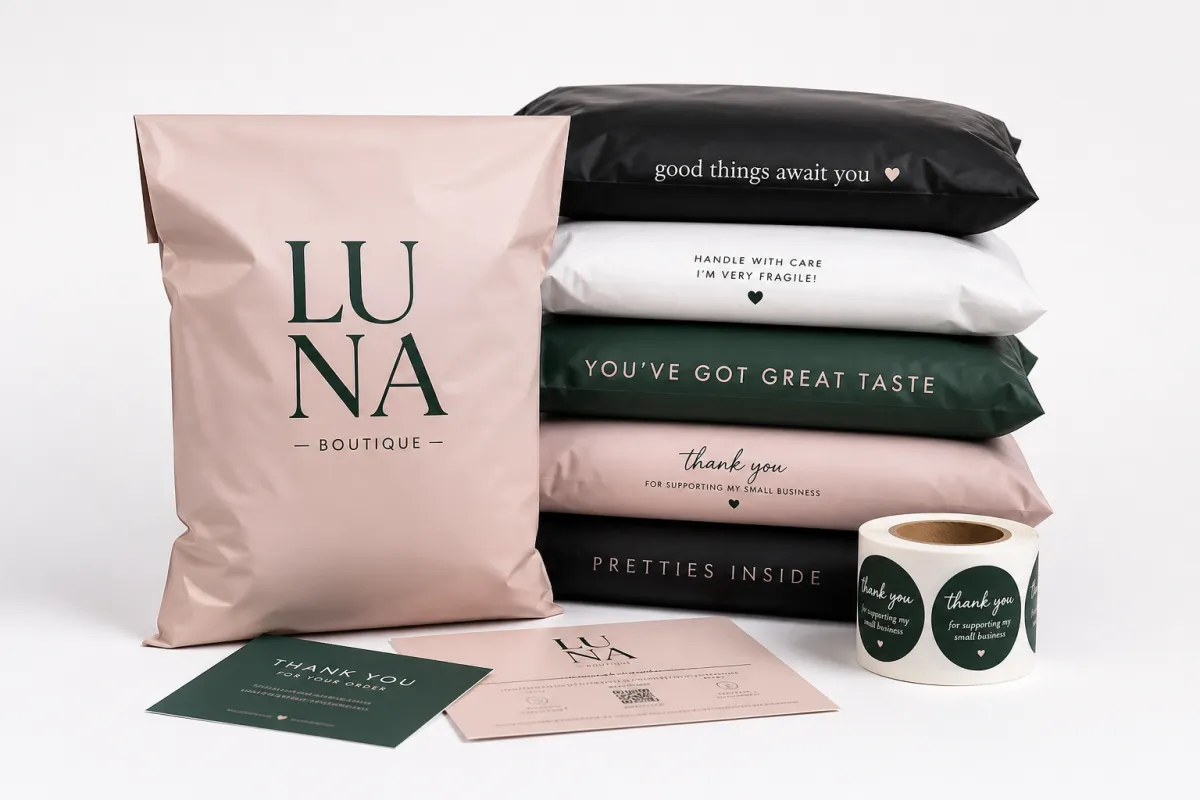
Think about a store sending out a single hoodie or a pair of socks. Put that order in a carton that is too large and the package can feel wasteful before the customer opens it. Put it in Custom Poly Mailers for dropshipping and the parcel stays smaller, the label sits cleanly, and the brand is visible the moment it lands on the porch. That is a modest shift on paper, but customers notice it immediately. I have seen plenty of brands improve the perceived quality of their shipments without changing the product at all; the packaging did the heavy lifting.
A custom poly mailer is a flexible plastic mailer built around your size, print, and closure requirements. It can carry a logo, repeat artwork, a return address panel, care details, or a restrained brand mark. The film is usually light, yet it still needs enough toughness to handle normal ecommerce shipping lanes, and it often includes a self-seal strip so packing moves quickly. For dropshipping, that speed matters because labor cost lives inside every order, even if nobody sees it on the invoice.
These mailers usually solve a few practical problems at once:
- Lower shipping weight: less packaging mass means less chance of paying for avoidable dimensional weight.
- Faster fulfillment: a self-seal mailer closes faster than a carton that needs folding, taping, and fill material.
- Cleaner branding: the customer sees the color, logo, and package identity right away.
- Less overpacking: soft goods rarely need a rigid box unless the product is fragile or oddly shaped.
The real gap between generic and custom mailers is consistency. A plain white mailer can do the job, but it does not keep reinforcing the brand after checkout. A custom format gives control over tone, color, and presentation, which helps if the store wants a retail feel even though the shipment moves through standard parcel channels. That is why many sellers treat Custom Poly Mailers for dropshipping as both a logistics tool and a brand asset.
Inventory planning gets easier too. Once the top products fit two or three standard sizes, the packaging kit stays tighter, new hires learn faster, and busy periods become less chaotic. A clear mailer system helps whether the business is sending 50 parcels a week or 5,000. It is one of those unglamorous decisions that quietly makes the rest of operations behave better.
For brands that ship both apparel and non-apparel items, poly mailers and custom printed boxes can work together instead of competing. Use mailers for flexible goods and boxes for items that need rigidity, stacking strength, or a more premium presentation. That is usually the cleanest way to build a packaging system that holds up in day-to-day fulfillment.
How custom poly mailers for dropshipping work in fulfillment
The fulfillment path is simple, but the details carry the weight. Product gets picked, folded or bundled, placed into the mailer, the seal strip is closed, and the label goes on. With custom poly mailers for dropshipping, that sequence usually moves faster than box packing because there are fewer material steps and less time spent dealing with void fill or tape lines. In a third-party warehouse or lean dropshipping setup, that difference matters a lot more than it does on a sample table.
Material choice matters more than most buyers expect. Many mailers use LDPE film, which gives a soft feel and solid tear resistance for lighter products. Others are co-extruded, meaning the bag is built from layered films so the outside prints cleanly while the inside stays durable and the middle layer carries the strength. Thickness matters as well. A 2.5 mil mailer may work well for tees and accessories, while 3 mil or 4 mil makes more sense for heavier garments, bundled orders, or routes where rough handling is more likely.
The closure deserves the same attention as the film. A pressure-sensitive self-seal strip lets packers close the bag with one press, which is faster than tape and more repeatable than heat sealing in many ecommerce operations. Tamper evidence can be built in as well. Some mailers show obvious opening marks once the seal is lifted, which helps when the package needs to feel secure and trustworthy in transit.
Print method changes both the look and the lead time. One-color logos are often cleaner and easier to run on many film types, while full-coverage graphics turn the mailer into a stronger brand surface. Heavy ink coverage and very dark backgrounds can reveal scuffs or inconsistencies if the film is too thin, so the artwork has to suit the substrate. That basic rule applies to poly mailers, custom printed boxes, and most other product packaging.
Mailer size is the last major variable. A proper fit keeps empty space down, helps the parcel hold its shape, and keeps the contents from sliding around inside. Too much slack makes the package feel sloppy; too little slack stresses the seam and can make sealing unreliable. For soft goods, a well-sized mailer usually delivers the best blend of protection, low bulk, and easy handling.
Packaging education groups such as packaging.org and test standards from ISTA are useful references if you want to judge packaging by performance and transit reality rather than appearance alone. That kind of source material helps keep decisions grounded in how parcels actually move, not how they look in a mockup.
Custom poly mailers for dropshipping: cost, pricing, and ROI
Price is never just the number on the quote. With custom poly mailers for dropshipping, the real question is what the mailer costs across the whole shipping system: unit price, freight, storage, packing labor, damage risk, and the branding value each parcel carries out the door. A cheaper bag is not always the less expensive option if it slows packing or fails during transit. That kind of hidden cost can eat a savings advantage pretty quickly.
Several variables move the price up or down:
- Size: larger mailers use more film and usually cost more.
- Thickness: higher mil counts increase material use and puncture resistance.
- Print coverage: a simple one-color logo usually costs less than full-coverage art.
- Quantity: higher volume almost always improves unit pricing.
- Special features: handles, dual adhesives, matte film, recycled-content blends, or custom sizing add cost.
For planning purposes, smaller branded runs often carry a higher unit cost because setup, printing, and freight are spread across fewer pieces. Larger runs usually reduce the per-unit price enough to justify holding more inventory. A buyer comparing options for custom poly mailers for dropshipping might see something like this:
| Option | Typical Use | Indicative Unit Cost at 5,000 pcs | Main Tradeoff |
|---|---|---|---|
| Basic one-color mailer | Tees, socks, light accessories | $0.12-$0.22 | Lowest print complexity, limited visual impact |
| Midweight branded mailer | Apparel, bundled soft goods | $0.18-$0.30 | Better film strength, stronger branding |
| Full-coverage custom mailer | Campaign launches, premium presentation | $0.24-$0.38 | Higher cost, more setup, stronger shelf and door-step presence |
Those numbers are working ranges, not quotes, and they shift with print coverage, film construction, freight, and quantity breaks. Even so, they help buyers think in terms of landed cost instead of unit cost alone. A mailer that saves a few cents in material but adds labor or causes re-shipments can lose money very quickly.
The best ROI test is simple: compare packaging cost against shipping speed, lower material handling, lighter parcels, and the brand lift that comes from a better-looking delivery. If custom poly mailers for dropshipping let a team process 20 extra orders per hour, or if the lighter pack-out keeps parcels in a lower postage bracket, the print premium can pay back sooner than expected. A clean bag that arrives intact supports logistics, marketing, and repeat purchases at once.
Cheapest should not be the guiding metric. The better question is whether the mailer supports the shipment, the brand, and the pace of fulfillment without creating hidden costs later. That is the frame I use when reviewing packaging programs, and it tends to keep everyone honest.
Custom poly mailers for dropshipping process and timeline
The production path for custom poly mailers for dropshipping is straightforward, yet it moves faster when the buyer prepares the spec properly. The process starts with artwork and dimensions, then moves into proofing, film selection, printing, finishing, packing, and final shipment. If any of those pieces are vague, the schedule slows down. That sounds obvious, but vague specs are still one of the most common reasons packaging jobs lose time.
A typical sequence looks like this:
- Artwork review: confirm logo placement, bleed, file format, and any legal copy.
- Material selection: choose film type, thickness, finish, and closure style.
- Proof approval: check layout, color expectations, and exact dimensions before production.
- Printing and curing: run the film, dry or cure the ink, and inspect registration.
- Packing and shipment: bundle the finished mailers and arrange freight or parcel delivery.
Timing changes with complexity. A repeat order with stable art and no size changes can move fairly quickly, often around 10-15 business days after proof approval depending on supplier queue and order size. A first run with new graphics, custom sizing, or specialty finishes can take longer, especially if there are revision rounds. Multiple ink colors or full-bleed coverage also add setup time. That is part of the process, not a surprise.
Reorders move faster because the approved spec already exists. Good documentation matters here. Keep the final dimensions, film thickness, seal placement, print colors, and art file version in one place. That spec sheet becomes the shortcut for every future run and keeps small changes from slipping in unnoticed. For custom poly mailers for dropshipping, stable specs give fulfillment teams something reliable to train against.
Buffer time matters too. If a product launch depends on a fresh packaging run, leave room for proofing, transit, and one possible correction. A promotion that starts before the mailers arrive creates pressure in the warehouse that is easy to avoid. A little margin costs less than emergency packaging at the last minute, and that is a lesson most operators only need once.
Key factors for choosing the right mailer
Choosing the right bag starts with fit, not graphics. A mailer should hold the product comfortably without forcing it into the seal area or leaving so much slack that it shifts around during transit. With custom poly mailers for dropshipping, that balance is what separates a clean shipment from a parcel that looks overstuffed or undersized.
Size selection should begin with the packed item, not the flat product alone. Fold the garment, add inserts if you use them, and account for a packaging card or thank-you note. Then check how that bundle sits in the mailer. If the product will be compressed, choose a size that keeps seal stress down. If it has too much room to move, step down one size or switch formats.
Thickness should match product weight and handling risk. Lightweight tees can often ship well in thinner film, while hoodies, denim, or multi-item bundles may need more puncture resistance. This is not the place to guess. A thin film might save a penny or two, but if it splits in the carrier network, the replacement cost will wipe out the savings quickly.
Branding choices are not only about logo placement. Color palette, matte versus glossy finish, and how much visual detail is used all change how the package reads from a distance. Loud graphics can work for some brands, but many stores get better results with a clean, high-contrast look that feels intentional rather than crowded. That is the package branding question in practical terms: what does the customer see before opening?
If the product can rattle around inside the bag, the bag is too large. If the seal feels strained, the bag is too small. The sweet spot is a mailer that closes easily, protects the contents, and still looks calm on the doorstep.
Sustainability deserves careful, factual language. If you use downgauged film, recycled content, or a supplier claim about recyclability, keep the wording specific and backed by documentation. Not every facility accepts every film, and not every green claim holds up across regions. That is why many brands pair efficient poly mailers with right-sized cartons for other SKUs, or use custom printed boxes where rigidity and material visibility matter more. A smart packaging mix usually beats a single-format strategy.
Carrier handling is the final piece. If your parcels move through rough lanes, multi-node networks, or high-volume sorting systems, test the mailer under those conditions before committing. Lane testing reveals more than a polished sample ever will. ISTA methods are useful because they keep the focus on transit as a physical event, not just a shipping label.
Step-by-step guide to ordering custom poly mailers for dropshipping
Ordering custom poly mailers for dropshipping goes much smoother when the project is handled like a packaging spec exercise instead of a simple print order. The strongest buyers start with the product, then work backward into dimensions, film, print, and quantity. That keeps the quote relevant and makes future reorders easier.
Here is a practical sequence that works well:
- List the products: note actual dimensions after folding, bundling, or adding inserts.
- Choose the size: aim for the smallest mailer that still closes comfortably.
- Select thickness: match the film to the product’s weight and handling risk.
- Prepare artwork: send vector files where possible, and confirm logo colors and placement.
- Request samples or mockups: look at how the art reads at sealed size, not just flat on screen.
- Ask for a quote with exact specs: include dimensions, quantity tier, print coverage, and finish.
- Approve the proof carefully: check fold lines, bleed, seal placement, and any text near edges.
- Document the approved spec: save the final version for the next reorder and for team training.
That last step is easy to skip and expensive to ignore. A good spec sheet means the next buyer, warehouse manager, or ops lead can reorder the same custom poly mailers for dropshipping without guesswork. It also keeps the brand steady if multiple people touch the packaging process over time. Once the document exists, it should do the boring work for you.
Pricing comparisons are only useful when the specs match. If one quote is for 2.5 mil film, another for 3 mil, and a third for a different size, the lowest number does not tell you much. Compare apples to apples: same dimensions, same print coverage, same quantity, same delivery location. That is how packaging design becomes a business input instead of a one-off purchase.
Before placing the order, ask a straightforward question: does this mailer fit the store’s shipping model for the next 3-6 months? If yes, the order is probably sized correctly. If the answer feels shaky, test another size or print version first. The strongest packaging decisions are usually the ones that keep working after the first reorder, not just the ones that look good on day one.
Common mistakes, expert tips, and next steps for custom poly mailers for dropshipping
The most common mistake is choosing a mailer that looks cheap on paper and expensive in practice. A thin bag that tears, a bag that is too large for the product, or a print layout that fights the fold line can all turn custom poly mailers for dropshipping into a weak point instead of a strength. The goal is not just to print a logo. The goal is to ship a product cleanly, repeatedly, and at a cost that survives volume.
Another frequent error is approving artwork without checking how it behaves once the bag is folded, sealed, and labeled. A design can look perfect in a flat PDF and still feel awkward on the actual mailer if the logo sits too close to the seam or the copy disappears under the shipping label. That is one reason proofing matters so much in product packaging. I have seen nice-looking artwork get buried by a shipping label more than once, and it is a frustrating fix because it is so easy to prevent.
Here are a few habits that save trouble later:
- Standardize two or three core sizes: this keeps purchasing, warehousing, and training simpler.
- Keep a reorder spec sheet: one page with film, size, closure, ink, and art version prevents drift.
- Test one shipping lane first: if a route is rough, you want to know before scaling the mailer across the whole store.
- Balance branding with restraint: clean package branding often ages better than a crowded graphic system.
- Match the format to the product: use mailers for soft goods and cartons where rigidity matters more.
There is a practical middle ground between minimal and overdesigned. A branded mailer with a strong logo, a clear color field, and decent film quality usually reads better than one packed with too many messages. That applies whether the brand is building retail packaging, ecommerce product packaging, or a mix of both.
For the next step, review current shipping sizes and identify the two products that leave most often. Then request quotes for two mailer options: one that is the smallest safe fit and one that offers a little more room or thickness. Compare total landed cost, pack-out speed, and how the finished parcel looks. That exercise usually shows which custom poly mailers for dropshipping are worth ordering first.
If you want a practical starting point, compare a branded mailer against the rest of the packaging mix on Custom Poly Mailers, then check whether any SKUs deserve a box format through Custom Shipping Boxes. The strongest packaging systems usually use both, because different products need different structures.
For most stores, custom poly mailers for dropshipping work best when logistics, branding, and reorder planning are treated as one system. That is the part people miss. A good mailer is not just a shipping wrapper; it is a repeatable piece of package branding that lowers waste, supports pack-out speed, and helps the customer feel like the order was handled with care from the first scan to the final doorstep drop. If you are getting this right, the packaging should feel almost invisible to the operations team and quietly memorable to the buyer.
The most useful next move is simple: measure the three fastest-moving SKUs, note the packed dimensions, and compare two sample mailer sizes with the same print spec. Once you see which one closes cleanly, protects the product, and keeps the parcel tidy, the decision usually becomes pretty clear.
Are custom poly mailers for dropshipping worth it for small stores?
Yes, they can make sense even at modest volume if the mailer saves packing time, reduces damage risk, or makes the brand look more organized. A small store does not need a huge run to benefit from custom poly mailers for dropshipping; it needs one reliable size, a clear print plan, and a reorder path that stays steady as orders grow. Many stores start with a versatile size and expand once their shipping profile becomes clearer.
What size should custom poly mailers for dropshipping be?
Choose the smallest size that fits the product comfortably after folding, bundling, and adding inserts. Measure the packed item, not just the flat product dimensions, because a shirt with a hang tag or thank-you card behaves differently than a shirt alone. If you are unsure, sample two sizes and see which one seals better, stacks better, and ships with less wasted space. That is usually the fastest way to narrow down custom poly mailers for dropshipping that fit the business.
How long does production usually take for custom poly mailers?
Timeline depends on artwork approval, order quantity, print complexity, and the supplier’s current queue. Simple repeat orders can move fairly quickly once the proof is approved, while first runs with new sizing or multi-color artwork usually take longer. A practical planning window is often around 10-15 business days after proof approval for straightforward jobs, plus transit time. If a launch depends on the mailers arriving on time, build in a buffer so the packaging does not become the bottleneck.
What affects the price of custom poly mailers the most?
The biggest drivers are quantity, size, film thickness, and print coverage. A larger or thicker bag costs more material-wise, and heavy print coverage or specialty finishes can add setup and production cost. Freight also matters, especially on heavy or bulky shipments. The best comparison is total landed cost, not unit price alone, because a slightly more expensive mailer can still save money if it packs faster, ships lighter, or reduces replacements.
Can custom poly mailers protect items well enough for dropshipping?
Yes, for many soft goods and non-fragile products they can protect quite well, especially when the film thickness and size are chosen correctly. They are less suitable for rigid, sharp, or breakable items unless you add cushioning or move to a box format. Real performance comes from the whole system: good fit, strong seal, appropriate film, and carrier handling that matches the product. That is why custom poly mailers for dropshipping should be selected with the shipping lane in mind, not just the artwork.