Buyer Fit Snapshot
| Best fit | Custom Poly Mailers With Punch Hole projects where brand print, material claims, artwork control, MOQ, and repeat-order consistency need to be specified before quoting. |
|---|---|
| Quote inputs | Share finished size, material target, print colors, finish, packing count, annual reorder estimate, ship-to region, and any compliance wording. |
| Proofing check | Approve dieline scale, logo placement, barcode or warning zones, color tolerance, closure strength, and carton packing before bulk production. |
| Main risk | Vague material claims, crowded artwork, missing packing details, or unclear freight terms can make a low unit price expensive after revisions. |
Fast answer: Custom Poly Mailers With Punch Hole: Uses, Costs, Fit should be specified like a repeatable production item. The safest quote records material, print method, finish, artwork proof, packing count, and reorder notes in one written spec.
Production checks before approval
Compare the actual filled-product size with the drawing, then confirm tolerance on folds, seals, hang holes, label areas, and retail display edges. Reserve space for logos, QR codes, warning copy, and material claims before decorative graphics fill the panel.
Quote comparison points
Review material grade, print process, finish, sampling route, tooling charges, carton quantity, and freight assumptions side by side. A quote is only useful when the supplier can repeat the same color, closure quality, and packing count on the next order.
Custom Poly Mailers with punch hole can look like a tiny line item on a spec sheet, yet that single opening changes how a package is stored, displayed, and moved. In a warehouse, a hang-ready bag can shave seconds off each pick. On a retail wall, it can turn a loose stack into a clean vertical row. The change sounds small. Multiplied across thousands of units, it stops being small very quickly.
For brands balancing branded packaging, product packaging, and package branding across soft goods, accessories, and subscription kits, the punch hole sits right between logistics and presentation. It is a functional choice that also shapes the customer’s first impression. If you are comparing formats across a broader lineup, see Custom Packaging Products and the catalog of Custom Poly Mailers.
Buyers often fixate on print, color, or film thickness and overlook a harder truth: storage drives the final spec more often than design does. A mailer that looks tidy on a screen can behave differently once it is hanging from a peg hook, loaded into a carton, or staged beside custom printed boxes on a shelf. That is where Custom Poly Mailers with punch hole earn their place. They solve a handling problem first, then a branding problem.
I have seen teams choose a beautiful mockup, only to realize later that the pack line needed the bags to hang, not lie flat. That usually turns into a scramble. A well-placed punch hole avoids that kind of cleanup.
What Custom Poly Mailers With Punch Hole Actually Are
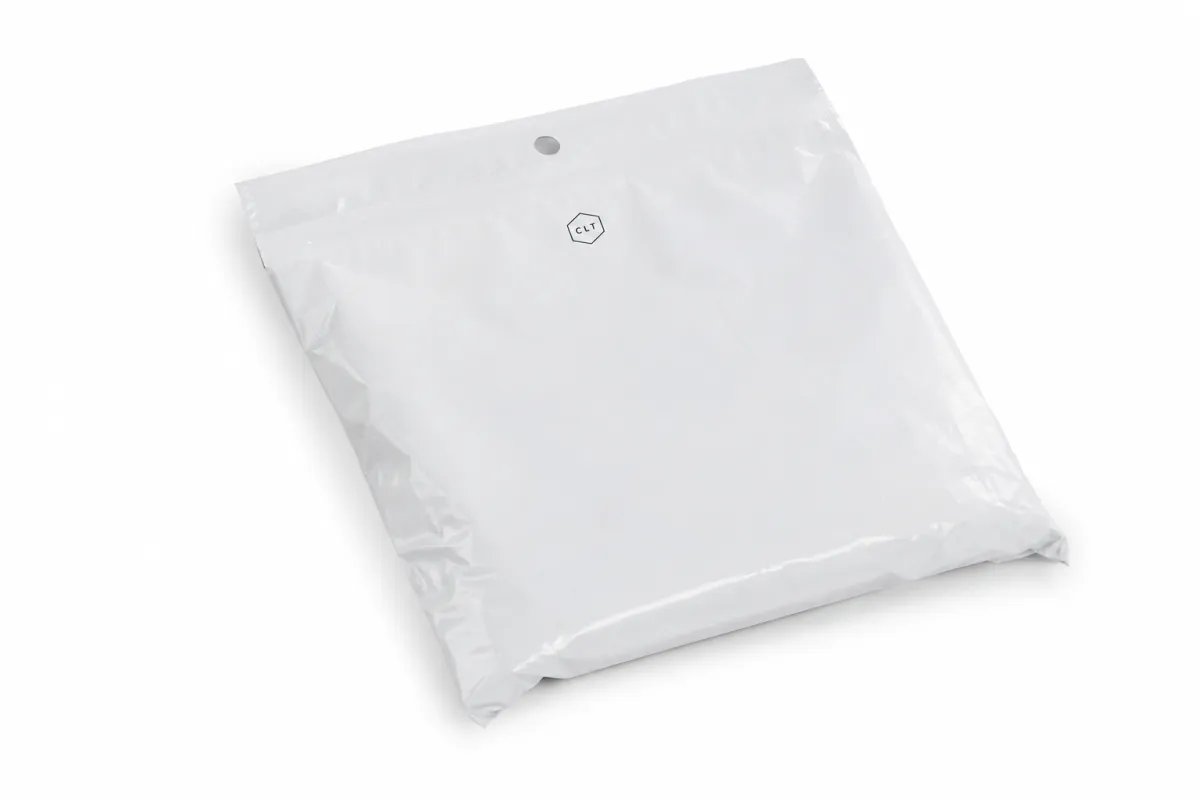
Custom Poly Mailers with punch hole are printed Plastic Mailing Bags with a cutout near the top so the finished bag can hang from a hook, rail, or display peg. The mailer still does the basic job of protecting the product, sealing closed, and shipping as a lightweight package. The opening adds a second use case that a standard mailer does not offer: display-ready storage.
The phrase sounds simple, but the cut changes the bag’s behavior. Some buyers want a standard round hang hole. Others need a euro-style slot with more surface area around the opening. A few ask for a thumb hole because they want easier handling during packing, not hanging. Those are different specs. Mixing them up can lead to the wrong die cut, the wrong display fit, and avoidable waste.
Most Custom Poly Mailers with punch hole are used for items that are both easy to hang and easy to count. Apparel leads the list: socks, underwear, T-shirts, leggings, beanies, and baby items. The format also suits soft goods, accessories, travel kits, stationery sets, small gift bundles, and subscription items that need orderly presentation before they are sold or packed out.
- Hang hole: A cutout intended for a hook or peg, usually round or euro-style.
- Thumb hole: A grip feature that helps someone open or handle the bag; not always meant for display.
- Euro-style punch hole: A wider cut often used in retail packaging for stronger hanging performance and clearer visibility.
From a packaging buyer’s point of view, the useful question is not just, “Do I want a hole?” It is, “Will the hole improve the way this item moves through the warehouse, the store, or the unboxing process?” That answer depends on film thickness, item weight, closure style, and the exact place where custom poly mailers with punch hole will live.
There is a branding angle too. A clean hole layout makes the bag feel like planned retail packaging rather than a generic shipping pouch. That matters more than many teams admit. Put the same product beside rigid cartons, hang-sell cards, and polished branded packaging, and the difference becomes obvious. The bag either belongs in the display, or it looks like it wandered in by mistake.
A punch hole is not decoration. It is a handling decision that happens to affect branding.
How Custom Poly Mailers With Punch Hole Work
The workflow is plain enough, but the consequences of each step are not. A product goes into the bag, the bag is sealed, and then custom poly mailers with punch hole can be suspended on peg hooks, display rails, warehouse hooks, or staging carts. That hanging position keeps SKUs visible and helps teams work faster when they are handling dozens or hundreds of near-identical items.
In a busy fulfillment environment, a hanging mailer often cuts table clutter. A packer can scan, pick, and stage in a vertical line instead of spreading bags across a flat surface. Retail uses the same logic. A wall display that stays aligned and readable is easier to shop, easier to replenish, and easier to count. That is why custom poly mailers with punch hole show up so often in high-SKU categories where visual order matters as much as protection.
Hole placement is where many orders go wrong. Top-center placement usually gives the best balance because the bag hangs evenly and the artwork stays readable. Slide the punch too close to the edge, and tear risk rises. Put it too low, and the mailer can sag awkwardly and cover part of the print. With custom poly mailers with punch hole, the safe zone around the opening should be planned before artwork is locked, not after a proof is already circulating.
Production timing matters as well. A hole can be added during cutting and finishing, which is usually better than trying to fix the bag after printing. When the punch is built into the workflow, consistency improves and each unit aligns more closely with the same die and placement spec. On high-volume runs, a 2-3 mm shift sounds tiny. On a wall display, it can read as sloppy.
The opening should never compromise the seal or the label zone. A mailer still needs enough top clearance for adhesive closure, tamper protection, and any shipping label or barcode panel. If the package is meant to survive parcel handling, custom poly mailers with punch hole still need to pass a realistic stress check. A hanging feature helps, but it does not excuse weak film, a poor seal, or artwork that crowds the top edge.
If the bags will travel beyond a local handoff, it is worth looking at transit-testing logic from ISTA test methods. The point is not to over-engineer a simple mailer. The point is to avoid discovering tear behavior after 3,000 units have already been printed and packed. That kind of mistake is the packaging version of a loose wheel on a cart: harmless until it suddenly is not.
Custom Poly Mailers With Punch Hole: Cost, Pricing, and MOQ
Pricing is not driven by the punch hole alone. Film gauge, bag size, print coverage, adhesive type, reinforcement, and quantity all shape the quote. Still, custom poly mailers with punch hole usually carry a modest premium compared with a plain printed mailer because the hole adds a finishing step and sometimes requires a stronger top zone or a special die.
In most quote conversations, quantity is the biggest cost lever. A run of 3,000 pieces usually prices higher per unit than 10,000 pieces because setup, plate, and finishing costs get spread across fewer bags. For custom poly mailers with punch hole, that gap can dwarf the hole surcharge. Buyers sometimes obsess over the punch line item and miss the larger effect of MOQ on the final number.
Indicative pricing for custom poly mailers with punch hole often looks something like this at mid-scale quantities. These are planning ranges, not fixed prices, but they are useful when you are comparing options side by side.
| Option | Typical Spec | Indicative Unit Cost at 5,000 pcs | Best Fit |
|---|---|---|---|
| Standard printed poly mailer | 2.5 mil, no hole, 1-color print | $0.16-$0.23 | Direct shipping, low-touch fulfillment |
| Custom poly mailers with punch hole | 2.5 mil, round hole, 1-color print | $0.17-$0.25 | Retail hanging, order staging, soft goods |
| Reinforced euro-hole mailer | 3 mil, reinforced top, 2-color print | $0.21-$0.34 | Longer display time, heavier light goods |
| Heavy-duty retail mailer | 4 mil, reinforced opening, full-coverage print | $0.28-$0.42 | Higher handling risk, premium retail packaging |
That table hides one important detail: the cheapest unit is not always the best value. If the film tears around the opening, or if store staff have to rehang damaged bags, labor cost can outgrow material savings fast. Custom poly mailers with punch hole can save money if they reduce handling time. They can also cost more over time if the spec is too thin or the hole placement is sloppy.
Here is the practical pricing framework I would ask for when comparing suppliers:
- Material: 2.5 mil, 3 mil, or 4 mil film, plus any recycled content claim.
- Size: Finished width and length, plus usable interior space.
- Punch style: Round hole, euro slot, reinforced hole, or thumb hole.
- Print: Number of colors, print coverage, and whether both sides are printed.
- Packaging: Loose-packed, bundled, carton count, and pallet configuration.
That is the right way to compare custom poly mailers with punch hole against other formats such as custom printed boxes or plain shipping mailers. A slightly higher quote can still be the smarter buy if the hole removes a step from the packing line, improves retail packaging speed, or lowers tear replacements. For a broader sustainability lens on packaging trade-offs, the EPA’s source reduction guidance is a useful reference point: EPA sustainable materials guidance.
My rule of thumb is simple: if the hole helps the product move, display, or sort, pay for the right spec. If it is only decorative, the premium is harder to defend. Custom poly mailers with punch hole should earn their place. Otherwise, you are paying extra for something that just looks clever in a mockup.
Process and Timeline for Ordering Custom Poly Mailers With Punch Hole
The ordering process is not complicated, but it rewards precision. The smoothest jobs are the ones where the buyer knows the product dimensions, the seal style, the print needs, and the exact hanging requirement before the first proof is drawn. Custom poly mailers with punch hole move faster when the brief is specific.
- Define the product: Measure the item flat and packed, not just the item on its own.
- Choose the size: Leave enough room for insertion without creating excess slack.
- Select the punch: Round, euro-style, reinforced, or another hook-specific shape.
- Prepare artwork: Keep logos, barcodes, and legal copy clear of the top zone.
- Review the proof: Check hole placement, color placement, and seal margins.
- Approve production: Lock the spec before printing starts.
A realistic timeline often starts with proof approval, then moves into printing, cutting, punching, inspection, and packing. For a straightforward run, 12-15 business days from final approval is a common planning window. If the order uses specialty film, full-coverage art, or a custom reinforced opening, 2-4 extra business days is not unusual. Add shipping time after that. Custom poly mailers with punch hole are not the slowest packaging item to make, but they are slower than a stock mailer because the finishing has to line up with the display spec.
The steps that slow things down most are predictable. Artwork changes after proofing, unclear hole placement, and last-minute size changes are the usual culprits. The hole spec is especially important because one vague instruction can lead to the wrong punch size or a layout that does not fit the hook system. Once the die is set, rework gets expensive.
That is why buyers should prepare the following before requesting a quote:
- Exact product dimensions in inches or millimeters.
- Hook type, peg diameter, or rail depth.
- Preferred hole shape and whether reinforcement is required.
- Print file format, logo placement, and safe zones.
- Closure type, whether adhesive strip or resealable seal.
- Shipping destination and carton count target.
From a production standpoint, custom poly mailers with punch hole work best when the order sheet removes guesswork. A sample hung on the real hook tells you more than a PDF ever will. That is also where packaging design becomes practical rather than theoretical: the artwork, hole placement, and product size have to work together, not separately.
Common Mistakes With Custom Poly Mailers With Punch Hole
The first mistake is choosing a hole before checking the hook. A bag that fits one peg display may fail on another because the opening is too small, too large, or cut in the wrong place. Custom poly mailers with punch hole need to match the actual hanging hardware, not an assumed display system. I have seen otherwise solid packaging miss the mark because the bag would not sit straight on the rack.
The second mistake is underestimating film strength. Thin material can tear around the opening, especially if the mailer is overfilled, rehung often, or loaded with dense product. A 2 mil film might be fine for ultra-light use, but many buyers are better served by 2.5 mil or 3 mil if the bag will hang for any length of time. Custom poly mailers with punch hole are only as reliable as the top edge around them.
Third, artwork gets crowded near the top seal. Logos, barcodes, reuse text, and legal copy should stay clear of the hole and the seal area. A design that looks bold on-screen can become awkward when the bag is hanging. If the opening covers part of the brand mark, the whole package loses the clean retail packaging effect that made the hole worthwhile in the first place.
Fourth, storage gets ignored. Punched bags stack and carton differently than plain bags. If the opening creates a protrusion or weak point, the carton may need a different internal pack pattern to keep the mailers flat. Otherwise, scuffed print, curled tops, or distorted edges show up before the bags ever reach the floor. Custom poly mailers with punch hole should be packed in a way that respects the finishing detail, not just the print run.
Fifth, people compare only unit price. That is a narrow view. A $0.02 premium can be rational if the bag cuts 5 to 10 seconds from each pack-out, or if it reduces replacement losses on the sales floor. If the line handles 8,000 units a week, a few seconds add up quickly. That is the kind of arithmetic packaging teams should be doing. A 40-hour week can hide a lot of waste.
There is also a testing gap that shows up too often. If the bags will ship through parcel networks, a simple desk check is not enough. A few relevant checks from ISTA test methods can reveal whether the opening stays intact under handling. For repeated flexing and impact, that is more honest than trusting a visual inspection alone.
A cheap mailer is not cheap if it tears on the rack, fails in transit, or forces a repack.
Expert Tips for Better Performance and Branding
Start with the packed weight, not the empty bag. That sounds obvious, but people often size the hole and the film around the mailer itself instead of the finished product. Once the item is loaded, the load path changes. Custom poly mailers with punch hole should be judged by the real hanging weight, because that is what the hook will feel.
If the bags will remain on display for a while, use a more rigid top zone or reinforcement. A stronger upper band helps the hole resist tearing and keeps the bag looking crisp after repeated handling. For retail packaging, that crisp look matters. It makes the product feel cared for, and branded packaging gains credibility when the bag does not sag or curl.
Keep critical branding below the hole line. That lets the logo remain visible even when the package hangs on a peg. It also prevents the opening from interrupting the artwork in a way that makes the bag look accidentally modified. Custom poly mailers with punch hole should feel designed, not patched together.
Test one sample on the real hook, rail, or peg before you approve the full run. A few millimeters can shift balance enough to matter. If the bag tilts left, rotates, or slides off too easily, fix the spec before production. From a packaging design standpoint, that one sample can save a full batch from looking off. A bad hang angle is one of those tiny flaws people notice immediately, even if they cannot explain why.
Think about the role this bag plays in the bigger package mix. Some products need both custom printed boxes and hanging bags. Others are perfectly served by a lighter mailer. The best choice depends on the product, not a trend. Custom poly mailers with punch hole can be the right answer for soft goods and light retail units, but they are not the right answer for everything.
There is a final branding insight that is easy to miss. A punch hole can make a package look more intentional, not less. When the artwork, hook point, and product size line up, the bag presents itself like a piece of retail packaging with a purpose. That kind of package branding is subtle, but buyers notice it immediately. Customers rarely say, “Nice hang hole.” They just feel that the package is organized and trustworthy.
Next Steps for Custom Poly Mailers With Punch Hole
If you are shortlisting custom poly mailers with punch hole, start with a simple checklist: product dimensions, film thickness, closure style, hole shape, print coverage, and the actual display hardware. Those six items determine most of the outcome. Leave one out, and you risk ordering a bag that looks fine on paper but fails in the real workflow.
Ask for a proof or a quoted sample before you approve production. Check whether the hole sits in the right place, whether the artwork clears the top zone, and whether the bag tears when you hang it on the real hook. That one test tells you more than a polished quote sheet. Custom poly mailers with punch hole should be proven against the use case, not just approved on price.
If two quotes are close, compare the actual spec rather than chasing the lower number. A thicker film, reinforced opening, or better print layout can be worth more than a small price gap. That is true for custom poly mailers with punch hole, and it is just as true for other product packaging decisions. The cheapest version is only the best version if it survives the job.
My advice is to approve one prototype, hang it, fill it, move it, and inspect it under real handling conditions. Then sign off on the run only if the bag behaves the way you need. That is the practical route for custom poly mailers with punch hole, and it is the closest thing to a safe bet in packaging. If the sample wobbles, tears, or hides the artwork, fix the spec before you commit.
What are custom poly mailers with punch hole used for?
They are commonly used for retail hanging, display racks, apparel packaging, and any lightweight product that benefits from easy suspension. The punch hole can also speed warehouse staging because the bags can be organized on hooks instead of taking up flat table space. In short, custom poly mailers with punch hole work best when the package needs both branding and a display-friendly format.
Will a punch hole weaken custom poly mailers?
It can if the film is too thin or the hole is cut too close to the edge. Reinforcement, proper hole placement, and the right material gauge reduce tear risk. Testing custom poly mailers with punch hole on the actual hook and with the real product weight is the safest check.
What punch hole size is best for custom poly mailers?
The best size depends on the hook, peg, or rail the bag will hang from. A standard hole is not always enough if the display system uses thicker hooks or needs extra clearance. Ask for a sample with the exact hole spec before approving a full run of custom poly mailers with punch hole.
How much do custom poly mailers with punch hole cost?
Cost depends on size, film thickness, print complexity, hole reinforcement, and order quantity. Higher MOQs usually lower the unit cost because setup expenses are spread across more bags. The cheapest option is not always best if a stronger bag prevents tears or reduces labor, which is often true with custom poly mailers with punch hole.
How long does it take to make custom poly mailers with punch hole?
Timeline depends on artwork readiness, proof approval, production setup, and shipping distance. Simple orders move faster; custom colors, special materials, or hole reinforcement can add time. Having final specs ready upfront is the best way to avoid delays with custom poly mailers with punch hole.
If you are ready to order custom poly mailers with punch hole, confirm the hook, the gauge, the punch shape, the artwork safe zone, and the seal area before you approve the run. That small checklist saves reprints, and it saves headaches too.

