Buyer Fit Snapshot
| Best fit | Custom Product Packaging Inserts Wholesale projects where brand print, material claims, artwork control, MOQ, and repeat-order consistency need to be specified before quoting. |
|---|---|
| Quote inputs | Share finished size, material target, print colors, finish, packing count, annual reorder estimate, ship-to region, and any compliance wording. |
| Proofing check | Approve dieline scale, logo placement, barcode or warning zones, color tolerance, closure strength, and carton packing before bulk production. |
| Main risk | Vague material claims, crowded artwork, missing packing details, or unclear freight terms can make a low unit price expensive after revisions. |
Fast answer: Custom Product Packaging Inserts Wholesale: Material, Print, Proofing, and Reorder Risk should be specified like a repeatable production item. The safest quote records material, print method, finish, artwork proof, packing count, and reorder notes in one written spec.
Production checks before approval
Compare the actual filled-product size with the drawing, then confirm tolerance on folds, seals, hang holes, label areas, and retail display edges. Reserve space for logos, QR codes, warning copy, and material claims before decorative graphics fill the panel.
Quote comparison points
Review material grade, print process, finish, sampling route, tooling charges, carton quantity, and freight assumptions side by side. A quote is only useful when the supplier can repeat the same color, closure quality, and packing count on the next order.
Custom Product Packaging Inserts Wholesale: What to Know
Custom Product Packaging inserts wholesale sounds like a sourcing line item. It rarely behaves that way once the cartons hit a truck. The insert becomes a damage decision, a labor decision, and a brand signal all at the same time. A product can leave the factory in perfect condition and still arrive compromised if it moves inside the box, and that movement turns into real money: replacements, credits, support tickets, and extra hands at the packing bench. In practical terms, the insert is where protection, presentation, and operating cost collide.
From a packaging buyer's point of view, custom Product Packaging Inserts wholesale only works when the spec is tight enough to protect the product and practical enough to run at volume. A strong insert does more than occupy space. It holds the item still, cuts down pack-out time, keeps freight damage lower, and supports a polished unboxing that belongs inside the wider product packaging system. That is the benchmark worth using during quote review.
The economics tell a blunt story. Once dimensions are fixed, Custom Product Packaging inserts wholesale often gets cheaper per unit as quantity rises because tooling, setup, and scrap are spread across more pieces. A slightly more expensive engineering step at the start can beat loose fill, air pillows, or paper wrap over the life of a program. Buyers who stare only at the unit price usually miss the larger cost in returns and labor. The better question is not, "What does one insert cost?" It is, "What does one damaged shipment cost if the insert is wrong?"
If the order needs a premium feel, branded packaging may call for a cleaner, more refined insert than a plain shipping tray. If the goal is heavy-duty protection, the insert may need stronger edges and better compression resistance. Either way, fit drives the result. A poor insert slows every pack station; a good one disappears into the workflow and leaves the team alone. That is the quiet advantage buyers usually notice only after the fact.
I have watched operations teams chase a two-cent savings on filler, then spend an afternoon troubleshooting crushed corners and rework. It is kinda funny from a distance, but nobody laughs when the returns start piling up. The cheapest-looking option can become the most expensive one once the truck leaves the dock.
How Do Custom Product Packaging Inserts Wholesale Pay Off Fast?
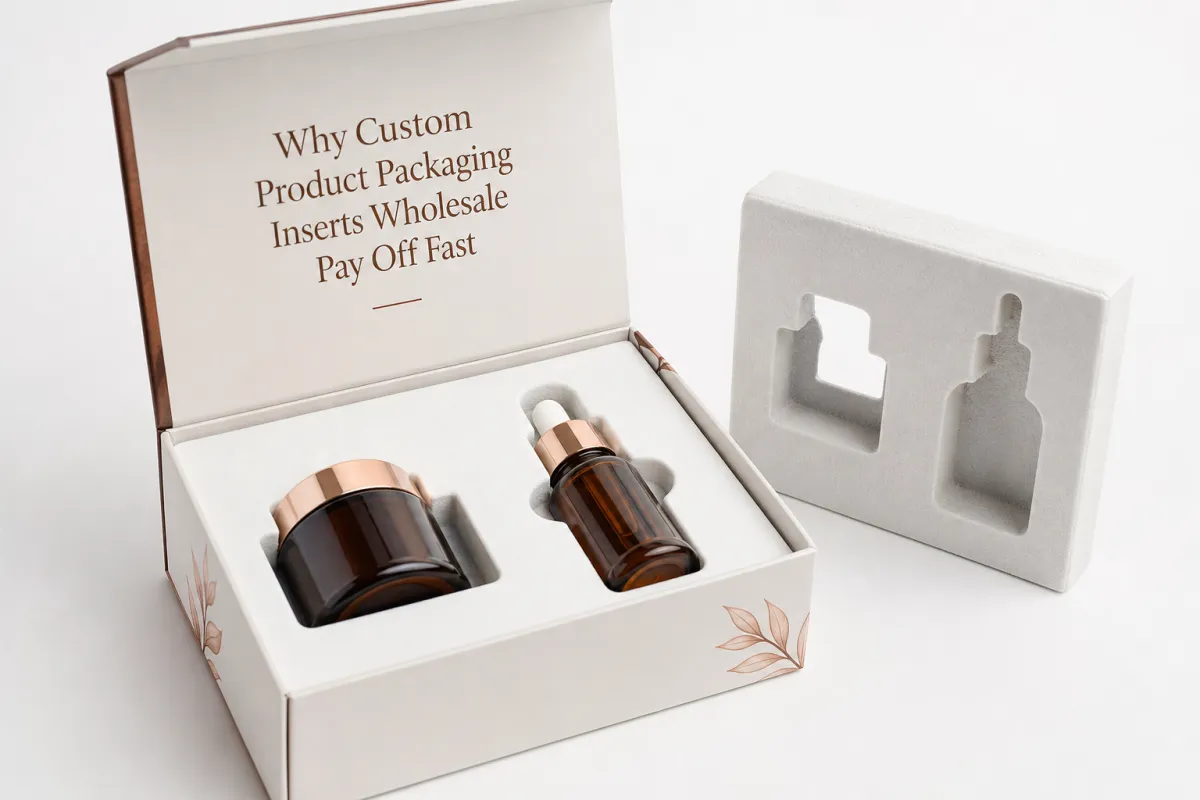
Custom product packaging inserts wholesale pays off quickly because shipping damage usually starts with movement, not with the carton itself. If a bottle can slide, a jar can chip. If a device can shift, a corner can scuff. If a kit can rattle, the customer opens a box that feels careless even when nothing is visibly broken. That is why custom product packaging inserts wholesale often saves more than it costs. The return is not only fewer breakages; it is fewer support tickets, fewer reships, and fewer awkward moments for the brand.
The contrast with generic dunnage is easy to see. Loose fill cushions, but it does not lock position. Air pillows can reduce empty space, but they do not create a precise cavity. Paper wrap helps with surface protection, but it compresses under load and leaves play around irregular shapes. A properly engineered insert is built around the product and the carton together. That level of control changes the outcome.
The business case usually comes down to fewer reships, fewer refunds, and fewer customer service calls. Even a small drop in breakage can justify custom product packaging inserts wholesale if the SKU ships in volume. A 2% damage rate on 10,000 orders means 200 problem shipments, and that is before the labor attached to each one. I have seen teams save pennies on a filler and spend multiples of that handling the fallout. The math gets ugly fast.
"The cheapest insert is not always the least expensive choice. The least expensive choice is the one that prevents the second shipment."
Wholesale buying changes the equation again. Once a project moves beyond samples and into production, the unit price usually drops because the setup work has already been absorbed. That matters in kitting programs, subscription boxes, and retail packaging lines where every second at the pack station carries a cost. Custom product packaging inserts wholesale can shave those seconds by making the product easier to place correctly, every time.
Presentation matters too. In premium package branding, the insert is not hidden waste. It is part of the reveal. The customer sees the product seated neatly instead of rattling in an empty cavity. That visual cue matters in ecommerce and shelf-ready retail packaging alike, where the first impression lands before the item is even lifted out. Small details can carry a lot of weight. Literally and figuratively.
One point gets missed often: custom product packaging inserts wholesale gives procurement teams stability. Once the dieline, material, and tolerance window are set, reorders become easier to forecast and easier to approve. A buyer does not have to renegotiate protection every time the product ships. That predictability is valuable, especially when several SKUs share one carton family. It also reduces internal back-and-forth between procurement, operations, and fulfillment.
There is a second-order benefit that does not always show up in a spreadsheet. When the insert makes packout more obvious, training new staff gets easier. That means fewer mistakes on the line and less dependence on tribal knowledge. In a busy warehouse, that matters more than the average brand team expects.
Custom Product Packaging Inserts Wholesale Options: Materials, Uses, and Formats
Custom product packaging inserts wholesale is not one product category. It is a set of design decisions tied to product weight, fragility, display goals, and shipping method. A light cosmetic set does not need the same structure as a glass bottle pack, and a premium retail display does not need the same build as a parcel shipper. That is why the material discussion has to start with use case, not preference. The product, the route, and the carton together decide the structure.
Corrugated board is the workhorse option for many custom product packaging inserts wholesale programs. It is familiar, cost-effective, and easy to die-cut into pads, sleeves, dividers, and multi-compartment trays. For heavier items or cartons that need stacking strength, corrugated often outperforms thinner paperboard. Molded fiber is another strong candidate when the buyer wants a recyclable feel and solid cushioning. It tends to suit items that benefit from a cradle rather than a hard-edged fit.
Paperboard works best when presentation matters and the product is light enough that the insert does not need much compression resistance. Foam can still be the right answer for fragile electronics, precision instruments, or items with delicate finishes, especially when vibration and long-distance shipping are part of the route. Pulp and specialty blends fill the middle ground in some applications, but no material should be chosen by trend alone. The carton, the product, and the transit path decide. No shortcut there.
Custom product packaging inserts wholesale can be shaped into several common formats:
- Single-item cradles for one product held in a fixed cavity
- Multi-compartment trays for kits, subscription boxes, and accessory sets
- Bottle dividers for beverage, cosmetics, and liquid product packaging
- Retail display inserts that keep the front face clean and aligned
- Electronics protection trays that support corners and cable areas
- Shipping dividers that prevent item-to-item contact inside master cartons
The gap between protection-first and presentation-first structures is wider than many buyers expect. A protection-first insert usually prioritizes retention, compression, and shock absorption. A presentation-first insert leans toward crisp edges, color consistency, and clear product visibility. Custom product packaging inserts wholesale can do both, but not always with the same thickness or finishing choices. That tradeoff needs to be made on purpose.
Branding options depend on the substrate. Corrugated and paperboard accept print well. Some inserts can carry simple one-color marks, while others can support richer graphics, embossing, or color matching to coordinate with custom printed boxes. Cutout windows can expose the product without weakening the structure if the die line is planned properly. Packaging design starts feeling practical right there, not decorative.
Sustainability deserves a real comparison, not a slogan. Recyclable fiber options can simplify the waste stream and fit better with FSC-oriented sourcing, but only if they still meet drop, vibration, and compression needs. A lower-impact material that fails in transit creates more waste than it prevents. For teams trying to balance protection and end-of-life performance, EPA sustainable materials guidance and FSC certification standards are useful references, but the final choice still has to pass the product test. And to be fair, not every "recyclable" label means the local curbside program will actually accept it.
| Material | Best For | Protection Level | Presentation | Typical Use |
|---|---|---|---|---|
| Corrugated board | Mid-weight products, dividers, shipping kits | High for compression, moderate for cushioning | Clean, functional, printable | Custom product packaging inserts wholesale for ecommerce and retail packs |
| Paperboard | Light products, retail sets, branded trays | Moderate | Strong visual appeal | Luxury packaging and lightweight product packaging |
| Molded fiber | Fragile items, eco-focused programs | Good cushioning and retention | Natural, understated | Custom product packaging inserts wholesale with recycled fiber positioning |
| Foam | Delicate electronics, precision parts | Very high for shock control | Functional, less decorative | High-value transit protection where movement cannot happen |
| Pulp blends | Mixed-use protection and presentation | Moderate to good | Natural, product-focused | Programs that want recyclable support and simple retail packaging |
For many buyers, the smartest custom product packaging inserts wholesale choice is not the most familiar one. It is the one that matches the product's center of gravity, fragile edges, and shipping stress points. That sounds obvious. It is also the point where many packaging programs drift into guesswork. A good insert is not just a shape; it is a response to physics.
One more wrinkle: the same material can perform differently depending on flute direction, density, or wall thickness. That is why two corrugated inserts that look similar on paper can behave very differently in the field. The spec has to capture the build, not just the category.
Custom Product Packaging Inserts Wholesale Specs That Matter
Custom product packaging inserts wholesale succeeds or fails on the details buyers provide up front. A sketch is not enough. A complete spec should include product length, width, height, weight, clearance, carton dimensions, ship method, and the number of units per shipper. If the insert is meant to hold accessories, power cords, literature, or sample items, those components need their own dimension callouts too. Otherwise the design gets built around assumptions. Assumptions are where expensive surprises start.
Tolerance is one of the most misunderstood variables in custom product packaging inserts wholesale. A millimeter or two can decide whether a bottle rattles, a cosmetic jar scuffs, or a device becomes hard to seat during packout. Tight tolerances matter most for premium custom printed boxes and high-value retail packaging, where even a slight mismatch looks careless. Loose tolerances are cheaper on paper and more expensive in the warehouse. The same is true for cavity depth: a shallow fit can be just as damaging as a loose one.
Material strength has to be read in context. Thickness matters, but so do flute profile, density, compression resistance, and how much edge support the insert provides. Heavy SKUs need more than a cavity; they need structural restraint. Stacked shipments need resistance to top load. Long-distance freight may require stronger corner protection, especially if pallets will be cross-docked or stored before final delivery. Custom product packaging inserts wholesale should be engineered for the actual route, not the ideal one.
Construction details are where good specs become good production. Die-cut accuracy affects fit. Score lines control fold behavior. Adhesive points affect assembly time and repeatability. Fold direction can matter for fiber orientation, especially if humidity or repeated handling are part of the equation. If the insert will ship through hot warehouses, cold chain environments, or high-humidity distribution centers, that should be stated early. A design that looks fine in a dry sample room can behave very differently in transit.
Fit testing against the real product is non-negotiable. I would not approve custom product packaging inserts wholesale from a drawing alone if the product has odd surfaces, a glossy finish, or weight concentrated in one area. Real product tests reveal whether a lip interferes with insertion, whether a foam cut is too shallow, or whether a paperboard tab is rubbing an edge. That is the point where theory meets the warehouse floor.
There is also a practical detail that gets overlooked: how the insert behaves after the first few packing cycles. If a team has to flex the material too much or force the product into place, the damage may not show up on day one. It shows up after the fiftieth packout, when the operator starts doing things a little differently to keep the line moving. That's the kind of slow failure nobody wants.
For buyers building a repeatable spec, here is the minimum data set that keeps reorders clean:
- Product dimensions and weight, measured on the actual finished item
- Carton inside dimensions and any clearance limits
- Number of units per insert and per shipper
- Shipping method, including parcel, LTL, or mixed fulfillment
- Environmental conditions such as humidity, cold storage, or long dwell time
- Branding requirements tied to package branding or shelf display
That list may look basic, but it separates a spec that survives procurement review from one that creates production friction. Custom product packaging inserts wholesale works best when engineering and operations can read the same document and reach the same conclusion. The best programs also include a photograph of the finished product, because a profile view can reveal a risk that dimensions alone miss.
Pricing, MOQ, and Unit Economics
Custom product packaging Inserts Wholesale Pricing is driven by a short list of variables buyers can actually control. Material choice is one. Complexity is another. Print coverage, die-cut depth, adhesive labor, kitting requirements, and any custom engineering work all add cost. If the insert needs multiple components, nested folds, or unusual cavities, the price can rise quickly because labor and waste rise with it.
MOQ, or minimum order quantity, is where wholesale economics become visible. Simple flat inserts may start at a lower threshold because they are easier to run and stack efficiently. More complex multi-part structures usually require a higher MOQ to cover setup time, tooling, and scrap. That does not mean a high MOQ is a warning sign. It means the design has more moving parts. Custom product packaging inserts wholesale is often more efficient once the order size is large enough to absorb those setup costs.
Quote comparison gets messy when buyers compare only the unit price. A lower unit number can hide thinner stock, a wider tolerance band, or freight that was omitted from the estimate. Always normalize quotes to the same material thickness, print coverage, dimensions, and quantity. If one supplier includes tooling and another separates it, the numbers are not equal. If one bid assumes manual assembly and another assumes machine assembly, the labor model changes too. That is why the most useful price is landed cost, not list price.
To make custom product packaging inserts wholesale easier to compare, buyers should ask for quotes at multiple volumes. A 1,000-piece run can show one reality. A 5,000-piece run can show another. A 10,000-piece run may shift the economics enough that the tooling becomes nearly invisible on a per-unit basis. The point is not to chase the lowest starting price. The point is to find the break point where the project begins to pay back its setup cost. That break point is often lower than buyers expect once labor savings are included.
Here is a practical way to think about unit economics:
- Sampling or prototyping may add a small upfront fee
- Tooling can be a one-time expense or a shared expense, depending on the design
- Freight can materially change the landed total if inserts are bulky
- Storage may matter for large wholesale buys
- Assembly or kitting labor can cost more than the insert itself if the design is inefficient
For many packaging programs, the sweet spot appears when custom product packaging inserts wholesale replaces a costly manual step. If workers no longer need to wrap, tape, or reorient each item, the labor savings can outweigh the slightly higher board cost. That is especially true in Wholesale Programs that ship consistent volumes and need stable pack-out times.
There is also a threshold effect. Once the order volume passes a certain point, wholesale sourcing almost always beats one-off buying because every incremental unit gets cheaper as setup cost is diluted. In that sense, custom product packaging inserts wholesale is not just a procurement decision. It is an operations decision with margin consequences.
One caveat: the lowest landed cost is not always the smartest move if the program is still changing. If the SKU design is still in motion, it can be wiser to pay for a sample run and tighten the spec first. Otherwise the savings can evaporate in revisions. That kind of "cheap" is not really cheap.
Process and Timeline for Bulk Inserts
Custom product packaging inserts wholesale usually follows a predictable workflow, but every step should still be documented. The first brief should define the product dimensions, ship environment, quantity target, branding goals, and any performance requirements. If the insert must fit inside existing cartons, those carton dimensions matter as much as the product itself. If the insert is part of a new launch, the launch date matters just as much as the spec. Clear inputs shorten the entire cycle.
The proof stage is where most delays can be prevented. A good supplier will review the dieline, build a digital rendering, produce a sample, and then fit test the sample against the real product and carton. That is the moment in custom product packaging inserts wholesale where small gaps reveal themselves. The insert may be too tight for efficient packout, too loose for transit, or too tall once the product is seated. Better to see that now than after a pallet has already left the dock.
Lead times vary by material and complexity. Simple corrugated inserts can often move quickly if the dieline is straightforward and print is limited. Engineered foam or molded options usually require more design time and sometimes tooling before production starts. A buyer should also account for review cycles. If the artwork, dimensions, and structural file go back and forth three times, the schedule stretches. That is normal. What is not normal is pretending review time does not exist.
For custom product packaging inserts wholesale, approval checkpoints should be clear:
- Dimension sign-off on the product and carton
- Material selection and performance target approval
- Dieline or structural drawing approval
- Print file approval if branding is involved
- Sample fit approval against the actual product
- Production schedule confirmation and freight booking
Freight planning matters more than many teams expect. If inserts arrive after the box run, the line sits idle. If they arrive too early and storage is tight, the buyer pays for space that is not needed yet. Custom product packaging inserts wholesale should be scheduled with the carton program, the assembly labor plan, and the launch window in the same calendar. Otherwise the packaging supply chain starts working against itself. The cleanest schedules treat the insert as part of the launch, not as an afterthought.
For sourcing teams that also buy Custom Packaging Products, the strongest approach is to line up the insert, outer shipper, and any printed collateral together. That reduces version drift and makes it easier to hold a stable pack sequence. A disconnected packaging plan, by contrast, creates small delays that compound across a full order cycle.
My practical view is simple: do not approve custom product packaging inserts wholesale on speed alone. Approve it on speed plus fit plus repeatability. If one of those three is missing, the schedule will cost more later. The production calendar can absorb a lot, but not a bad spec.
Why Buyers Choose Us for Wholesale Packaging Inserts
Buyers do not just want a supplier. They want a control point. That is the real reason custom product packaging inserts wholesale works best with a partner who can handle spec review, sampling, production, and reorder consistency in one place. Once the insert is approved, the buyer should not have to rebuild the same file chain for every refill order. Version control matters. So does documentation. So does the ability to track the exact material and dimensions used on the last run.
Quality control is where wholesale programs separate themselves from one-off jobs. Dimensional checks keep the cavity true. Material verification protects against weight and thickness drift. Batch repeatability keeps the insert behaving the same from one production lot to the next. For operations teams, that stability is not a luxury. It is what keeps pack-out predictable. Custom product packaging inserts wholesale becomes far more useful when each reorder lands inside the same tolerance window as the previous one.
Speed is valuable, but only if discipline is still present. A supplier can promise a fast quote and still miss the real requirement: holding tolerances and shipping on the promised date. That is why custom product packaging inserts wholesale should be assessed on both responsiveness and process control. A quoting team that asks the right questions early usually saves the buyer more time than a quick, vague estimate ever could.
Support also matters after approval. Wholesale buyers often need reorder data, minor updates for changing SKUs, and help adjusting the insert when product dimensions shift. That is common in subscription programs, seasonal retail packaging, and kits that evolve over time. The best suppliers treat those changes as part of the program rather than as exceptions. That lowers friction and reduces the risk of an outdated die line making its way into production.
There is a direct connection between supplier discipline and customer experience. Fewer transit failures mean fewer refunds. Cleaner pack stations mean faster fulfillment. Predictable costs make budget planning easier. And a polished insert improves the unboxing moment, which supports branded packaging far beyond the box itself. Those are operational gains, not abstract brand claims.
Buyers also care about transparency. A supplier who can explain the tradeoff between protective strength and visual finish is more useful than one who pushes a single material every time. Honest guidance matters especially in custom printed boxes programs where the insert and outer structure need to work as one system. A good fit inside a bad box is still a bad outcome. Nobody wins by pretending otherwise.
That is the standard behind our wholesale approach: specify clearly, sample early, and produce consistently. For teams comparing custom product packaging inserts wholesale across multiple vendors, that workflow is often the difference between a clean launch and a slow correction cycle. It also makes repeat orders easier to forecast, which matters more than many buyers expect.
Next Steps to Order Custom Product Packaging Inserts Wholesale
If you are ready to request pricing, the best next step is to gather the information that makes custom product packaging inserts wholesale quote-ready on the first pass. Start with product dimensions, product weight, carton size, shipping method, and your target monthly volume. If the product has irregular edges, fragile surfaces, or accessory sets, send photos or a sample unit. Those details often change the structural approach more than buyers expect.
Then decide what matters most. Lowest cost? Fastest turnaround? Maximum protection? Premium presentation? Custom product packaging inserts wholesale can be tuned toward any one of those goals, but not all of them equally. If the priority is a retail launch, the design may need better visual alignment. If the priority is long-distance shipping, edge support and cavity retention may matter more than decoration. If the priority is reduced labor, the insert may need to be easier to assemble than it is to admire.
Before approval, confirm whether the program needs printed branding, recyclable fibers, nested components, or mixed-SKU placement. Those are not minor add-ons. They affect the structural design and the lead time. A change from plain fiber to branded packaging can alter print setup and proof cycles. A shift from a single SKU to a kit may require completely different retention points. This is why the brief should be complete before the design starts.
For many buyers, the cleanest path is to move from quote to sample to production without changing the spec in the middle. That keeps the approval chain short and the results predictable. If you are sourcing alongside other packaging materials, coordinate the insert with your outer carton and any filler components so the full pack system behaves as one unit. That is how product packaging stops being a collection of parts and becomes a working process.
Here is the simplest action sequence:
- Send product and carton measurements
- State the monthly and initial order volume
- Define protection and branding priorities
- Request a sample or dieline review
- Approve the fit before release to production
If you are comparing multiple suppliers, ask each one to quote the same spec and explain any difference in material weight, assembly time, or freight assumptions. That is the cleanest way to compare custom product packaging inserts wholesale without getting trapped by uneven bids. Once the sample is approved, lock the schedule and keep the version control tight.
For a broader view of available packaging formats, you can also review our Custom Packaging Products and see how custom product packaging inserts wholesale fits into a full packaging system. The goal is not just to buy an insert. The goal is to buy a repeatable protection structure that performs on the line, in transit, and at the customer door.
Done well, custom product packaging inserts wholesale lowers damage, speeds packout, and supports a cleaner brand presentation without overcomplicating fulfillment. That is the outcome worth paying for.
If you want the shortest possible decision rule, use this one: measure the product, test the insert with the real carton, and approve the sample under the same shipping conditions the order will actually face. Everything else is secondary. Miss that step, and the rest of the program is kinda built on guesswork.
FAQ
What is the typical MOQ for custom product packaging inserts wholesale?
MOQ depends on material, tooling, and design complexity. Simple die-cut fiber inserts often start lower than engineered foam or molded structures because they are easier to produce and stack efficiently. For custom product packaging inserts wholesale, ask for quotes at two or three quantity levels so you can see where setup costs spread out and the unit price becomes more efficient. If you are launching a new SKU, request a sample or short-run prototype first so you do not commit to the wrong structure. That little detour can save a lot of cleanup later.
Which material is best for fragile products that ship long distances?
Choose the material based on weight, fragility, and transit conditions, not on appearance alone. For heavier or impact-sensitive items, high-compression corrugated or molded fiber often performs well. For premium presentation with lighter products, paperboard may be the better fit. Custom product packaging inserts wholesale should always be tested with the real product weight and the actual carton size before production is approved. If the route includes rough handling or dwell time, say so up front.
How do I compare quotes for custom packaging inserts wholesale?
Normalize every quote to the same spec: same dimensions, same material thickness, same print coverage, and same quantity. Check whether sampling, tooling, freight, and assembly are included, because those costs can change the real landed price. A lower unit price is not always better if it increases damage risk or slows packout. In custom product packaging inserts wholesale, the cheapest bid is not always the best bid. Compare the whole program, not just the number on the first line.
How long does production usually take for wholesale packaging inserts?
Timing depends on complexity. Straightforward inserts can move faster than custom-engineered formats that need tooling or multiple approval rounds. Build in time for dieline review, sample approval, production, and freight so the launch date is realistic. If the project is urgent, ask which step is the bottleneck before you commit to a ship date. Custom product packaging inserts wholesale works best when the schedule is built around actual approvals, not optimistic assumptions.
Can custom product packaging inserts wholesale be branded?
Yes, many inserts can include print, color, texture, debossing, or cutout design elements depending on the material. Branding should not compromise protection, so confirm that decorative choices still leave enough strength and fit tolerance. If the insert is part of the unboxing experience, ask for a sample that shows both appearance and function. That is the safest way to align package branding with transit performance. Pretty is fine. Pretty and protective is better.

