Buyer Fit Snapshot
| Best fit | Custom Retail Paper Bags Bulk projects where brand print, material claims, artwork control, MOQ, and repeat-order consistency need to be specified before quoting. |
|---|---|
| Quote inputs | Share finished size, material target, print colors, finish, packing count, annual reorder estimate, ship-to region, and any compliance wording. |
| Proofing check | Approve dieline scale, logo placement, barcode or warning zones, color tolerance, closure strength, and carton packing before bulk production. |
| Main risk | Vague material claims, crowded artwork, missing packing details, or unclear freight terms can make a low unit price expensive after revisions. |
Fast answer: Custom Retail Paper Bags Bulk: Pricing, Specs, MOQ should be specified like a repeatable production item. The safest quote records material, print method, finish, artwork proof, packing count, and reorder notes in one written spec.
Production checks before approval
Compare the actual filled-product size with the drawing, then confirm tolerance on folds, seals, hang holes, label areas, and retail display edges. Reserve space for logos, QR codes, warning copy, and material claims before decorative graphics fill the panel.
Quote comparison points
Review material grade, print process, finish, sampling route, tooling charges, carton quantity, and freight assumptions side by side. A quote is only useful when the supplier can repeat the same color, closure quality, and packing count on the next order.
Custom Retail Paper Bags bulk can seem like the least dramatic part of retail, right up until a handle snaps, a logo prints off-center, or the gusset is too shallow to hold the actual product mix. Then the bag stops being background noise and starts acting like a tiny referendum on the store. It moves from counter to street to car trunk to office desk, and sometimes to a customer photo before the receipt even leaves the register. That kind of travel makes packaging part of the brand, whether the brand planned for it or not.
I have watched a boutique spend weeks polishing its product displays, only to hand every sale over in a bag that looked two steps removed from a grocery sack. The mismatch was jarring. One well-built paper bag changed the entire exit experience. That is why custom Retail Paper Bags bulk matters: it keeps the presentation consistent, lowers unit cost, and gives a retailer a packaging supply it can actually forecast instead of chasing last-minute substitutions.
For Custom Logo Things, the job is not to sell the fanciest bag on the shelf. It is to match the bag to the merchandise, the margin, and the brand voice. A natural kraft bag with one-color print may be exactly right for a specialty shop with a restrained identity. A heavier laminated bag with rope handles may be better for premium apparel or cosmetics where the packaging has to feel a little more elevated. The spec should start with utility, then move to presentation. Not the other way around.
Retailers buy in volume for the same reason they keep shelves stocked and lights on: predictable supply. They need repeatable print. They need a bag that arrives on schedule. They need pricing that does not lurch every time the season changes. Custom retail paper bags bulk solves those operational headaches cleanly. It is not decoration. It is infrastructure.
Why Custom Retail Paper Bags Bulk Makes Sense for Stores
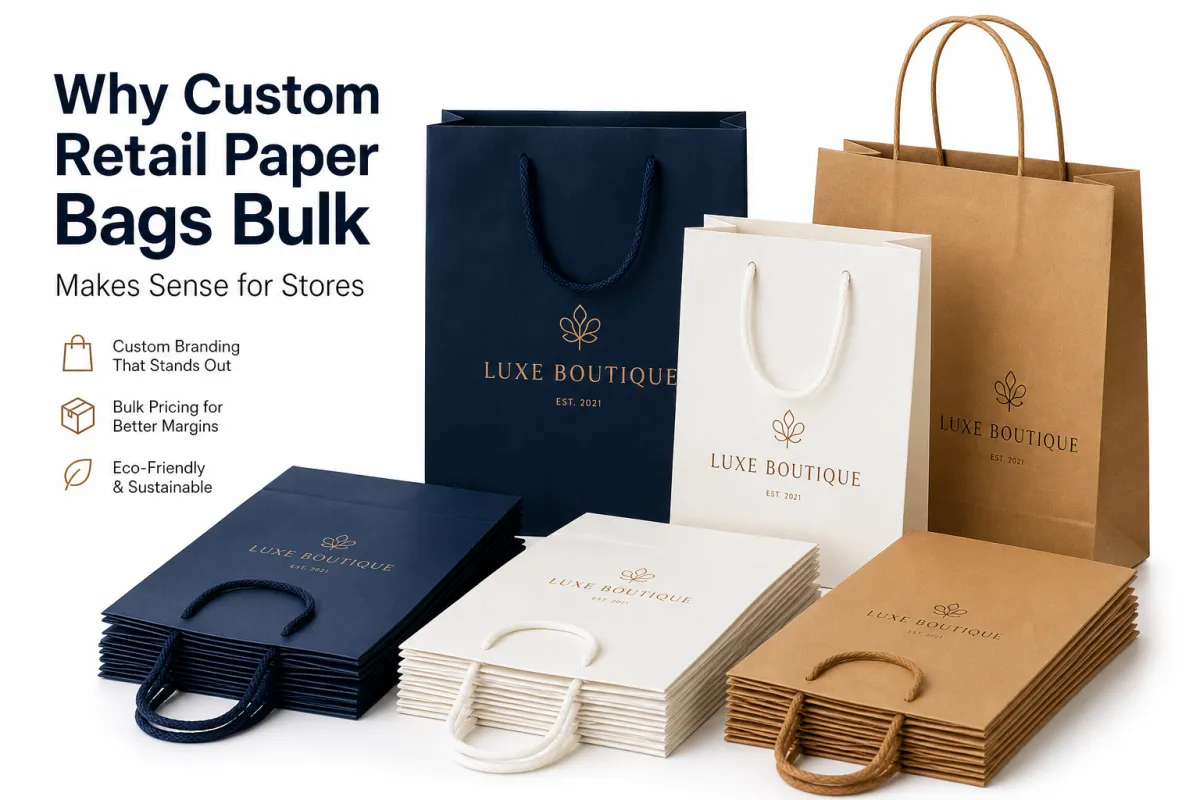
A bag often outlives the transaction. Customers carry it through a mall, into a parking lot, across a campus, or back home for later use. That is a small but real media channel. Compared with a plain stock bag that disappears in a second, a custom bag keeps the brand visible after the sale. Custom retail paper bags bulk turns a routine checkout into a repeating brand moment, and that is no small thing for stores competing on recognition as much as product.
Lower unit cost is the obvious advantage, but the mechanics behind that savings matter more. A 1,000-piece order carries a much larger share of setup, print prep, and freight overhead than a 10,000-piece order. Spread those fixed costs farther, and the economics change fast. A bag that looks overpriced at a small quantity may look entirely reasonable at scale. That is the logic behind custom retail paper bags bulk: fewer surprises, better cost control, and a cleaner path for reorder planning.
Retail teams feel the difference in daily use. A sturdy paper shopping bag with a clean print and dependable handle says the product inside was handled with care. That signal matters for apparel, giftware, candles, cosmetics, specialty foods, and anything likely to be photographed or gifted. A flimsy bag does not merely fail physically. It sends the wrong message about the product and the store. That message is not subtle. Customers notice it instantly, even if they never say so aloud.
Bulk buying also protects against the kind of shortage that shows up at the worst possible time. Holiday traffic. A product launch. A store opening. A weekend promotion that outperforms the forecast by 30 percent. Running short on packaging in the middle of a sales push forces a scramble, and emergency replenishment usually costs more and fits the brand less well. Custom retail paper bags bulk reduces that risk by keeping inventory on hand and the spec stable.
“The cheapest bag is rarely the cheapest choice if it tears at checkout, obscures the logo, or forces a second order before the first run is gone.”
Buyers who treat custom retail paper bags bulk as part of a larger packaging system usually make better decisions. The same store that coordinates tissue, inserts, boxes, and shelf labels tends to get more out of the bag itself. If the packaging tells one story at the counter and another in the shipping box, the brand has already lost some force. Packaging works better as a set than as a pile of unrelated purchases. That sounds obvious, but plenty of stores still learn it the hard way.
Repeat ordering also cuts down on administrative drag. One-off packaging purchases bring new proofs, fresh negotiations, and more room for dimensions to drift. Bulk programs lock the spec and keep the result steady. That predictability is not glamorous, though it saves time, money, and frustration in ways finance teams actually understand. You do not have to be romantic about packaging to respect that.
Custom Retail Paper Bags Bulk Product Details
Custom retail paper bags bulk comes in several styles, and the right one depends on what the bag has to carry and how the store wants to be perceived. Flat-handle bags are economical and straightforward. Twisted-handle bags are the practical middle ground because they carry well and still keep the budget under control. Rope-handle bags sit higher on the presentation scale and fit boutiques, cosmetics, jewelry, and other retail categories where the bag becomes part of the experience rather than just the container.
SOS bags, short for self-opening square bags, are a different animal. No handle. Straight construction. Efficient for food service, inner carry applications, and light merchandise that does not need a more finished presentation. Laminated shopping bags and specialty gift bags move toward premium branded packaging, where surface finish, board thickness, and overall feel matter as much as function. That is often the point where custom retail paper bags bulk starts behaving more like a branded product and less like a basic supply item.
Use case should decide the build. An apparel store does not need the same structure as a beauty brand moving boxed sets across a counter. Twisted-handle kraft bags usually work well for clothing. Gift retail often needs richer print and more visual polish. Specialty food packaging may require a stronger bottom, better grease resistance, or a size that keeps the bag upright even when the contents are uneven. The merchandise should guide the spec. The bag should not dictate the merchandise. That one detail can save a lot of frustration later.
Handle selection changes both carry comfort and perceived value. Flat handles keep price down, but they read as basic. Twisted paper handles feel familiar, printable, and reliable. Rope handles create a more premium impression and typically carry heavier items better, though they push the price upward. In custom retail paper bags bulk, that added cost is not merely cosmetic. It changes the experience of the whole transaction, and sometimes that is exactly the point.
Finish does a lot of quiet work. Matte gives the bag a restrained, contemporary look. Gloss reflects light and helps color pop. Soft-touch lamination feels expensive, but it only earns its keep when the product and brand can support the extra cost. For everyday apparel or general retail packaging, uncoated or lightly coated stock usually covers the need. For a higher-ticket purchase, the finish can help the bag match the price point instead of fighting it. A flimsy finish choice can make a premium item look kinda ordinary, which is not the goal.
Print choices should stay disciplined. A one-color logo on kraft can look excellent if the mark is strong. Full-color print suits brands with more detailed graphics, though it raises cost and adds complexity to color matching. Foil, inside printing, or hot stamping make sense only if the bag is meant to be part of a richer branded packaging system. Otherwise they are decoration without a clear return. Custom retail paper bags bulk usually looks sharper when the design is controlled rather than crowded.
| Bag Style | Best For | Typical MOQ | Common Price Range | Tradeoff |
|---|---|---|---|---|
| Flat Handle Kraft | Light apparel, flyers, small retail items | 1,000-3,000 | $0.18-$0.32 per unit | Lowest cost, more basic look |
| Twisted Handle | Boutiques, gift shops, general retail | 1,000-5,000 | $0.22-$0.40 per unit | Best balance of price and presentation |
| Rope Handle | Premium retail, cosmetics, jewelry | 500-1,000 | $0.48-$0.95 per unit | Higher carry comfort, higher cost |
| SOS No-Handle | Food packaging, inner carry bags, lightweight goods | 500-2,000 | $0.14-$0.26 per unit | Efficient, but not as polished at checkout |
| Laminated Luxury | High-value retail, promotional events, gifting | 500-3,000 | $0.65-$1.40 per unit | Strong shelf appeal, more setup and finishing cost |
Those ranges are working numbers, not fixed laws. A larger bag, a heavier board, more ink coverage, or a specialty finish can shift the price quickly. Still, the pattern stays the same. In custom retail paper bags bulk, lower cost usually comes with simpler construction, while a more polished bag raises the unit price. Packaging is physical. It costs what material, labor, and setup cost. No magic. Just math and paper fiber.
What Should You Know Before Ordering Custom Retail Paper Bags Bulk?
Before asking for a quote on custom retail paper bags bulk, the spec sheet should already be close to final. The core details are simple: width, gusset, height, paper weight, handle type, print sides, finish, and quantity. Leave out one of those and the quote turns into a guess. Guesswork is how buyers end up approving a bag that looks fine in a mockup and awkward on the sales floor. I have seen that happen more than once, and it is rarely cheap to fix.
Dimensions should be written in standard width x gusset x height format. An 8 x 4 x 10 inch bag works for smaller retail goods. A 12 x 5 x 15 inch bag suits apparel. A 16 x 6 x 12 inch bag can handle larger folded items or shoeboxes. Paper bags can look right in a drawing and still fail in use if the gusset is too shallow. Width matters, yet the depth is what prevents sidewalls from ballooning and handles from pulling at the top. That little measurement can make or break the whole experience.
Paper weight is where buyers either overbuy or underspec. Kraft paper often sits in the 60 gsm to 150 gsm range depending on style and expected load. White or coated paper may go higher, especially for premium retail packaging and laminated options. Lighter stock usually works for apparel, accessories, and small gifts. Heavier stock makes more sense for boxed items, bottles, shoes, or anything that needs the bag to stand upright rather than sag under pressure. A few grams per square meter may not sound like much, but in practice it changes the feel in hand and the lifespan of the bag.
Material choice changes both strength and visual tone. Brown kraft has a natural, practical look and tends to hide scuffs well. White paper gives a cleaner print surface and handles bright logos or photography more convincingly. Coated stock can improve print quality, but it may raise cost and can affect recyclability depending on the finish. Recycled stock fits brands that want a lower-impact story, yet it still needs to be tested for carry strength. A sustainability claim is not useful if the bag fails before the customer reaches the door. Honest performance beats marketing every time.
One common mistake with custom retail paper bags bulk is choosing the size based on the smallest product in the store. That logic breaks as soon as a larger order comes through. The bag should fit the widest realistic purchase, plus room for tissue, inserts, or folded apparel. Mixed-merchandise stores should test the largest likely combinations rather than guessing from a single product. A good bag closes cleanly, stands upright in hand, and does not look strained. The customer should never feel like they are fighting the packaging.
Print placement should be locked before production begins. One side, both sides, centered front and back, bottom placement, inside printing, or repeated pattern work all affect the setup. Retailers using other branded packaging should keep the whole visual system in sync. A bag that clashes with custom printed boxes or shelf tags can weaken the impression even if the bag itself is well made. Packaging design is coordination, not decoration. That is the part many teams miss because coordination is less visible than a shiny finish.
Specifications for Custom Retail Paper Bags Bulk
Here is a practical quote checklist for custom retail paper bags bulk:
- Exact bag dimensions in inches or millimeters
- Paper stock and gsm or lb basis weight
- Handle type and reinforcement method
- Print count, print sides, and color count
- Finish such as matte, gloss, soft-touch, or uncoated
- Quantity, shipping destination, and target delivery date
For premium programs, sample approval is worth the time. A digital proof shows layout and copy placement, but it cannot tell you how the handle feels or how stiff the paper really is. A physical sample answers those questions quickly. For custom retail paper bags bulk, that extra check can save a lot of correction work later. Nobody enjoys discovering the bag feels flimsy after 8,000 units are already in motion.
Buyers who want outside references can look to FSC certification for paper sourcing and ISTA test methods for packaging that survives handling and transit. Those references are useful if the order needs a more formal specification discussion: FSC and ISTA. Not every run needs a lab report attached, but the standards exist because packaging failure is usually more expensive than prevention. The market has learned that lesson the expensive way.
As a practical rule, if the bag will carry anything heavier than folded apparel, ask for a test sample at or above your expected load. That is especially true for rope handles, which can look premium yet still require proper reinforcement at the attachment points. The photo can hide a lot. The hand cannot.
Custom Retail Paper Bags Bulk Pricing and MOQ
Pricing for custom retail paper bags bulk depends on a short list of variables, and none of them stay hidden for long. Size, paper grade, handle style, print colors, special finishes, and order quantity drive most of the cost. If a quote looks suspiciously low, assume something is missing. Setup. Shipping. Finish. Handle reinforcement. One of those often appears later because it has to. The price that matters is the one that lands on the dock.
Quantity is the strongest lever. A small run keeps more of the setup cost attached to each bag. A larger run spreads that burden out, so the Price Per Unit falls. That is why 1,000 bags can feel expensive while 5,000 or 10,000 pieces suddenly look practical. In custom retail paper bags bulk, volume is not a bonus. It is the mechanism that makes the order make sense.
Minimum order quantity changes with style. Simple kraft bags can begin lower, sometimes around 500 or 1,000 pieces depending on size and print method. Twisted-handle bags commonly start at 1,000 pieces and scale well. Rope-handle and laminated styles tend to ask for a higher minimum because the materials and finishing steps are more involved. Smaller runs are possible, though the per-unit price rises because fixed costs have fewer bags to absorb them.
The cheapest quote is rarely the strongest choice. Some vendors exclude freight. Some leave out plates or setup. Some quietly downgrade paper weight. A proper quote should state the stock, handle, color count, and any one-time tooling cost in plain language. If the estimate takes detective work to understand, it is not helping enough. Buyers should not need a decoder ring to compare custom retail paper bags bulk options.
Here is the pricing comparison buyers should actually ask for:
- Exact bag size and paper weight
- Handle type and reinforcement details
- Number of print colors and print sides
- Finish, lamination, or foil work
- One-time setup or plate charges
- Freight method and destination
- Lead time from proof approval
Two quotes can sit close on paper and still land in different places once the shipment arrives. A cheaper bag with thinner paper may fail sooner. A slightly pricier bag with a better handle may save money if it avoids replacements, damaged goods, or a stream of complaints at the counter. Packaging should help the sale move forward, not create another operational problem. That is the metric that matters.
Custom retail paper bags bulk also changes how print options behave. More elaborate artwork and more finish work usually push suppliers toward cleaner production runs. That is one reason a single-color logo often starts lower than a multi-color or foil-stamped design. Buyers who want a smarter entry point usually get the best value from a strong one-color mark on a solid substrate. Clean. Readable. Not overbuilt.
Stores testing a design for the first time should ask about a staged order. A smaller initial run can confirm size, print feel, and brand fit before a larger replenishment program is approved. That is especially useful for seasonal packaging, product launches, and retailers still tuning their packaging stack. A cautious first order beats discovering a flaw after the budget is already locked. Nobody wants a warehouse full of a bag that looked better in theory than in practice.
Freight can distort the landed cost enough to change the whole comparison. A bag that seems cheap before shipping may become the expensive choice once cartons, warehouse handling, and transit are included. That is why smart buyers of custom retail paper bags bulk compare landed cost instead of stopping at ex-works price. The better shipping structure can make a slightly higher unit price the lower total cost. Price alone is a tease; landed cost is the truth.
Custom Retail Paper Bags Bulk Process and Timeline
The process for custom retail paper bags bulk is simple in theory and less simple where delays usually happen. Inquiry comes first. The supplier confirms dimensions, material, handle style, print method, and quantity. Artwork gets reviewed. Proofs are prepared. Approval is given. Production starts. Bags are packed and shipped. That path sounds tidy until a missing dimension, a blurry logo, or a late revision forces the schedule to move. And yes, it moves.
Artwork is where time tends to disappear. Vector files in AI, EPS, or print-ready PDF move fastest. Low-resolution images, screenshots, and logos without color references slow the pace. Multiple print locations or a detailed graphic increase the chance of extra proof rounds. Final artwork and confirmed measurements shorten the back-and-forth. That is not a luxury. It is the fastest way to keep the order from drifting.
Lead time varies by style. Simple single-color custom retail paper bags bulk orders can often move in about 7-12 business days after proof approval. Standard printed kraft or twisted-handle bags usually fall in the 12-18 business day range. Premium laminated bags, hot stamping, and more complex print builds can take 18-30 business days. Shipping time comes after that, and ocean freight does not hurry for anyone. If the bags are needed for a launch, build in slack. Always.
Three delays show up over and over. Unclear measurements. Slow proof approval. Last-minute artwork changes after the proof is already set. Buyers often assume a correction is minor. Production does not care. Even a one-line change can require a new plate, a new file, or a slot in a new schedule. That is how a clean order becomes a slow one. It is not drama. It is just manufacturing reality.
Store openings, product launches, and holiday campaigns need buffer time. Proof review, minor revisions, and shipping variance should all fit inside the timeline. For custom retail paper bags bulk, the clock should start from the point where the artwork and specification are actually final, not from the first email in the thread. Those are different dates, and mixing them up causes problems. People do it all the time, and then act surprised when production misses the window.
It helps to align the bag timeline with the rest of the packaging program. If tissue, inserts, tags, or custom printed boxes are part of the same launch, their approvals should move together. Package branding works better when the pieces arrive as a set. That is especially true for chains and multi-location retailers that need predictable arrival windows rather than staggered surprises. One late component can make the whole presentation feel improvised.
Quality checks belong before packing, not after delivery. Confirm print alignment, handle attachment, glue integrity, bottom fold strength, and carton count. Transit protection matters too if the bags are heading into retail distribution. They have to survive stacking, pallet movement, and the shipping chain itself. ISTA exists because packages are often treated roughly, and even simple packaging benefits from that discipline. A bag that survives production but fails in transit has not really succeeded.
Why Choose Us for Custom Retail Paper Bags Bulk
For custom retail paper bags bulk, buyers should care less about marketing noise and more about whether the supplier can keep color, structure, and delivery consistent from one run to the next. Good production repeats. The logo shade stays steady. The handle feel stays the same. The carton count matches the order. Reorders arrive looking like they belong to the same program rather than a different experiment. Reliability is the product here.
Quality control is where the value becomes visible. The bag should be checked for print alignment, clean edges, handle strength, glue integrity, and carton-ready packing. If the handle gives out after a few uses, the customer notices. If the print drifts, the brand notices. If the bottom fails under weight, everyone notices. These are not glamorous defects. They are the practical ones that separate usable packaging from expensive irritation.
Experience matters because a good quoting team does more than send numbers. It helps match the bag to the use case, explains where paper thickness matters, and flags a finish that looks attractive but adds cost without much benefit. That guidance is valuable in custom retail paper bags bulk because the wrong spec creates problems at both ends. Too little bag, and the store hears complaints. Too much bag, and the margin disappears. That tradeoff is not abstract; it shows up in returns, waste, and reorders.
Material flexibility also matters. Some programs want kraft. Some want white paper. Others want recycled stock, coated stock, or a premium laminated build. A minimalist logo might fit everyday retail, while a richer print system may need to connect to broader branded packaging. The right supplier should explain the tradeoff plainly instead of pretending every option is equal. They are not. Some look better. Some perform better. Some simply cost more.
Retail packaging rarely exists by itself. The bag often works alongside tissue, labels, inserts, or a matching box. If your packaging stack needs to work together, browse our Custom Packaging Products to compare options that feel coordinated instead of improvised. A bag that matches the rest of the product packaging gives the purchase a more finished ending.
Good packaging should support the sale, not create a new problem at the register. That standard is simple. No drama. No gimmicks. A bag that looks right, carries well, and arrives as specified already does most of the work. For custom retail paper bags bulk, that is the whole point, and it is why the spec matters more than the sales pitch.
Next Steps for Ordering Custom Retail Paper Bags Bulk
If you are ready to order custom retail paper bags bulk, start with the three choices that shape the rest of the order: bag size, paper weight, and handle type. Get those wrong and the rest gets messy fast. Get them right and the remaining decisions become much easier to make. Buyers who begin there usually move through the process with less friction because the later details only make sense after the basics are fixed.
Estimate usage before placing the order. Permanent stores should look at monthly traffic and the average number of items per transaction. Seasonal Retail Packaging Needs a campaign window estimate plus a cushion for returns, damaged units, and unexpected demand. A realistic quantity works better than a guess dressed up as certainty. Custom retail paper bags bulk should match the actual pace of the store, not a fantasy version of it. Planning on vibes is not a procurement strategy.
If the bags will carry premium products, request a sample or at least a digital proof before production starts. That matters even more when the logo is large, the color has to be exact, or the bag needs to feel stronger than standard. A sample is not overcautious. It is basic due diligence. With custom retail paper bags bulk, a small check can prevent a large mistake. That exchange rate is hard to beat.
Reorder planning helps Stores That Sell year-round. One approved spec and one locked artwork file can save time and prevent drift between batches. The process becomes much easier when the repeat order is already defined. If you need a broader recurring packaging structure, our Wholesale Programs are built for that kind of flow.
Here is the practical order path:
- Measure the widest product you need to fit
- Choose paper weight based on load and presentation
- Select handle style and finish
- Confirm logo files and print placement
- Request a quote with quantity and ship-to location
- Review proof, then approve production
That is the clean path. No theatrics. No inflated promises. Just the right information up front so the quote reflects reality and production stays on schedule.
Custom retail paper bags bulk makes sense when the size is right, the print is clear, and the quantity matches the way the store actually operates. Send the dimensions, paper preference, handle style, artwork, and target quantity, and the quote will reflect the order instead of a rough guess. If the goal is packaging that supports the sale and keeps branding steady, the real takeaway is simple: lock the spec before the quote, because the bag will only perform as well as the instructions behind it.
Frequently Asked Questions
What size should I choose for custom retail paper bags bulk orders?
Choose the bag size based on the widest product you sell, not the smallest item. Leave enough gusset depth for folded apparel, boxes, or gift sets without forcing the sides to bulge. Mixed-merchandise stores should ask for a size chart before placing an order so the bag works across normal transactions rather than only on the easiest one. A bag that only fits the easiest sale is not really doing its job.
What paper weight is best for retail paper bags in bulk?
Lighter stock works well for apparel and lighter items. Heavier stock suits shoes, boxed goods, and premium retail packaging. If the bag needs to feel strong in hand, do not shave the paper weight just to save a few cents. That usually creates higher costs later through replacements, damaged products, and customer complaints. A small savings on paper can become a larger loss at the register.
How does MOQ affect custom retail paper bags bulk pricing?
Larger quantities usually reduce the unit price because setup is spread across more bags. Simple designs often allow lower MOQs than premium printed or finished bags. Smaller runs are possible, though the price per unit rises. That is normal, and it is often a better choice than overordering a style you have not tested yet. Paying a little more for a trial run can be cheaper than guessing wrong at scale.
Can I print my logo on both sides of the bag?
Yes, double-sided printing is common for retail bags. It increases brand visibility at checkout and while customers carry the bag around. Confirm whether both sides use the same artwork or different placements before approving the proof so the production team does not have to guess at the layout. Guessing is how small errors become expensive ones.
How long does a bulk retail paper bag order usually take?
Lead time depends on the bag style, the print complexity, and how quickly artwork is approved. Simple orders move faster than special finishes or custom handle builds. Artwork approval and final spec confirmation are the biggest timing risks, so lock those early if the bags are needed for a launch or seasonal display. If timing matters, the safest move is to finalize the spec before the calendar gets crowded.

