Custom Ribbon Handle Paper Bags Bulk Order for Retail Buyers
Custom ribbon handle Paper Bags Bulk order requests usually start with a practical need: the bag has to carry the product, survive handling, and still look intentional at checkout. The ribbon handle changes the first impression fast. The bag stops reading as a plain carrier and starts functioning as part of the purchase experience.
That is why retail buyers use this format for boutiques, cosmetics, premium bakery items, event kits, and corporate gifts. If you manage retail packaging or branded packaging, the order should be handled like a packaging project, not just a logo print job. If you already manage multiple formats, the Custom Packaging Products page and Wholesale Programs are useful reference points, and the FAQ covers artwork and file basics.
Why ribbon handles change the value of a paper bag
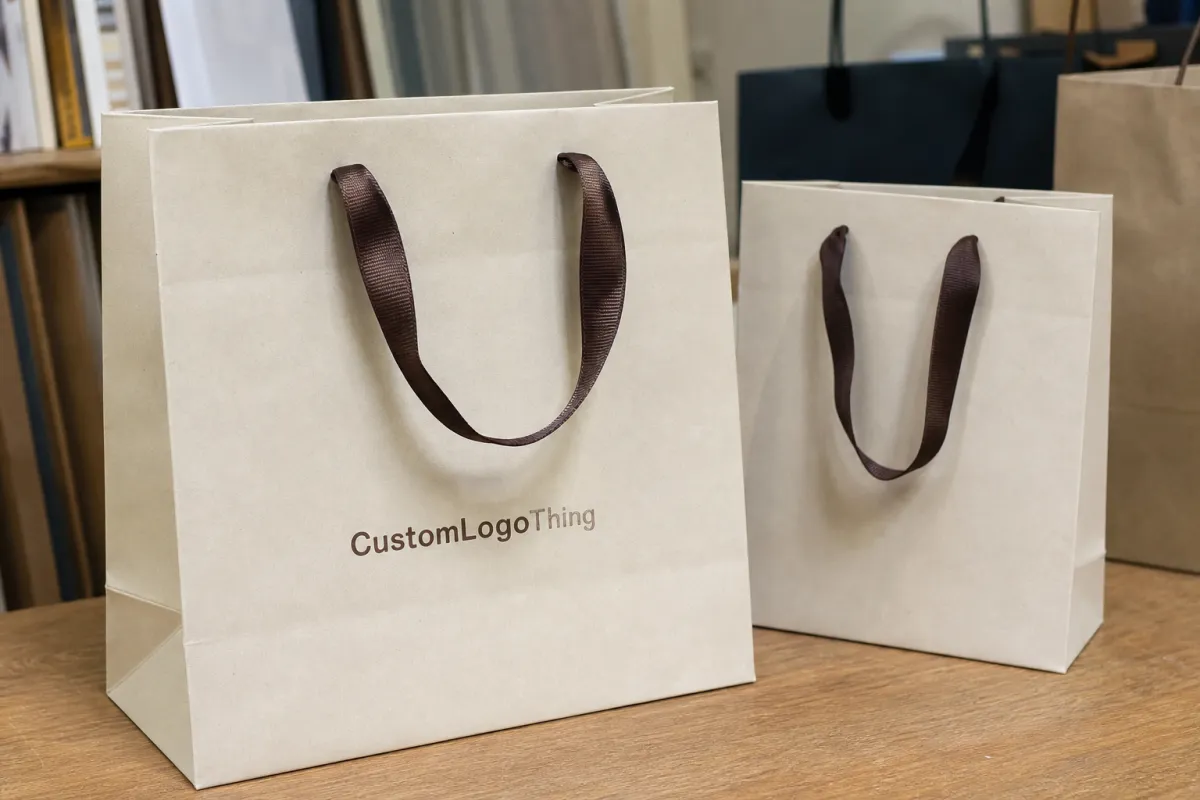
A twisted paper handle says practical. A ribbon handle says someone paid attention. That small shift matters because the handle is one of the first parts a customer touches. Satin feels softer. Grosgrain feels more structured and grips better in the hand. Either one can raise the perceived value before the product inside gets any credit.
The visual effect matters too. Ribbon handles change the silhouette of the bag. The top edge looks cleaner, and the bag reads closer to gift packaging than a standard shopping bag. That makes the format useful for cosmetics, fragrance, jewelry, ready-to-gift sets, event materials, and higher-margin retail purchases.
The tradeoff is structure. Ribbon handles look best when the paper stock and the product weight are matched correctly. A lightweight paper bag can work for folded apparel or small accessories. A boxed skincare set or heavier gift kit needs stronger board, better top reinforcement, and a handle attachment method that will not pull loose under load. Pretty is fine. Pretty and weak is not.
What a custom ribbon handle paper bag order includes
A clean order starts with the structure: paper stock, dimensions, gusset depth, handle style, print coverage, and finishing. If any of those are vague, the quote becomes unstable. Two bags can look identical from the outside and still price very differently once paper weight, lamination, handle attachment, or reinforcement changes.
A standard build usually includes a folded paper body, a reinforced top edge, anchor points or internal ties for the ribbon, outside printing, and flat packing for shipment. Some buyers add a bottom board for stability. Others want matte, gloss, soft-touch, or an uncoated paper look. If the bag needs to sit upright on a shelf or support a boxed item without bowing, the base and top fold deserve more attention than the artwork mockup.
Think through the use case before approving the design. A small accessory bag does not need the same construction as a fragrance gift set or a stacked apparel order. A high-end presentation bag may justify thicker board and wider ribbon. A fast-turn retail bag may do better with a simpler build that keeps unit cost under control. The right spec is the one that holds up in actual use, not the one that looks fancy in a PDF.
Common build decisions buyers make
- Stock: 120gsm to 250gsm paper, depending on load and finish.
- Ribbon: 10mm, 15mm, 20mm, or 25mm widths, usually satin or grosgrain polyester.
- Print: 1-color logo, multi-color artwork, or print on both sides.
- Reinforcement: top folding, bottom board, or a rigid insert for heavier sets.
"The cleanest orders are the ones that start with a spec sheet, not a guess."
Paper weight, ribbon width, and print specs to confirm early
Three details drive most of the performance and the price: paper GSM, ribbon width, and print method. Get those right early and the rest of the order gets much easier to control. Get them wrong and every revision starts moving the quote.
Paper weight affects stiffness, fold memory, and how well the bag keeps its shape after handling. Ribbon width affects comfort, balance, and how the handle sits against the top of the bag. Print method affects color consistency, setup cost, and how many passes the job needs on press. That is why a supplier should ask for the bag size, expected fill weight, artwork files, and finish preferences before pricing the job.
Material choice matters too. A 180gsm art paper bag with 15mm satin ribbon is not the same job as a 230gsm kraft-laminated bag with 25mm grosgrain. Same footprint. Different cost, different labor, different result. If the bags are going into bakery packaging, cosmetics, or gift sets, ask about grease resistance, scuff resistance, and how the print holds up under handling. If the bags need to support a sustainability claim, ask for FSC documentation and verify the standard directly at FSC.org. For shipping durability, ISTA is a useful reference at ISTA.org.
Ribbon color and bag color should be checked together, not separately. A cream bag with a cool white ribbon can look off. A black bag with a sheen-heavy ribbon can look louder than intended. Those are small misses on screen and obvious misses in person.
Custom ribbon handle paper bags bulk order pricing and MOQ
Price depends on size, stock, ribbon selection, print colors, finish, and volume. MOQ follows the same pattern. Standard dimensions and common ribbon colors usually allow lower minimums. Unusual papers, custom-dyed ribbon, foil, embossing, or multiple artwork versions usually push the minimum up because setup time rises with every extra variable.
The easiest way to keep control of the budget is to standardize the bag structure and limit the moving parts. Change the bag width, the ribbon color, and the print coverage all at once, and the quote will jump around. Keep the structure fixed and change only the artwork, and supplier quotes become much easier to compare.
The ranges below are planning figures, not locked quotes. Freight, paper market changes, region, and finishing can move them up or down.
| Order tier | Typical build | Estimated unit price | Common MOQ | Typical lead time after proof approval |
|---|---|---|---|---|
| 5,000 units | 120-157gsm paper, 1-color print, satin ribbon | $0.48-$0.78 | 5,000 | 12-18 business days |
| 10,000 units | 157gsm paper, 2-color print, matte or gloss finish | $0.34-$0.58 | 5,000-10,000 | 15-22 business days |
| 20,000 units | Heavy paper, custom ribbon color, reinforced top | $0.24-$0.42 | 10,000+ | 18-28 business days |
Those numbers shift again if the order includes a special insert, foil stamping, embossed artwork, or a custom ribbon shade. A buyer comparing suppliers should look at the total landed cost, not just the headline unit price. Packaging that arrives cheaper but needs rework, relabeling, or replacement is not cheap. It is just delayed pain.
The same discipline used for Custom Printed Boxes applies here: compare structure, finish, freight, and inspection terms together.
Process and timeline from artwork to delivery
The production path is simple enough: inquiry, quote, artwork review, proof approval, sample sign-off, bulk production, inspection, packing, and shipment. The schedule gets messy when the spec keeps changing. If dimensions are unclear or the artwork file needs constant rebuilding, the timeline slips fast.
A realistic plan looks like this: quotes often return in 24-48 hours once the core spec is clear. Artwork review may take 1-3 days. A sample can take 5-7 days for a straightforward bag and longer if the handle method or print is more involved. Bulk production usually runs 10-18 business days after approval. Then freight takes over, and air, sea, or courier will change the arrival date more than most buyers expect.
The approval window matters more than people think. A physical sample shows handle feel, print finish, and structure. A digital proof shows layout. It does not show whether the ribbon sits cleanly or whether the bag will buckle at the fold. If the launch date is fixed, build buffer time for proofing and shipping before production starts. A bag order is not the place to gamble with a retail calendar.
Quality checks that prevent ribbon and handle failures
The common failures are not dramatic. They are annoying: handle pull-out, uneven ribbon placement, weak glue on the top fold, color drift, scuffed edges, and crushed cartons. None of that looks good on a shelf, and all of it shows up in a customer's hand.
Ask how the supplier checks handle strength. The right question is not whether the bag "looks good." The right question is how the handle is tested against the intended fill weight. A bag that survives a light sample load may still fail once it is filled with a boxed fragrance set or a heavier retail kit. A real test uses the real weight, not just a visual check from across the table.
Other useful checks are simple: confirm the ribbon cut length, confirm the attachment position, check square corners, verify rub resistance on the print, and inspect the first and last cartons from the run. If the order is large, ask whether the supplier uses a sampling plan such as AQL or an equivalent internal inspection method. That tells you more about process control than a polished mockup ever will.
Packing matters too. Flat cartons, clean bundle counts, dry storage, and edge protection reduce damage before the bags reach the store. Moisture can warp paper. Heat can soften adhesive. A bag that ships flat and clean is easier for staff to use quickly, which is the point of the whole exercise.
Strong suppliers talk about tolerances before they talk about price.
How to compare suppliers before you place the bulk order
Price is only one variable. The supplier that wins the job is often the one that can repeat the same build without drifting on color, finish, or handle placement. That matters more on a bulk order than on a small trial. A 2% defect rate sounds small until it lands across thousands of bags.
Ask for the dieline, the proofing method, the inspection checkpoints, and the packing spec. Ask what happens if the planned ribbon color goes out of stock. Ask whether the quoted price includes cartons, inner packing, export marks, and replacement policy for obvious defects. A clear answer is worth money because it lowers the chance of a late surprise.
Speed matters too. Fast replies do not prove quality, but slow replies usually predict more delay later. Better suppliers are clear about what they need, realistic about timing, and specific about what is included. They should be able to explain alternatives without changing the design intent. If the approved ribbon is unavailable, what is the fallback? If the paper grade changes, does the bag still hold weight? Those are first-round questions, not post-approval headaches.
Next steps to lock a clean bulk order
Send five things first: bag dimensions, paper weight target, ribbon preference, print files, and delivery location. That is enough for a serious quote and enough for the supplier to flag obvious risks early. If the brief is clean, the order moves faster. If the brief is fuzzy, the order starts collecting revisions.
Keep one base spec, one proof round, and one approved sample when the build is new. After that, reuse the approved spec sheet for reorders. That makes future custom ribbon handle Paper Bags Bulk Order jobs easier to price and easier to repeat without drift. Consistency is usually more valuable than reinvention, especially for retail buyers who need the same bag to show up looking the same every time.
The same approach works across branded packaging, seasonal gift sets, and related product packaging projects. Lock the spec early, protect the timeline, and buy repeatability instead of guessing your way through production.
FAQ
What is the MOQ for custom ribbon handle paper bags bulk order?
MOQ depends on bag size, paper grade, ribbon style, and print complexity. Standard builds usually support lower minimums than heavily customized bags. If you need multiple versions, each version may carry its own setup requirement unless the supplier can run them together efficiently.
How can I lower unit cost without lowering bag quality?
Use one standard bag size, one ribbon width, and a limited print palette. Then compare unit cost across volume tiers instead of chasing the lowest first quote. Volume usually lowers cost more effectively than small spec changes.
What artwork files do you need for a quote?
Send vector artwork when possible, plus brand color references, logo placement notes, and dieline preferences. If color matching matters, include Pantone references and confirm whether the ribbon has to match the logo or the full bag.
Can I mix sizes or ribbon colors in one bulk order?
Sometimes, but mixed specs usually add setup time and can raise per-unit pricing because each variant has its own production requirements. The cleanest approach is to keep one bag structure and change only one variable, such as ribbon color or print version.
How long does production usually take after proof approval?
Lead time depends on order size, finishing steps, and shipping method, but production starts only after the proof and sample are approved. Build extra time for freight, customs, and any revision cycle so the bags arrive before the launch or promotion date.

