Buyer Fit Snapshot
| Best fit | Custom Shredded Paper Void Fill projects where brand print, material claims, artwork control, MOQ, and repeat-order consistency need to be specified before quoting. |
|---|---|
| Quote inputs | Share finished size, material target, print colors, finish, packing count, annual reorder estimate, ship-to region, and any compliance wording. |
| Proofing check | Approve dieline scale, logo placement, barcode or warning zones, color tolerance, closure strength, and carton packing before bulk production. |
| Main risk | Vague material claims, crowded artwork, missing packing details, or unclear freight terms can make a low unit price expensive after revisions. |
Fast answer: Custom Shredded Paper Void Fill: Material, Print, Proofing, and Reorder Risk should be specified like a repeatable production item. The safest quote records material, print method, finish, artwork proof, packing count, and reorder notes in one written spec.
Production checks before approval
Compare the actual filled-product size with the drawing, then confirm tolerance on folds, seals, hang holes, label areas, and retail display edges. Reserve space for logos, QR codes, warning copy, and material claims before decorative graphics fill the panel.
Quote comparison points
Review material grade, print process, finish, sampling route, tooling charges, carton quantity, and freight assumptions side by side. A quote is only useful when the supplier can repeat the same color, closure quality, and packing count on the next order.
Custom Shredded Paper Void Fill: What to Know Before Buying
Good packaging should feel settled in the hand. When a box rattles, the whole experience sours before the customer sees a single product detail, and the brand suddenly looks careless in ways that are hard to undo. That is where custom shredded Paper Void Fill earns its place. It is not window dressing. It belongs to the protection system, the presentation layer, and the message a package sends the moment it lands on a doorstep.
Buyers usually end up choosing between two bad outcomes: too little filler, which leaves the product sliding around, or too much filler, which forces the carton to bulge and makes the pack-out look hurried. custom shredded Paper Void Fill sits in the useful middle when it is specified with care. It fills dead space, holds the item in position, and gives retail packaging a cleaner first impression without stuffing the box until it feels overworked.
What Custom Shredded Paper Void Fill Really Is
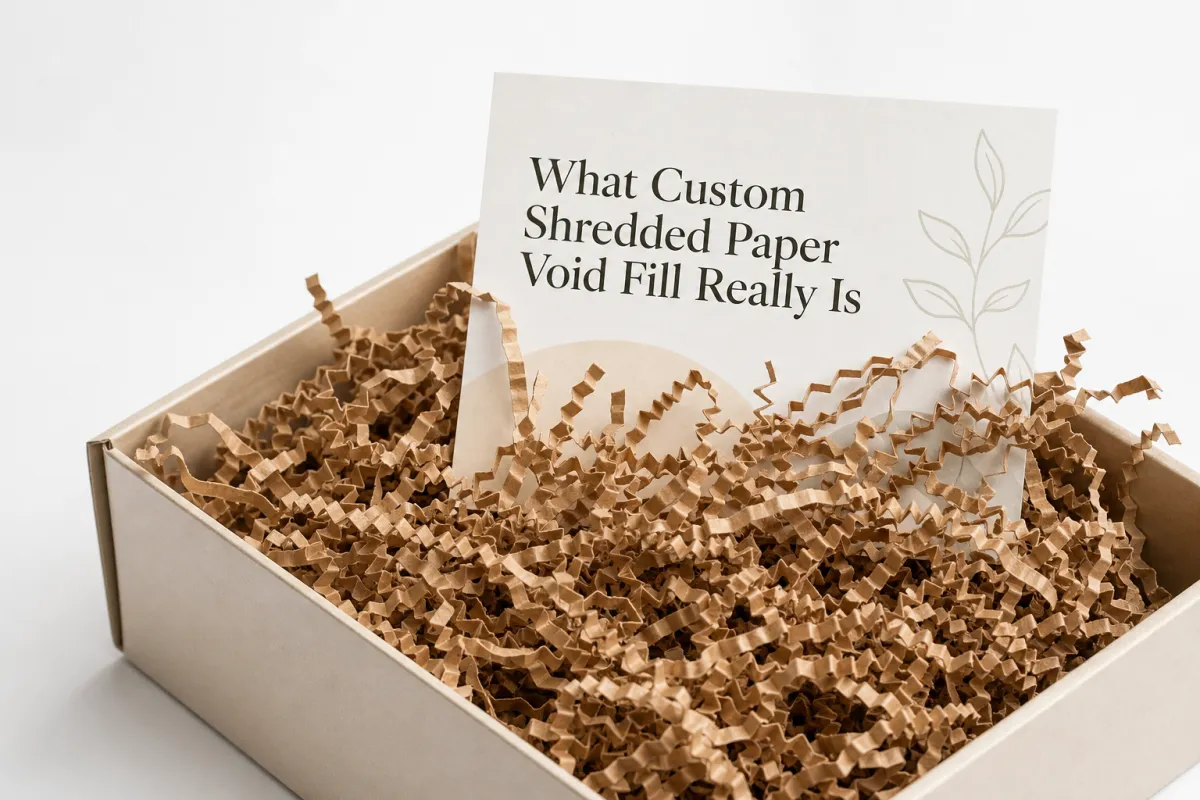
Custom shredded Paper Void Fill is loose-fill paper that has been cut or shredded to occupy empty space inside a carton, mailer, gift box, or product set. The custom part can come from color matching, a branded print on the source sheet, a specific shred width, or a paper choice that fits a brand's material standards. It is still filler, but it has to do more than pad a box. It has to protect the product and hold up the presentation at the same time.
That distinction matters more than most buying sheets admit. Decorative filler can look attractive in a studio photo and still fail the first rough ride through a parcel network. Real custom shredded paper void fill has a job: reduce movement, cushion the item a little, and remove the hollow space that makes a package sound cheap when it is lifted. A pretty interior is useful. A pretty interior that lets the product drift around is just expensive confetti.
From a packaging buyer's point of view, the real question is not whether the filler photographs well. The question is whether custom shredded paper void fill fits the product weight, the carton size, the assembly pace, and the shipping route. A lightweight candle in a rigid tuck box asks for something different than a glass set in a corrugated shipper. That is why one-size-fits-all sourcing rarely holds up in product packaging or branded packaging programs.
There is also a design issue that gets missed all the time: more filler is not always better. Once the carton starts to bulge, the closure gets stressed, the shelf-ready look falls apart, and the package arrives looking overpacked. Better results usually come from the right placement, the right shred density, and the right mix of protection components. In many cases, custom shredded paper void fill should support the product rather than replace the rest of the packaging structure.
A box should open with intention, not sound like the contents are trying to break free.
So the buying decision is really a careful balance of protection, brand fit, pack speed, cost, and lead time. That is the quiet checklist behind every decent custom shredded paper void fill spec. It becomes even more useful once you compare it with custom printed boxes, insert systems, and other product packaging choices.
How Custom Shredded Paper Void Fill Works in Shipping
Custom shredded paper void fill works because the paper settles around the product and occupies the air gaps that let items move in transit. The shredded fibers create friction, and friction is what stops side-to-side motion. A rigid item packed with too much open space will strike the carton wall when vibration starts; a properly packed item gets held in place by the mass of filler around it. That is the basic mechanical reason it works.
It usually performs best with rigid or semi-rigid products: candles, glass jars, cosmetics sets, gift kits, accessories, and bundled retail packaging that needs presentation as much as protection. A soft sweatshirt does not ask for the same treatment as a glass diffuser bottle. A heavy ceramic mug does not need the same placement as a flat card game. custom shredded paper void fill is useful, but it is not magic. It works best when the product already has a stable shape or when the box design supports the load.
The customer sees the effect immediately, before the product is even lifted out. Good custom shredded paper void fill makes the box feel deliberate. The reveal looks organized rather than thrown together. That matters because package branding starts the moment the lid opens, not when a logo first comes into view. If the brand leans premium, artisanal, playful, or seasonal, the filler needs to match that tone instead of fighting it.
Box size and insert design affect the amount of shred more than people expect. A narrow carton with a tall product may need less filler than a wide carton with the same item, because the gaps behave differently. A tray insert can handle vertical control while the shred fills corners and side voids. custom shredded paper void fill often works best as part of a system, not as the only system.
That is where pairing matters. Some packs need die-cuts, molded pulp, tissue wrap, or foam-free inserts alongside the shred. If the product can roll, tip, or collapse under pressure, the filler alone will not do every job. For shipping tests, distribution profiles from ISTA are a practical reference point, because real transit includes vibration, drops, compression, and the sort of rough handling that never appears in a neat sample room.
Brands with sustainability goals usually find paper-based fillers easier to fit into recycled-content systems than mixed-material alternatives. If chain-of-custody or fiber sourcing matters, the standards and supplier documentation from FSC are worth checking. That does not make every paper choice perfect, but it does give the sourcing conversation more substance than a vague eco claim printed on a carton and left to stand on its own.
Custom Shredded Paper Void Fill Cost and Pricing Factors
custom shredded paper void fill pricing begins with the paper itself, then picks up cost from color, cut style, print complexity, order quantity, and whether the material uses recycled content or premium fiber. A specific brand color may require dyed stock or a custom run, which usually costs more than plain kraft. If the shred is made from printed sheets, the print itself and the extra handling add to the total. Packaging almost never lives as a single number. It is usually a stack of small numbers sitting on top of one another.
Setup friction is the part many buyers learn the hard way. A short run of custom shredded paper void fill often carries a higher per-unit cost because the supplier still has to set the process, confirm the color, and move material through the line. Once volume rises, the gap starts to close. A brand ordering 500 units sees a very different quote than a brand ordering 5,000 or 20,000 units, even when the material looks similar on paper.
| Option | Typical Use | Approx. Cost Per Packed Box | Pros | Tradeoffs |
|---|---|---|---|---|
| Plain kraft shred | Basic void fill for simple shipping | $0.04-$0.10 | Low cost, easy to source, decent cushioning | Limited branding, less visual impact |
| Colored stock shred | Gift packaging and retail packaging | $0.08-$0.18 | Better presentation, stronger brand fit | Color choice may be limited by stock |
| Custom shredded paper void fill | Branded product packaging with visual control | $0.10-$0.28 | Best balance of branding and protection | Setup costs, lead time, MOQ pressure |
| Custom shred plus insert system | Fragile or premium kits | $0.18-$0.40+ | Highest stability, strong unboxing experience | More parts, more assembly time |
Those numbers are intentionally broad. A small run of custom shredded paper void fill can land above the range because the supplier still has to absorb setup and short-run handling. Larger programs can bring the per-box cost down, especially when the shred is packed in bulk and used across several SKU families. As a rough planning range, smaller brands often budget around $0.25-$0.60 per packed order for branded filler on short runs, while mid-size programs may settle closer to $0.10-$0.25 once volumes stabilize.
Minimum order quantities matter as well, and they are not always friendly. Many suppliers want 250-500 lb minimums for standard paper shred, while branded or custom-colored runs can push that higher. It is frustrating, though it is also how material runs stay efficient. Freight and storage deserve a line item too. Bulky custom shredded paper void fill can look inexpensive in a quote and then become more expensive once pallet shipping, warehouse floor space, and inventory turns show up.
Recycled or FSC-certified fiber may nudge the price upward, yet it can also make the sales conversation easier if your customers care about sourcing. For some brands, the extra dollar or two per hundred packs is a small price for a cleaner story. For others, that same budget is better spent on pack control or on better custom printed boxes. The right answer depends on what the buyer sees and what the warehouse can handle every day.
Step-by-Step: Ordering Custom Shredded Paper Void Fill
The cleanest way to order custom shredded paper void fill is to start with the product rather than the artwork. Measure the product dimensions, weight, and fragility. Note whether it shifts inside the carton, whether it needs corner support, and whether the shipper is a mailer, a corrugated box, or a retail-ready gift pack. If the item is oddly shaped or top-heavy, say that plainly. Guessing at those details is how brands end up buying filler that looks polished in a mockup and behaves badly in real packing.
Next, decide what the fill should do visually. Should it feel natural and matte, or bold and color-forward? Should it read premium, playful, or seasonal? That choice affects paper finish, shred width, and color. A cleaner-cut wider shred usually looks fuller and more elevated; a finer shred can nest more tightly and work better in compact spaces. Good packaging design does not ask the filler to carry the whole brand story, but it does ask it to support the scene.
Then ask for a sample or proof. Not a guess. Not a screenshot. A real sample. custom shredded paper void fill looks different once it is handled, compressed, and packed into an actual box. Screen color can be misleading. Density can be misleading. If the supplier offers a pack-out sample, use it. If they offer a pre-production proof, inspect it against the product and the box together. That is the only reliable way to know whether the material fits your workflow.
It helps to write the spec by SKU instead of by mood. One SKU may need a shallow bed of filler under a cosmetic jar. Another may need shoulder support on both sides. A third may only need a presentational layer. Put that into a fill standard sheet so the warehouse does not improvise. The best custom shredded paper void fill programs are boring in the right way: same input, same result, fewer surprises.
If you are still building the broader packaging program, it is worth reviewing the rest of the carton system at the same time. Browse Custom Packaging Products if you need a wider look at matching inserts, cartons, and branded packaging components. A filler decision gets easier once the rest of the pack-out is on the table rather than hidden in separate spreadsheets.
Before approval, test three things: pack speed, box closure, and shake performance. If the team can pack the order cleanly without fighting the material, that is a good sign. If the lid closes without bowing, that is a better sign. If a gentle shake leaves the product quiet, you are probably close. If not, adjust the spec. custom shredded paper void fill should make the process easier, not turn every order into a craft project.
For brands comparing packaging options, a second pass through branded packaging components can help before final approval. The filler should fit the carton family instead of forcing the carton family to work around it.
Custom Shredded Paper Void Fill Process and Timeline
The timeline for custom shredded paper void fill usually moves through brief, sample, proof, production, and delivery. That sounds obvious until someone skips a handoff and then acts surprised when the shipment misses launch week. Build the process in order. Confirm the quantity, color, shred style, and box usage first. Review samples next. Lock the proof after that. Production comes last. That sequence is the difference between organized procurement and panic with a spreadsheet.
For standard runs, a realistic planning window is often 7-12 business days after proof approval if the paper and finish are straightforward. If the job needs custom color matching, special cut dimensions, or higher-volume sourcing, 12-20 business days is more realistic. Freight can add another 3-7 business days depending on distance and shipping mode. custom shredded paper void fill is not usually the slowest part of a packaging launch, but it gets blamed when the calendar was already too tight.
Rush orders can buy time, but they do not buy miracles. A rush fee may move the job ahead in a queue or reduce internal buffer time, yet artwork still has to be approved, materials still have to be sourced, and cartons still have to be available for testing. Seasonal demand makes that worse. Holiday drops, subscription-box launches, and retail packaging refreshes all crowd the same production calendar. If your order has a fixed launch date, give yourself a cushion of at least two extra weeks before it becomes somebody else's emergency.
Plant workload changes the schedule too. If the supplier is already running custom printed boxes, inserts, or large branded packaging programs, a filler-only order can still wait its turn behind a bigger batch. That is normal. It is also why lead-time conversations should happen before the buyer sends the launch announcement to marketing. custom shredded paper void fill works best when procurement and launch planning stop pretending they live in separate worlds.
- Week 1: final brief, size check, and sample request
- Week 2: proof approval and fill standard sign-off
- Week 3: production slot and quality check
- Week 4: freight, receiving, and warehouse rollout
If the packaging program is moving quickly, that schedule only compresses when every handoff stays clean. When it does not, the gap between "ordered" and "usable" widens, and custom shredded paper void fill becomes another item sitting in receiving while someone asks why the boxes are ready but the fill is not.
Common Mistakes With Custom Shredded Paper Void Fill
The most common mistake is underfilling. The product shifts, the carton sounds hollow, and the customer feels that movement immediately. Underfilled custom shredded paper void fill turns the opening experience into a rattle test, which is a poor brand promise. It also increases the odds of scuffing, impact damage, and ugly returns that cost far more than the filler would have.
Overfilling is the second classic error. The box strains, the lid fights to close, tape gets stretched across a bulging edge, and the final pack-out looks rushed. That is not premium. That is panic in paper form. Many brands think they are being careful by adding more custom shredded paper void fill, but once the carton loses its shape, the packaging starts working against itself.
Shred size creates trouble too. A cut that looks attractive in a lifestyle photo may compact too hard in shipment, leaving the product exposed. Another cut may shed too much and make the inside of the box messy. If your product has tight cavities or fine details, a smaller shred may behave better. If you want a richer reveal, a wider shred may be the better fit. Choose based on the pack-out, not on the sample sheet alone.
People also mismatch the filler to the product type. Glass, ceramics, cosmetics, soft goods, and subscription kits all behave differently. Heavy items need more side support. Light items often need more presentation control than cushioning. A box with a loose accessory set may need a mix of wrap, insert, and custom shredded paper void fill rather than shred alone. That is the part buyers skip when they want one material to solve four jobs.
Branding mistakes show up fast too. Color clash is real. If the shred fights the carton color, the logo, or the tissue wrap, the whole opening looks accidental. Good package branding is coordinated. It does not need to shout, but it should feel planned. If the box is muted and the filler is neon, the customer notices. Usually not in a flattering way.
A filler spec that looks clever on a mood board can still fail the first shake test. Reality is rude that way.
Most failures with custom shredded paper void fill come from focusing on appearance instead of behavior. That part is fixable. Measure, test, adjust, and document the final spec so the next order does not restart the same argument.
Expert Tips for Better Custom Shredded Paper Void Fill
Start with real products, real boxes, and real packers. Not the cheapest sample box in the room. Not the one everyone waves at during a marketing review. A proper test for custom shredded paper void fill should include the product SKU, the actual carton dimensions, and the people who will pack it every day. Warehouse staff usually spot bad specs quickly because they see where the material slows them down.
Document a fill standard sheet for each major SKU. Include box size, fill depth, target appearance, whether the product should sit flush or suspended, and any seasonal change notes. That keeps the pack-out consistent across shifts and locations. It also makes reorders much easier because nobody has to reconstruct the original decision from memory and a handful of vague photos. custom shredded paper void fill is far easier to manage when the spec reads like an operating rule rather than an inbox artifact.
Pair the shred with other components when the product needs more control. A molded pulp tray or die-cut insert can stabilize the item while the shred handles the reveal and the dead space. Tissue wrap can prevent surface scuffing. A small carton divider can keep accessories in their lane. That layered packaging design usually works better than forcing one material to do everything. It also helps when a brand uses multiple box sizes across a product line.
Balance brand impact with fulfillment speed. A beautiful pack-out that adds twenty seconds per order becomes expensive quickly. If your team packs 1,000 orders a week, those seconds become labor. custom shredded paper void fill should support the line, not turn into an arts-and-crafts bottleneck. The best version is the one the warehouse can repeat cleanly at speed.
Use standards where they help. If the product moves through parcel networks, test against ISTA distribution profiles. If the customer base cares about sourcing, keep FSC paperwork clean. If the box needs impact and vibration checks, use the tests that match the route rather than a random desk shake. That sounds basic because it is basic. It is still where a lot of packaging programs go off the rails.
Here is the practical buying list I would use:
- Audit your top-selling SKUs and note the ones that shift in transit.
- Request a sample of custom shredded paper void fill in the exact color and shred style you want.
- Run a shake test and a short ship test with the real box.
- Measure pack speed and update the fill standard sheet.
- Set a reorder point before inventory gets thin.
Do that, and you avoid the usual packaging drama. Skip it, and you end up paying twice: once for the filler, and again for the fixes. That is not a smart way to buy anything.
Custom shredded paper void fill can be a strong part of branded packaging, especially for gift sets, premium mailers, and product packaging where presentation matters. It is not the only answer, and it should not be asked to solve every shipping problem in the building. Used well, it gives you better void control, a cleaner presentation, and fewer damaged arrivals. That is a sound trade when the box matters as much as the product inside.
Take the final step by tying the fill spec to one real SKU, one real carton, and one real warehouse workflow, then document that setup before the next order goes live. That simple discipline is what keeps custom shredded paper void fill useful instead of ornamental, and it is usually the difference between a nice unboxing moment and a box That Travels Well every time.
How much custom shredded paper void fill do I need per box?
Base the amount on the box size, the shape of the product, and how much movement you feel in a shake test. Start with a small pack-out test for each SKU, then increase the amount until the item stops shifting without overstuffing the carton. Heavier or oddly shaped items usually need more fill around the sides and corners, while lighter gifts often need less. There is no single number that fits every package.
Is custom shredded paper void fill more expensive than plain filler?
Usually yes, because customization adds setup, color matching, or print-related costs. The tradeoff is stronger branding and often less need for extra decorative packaging elsewhere. For higher volumes, the per-unit gap shrinks, so the real question is whether the branded experience is worth the increase. For many product launches, it is. For basic shipping-only cartons, maybe not.
What shred size works best for custom shredded paper void fill?
Wider shred tends to look fuller and more premium, while finer shred can pack tighter and work better for smaller products or tighter box cavities. The best choice depends on whether your priority is presentation, cushioning, or faster packing. If the item is fragile, test both. The prettiest option is not always the best-performing one.
How long does custom shredded paper void fill take to produce?
Lead time depends on artwork approval, color matching, paper availability, and order size. Simple runs are faster when specs are clean; custom colors and special finishes take longer. If the launch date matters, build in extra time for sampling and freight, because shipping does not care about your deadline. That sounds blunt because it is.
Can custom shredded paper void fill be used for food, cosmetics, or subscription boxes?
Yes, but the paper grade and cleanliness standards need to match the product type and any regulatory requirements. For direct-contact or sensitive items, use barriers or inserts where needed instead of assuming the shred alone is enough. Subscription boxes are a strong fit because the filler adds both void control and a branded reveal. In that setup, custom shredded paper void fill does more than look good; it helps the whole pack-out feel intentional.

