Buyer Fit Snapshot
| Best fit | Custom Tissue Inserts Wholesale Quote projects where brand print, material claims, artwork control, MOQ, and repeat-order consistency need to be specified before quoting. |
|---|---|
| Quote inputs | Share finished size, material target, print colors, finish, packing count, annual reorder estimate, ship-to region, and any compliance wording. |
| Proofing check | Approve dieline scale, logo placement, barcode or warning zones, color tolerance, closure strength, and carton packing before bulk production. |
| Main risk | Vague material claims, crowded artwork, missing packing details, or unclear freight terms can make a low unit price expensive after revisions. |
Fast answer: Custom Tissue Inserts Wholesale Quote: Pricing & Specs should be specified like a repeatable production item. The safest quote records material, print method, finish, artwork proof, packing count, and reorder notes in one written spec.
Production checks before approval
Compare the actual filled-product size with the drawing, then confirm tolerance on folds, seals, hang holes, label areas, and retail display edges. Reserve space for logos, QR codes, warning copy, and material claims before decorative graphics fill the panel.
Quote comparison points
Review material grade, print process, finish, sampling route, tooling charges, carton quantity, and freight assumptions side by side. A quote is only useful when the supplier can repeat the same color, closure quality, and packing count on the next order.
Custom Tissue Inserts Wholesale Quote: Pricing & Specs
A custom Tissue Inserts Wholesale quote is not just a price per sheet. The better version tells you how the tissue prints, folds, ships, and behaves on a real packing table. That is where the actual cost sits. Not in the sheet itself. In the labor, the scrap, the rework, and the tiny packaging problems that quietly chew through margin.
Buyers in apparel, cosmetics, gifts, and subscription packaging ask for a quote before approving a spec for a simple reason: the quote exposes the real job. It shows whether the insert is easy to run, whether the fold fits the workflow, and whether the sheet will sit inside the carton without trimming, force-fitting, or a last-minute workaround. For branded packaging, those details matter just as much as the logo.
From a packaging buyer’s point of view, a messy request gets a messy answer. A clean request gets a clearer comparison, more accurate freight estimates, and fewer revisions after artwork is already in motion. If you need support beyond tissue, our Custom Packaging Products page shows where tissue inserts sit alongside boxes, sleeves, and other packaging components.
If the fold, print, and pack format are missing, the supplier is guessing. Guessing costs money, and it usually shows up after the job has started.
The Small Insert That Can Lower Total Pack-Out Cost
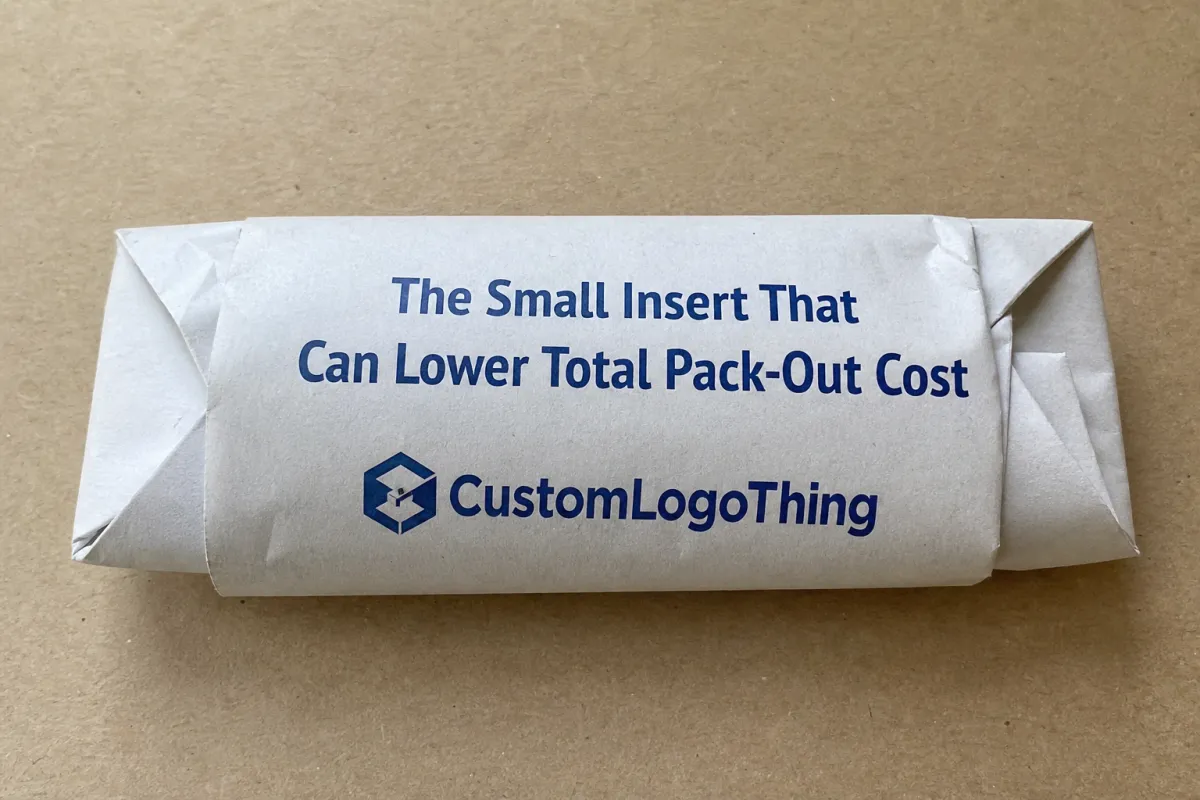
Small parts cause big headaches when they are wrong. Tissue inserts are light, easy to store, and cheap to move, which is exactly why they can reduce labor. They protect products from scuffing, center items inside the carton, and make the finished package feel planned instead of assembled in a hurry.
The real savings show up in the line flow. A correctly sized sheet can eliminate extra void fill, cut down on re-folding, and give operators one repeatable motion instead of three improvised ones and a sigh. A sheet that is too small, too large, or printed against the grain does the opposite. It creates waste, slows close-out, and makes the carton look rushed. Because it is rushed.
That is why a Custom Tissue Inserts wholesale quote should be treated as a full job estimate, not a paper-only comparison. The price needs to account for stock grade, print coverage, cutting, bundling, and the way the inserts are packed for your team. The lowest quote is not a win if it adds handling steps or slows fulfillment.
For product packaging teams, tissue inserts sit right between presentation and protection. They are not structural packaging, and nobody should pretend they are. They do, however, make custom printed boxes feel more premium without forcing a full redesign. That matters. A lot more than a beautiful package that falls apart as soon as someone tries to pack it.
They also scale well. A small first order can be tested on one product line, then expanded across the catalog once the fold and print are locked. Wholesale programs make sense for that reason alone. The same sheet can often support multiple sizes with a small change in fold or trim, which is a practical way to avoid solving the same packaging problem three times.
What Custom Tissue Inserts Include: Materials, Sizes, and Print Options
A tissue insert is a lightweight paper component used to wrap, separate, cushion, or present products inside cartons, sleeves, rigid boxes, and mailers. It is thinner than most wrap paper, and that thinness is part of the point. The insert can fold around a product, sit above the item as a presentation layer, or act as branded tissue that becomes part of the unboxing.
Material choice usually starts with basis weight and opacity. Standard tissue often sits around 17 to 21 gsm, which is light enough for wrapping without making the pack bulky. If the print needs more concealment or the sheet needs more body, buyers may step up to a higher-opacity stock or a slightly heavier grade. Recycled-content tissue is common for brands that want to support sustainability claims. Acid-free tissue is worth considering for delicate goods, archival items, or anything that should not sit against paper chemistry that gets unpredictable over time.
Sizes should follow the carton and pack-out logic, not a random dimension that looked tidy on a spec sheet. A flat sheet works for a basic wrap. A folded insert can speed pack-out when operators need a consistent opening sequence. Die-cut shapes, branded wraps, and pre-packed bundles all have a place depending on the line setup. High-volume fulfillment usually benefits from bundled inserts because the operator grabs a repeatable stack instead of counting sheets like it is a penalty.
Print options affect both appearance and price. A simple one-color logo is the most common starting point because it keeps setup simple and still gives a clean branded result. More coverage, multiple ink colors, or edge-to-edge printing raises cost because it takes more press time, tighter registration, and more inspection. Some buyers keep the design minimal on purpose. A logo mark, a short line of copy, and a repeat pattern can signal quality without turning the unit price into a bad joke.
That is where packaging design choices make a real difference. A tissue insert that matches the carton color, fold style, and product category usually looks more considered than a loud print fighting with the item inside. In retail packaging, restraint often reads better than shouting.
Here is a practical way to think about the common options:
| Option | Typical Spec | Best For | General Wholesale Impact |
|---|---|---|---|
| Unprinted standard tissue | 17-21 gsm, flat sheet | Basic wrap and separation | Lowest cost, simplest setup |
| Single-color branded tissue | 17-21 gsm, one logo or repeat pattern | Apparel, gifts, entry-level branding | Moderate cost, common MOQ |
| Higher-opacity printed tissue | 21-28 gsm, more ink coverage | Premium presentation, better concealment | Higher unit cost, stronger visual impact |
| Recycled or acid-free tissue | Custom spec by application | Eco-focused or delicate products | May add cost, sometimes important for compliance or product care |
| Folded or pre-packed inserts | Finished format ready for line use | Fast pack-out, subscription kits, multi-SKU programs | May raise quote, but can reduce labor at fulfillment |
If you are comparing options for different products, keep the comparison honest. Quote the same size, the same print assumptions, and the same packaging format. A unit price that looks great on one spec can get ugly fast once the sheet size, ink coverage, or bundle count changes. That is especially true for custom printed boxes and the inserts that finish them. The visual system has to work as one package, not as a pile of unrelated parts.
Specifications to Confirm Before You Request a Quote
Good quotes start with clear inputs. If the supplier has to guess at the finished format, the estimate comes back padded with risk or gets revised later. Either way, everyone loses time. The cleanest RFQ gives the real dimensions, the fold orientation, the print target, and the quantity in one message.
Start with the finished size. Do you need a square sheet, a rectangular wrap, or a cut piece that nests inside a box lid? If the insert folds around a product, say whether the fold is centered, offset, or meant to create a visual reveal. That detail changes the material yield and can move cost more than most people expect.
Next, confirm the paper spec. Basis weight, opacity, color, recycled content, and acid-free requirements all belong in the request. A white tissue with a light print is not the same job as a cream sheet or a fully branded insert. If your product line depends on color accuracy, include Pantone targets or approved CMYK values so the print team knows what they are aiming at.
Artwork needs the same level of clarity. Note logo placement, the number of ink colors, repeat pattern requirements, and whether the design must align across multiple product sizes. If the insert has to match a family of cartons or sleeves, say that early. It is much easier to plan a repeat pattern before the plate or screen is made than after the press is already running and everyone is trying to reduce a real problem into a “small adjustment.”
Also include handling requirements. Bundle counts, shrink wrap or carton packing, and any certification or recycled-content claims should all be part of the quote request. If a brand needs chain-of-custody documentation, links to recognized programs such as FSC certification guidance can help clarify what the material needs to support. If the insert is being tested for shipability inside a larger package, the structural side of the overall pack may also need verification under standards discussed by the ISTA testing community.
Finally, send the commercial details. Quantity, destination, and target ship date affect unit cost, freight, and schedule. A supplier cannot quote transportation accurately without a destination, and nobody should promise a production slot without a real in-hand date. If the program is still taking shape, our Contact Us page is the fastest place to start the conversation.
Use this checklist before you send the request:
- Exact finished dimensions and fold orientation
- Paper weight or basis weight, opacity, and color
- Print colors, artwork placement, and repeat pattern needs
- Bundle count, carton count, and packing preference
- Quantity, destination, and target in-hand date
- Any recycled-content, acid-free, or certification requirements
Custom Tissue Inserts Quote, Pricing, and MOQ
The price behind a custom tissue insert usually comes down to six things: material grade, sheet size, print complexity, order volume, packing format, and destination. Change any one of those, and the quote will move. That is not a supplier trying to be mysterious. It is how paper converting and print economics work.
MOQ is less about a wall and more about how setup costs get spread across the run. If a job needs plate creation, cut tooling, press setup, or custom bundling, those fixed costs exist whether the order is tiny or large. On a small run, that cost sits on fewer pieces, so the unit price rises. On a larger run, the same work gets spread out, and the price usually drops in a very visible way.
Wholesale tiers usually show the pattern clearly. A simple unprinted sheet may land in a lower range, while branded or higher-opacity tissue sits higher. As a working guide, small wholesale runs might land around $0.03-$0.08 per unit for plain tissue, $0.06-$0.15 for a simple branded print, and $0.12-$0.30 or more for heavier, higher-coverage, or specially finished formats. Those are not promises. They are the kind of ranges buyers often see before freight and extra handling show up.
The best quote is the one that explains where the money goes. A clean estimate should list the unit price, setup or plate charges, sample costs if applicable, freight, overage policy, and any reprint terms. If one of those is buried or missing, the comparison is incomplete. A low unit price is easy to make look good when the sample charge is ugly or freight gets reworked later.
Ask for multiple quantity breaks. That request usually saves time later because it shows where the run starts to get efficient. A 2,500-piece quote, a 5,000-piece quote, and a 10,000-piece quote can reveal whether the next volume level is worth the inventory commitment. For brands running custom printed boxes with coordinated inserts, that break pricing can help line up the packaging budget with the sales forecast instead of forcing a bad compromise.
Here is a practical comparison buyers can use when evaluating a custom tissue inserts wholesale quote:
| Quote Element | What It Means | Buyer Check |
|---|---|---|
| Unit price | Cost per insert at the stated quantity | Confirm it matches the exact size and print spec |
| Setup charge | Fixed cost for press, plates, or tooling | Ask whether it is one-time or repeatable on reorders |
| Sample or proof fee | Charge for pre-production approval or mockup | Know if it can be credited toward the order |
| Freight | Transportation to your destination | Check whether it is included, estimated, or billed later |
| Overage policy | Allowed extra quantity above the ordered amount | Make sure extras are acceptable and priced clearly |
| Reprint terms | What happens if a repeat order is needed | Confirm whether the artwork and specs stay on file |
The fairest comparison is always apples to apples. Match the same dimensions, same sheet weight, same print assumptions, and same delivery terms before deciding which supplier is best. A quote that looks higher can still be the smarter option if it includes freight, proofing, and tighter quality control. That matters a lot for package branding programs where consistency beats shaving a fraction of a cent off one line item.
Process and Timeline: From Artwork to Delivery
A good tissue insert order follows a predictable path. First comes inquiry and spec review, then artwork checking, proof approval, sample review if needed, production, quality inspection, packing, and shipment. Every step has a chance to add time if the information is thin. The smoother the front end, the less drama at the back end. Which is rare in packaging, but still possible.
Most delays come from plain old missing details. Artwork may not be sized correctly. The fold direction may be vague. The color target may be described in general terms instead of a standard like Pantone or approved CMYK. Sometimes the buyer knows exactly what the insert should look like, but the supplier does not have enough detail to move efficiently. That gap can add days, sometimes more, to a schedule that should have been simple.
Lead time usually depends on whether the job is a first-time print or a repeat run. Reorders are typically faster because the spec, artwork, and print setup are already established. First-time jobs take longer because the proof has to be reviewed and the production method needs to be confirmed. The more complex the coverage or folding pattern, the more important that approval step becomes. Simple jobs move quickly. Detailed jobs need actual discipline.
Rush production is sometimes possible, but only if the artwork is ready and the material is already on hand. Speed starts with a complete request. If the dimensions are still shifting or the artwork is not print-ready, the fastest plant in the world cannot erase the time needed to lock the spec. Buyers who understand that usually get better results because they plan around decision points instead of around hope.
Typical timelines often land around 12-15 business days from proof approval for a straightforward printed insert, with more time needed for complex coverage, special folding, or larger quantities. That is a planning range, not a promise, because production schedules and freight options change. Still, it is useful when you are lining up tissue inserts with apparel drops, launch dates, or subscription cycles.
It helps to ask for a milestone schedule. A simple timeline that shows proof date, production window, inspection, and shipment date gives the buyer something real to manage. It also keeps internal communication cleaner when several teams are poking at the same packaging decision.
If you want to keep the process moving, send the supplier these items in one packet:
- Artwork or dieline with exact dimensions
- Print color targets and fold orientation
- Quantity and destination
- Target in-hand date
- Any packaging or certification requirements
Why Choose Us for Wholesale Tissue Inserts
A tissue insert may be light, but the buying decision is not. You need a supplier that understands how the product behaves on the floor, how it packs into the carton, and how it shows up in the customer’s hands. That is where actual packaging experience matters more than polished sales language. The real question is whether the insert arrives with the right fold, the right finish, and the same consistency across the whole run.
At Custom Logo Things, the wholesale value sits in steady execution. That means clear spec handling, repeatable print quality, and communication that stays focused on the packaging job instead of wandering into fluff. If a buyer wants a simple branded sheet, a premium presentation wrap, or a coordinated component for broader branded packaging, the goal is to keep the path from quote to shipment direct and easy to manage.
Consistency matters because tissue is visible. Small shifts in color, trim, or fold can make a strong presentation look unfinished. Repeat orders should not force the spec to be rebuilt from scratch every time. A stable wholesale program makes inventory planning easier, keeps reorders moving, and helps the packaging system stay aligned as the brand grows.
There is also a labor story behind every good quote. A thoughtful insert can reduce hand work, shorten the pack sequence, and make the team less dependent on last-minute wrapping tricks. That matters on a real floor where every extra motion gets multiplied across hundreds or thousands of units. The right insert does not just look polished. It helps the operation move the same way every time.
For buyers comparing vendors, this is where our Wholesale Programs fit well. They are built for repeat business, clearer pricing structure, and order planning that reflects actual production needs instead of a shiny headline number. If you are still shaping the broader line, the same approach can be used across product packaging components so the whole presentation works together.
One more practical advantage: tissue inserts scale cleanly across categories. Apparel often needs a soft, elegant wrap. Cosmetics may need a brighter white sheet with tighter print consistency. Gift packaging usually benefits from an elevated reveal. Subscription packaging needs efficiency and repeatability. The same base material can support all of those goals if the spec is set properly.
That balance of appearance and utility is what buyers pay for. Not hype. Not excess. Just a package that feels intentional, works on the line, and supports the product without getting in its way.
How to Request a Quote and Take the Next Step
The easiest way to get a useful answer is to send a complete request from the start. List the dimensions, quantity, artwork, fold style, delivery address, and target in-hand date. If you already know the carton size or the product dimensions, include those too. A product photo or dieline can shorten the back-and-forth because it shows the supplier how the insert needs to function inside the package.
If you are still deciding between a few directions, ask for three versions: a best-value option, a presentation-focused option, and a faster-turn option. That gives you a cleaner basis for the decision. Sometimes the best choice is obvious once you see the price spread. Other times the middle option is the one that balances appearance, Cost, and Timing without making the rest of the team miserable.
When the quote arrives, read it like a production document, not a sales note. Check whether the dimensions match your request, whether the print assumptions are the same, and whether the timeline is realistic for your launch or replenishment plan. Make sure extra charges are visible. If freight, proofs, or setup are hidden, the total cost may be higher than it first appears. Funny how that keeps happening.
It also helps to compare landed cost instead of unit cost alone. The cheapest line item is not always the cheapest order. Freight, overage, and reprint terms can matter just as much, especially on a product that will be reordered. That is one reason experienced buyers focus on the complete package instead of the paper line by itself.
If you are ready to move forward, request a custom tissue inserts wholesale quote with complete specs so pricing is accurate the first time. That one step can save days of revisions, reduce surprise charges, and help you choose the right level of presentation for the product. For the next conversation, use Contact Us and send the dimensions, artwork, quantity, and delivery details together so the response comes back cleanly.
Done well, tissue inserts are a small investment that pays off in presentation, protection, and packing efficiency. Done loosely, they become a line item that creates delays and confusion. The difference usually comes down to how well the spec is written and how clearly the quote is structured.
Frequently Asked Questions
What should be included in a custom tissue inserts wholesale quote?
The quote should include the exact size, fold style, and finished format so the supplier is pricing the real production item. It should also show paper weight, color, print colors, quantity, and destination because each one changes unit cost. Any setup, sample, freight, or packing charges should be visible as well so the comparison stays honest.
How does MOQ affect tissue insert pricing?
MOQ affects pricing because fixed setup and production costs are spread over more units as the order grows. Smaller runs usually carry a higher unit cost because press time, cutting, and handling do not shrink much with the order size. Tiered quantity pricing often shows the best savings once you pass a higher volume break.
What files do I need before requesting a wholesale tissue insert quote?
A flat artwork file or dieline with the correct dimensions and fold orientation is the best starting point. If print matching matters, include color references such as Pantone targets or approved CMYK values. The shipment destination and target date should also be included so freight and lead time can be quoted correctly.
How long does custom tissue insert production usually take?
Timing depends on proof approval, print complexity, and whether materials are already in stock. First-time jobs usually take longer than repeat orders because the artwork and specifications must be confirmed before production starts. Ask for a schedule that separates proofing, production, and shipping so expectations stay clear.
Can I compare more than one option in a custom tissue inserts wholesale quote?
Yes, and that is often the smartest way to buy. Ask for alternate sizes, paper weights, or print methods in the same request so you can compare practical choices side by side. Review both unit cost and total landed cost so the lowest line item does not hide a higher freight or setup burden.
Best move: send one complete RFQ with dimensions, print details, quantity, destination, and the in-hand date. That gives you a usable custom tissue inserts wholesale quote instead of a vague price, and it is the fastest way to keep the order moving without avoidable revisions.

