Buyer Fit Snapshot
| Best fit | Custom Vinyl Stickers for Packaging projects where brand print, material claims, artwork control, MOQ, and repeat-order consistency need to be specified before quoting. |
|---|---|
| Quote inputs | Share finished size, material target, print colors, finish, packing count, annual reorder estimate, ship-to region, and any compliance wording. |
| Proofing check | Approve dieline scale, logo placement, barcode or warning zones, color tolerance, closure strength, and carton packing before bulk production. |
| Main risk | Vague material claims, crowded artwork, missing packing details, or unclear freight terms can make a low unit price expensive after revisions. |
Fast answer: Custom Vinyl Stickers for Packaging: Design, Cost & Use should be specified like a repeatable production item. The safest quote records material, print method, finish, artwork proof, packing count, and reorder notes in one written spec.
Production checks before approval
Compare the actual filled-product size with the drawing, then confirm tolerance on folds, seals, hang holes, label areas, and retail display edges. Reserve space for logos, QR codes, warning copy, and material claims before decorative graphics fill the panel.
Quote comparison points
Review material grade, print process, finish, sampling route, tooling charges, carton quantity, and freight assumptions side by side. A quote is only useful when the supplier can repeat the same color, closure quality, and packing count on the next order.
Custom vinyl Stickers for Packaging solve a narrow problem very well: they turn a plain mailer, pouch, or box into something that feels deliberate without forcing a full custom print run. A single sticker can carry the logo, close the flap, and make the parcel look like somebody actually planned the experience instead of assembling it five minutes before pickup.
That matters because packaging has to do more than photograph well. It has to survive trucks, warehouse shelves, fridge condensation, and the odd customer who drags a package across a countertop with zero concern for the contents. Custom vinyl stickers for packaging are built for that kind of treatment, which is why they show up so often in branded packaging, product packaging, waterproof packaging labels, and smaller-run retail packaging where full coverage printing would be overkill.
If a label looks perfect on the proof and falls apart on the parcel, the proof was never the real test.
For brands that need flexibility, custom vinyl stickers for packaging land in an unusually practical zone: tougher than paper labels, less permanent than Custom Printed Boxes, and easier to adapt across different package formats. The real work is in matching material, adhesive, finish, and size to the package surface so the sticker supports the design instead of fighting it. That is where vinyl decals, die-cut stickers, and other adhesive labels earn their keep. I have seen more than one promising launch get tripped up by a label that looked elegant on screen and kinda ordinary on the actual carton.
What Custom Vinyl Stickers for Packaging Are
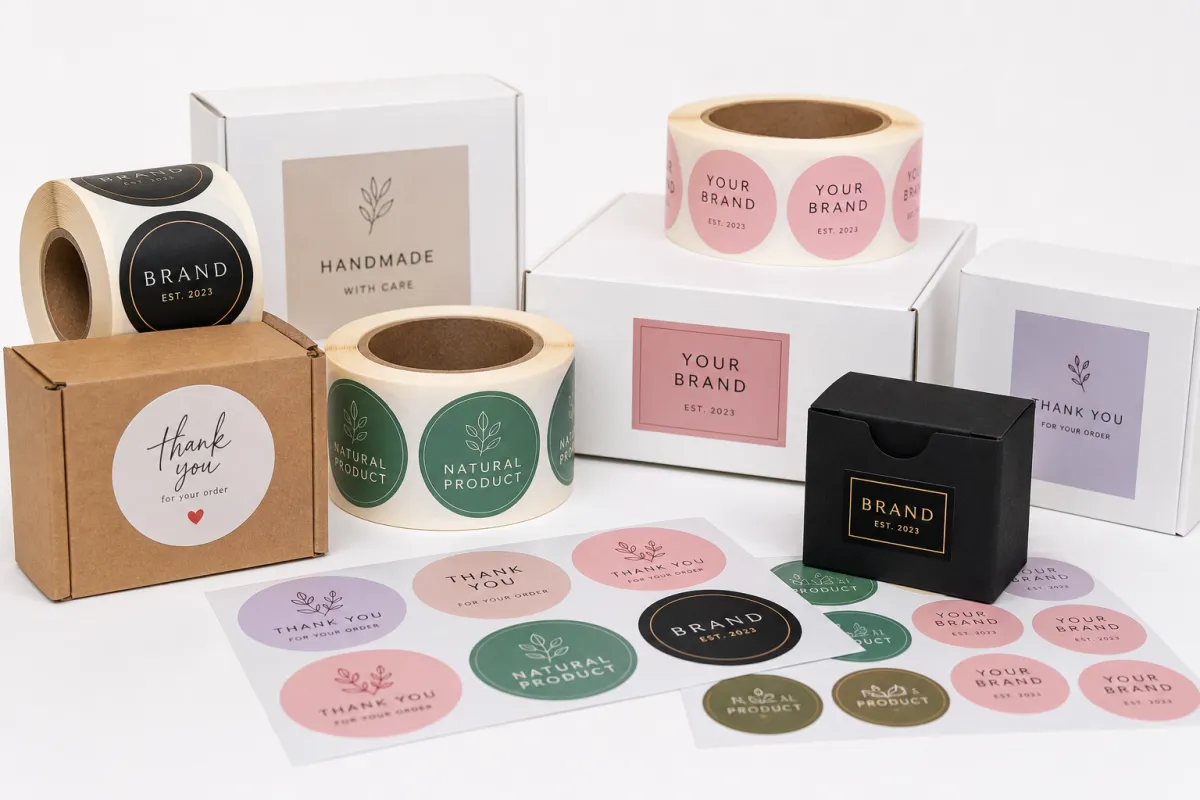
At the simplest level, custom vinyl stickers for packaging are printed vinyl labels or decals used to brand, seal, identify, or decorate a packaged product. They may be round, square, die-cut to match a logo, or stretched into long sealing strips for mailers and cartons. Vinyl, rather than paper, gives the sticker better resistance to moisture, abrasion, and transit wear.
That difference shows up fast in real use. Shipping boxes, soap jars, cosmetic bottles, insulated mailers, mylar pouches, glass jars, kraft envelopes, and Rigid Gift Boxes all ask different things from a label. If the packaging sits on a shelf for weeks, gets tossed into a tote bag, or ends up in a damp bathroom, custom vinyl stickers for packaging tend to hold together far better than basic paper labels. In a shop proof, paper and vinyl can look almost identical. Three days in a delivery network, not so much.
The extra durability does come with a tradeoff. Vinyl is not always the cheapest option, especially at low quantities. Still, the math changes once the sticker has to do more than decorate a surface. Scuff resistance, moisture tolerance, and a longer shelf life in storage and transit are not abstract benefits. They are what keep the package looking finished after the customer has already paid for it.
Most brands use custom vinyl stickers for packaging for one of five reasons:
- Branding - turning plain packaging into branded packaging fast.
- Tamper evidence - sealing a flap or closure point.
- Product labeling - ingredients, SKU IDs, barcodes, or variant marks.
- Seasonal promos - limited edition messaging without reprinting boxes.
- Unboxing details - thank-you notes, social handles, or QR codes.
That flexibility becomes especially useful in lean packaging systems. Standard boxes can stay in inventory while sticker artwork shifts by season, product line, or campaign. Compared with locking everything into one fixed box design, that approach protects budget and keeps the packaging from going stale.
For teams comparing packaging tools, stickers are only one part of the picture. Our Custom Packaging Products page is a useful place to start if you are deciding whether labels, inserts, or printed cartons should carry the visual load.
How Do Custom Vinyl Stickers for Packaging Work?
The structure is simple, even when the performance details are not. Most custom vinyl stickers for packaging use four main parts: the vinyl face stock, the adhesive layer, the liner or backing paper, and the printed image. Some also include a laminate or protective coating to improve scratch resistance and make cleaning easier.
The face stock is what the customer sees. Standard options often begin around 3 to 4 mil vinyl, thick enough for daily handling without turning the sticker into a rigid plastic plaque. Adhesive decides whether the label stays in place on coated cartons, glass, plastic, or textured kraft. The liner keeps the sticker flat during production and gives the packing team a surface that peels cleanly. A laminate or coating can be added when the design needs extra help against scuffs, UV exposure, or moisture.
Custom vinyl stickers for packaging show up across a wide range of package types. On smooth coated cartons, they usually lay flat and apply cleanly. On textured kraft, the surface has more grab and less predictability, so the fit becomes more finicky. On pouches and bottles, the curve of the package matters as much as the adhesive. A sticker can look flawless on a flat mockup and still misbehave on a rounded jar if the stock is too stiff.
Here is the basic workflow from file to finished label:
- Artwork is prepared with the correct size, bleed, and cut line.
- A digital proof is reviewed for layout, spelling, color expectations, and finish.
- The printer outputs the design on the selected vinyl stock.
- A laminate, varnish, or spot finish is added if requested.
- The label is die-cut, kiss-cut, or sheeted depending on how it will be applied.
- Final packing and shipping happen after inspection.
Adhesive choice is where a lot of projects go sideways. Permanent adhesive is the standard for shipping cartons, retail cartons, and products that need the label to stay put for the life of the package. Removable adhesive fits temporary wraps or promos that should peel off later without residue. Repositionable adhesive helps during application, but that does not make it permanent. Wrong adhesive, right artwork. Still the wrong label.
For teams selling accessories, cosmetics, or food-adjacent goods, custom vinyl stickers for packaging often bridge the gap between a plain stock box and a complete package branding system. If you need labels and tags alongside stickers, our Custom Labels & Tags page is a practical next step.
Key Factors That Change the Look and Performance
Not all custom vinyl stickers for packaging are built the same, and that is where most buyer confusion starts. Material, adhesive, size, shape, print quality, and finish all affect how the sticker looks in the hand and how it behaves after it leaves the packing table.
Material choice comes first. Glossy vinyl gives a brighter, cleaner appearance and usually makes colors feel louder. Matte vinyl reads as softer and more restrained, which suits minimalist packaging or Natural Kraft Boxes. Clear vinyl can disappear onto transparent or polished surfaces, though it usually needs white ink underlay if logos and type need to stay visible. White vinyl is the safest choice for contrast and readability.
Adhesive choice should match both the package surface and the storage conditions. Coated carton board usually works well with standard permanent adhesive. Rough kraft may need a higher-tack adhesive to deal with texture. Refrigerated packaging brings another complication: condensation can interrupt adhesion, so temperature range matters more than many buyers expect. Oily or silicone-coated surfaces raise the failure rate unless the adhesive is selected for that substrate. If the package is going into cold transit or repeated handling, test before committing to a full run.
Size and shape matter more than people assume. A 2-inch logo sticker is quick to apply but may not carry enough information for a launch series, subscription box, or retail packaging line. A 4-by-6-inch label can hold more detail, but it also takes longer to place, costs more, and can crowd the packaging layout. Oversized stickers slow down a packing team. Tiny ones can make the brand look cheap or unreadable. Neither outcome is flattering.
Print quality is where the design either holds together or starts looking amateur. Clean line work, strong contrast, and accurate color matching matter more on small labels than on large signage. Thin serifs, low-contrast gradients, and tiny type need enough resolution and the right file format to survive print. For most jobs, 300 dpi at final size is the minimum sensible baseline. Vector artwork is even better when the design allows it.
Finish and durability round out the decision. Gloss can hide minor handling marks and deliver a brighter retail feel. Matte can look more deliberate and often suits natural cardboard or low-key branding. Lamination helps with scratch resistance and water exposure. UV resistance matters if the package sits near a window or under strong retail lighting. If the label is going to be rubbed, stacked, or shipped through humid conditions, custom vinyl stickers for packaging should be built for that environment rather than just for the mockup.
Here is a quick comparison that helps buyers sort the options without overthinking it:
| Option | Best For | Typical Unit Price Range | Notes |
|---|---|---|---|
| Glossy white vinyl | Retail packaging, bold branding | $0.10-$0.28 at 1,000+ pieces | Bright color, strong contrast, shows fingerprints less than people think |
| Matte white vinyl | Premium mailers, understated branding | $0.12-$0.32 at 1,000+ pieces | Soft finish, better for minimal packaging design |
| Clear vinyl | Glass, clear jars, clean product packaging | $0.14-$0.38 at 1,000+ pieces | Usually needs white ink for readability |
| Specialty laminate | Shipping abuse, moisture, long shelf life | Adds $0.02-$0.08 per unit | Worth it when the label is part of the customer-facing experience |
If you are choosing between a quieter matte finish and a louder gloss, match the surface to the brand position. Matte tends to support calm, premium package branding. Gloss works better for energetic, high-contrast designs. Neither is universally better. One simply fits the job better.
For compliance-minded buyers, shipping and handling standards deserve a look too. If packaging moves through parcel networks or fragile-goods channels, organizations like the ISTA publish testing guidance that can help define how much abrasion and vibration your label needs to survive. For paper and board sourcing, the FSC chain of custody model at FSC is worth understanding when the packaging mix includes paperboard components.
Custom Vinyl Stickers for Packaging Process and Timeline
The production timeline for custom vinyl stickers for packaging usually follows a familiar sequence, but speed depends on how clean the artwork is and how many variables sit inside the order. Straightforward labels with vector art move faster. Orders with custom shapes, specialty finishes, or multiple versions take longer because every change adds setup time and proof review time.
Here is the typical path:
- File setup - artwork is checked for size, bleed, safe area, and cut path.
- Proofing - the customer confirms layout, quantity, finish, and adhesive.
- Printing - the design is run on the selected vinyl stock.
- Finishing - laminate, coating, or additional effects are applied if needed.
- Cutting - labels are kiss-cut, die-cut, or sheeted for application.
- Packing - finished labels are counted, packed, and prepared for shipment.
Delays usually come from missing bleed, low-resolution artwork, and slow proof approval. That sounds mundane, but it is the part that derails schedules. A designer who sends a 72 dpi logo with no cut line can burn two days before the order reaches press. Changes after proof sign-off create another classic problem. Once the job is approved, the printer is not guessing. They are printing.
For simple custom vinyl stickers for packaging orders, a realistic timeline often lands around 3-5 business days after proof approval for production, plus shipping time. More complex work, such as white ink, specialty shapes, layered effects, or very large quantities, often falls in the 7-12 business day range for production. Some difficult jobs stretch to 15 business days or more, especially when a proof revision has to be reworked. The exact window depends on the shop, the queue, and the condition of the artwork file.
Quantity changes the equation too. A rush job for 200 stickers is not the same thing as 20,000 units for a product launch. Small orders may move faster because setup is lighter, but they can look expensive on a per-unit basis because fixed costs do not disappear. Large orders usually improve unit pricing, yet they need more press time and more careful quality control.
Sampling is the smart move when the package is sensitive, the finish is new, or the label must interact with a specific surface. A proof shows whether the design is laid out correctly. A sample run shows whether the sticker actually behaves on the package. If you are working with textured kraft, cold-chain cartons, or coated plastic pouches, test on the real thing before ordering 5,000 pieces and discovering the fit the hard way.
From a packaging buyer’s point of view, the safest workflow is simple: define the use case, choose material and adhesive, review the proof, test the sticker on actual packaging, then place the production order. That sequence prevents most of the expensive mistakes that make custom vinyl stickers for packaging feel harder than they are.
What Do Custom Vinyl Stickers for Packaging Cost?
Pricing for custom vinyl stickers for packaging comes from a few moving parts, and each one changes the total in a predictable way. Material type, print coverage, finish, size, quantity, cut style, and shipping all matter. If the artwork needs white ink, metallic accents, or unusual trimming, the cost rises. If the order is a standard round label in a common size, the price stays much friendlier.
The biggest rule is straightforward: unit price drops as quantity rises. Setup costs get spread across more pieces. A run of 250 stickers can feel oddly expensive, while 5,000 pieces often land in a better per-unit range. Nothing mystical is happening. The press setup still costs the same whether the shop prints 200 or 2,000.
Here is a practical pricing framework buyers can use:
- Small runs - 100 to 500 pieces often fall around $0.35-$0.85 per unit, depending on size and finish.
- Mid-size runs - 1,000 to 2,500 pieces often land around $0.18-$0.40 per unit.
- Larger runs - 5,000+ pieces can drop to roughly $0.08-$0.22 per unit for simpler specifications.
- Premium add-ons - laminate, specialty cutting, white ink, and rush handling add cost on top of the base rate.
Those ranges are not universal, and they should never be treated as a quote. Size, coverage, and finish can move the numbers hard. A tiny one-color seal sticker is a different animal from a large, full-coverage label with white ink on clear vinyl. Even so, the ranges show where custom vinyl stickers for packaging stop being cheap and start being efficient.
Hidden costs show up in a few places. Rush fees are obvious. Artwork cleanup is less obvious, but just as real. Proof revisions can add time and sometimes cost if the art changes after setup. Mixed designs in one order often increase production complexity because each version needs its own setup or count verification. Shipping can become another quiet cost if the labels are heavy, boxed separately, or needed on a tight deadline.
The smartest spending decision is not always the lowest unit price. Sometimes it is the sticker that costs a little more but survives shipping, looks better on shelf, and avoids a reprint. That matters more in retail packaging than people admit out loud. A label that peels off in transit can erase the savings from the cheapest quote very quickly.
For teams balancing sticker budgets against broader packaging spend, total package performance matters. A more durable sticker may let you use stock cartons, stock mailers, or simpler custom printed boxes instead of paying for full-color packaging inventory across multiple SKUs. That is where custom vinyl stickers for packaging often earn their place.
Common Mistakes With Custom Vinyl Stickers for Packaging
The most common mistake is also the easiest to avoid: cluttered design. Tiny type, too many colors, and logos squeezed into an undersized label make the final piece hard to read and cheap-looking. If the customer has to bring the package closer just to read the brand name, the design failed. Keep the core message readable at arm’s length. That is the minimum.
Another common problem is choosing the wrong adhesive for the package surface. A sticker that works perfectly on a coated carton may fail on rough kraft or condensation-prone cold packaging. Refrigerated goods, high-touch shipping sleeves, and textured substrates all deserve a test run. If the adhesive is too weak, the label curls. If it is too aggressive, it can damage the packaging or leave residue. Either way, the result is not great.
People also underestimate proofing and color matching. A logo that looks crisp on a monitor can print too dark, too muted, or too busy once it lands on the actual package. That happens often when the background color of the carton or pouch changes the way the sticker reads. If you are using custom vinyl stickers for packaging to create a premium look, proof against the actual packaging color whenever possible. That step saves more embarrassment than time.
Finish mismatch is another quiet issue. A bright gloss label on natural kraft can feel out of place if the rest of the packaging is soft and understated. A matte sticker on a shiny retail pouch can look underpowered. The wrong finish does more than change appearance. It shifts the emotional temperature of the whole package. That becomes a packaging design problem, but the sticker is usually what gets blamed.
Operations matter too. It is easy to talk about branding and then forget that a fulfillment team may need to place hundreds or thousands of stickers a day. If the shape is awkward, the liner is hard to peel, or the size is inconsistent, application slows down fast. Test the placement speed before ordering a full production run. A beautiful sticker that adds 20 seconds to every pack line unit is not a bargain.
If you want to cut those mistakes down, think in terms of process rather than aesthetics alone. Custom vinyl stickers for packaging need to fit the surface, the brand, the environment, and the pack-out workflow. Leave out any one of those, and the job starts to wobble.
Expert Tips and Next Steps for Better Packaging
My first tip is simple: keep the message visible at a glance. On a small sticker, the logo, product name, or seal message should do the heavy lifting. Fine details can live in the larger package design, the insert card, or the website. A label does not need to say everything. It needs to say the right thing quickly.
Second, match the finish to the brand position. Matte feels more restrained and often fits premium wellness, beauty, or artisan food packaging. Gloss is sharper and more energetic, which works for bolder retail packaging. Clear vinyl can look elegant on glass or smooth plastic, but it asks for careful handling in both design and printing. That is why custom vinyl stickers for packaging should be chosen as part of the whole package system, not as an afterthought.
Third, test the sticker on the exact package you plan to ship. Not on a random box. Not on a desk sample. On the actual package. Check how it applies, how it looks under normal light, and how the edges behave after a day or two. If the adhesive starts lifting, the surface is the problem or the adhesive is the wrong fit. Either way, you found out before spending on the full batch. That is the point.
I have watched brands skip that one step and pay for it twice. First in the sticker order, then in the reprint. Nobody loves that bill. It is not glamorous, but a 10-minute substrate test can save a week of cleanup later, and that is a pretty good trade.
Here is a practical action plan:
- Define the use case: branding, sealing, identification, or promotion.
- Choose the package surface: carton, pouch, jar, bottle, or mailer.
- Pick the right vinyl, adhesive, and finish for that surface.
- Request a proof and review size, contrast, and placement.
- Test on real packaging before production.
- Approve the run only after the sample behaves the way it should.
That path usually saves money and frustration. It also helps you decide whether custom vinyl stickers for packaging should carry the brand on their own or work alongside inserts, seals, and Custom Packaging Products. If the packaging needs more structure, the strongest result often comes from custom vinyl stickers for packaging plus a few supporting pieces, not one sticker type doing all the work.
One last point: custom vinyl stickers for packaging are not a luxury upgrade. They are a practical tool. Used well, they improve shelf appeal, shipping durability, and recognition without forcing a full packaging overhaul. Used badly, they become small and expensive problems. The honest version is simple. Get the adhesive right, keep the design readable, and test it on the real package. Do that, and custom vinyl stickers for packaging do exactly what they are supposed to do.
FAQ
Are custom vinyl stickers for packaging better than paper labels?
Usually, yes, if the package faces moisture, abrasion, cold storage, or repeated handling. Custom vinyl stickers for packaging hold up better against scuffing and moisture than most paper labels. Paper can still work for short-lived, low-stress applications, but it is more likely to wrinkle, tear, or wear down during shipping.
What adhesive should I choose for custom vinyl stickers for packaging?
Permanent adhesive is the default for most shipping and retail uses because it stays put on the package surface. Removable adhesive makes more sense when the label must peel away later without damage. The right choice depends on the surface, so test custom vinyl stickers for packaging on the actual carton, pouch, or jar before ordering a full run.
How long do custom vinyl stickers for packaging usually take to produce?
Simple orders can move in about 3-5 business days after proof approval, while more complex jobs often take 7-12 business days or more. Artwork fixes, color changes, and proof revisions are the most common causes of delay. If the launch date matters, approve the proof fast and ask for a realistic production window up front.
How much do custom vinyl stickers for packaging cost in practice?
Cost depends on size, material, finish, quantity, and whether the design needs special printing or cutting. Small orders can land around $0.35-$0.85 per unit, while larger runs often drop much lower. Premium options cost more, but they can save money when custom vinyl stickers for packaging prevent damage, reprints, or weak brand presentation.
What size works best for custom vinyl stickers for packaging?
The best size depends on the job. Branding stickers can be small if the logo is simple, while sealing labels and product info labels usually need more room. A sticker should be large enough to read quickly and small enough to fit the package. A paper mockup on the actual package is the easiest way to judge balance before production.


