For streetwear brands, Die Cut Handle Bags for streetwear labels material comparison is not a side conversation. It affects how the drop feels in hand, how it photographs, and how much value customers think they just bought. A bag can make a hoodie feel considered. It can also make a premium tee look like it came out of a bulk bin.
The handle bag is a touchpoint, a carry device, and a piece of brand theater that has to survive real use. People grab it, swing it, stuff it into a car, and post it in motion. If the film is too thin, too loud, too glossy, or just plain awkward, the packaging works against the garment. That is why the material decision deserves more scrutiny than most teams give it.
The useful way to compare options is not by spec sheet alone. It is by stiffness, drape, opacity, print behavior, tear resistance, noise, perceived quality, and how the bag behaves when it is full, half full, or folded flat in storage. That mix tells you a lot more than a headline price.
Die Cut Handle Bags for Streetwear Labels: What Changes by Material
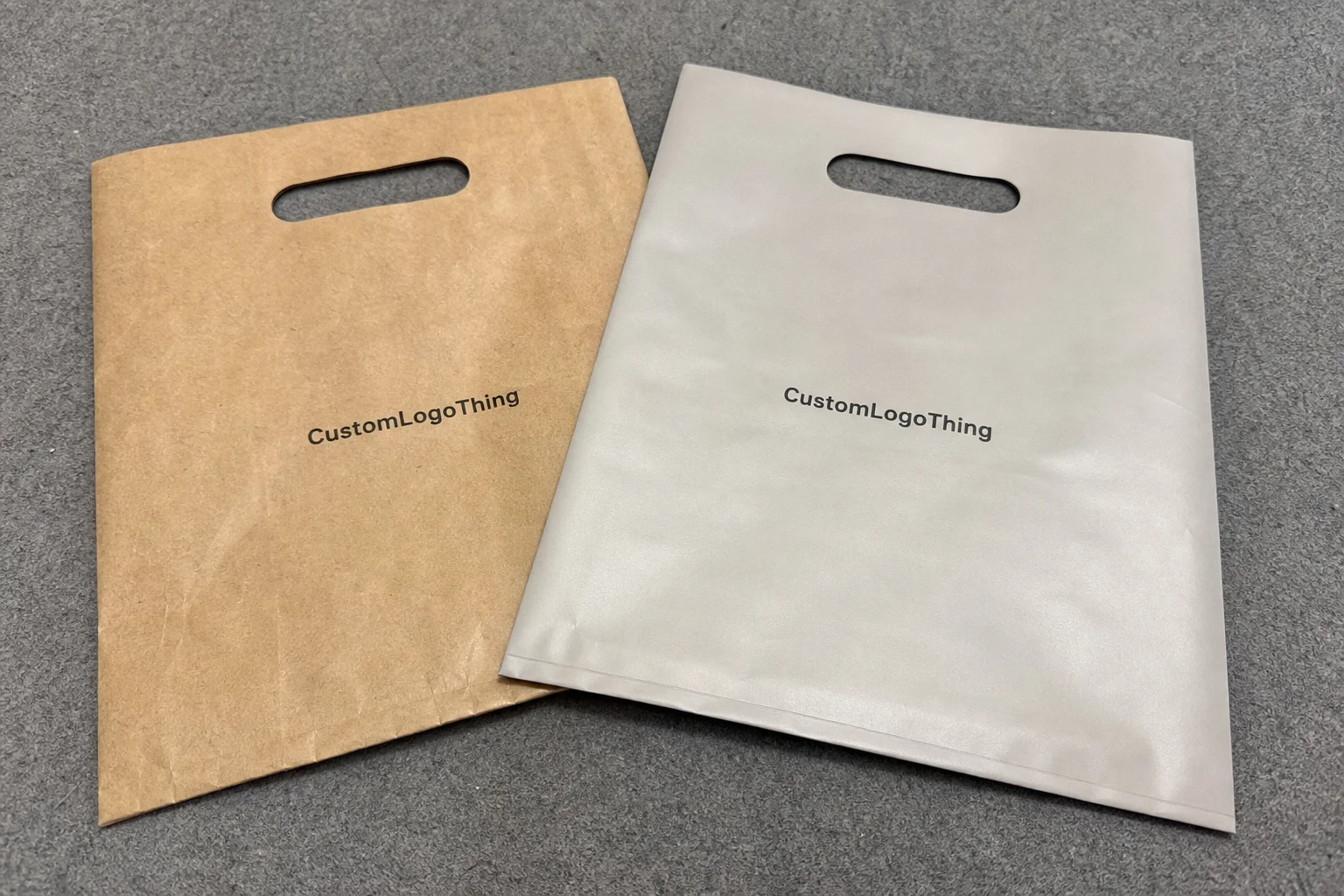
The material changes the impression before the customer even reads the logo. LDPE usually feels softer and drapes more naturally. HDPE is lighter and crisper. PP and premium film constructions move toward stiffness, gloss, and a more polished presentation. If you are comparing Die Cut Handle Bags for streetwear labels material comparison options, start with that basic handfeel difference. It shapes everything else.
Streetwear buyers do not handle packaging in a lab. They carry it through transit, under bright retail lights, across parking lots, and into social posts. The bag has to look intentional while it is moving. That means the surface needs to stay readable, the structure needs to hold some shape, and the handles need to feel like they were designed for the product inside rather than whatever happened to be cheap that week.
The most useful comparison lens is practical:
- Stiffness: does the bag stand up or collapse immediately?
- Drape: does it hang softly or feel rigid and industrial?
- Opacity: can it hide folded garments, tags, or box edges?
- Print fidelity: do solids stay solid, and do small type and fine lines hold?
- Noise: does it sound cheap when handled?
- Recycled content story: can the supplier document what is actually in the film?
That last point matters because packaging claims get checked more often than brands expect. If a supplier says recycled content or reduced material use, ask for the actual composition and the method used to verify it. A tidy marketing line is not the same thing as a defensible spec. If your broader packaging system includes paper mailers, cartons, or inserts, keep the story consistent across those materials too. Mixed signals make the brand look less intentional, not more.
Reality check: the “best” material is rarely the strongest or the cheapest. It is the one that matches the garment weight, the visual tone, and the date the bags need to land.
How the Handle Cut and Reinforcement Affect Carry Performance
A die-cut handle removes material from the film, which means the stress concentrates around the cut edge. That is the weak point. Not the center panel. Not the print area. The handle opening. If that area is under-designed, the bag may look fine on a flat proof and still tear once a customer loads it with a hoodie, denim, or a second item from the same drop.
Shape matters more than people think. Rounded corners spread stress better than sharp angles. A larger finger opening helps reduce pinch and makes the bag feel easier to carry. Centered placement matters too, because even a small offset can make the load swing awkwardly. That sounds minor until the customer is holding three other things and trying to keep moving.
Three common handle builds
- Unreinforced handle zone: lowest cost, useful for lighter apparel, least forgiving under load.
- Reinforced handle zone: extra film, patching, or edge strengthening for better tear resistance.
- Extra-thick handle zone: stronger feel and more margin for heavier products, but adds cost and can reduce foldability.
The load test should reflect actual use, not warehouse convenience. A bag that survives a quick lift in a packing room is not automatically safe for a 14-ounce hoodie plus accessories carried for twenty minutes. Customers overfill bags. They twist the handles. They pull one-handed. They do things that a neat internal test will never fully mimic unless the test is designed to do that.
For basic quality checks, packaging teams often borrow thinking from transit standards such as ISTA, even when the bag is not a shipping carton. The point is not to over-engineer the carrier. The point is to understand where a weak handle cut or thin gauge will fail first. If the bag is for retail handoff only, the test should still assume real customer handling, not best-case behavior.
Bottom line: the handle is a structural decision, not a decoration.
Material Comparison: LDPE, HDPE, PP, and Premium Film Options
This is where the comparison gets concrete. The film changes handfeel, print behavior, stiffness, and the overall read of the package faster than almost any other decision.
| Material | Typical feel | Best for | Trade-offs |
|---|---|---|---|
| LDPE | Soft, flexible, more premium drape | Elevated streetwear, lighter luxury cues | Can feel film-like at low gauges |
| HDPE | Crisp, light, economical | Higher volume drops, tighter budgets | Noisier, less soft in hand |
| PP | Stiffer, glossier, clearer | Boutique presentation, sharper shelf presence | Can feel less forgiving and more rigid |
| Premium laminated film | Structured, refined, custom-feeling | Capsule drops, gift-style retail packaging | Higher cost and more specification work |
LDPE is usually the safest choice when the priority is a softer hand and a more premium drape. It prints well, carries apparel cleanly, and tends to look less harsh under store lighting. For a label trying to make the bag feel intentional rather than disposable, LDPE usually lands in a good place. It is not flashy, which is often the point.
HDPE is the budget-first option. It gives crisp structure, can run at lower gauges, and helps keep unit cost down. The catch is that it can sound and feel cheaper. For a minimal brand with a raw aesthetic, that can be fine. For a label selling heavyweight fleece at a premium price, it can feel like a mismatch. Sample bags can hide that problem. Full orders do not.
PP and premium film constructions are better when the bag needs stronger gloss, better stiffness, or a cleaner boutique read. They show well under lights and can make the packaging photograph better than a softer film. The trade-off is emotional as much as mechanical. If the brand language is muted, washed, or matte-heavy, a glossy carrier can pull the whole presentation off-center.
Thickness matters just as much as resin type. A thin LDPE bag and a heavier LDPE bag do not behave the same way. The gauge affects noise, drape, print flatness, and tear margin. If the supplier skips over gauge and talks only about material family, that is a red flag. Ask for the exact thickness, not a vague promise of “better quality.”
There is also the recycled-content question. Some brands want a cleaner materials story, while others care more about reducing excess without adding complexity to the supply chain. Ask for the exact resin mix, what portion is post-consumer or post-industrial, and whether the claim can be documented. Do not assume “eco” because the bag looks plain. Plain is not proof.
If sustainability is part of your broader packaging strategy, look at the whole system. Recycled cartons, kraft inserts, and packaging that can be separated cleanly matter more than a single green-sounding detail on the carrier bag. The EPA’s recycling resources are a neutral reference if you need a baseline for materials language: EPA recycling resources.
The mistake I see most often is sample bias. A team approves a bag because it looks good on a table, then the real product arrives and the film wrinkles, the handle flexes too much, or the printed area feels off next to the garment. The right test is with the actual packed item, not a guessed weight.
Cost, Pricing, MOQ, and Unit Cost Drivers
Headline price is useful, but incomplete. A proper quote needs to separate the variables that actually move cost: bag size, material gauge, print colors, ink coverage, handle reinforcement, and whether the order uses a standard size or a custom dimension. That is the only way to compare die Cut Handle Bags for Streetwear labels material comparison options without fooling yourself.
For apparel programs, landed cost matters more than ex-factory cost. Setup fees, proofing, freight, palletization, split shipments, and any secondary packing requirements can push the real number up fast. If the bags need to be poly-wrapped, boxed, or packed a specific way for fulfillment, get that written into the quote. Otherwise the “cheap” quote gets expensive in the warehouse.
As a rough planning range, simple custom die-cut bags might land around $0.12 to $0.18 per unit at higher volumes for lighter specs, while thicker or more premium builds can move into the $0.22 to $0.40 per unit range depending on quantity, finish, and print coverage. Small orders usually cost more per piece because setup and waste are spread across fewer units. There is no trick there. That is just how production math works.
MOQ pricing usually follows the same logic:
- The supplier spends time setting up the line and calibrating the run.
- Waste and trim loss are absorbed into the order.
- Lower quantities carry more overhead per unit.
That is why a 2,000-piece order can look disproportionately expensive next to 5,000 or 10,000 pieces. The work is not four times harder. It is just less efficient. If you are building a drop with multiple SKUs, ask whether the supplier can combine sizes or print versions into one run. Sometimes the answer is yes. Sometimes the registration and packing rules make that impractical. Better to know before the calendar gets tight.
Ask for a like-for-like comparison sheet. The quote should keep size, gauge, print method, and freight assumptions consistent across every quantity tier. If those factors change between quotes, the comparison is useless. That is one of the easiest ways to save money and one of the easiest ways to get misled.
Good buyer question: “What is the landed unit cost at 3,000, 5,000, and 10,000 pieces, and what changes at each tier?”
If the answer is vague, the quote is not finished.
Production Steps and Lead Time: From Spec Sheet to Delivery
Lead time starts before the bags are made. First comes size confirmation, then material selection, artwork prep, proof approval, sampling if needed, production, inspection, packing, and freight booking. If any one of those steps slips, the whole schedule moves. That is especially true for packaging tied to a launch date or a pop-up that cannot be moved.
Simple orders with finalized artwork can often move in about 12 to 15 business days after proof approval. More complex runs can stretch to 3 to 5 weeks once sampling, special colors, and freight are included. Overseas shipping and customs can add more uncertainty. Packaging buyers like to focus on manufacturing time. That is only part of the equation.
The most common bottleneck is artwork approval. The machine may be ready before the brand is. A team can spend three days debating whether the logo needs to sit slightly higher or whether the background should be fully flooded, and that delay can push the order into a later ship window. The bag itself is rarely the problem. Decision-making is.
“The schedule usually breaks at approval, not at production.” That line holds up more often than teams want to admit.
If the bags are part of a larger packaging system, coordinate the timing with cartons, tissue, inserts, and shipping materials. Nothing is more annoying than a box of finished bags sitting in storage while the rest of the packaging is still in transit. That creates handling issues and unnecessary rework. Treat the bag like inventory, because that is what it is.
A practical lead-time checklist:
- Lock the product weight and folded dimensions first.
- Approve the material sample before final artwork sign-off.
- Confirm print method, ink coverage, and any special finishes.
- Set a hard approval deadline.
- Book freight with buffer time for delay.
If the schedule is tight, reduce variables. Stock sizes, fewer print colors, and simpler artwork usually move faster. Special metallics, extra-thick handles, or unusual film constructions can be worth it, but they come with real timing cost. There is no free lunch in packaging.
Common Mistakes Streetwear Brands Make When Spec'ing Bags
The first mistake is undersizing the bag for the real product mix. A folded tee is not the same as a hoodie, and a hoodie is not the same as a hoodie plus beanie plus accessory. When the bag is too tight, the load bulges, the handle takes more stress, and the package looks less premium. A slightly larger bag often presents better than an overstuffed one.
The second mistake is letting artwork drive the spec instead of the product. Heavy graphics, dark floods, and dense print can look aggressive in mockups but end up cheapening the package once the film is folded and handled. Clean typography and controlled spacing usually age better. Streetwear already has enough visual noise. Packaging does not need to add more.
The third mistake is a tone mismatch. A premium capsule in a flimsy, noisy bag sends the wrong signal. The reverse happens too: a stripped-back label gets trapped in a glossy, overfinished carrier that feels off-brand. Material should support the label’s visual language. If it competes with the clothing, it is doing too much.
The fourth mistake is ignoring storage and handoff conditions. Will the bags sit flat for months? Be stacked in a back room? Handed out in a fast line at a launch event? A bag that looks good in a proof can behave differently once it has been folded, dragged, and stored with the rest of the packaging. That is why a real sample, not just a PDF, matters.
The fifth mistake is forgetting the rest of the packaging system. If you already use kraft paper tissue, recycled-content cartons, or FSC certified inserts, the carrier bag should fit that same standard. Otherwise the customer gets a packaging family that looks assembled instead of designed. That gap is visible.
One more problem that shows up constantly: teams approve a spec based on a single sample and never test the actual packed weight. Sample approval is not load validation. Those are different tasks. Confusing them is how you end up with a bag that looks premium until somebody carries it.
Next Steps: Build a Spec That Matches Your Drop
Start with the garment. What is the heaviest item the bag must carry? What folded size does it need? What should it communicate before the customer even opens it? Once those answers are clear, the material choice gets much easier to narrow down.
Then compare two or three samples side by side using the actual product. Check the handfeel, the noise level, the opacity, the print clarity, and how the handle behaves after a few real lifts. If the sample only works when treated gently, it is not ready. The bag should survive normal customer behavior, not ideal handling.
Ask for a quote that breaks out unit cost, setup, and freight. Then compare the landed number against your margin target and your launch calendar. A bag that is five cents cheaper but arrives late is not cheaper. It is a schedule problem with a nice price tag.
For most streetwear labels, the cleanest decision rule is simple: choose the material that balances brand perception, load performance, and turnaround, then lock the spec so reorders stay consistent. Customers notice packaging drift between drops more than brands expect. Consistency reads as control.
If you are comparing Die Cut Handle Bags for streetwear labels material comparison options for a live project, keep the decision grounded in what the bag has to carry, how it should feel, and how fast it needs to arrive. That combination tells you more than any generic “premium” claim ever will.
Which material is best for die cut handle bags for streetwear labels?
LDPE is usually the best starting point if you want a softer, more premium handfeel. HDPE is stronger on price and structure, but it can feel less elevated. PP or specialty film makes sense when the brand wants more gloss, stiffness, and shelf presence.
Are die cut handle bags strong enough for hoodies and denim?
Yes, if the gauge, handle reinforcement, and bag size are matched to the product weight. Heavier garments need better edge finishing, wider handles, or thicker film to reduce tear risk. Test the actual packed product, not just the empty sample.
What MOQ should I expect for custom die cut handle bags?
MOQ depends on size, print complexity, and whether the bag is stock or fully custom. Lower quantities usually have a higher unit cost because setup and waste are spread across fewer bags. Ask suppliers to quote multiple quantities so the price break is visible.
How long do custom die cut handle bags take to produce?
Lead time usually includes artwork approval, production, quality checks, and freight, not just the manufacturing slot. Custom sizes, special colors, and sampling can extend the schedule quickly. Fast turnaround depends on finalized artwork and a clean spec sheet.
How can I make the bags feel premium without inflating cost too much?
Start with the right material and gauge before adding expensive print effects. Clean typography, good spacing, and a controlled color palette often do more than extra decoration. Compare a few thickness and finish options to find the point where perceived value rises without pushing unit cost too far.


