Buyer Fit Snapshot
| Best fit | Eco Friendly Gift Bags with Logo projects where brand print, material claims, artwork control, MOQ, and repeat-order consistency need to be specified before quoting. |
|---|---|
| Quote inputs | Share finished size, material target, print colors, finish, packing count, annual reorder estimate, ship-to region, and any compliance wording. |
| Proofing check | Approve dieline scale, logo placement, barcode or warning zones, color tolerance, closure strength, and carton packing before bulk production. |
| Main risk | Vague material claims, crowded artwork, missing packing details, or unclear freight terms can make a low unit price expensive after revisions. |
Fast answer: Eco Friendly Gift Bags with Logo: Film, Print, MOQ, and Carton Packing should be specified like a repeatable production item. The safest quote records material, print method, finish, artwork proof, packing count, and reorder notes in one written spec.
Production checks before approval
Compare the actual filled-product size with the drawing, then confirm tolerance on folds, seals, hang holes, label areas, and retail display edges. Reserve space for logos, QR codes, warning copy, and material claims before decorative graphics fill the panel.
Quote comparison points
Review material grade, print process, finish, sampling route, tooling charges, carton quantity, and freight assumptions side by side. A quote is only useful when the supplier can repeat the same color, closure quality, and packing count on the next order.
Eco friendly gift Bags with Logo have a harder job than they look. They need to hold a product, carry a brand, and still make sense after the gift changes hands. A receipt gets tossed. A decent bag often gets kept. That gap matters more than most people think. It is why eco friendly gift bags with logo can outperform glossy promo bags, flimsy paper carriers, or a nice-looking novelty item that gets binned before the customer leaves the building.
I remember a premium candle launch where the packaging looked beautiful in the conference room and then collapsed in the elevator. The bag was technically branded and technically recycled, but the handles were underbuilt and the gusset was too shallow. The whole thing felt expensive and cheap at the same time, which is a weird combination, but not an unusual one. That kind of mistake is exactly why the details matter.
Choosing them is less about chasing a trend and more about balancing three practical demands at once. The bag has to feel responsible, look intentional, and survive real handling without falling apart. Material weight, print method, handle construction, finish, and sourcing proof all affect the result. Miss one, and the claim gets shaky pretty fast.
For brands ordering custom packaging, the real question is not whether a bag sounds sustainable. It is whether eco friendly gift Bags with Logo fit the product, the budget, and the way customers actually use them. For buyers comparing recycled paper bags to reusable carrier bags, the same test applies: does the bag earn its keep after the first handoff, or is it just going to sit there looking good for ten seconds?
What Are Eco Friendly Gift Bags With Logo, and Why Do They Matter?
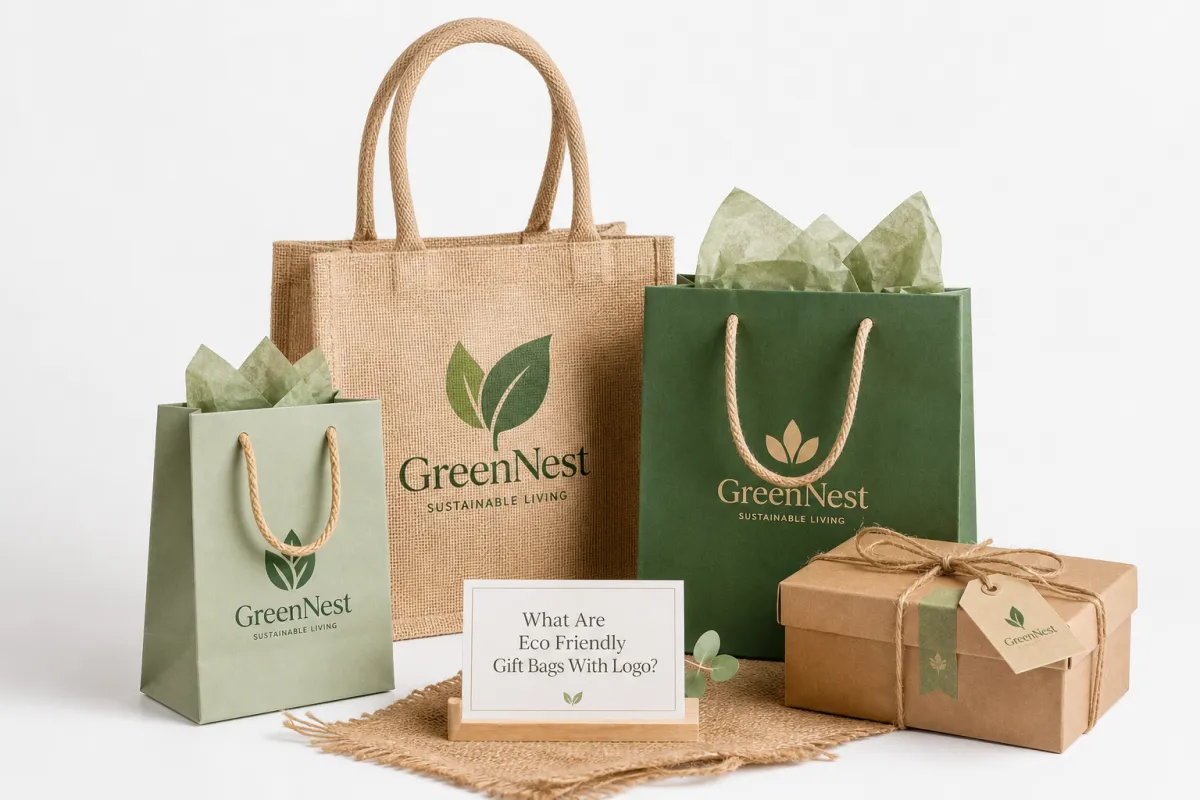
Eco friendly gift Bags with Logo are branded carry bags made with lower-impact materials or production methods than a conventional virgin-plastic or heavily laminated alternative. That can mean recycled paper, FSC-certified stock, renewable fibers such as cotton or jute, compostable components where local systems support them, or print choices that reduce waste and chemical load. The phrase is broad. Broad can help buyers compare options, but it can also hide a lot.
The logo is not decorative fluff. It changes how the bag is read. A weak logo placement makes the item easy to forget. A loud one can make the bag feel disposable, like an ad with handles. The strongest eco friendly gift bags with logo do something harder: they look calm, useful, and worth keeping. They suggest restraint rather than noise.
Reuse is often the real environmental dividend. A sturdy paper or fabric bag that gets used five or ten times can do more good than a cheaper recyclable bag that tears on the first trip. Recycling matters. Reuse often matters more. The difference shows up in the customer's hands, not just in a sustainability deck.
Marketing language and actual performance are not the same thing. “Eco-friendly” can refer to recycled content, renewable fiber, water-based inks, low-waste production, or a reduced-impact finish. It can also be slapped onto a bag with no real evidence behind it. That is where a buyer has to slow down and ask for the concrete stuff: recycled content percentage, certifications, finish details, and disposal guidance for the target market.
A sustainable bag is not the one that sounds green in a pitch deck. It is the one that still works after the customer has carried it, folded it, stored it, and used it again.
A useful rule keeps the noise down: the more specific the supplier can be, the more credible the claim usually is. If they can explain the fiber source, the print process, and the end-of-life path without sliding into vague adjectives, the bag is probably closer to what it claims to be. That holds especially true for eco friendly gift bags with logo, where branding can hide weak construction if nobody asks the right questions.
Recycled paper bags, FSC-certified stock, cotton totes, and jute carriers all sit in the same broad family, but they behave very differently in use. That is why the right choice depends on the product, the route to the customer, and how often you expect the bag to be reused.
How Eco Friendly Gift Bags With Logo Work
The mechanics are simple enough, even if the materials are not. Most eco friendly gift bags with logo begin with a substrate, then add structure, handles, adhesive, printing, and finishing. The substrate might be kraft paper, recycled paperboard, cotton, jute, or a nonwoven material. Each behaves differently under weight, moisture, and repeated use.
Paper bags live or die on the relationship between paper weight and construction. A 120gsm kraft bag with narrow rope handles can look clean on a shelf. Put a heavy candle or boxed set inside it, and the limits show fast if the gusset is shallow or the adhesive is weak. Step up to 150gsm or 170gsm, and the bag usually holds shape better and feels more premium. Fabric bags change the equation. Stitch quality, seam reinforcement, and handle attachment matter more than print glamour. A bag can look sustainable on paper and still fail in practice if the build is flimsy.
Branding gets applied in a few ways. Flexographic printing is common for larger runs and simpler artwork. Digital printing suits shorter runs or more detailed graphics. One-color logos often create the cleanest sustainability story because they use less ink and keep the visual field quiet. Embossing can add depth without adding much clutter. Foil effects deserve caution; some lower-impact versions exist, but not all are equal, so the supplier should say exactly what they are using.
End-of-life is where the material choice stops being theoretical. Plain kraft paper can often enter curbside recycling streams, though local rules still decide the outcome. Recycled paper can be a strong option if the finish stays simple enough to recycle again. Cotton and jute are more often reused than recycled, which is not a flaw; it is a different kind of value. Nonwoven materials can be trickier because some are not accepted in standard recycling programs. The EPA recycling guidance helps as a general reference, but local collection rules have the final word.
The customer experience changes the math more than many buyers expect. If the handle digs into the hand or the bag buckles under a bottle, the brand impression drops immediately. If the bag feels sturdy, keeps its shape, and survives a second or third use, the logo keeps working long after the transaction. That is the quiet advantage of eco friendly gift bags with logo: every extra carry is another impression without another media spend.
Event kits, retail gifts, and premium sample packs need transit stress in the equation too. Bags used in shipping or courier handoff should be tested for compression, abrasion, and drop risk. If a supplier mentions ISTA-style handling tests or a similar quality check, that is usually a sign they understand more than shelf appeal. The bag should arrive intact, not just look respectable in a product photo.
Three things usually define the best eco friendly gift bags with logo: a substrate that matches the load, a print method that suits the artwork, and a build that invites reuse instead of immediate disposal.
For reusable carrier bags, the real test is simple: would a customer keep it after the unboxing moment, or would it head straight for the bin?
Key Factors That Affect Performance, Look, and Cost
Two bags can look similar from across a room and still price very differently. That is normal. The cost structure behind eco friendly gift bags with logo depends on more than print count. Material, size, construction, certification, and production method all pull on the final number.
Material comes first. Kraft paper is usually the most accessible option for lightweight gifting and retail carry. Recycled paper may cost more if the supplier is sourcing a more specific grade, though the gap is not always large. FSC-certified stock signals responsible forest management, and that certification helps with brand governance when the buyer needs a documented sourcing standard. The chain-of-custody logic is laid out at the FSC site.
Cotton and jute sit in another bracket. They are usually more expensive, but they can deliver higher reuse value and a stronger tactile impression. Nonwoven options can be cost-effective at volume, yet they need closer scrutiny because sustainability claims get fuzzy if the bag is not truly reusable or accepted in local recovery streams. That is where buyers get caught out most often: they compare only unit price and ignore lifespan.
Print coverage changes the price quickly. A one-color logo placed small and clean costs less and often looks better on a natural substrate. Full-bleed graphics, multiple ink colors, or artwork that wraps around the bag add setup and production complexity. Heavy ink coverage can also dilute the environmental story if the result feels more like promotional waste than a reusable carrier. For eco friendly gift bags with logo, restraint usually reads better than excess.
Bag size affects cost in two ways. Larger bags use more material, which raises the base price. They also need stronger handles and a tougher build, especially if the contents are dense or awkwardly shaped. A bag for apparel will not perform like one built for candles, jars, or boxed cosmetics. The product inside determines what counts as overbuilt or underbuilt.
Certification and transparency are not free either. Recycled content verification, FSC paperwork, and documented supplier controls all show up somewhere in the price. That is not a problem. It is the cost of credibility.
A practical comparison helps keep the options grounded:
| Material / Build | Typical Use | Cost Signal | Strengths | Watchouts |
|---|---|---|---|---|
| Kraft paper, 120gsm-150gsm | Light retail gifts, events, apparel | Usually the lowest entry price | Printable, familiar, often recyclable | Can tear if undersized or overloaded |
| Recycled paper, FSC-certified | Brand gifting, boutique retail | Moderate uplift over plain kraft | Strong sourcing signal, good print surface | Finish choices can affect recyclability |
| Cotton tote-style bag | Premium gifting, repeat-use campaigns | Higher unit cost | High reuse value, tactile premium feel | Artwork must suit the fabric surface |
| Jute bag | Gift sets, corporate packs | Higher than paper, often lower than heavy fabric | Natural look, sturdy construction | Print detail can be limited |
| Nonwoven reusable bag | Promotions, trade events | Competitive at volume | Lightweight, reusable, easy to carry | End-of-life claims need careful checking |
Handle type matters too. Twisted paper handles usually cost less than rope handles or stitched fabric handles. Rope handles feel more premium, yet they raise cost and can raise breakage risk if the attachment is poorly executed. Die-cut handles are economical, but they are not always comfortable for heavier loads. For eco friendly gift bags with logo, the handle can decide whether the bag gets kept or discarded immediately.
Special finishes push pricing up quietly. Soft-touch lamination, spot coatings, metallic effects, and custom embossing all add process steps. Some finishes are worth it when the bag sits next to premium product packaging and has to hold its own. Others are decorative noise. A clean matte or satin surface with crisp print often beats a heavily dressed-up bag with unclear environmental value.
Credibility signals should sit beside the visual choice. Ask for recycled content details, FSC numbers when relevant, and a plain-language explanation of disposal or reuse. Ask whether the supplier can explain any claim in one sentence that a procurement manager, a marketer, and a sustainability lead would all understand. If not, keep looking.
Eco Friendly Gift Bags With Logo Pricing: What Changes the Cost?
Pricing for eco friendly gift bags with logo usually splits into two layers: unit cost and project cost. Buyers often focus on the per-piece number, but the invoice tells a wider story. Setup fees, artwork preparation, sampling, freight, storage, and rework can add materially to the real spend, especially on smaller runs.
For scale, a simple kraft paper bag in a standard size might sit around $0.18-$0.35 per unit at mid-volume, depending on handle style, print coverage, and paper weight. Recycled or FSC-certified versions may land a little higher. Cotton and jute sit much higher, often from around $0.90 to several dollars per unit depending on size and finishing. Those are broad ranges, not promises. They still help, because they stop a buyer from expecting tote-bag durability at paper-bag pricing.
Minimum order quantities change the equation. A higher MOQ can lower the unit price, but it raises upfront spend and storage needs. That trade-off is real. If the bags support a seasonal campaign or a launch with uncertain demand, a lower MOQ may be smarter even if the unit price climbs. If the bags will be used steadily in stores, the larger run can make sense.
Customization is usually the biggest cost lever. Custom dimensions need new tooling or a new production setup. Reinforced handles add material and labor. Multi-color artwork raises printing complexity. Specialty paper stocks can increase waste during production. When buyers ask why one quote looks much higher than another, the answer usually sits in these details rather than the headline size.
A comparison of common choices makes the pattern easier to read:
| Choice | Impact on Unit Price | Impact on Brand Value | Best Fit |
|---|---|---|---|
| One-color logo on standard kraft | Lower | Clean, understated, easy to reuse | Retail carry, events, budget-conscious gifting |
| Two- to four-color print on recycled stock | Moderate | More expressive, still credible | Boutiques, product launches, premium giveaways |
| Embossed or foil-style branding | Higher | Strong premium impression | Luxury gifting, executive packs |
| Cotton or jute reusable bag | Highest | High reuse potential and tactile quality | Corporate gifting, long-life campaigns |
There is a less obvious cost question too: what does the bag save later? A bag that tears less often, improves the unboxing moment, or gets reused by the customer can justify a higher initial spend. The right eco friendly gift bags with logo are not always the cheapest on paper. Sometimes they are the ones that reduce damage, reduce complaints, and keep the brand visible for weeks instead of minutes.
Shipping and packing can also distort pricing. Bulk cartons of flat-packed paper bags are usually efficient, while heavier fabric bags may take more space and cost more to move. If the order needs warehousing before a campaign launch, storage belongs in the budget. On a smaller order, freight can matter almost as much as production. A quote that looks 12 percent cheaper can end up more expensive once logistics are included.
One more pricing point deserves attention: if the bag is part of a larger packaging system, compare it against the value of the whole system. A slightly more expensive bag can protect a premium product better than a cheap alternative, lowering damages and making the gift feel worth more. In that case, eco friendly gift bags with logo are not just a packaging line item. They are part of the customer experience.
Buying choices like this often mirror the difference between Branded Paper Bags that disappear quickly and reusable carrier bags that stay visible for months. That extra lifespan is hard to see in a quote, but it matters in the real world.
Process and Timeline: From Brief to Delivery
A clean order starts with a clean brief. The most efficient eco friendly gift bags with logo projects answer five questions up front: what will the bag carry, how premium should it feel, what material is preferred, how many units are needed, and when does delivery need to land. If those answers are fuzzy, the quote will be too.
The usual workflow looks like this:
- Define the product size, weight, and intended use.
- Choose material candidates and request samples.
- Confirm print method, artwork file type, and brand colors.
- Review digital proofs and physical samples.
- Approve production and lock the schedule.
- Inspect the first batch if quality control is needed.
Timelines vary with complexity. Simple stock-style paper bags with a basic logo can sometimes move in about 10 to 15 business days after proof approval, assuming materials are available. More custom projects often land closer to 3 to 5 weeks, especially if sampling, unusual dimensions, or special finishes are involved. Fabric and jute orders can take longer because of stitching, panel cutting, and print alignment. None of that is unusual. It is just the reality of making eco friendly gift bags with logo that actually hold up.
Sampling is the step that saves the most pain later. A sample reveals paper stiffness, handle feel, print clarity, and whether the bag stands up without sagging. It also shows whether a logo is too small for the substrate or too detailed for the print method. A digital mockup can hide a lot. A printed sample usually tells the truth.
Artwork changes are one of the fastest ways to blow up a schedule. If the team is still adjusting the logo, color palette, or strap line after the proof stage, the clock resets. Late changes do not only delay production; they can raise costs if materials need to be rerun. Vector artwork handed over early keeps the process from wandering.
Planning works best when the countdown starts from the date the bags are needed in hand, not the launch date. If a retail campaign opens on a Friday, the bags should not arrive that morning. Inventory should be checked early enough to allow for transit delays, quality inspection, and a buffer for replacement units if something is off.
Trade shows, gift-with-purchase programs, and subscription inserts all benefit from a small overage. A few extra percent in the order can prevent a last-minute scramble if customer demand rises or a few bags fail a visual check. With eco friendly gift bags with logo, a little planning margin usually costs less than emergency shipping.
Common Mistakes When Ordering Eco Friendly Gift Bags With Logo
The biggest mistake is trusting the green label without checking what it means. A bag described as eco-friendly may still be coated, laminated, or built from mixed materials that are hard to recycle. If the bag is supposed to be recyclable in your market, ask whether it is actually accepted in local collection streams. If it is supposed to be reused, ask how many uses the construction can realistically survive. Eco friendly gift bags with logo should be judged by outcome, not language.
Oversized branding is another common problem. A huge logo with dense ink coverage can make the bag feel like a billboard instead of a carrier. That can work for a marketing event. It is less convincing for premium gift packaging. Smaller, more restrained branding usually ages better. It also gets reused more often because the customer does not feel like they are carrying an ad.
Weak handles create invisible waste. If the handle breaks, the bag gets discarded early. That damages both the customer experience and the sustainability claim. Poor gusset design causes similar trouble; the bag tips, creases, or loses shape. These seem like minor engineering details, then they decide whether the bag survives the first use. For eco friendly gift bags with logo, construction is not a side note. It is the product.
Skipping samples is another expensive habit. A screen preview cannot reliably show paper texture, ink absorption, or seam quality. Color can shift more than buyers expect, especially on natural kraft or recycled stock. A muted brown substrate changes how white ink reads. A cotton weave changes how fine detail appears. If the logo has thin strokes, the sample is worth the time.
Several practical checks cut down on mistakes:
- Confirm the target load weight and choose a bag rated above it.
- Ask for disposal guidance in the target market, not just a generic sustainability claim.
- Review handle attachment strength, not only handle appearance.
- Request color proofing on the actual substrate if the artwork is brand-sensitive.
- Check whether the finish affects recycling or reuse expectations.
Budgeting goes wrong too, especially when the cheapest quote leaves out freight, art prep, sampling, or carton labeling. Some low prices simply hide a thinner paper or a lower-grade handle. If two proposals for eco friendly gift bags with logo seem close, compare the spec line by line before choosing the lower number.
Product context matters as well. A bag for a small fragrance set does not need the same build as a bag for a wine bottle. A bag for a corporate event may need stronger handles and a broader visual language than a boutique retail bag. The wrong spec wastes money in both directions: too light, and it fails; too heavy, and it costs more than necessary.
Expert Tips and Next Steps for Eco Friendly Gift Bags With Logo
The smartest way to approach eco friendly gift bags with logo is to start with the use case, not the material. Retail gifting, corporate events, trade shows, and subscription packaging all ask for something different. A trade-show bag needs durability and easy carrying. A boutique gift bag needs shelf appeal. A recurring retail bag needs to be attractive enough to keep, but simple enough to reorder consistently.
My preferred decision frame is simple: choose the lightest material that still protects the product and still feels worth reusing. That avoids overbuilding. It also avoids the trap of assuming heavier automatically means better. A bag is successful only if it fits the contents, the brand, and the real customer journey.
When comparing options, ask for three things: samples, proof of sourcing, and a clear production schedule. If a supplier can show recycled content documents, FSC certification where relevant, or a straightforward explanation of how the bag meets the claim, that is useful. Ask for print samples too. Logo clarity can change sharply between substrates. Vector files help, but the substrate and ink process still decide the final result.
Comparing two or three bag types side by side often exposes the trade-offs quickly. One may be cheaper but less reusable. Another may cost more but fit the brand story better and create fewer complaints. A third might work as a hybrid: a practical paper bag for the event version and a more durable fabric bag for VIP gifting. There is no universal winner. There is only the right fit for the use case and the budget.
If you want a practical shortlist, use this:
- Set the product weight and dimensions first.
- Decide whether recycle, reuse, or premium feel matters most.
- Request 2 to 3 sample options with different materials.
- Check print clarity on the actual substrate.
- Ask for a lead-time estimate that includes proofing and shipping.
- Build a small quantity buffer if the bags support a launch or event.
Not every sustainability feature needs to be shouted from the design. Sometimes the strongest-looking eco friendly gift bags with logo are the quiet ones. Natural paper, a restrained logo, a solid handle, and a believable sourcing claim can do more for brand perception than a crowded layout packed with effects.
For buyers who want a more disciplined sourcing conversation, industry resources such as the Institute of Packaging Professionals and related packaging standards bodies can help frame the right questions, especially around material choice and recovery pathways. If the bag is going into heavier transport or mixed handling, ask whether any quality checks align with common durability expectations rather than relying on appearance alone.
Start with the outcome you need, then work backward. If the bag has to travel well, choose a stronger build. If it has to be reused, prioritize comfort and handle strength. If the branding has to feel premium, keep the artwork clean and confirm the finish on a sample. That is the practical path for eco friendly gift bags with logo, and it is usually the one That Holds Up after the launch is over.
For brands that want repeated exposure after the sale, eco friendly gift bags with logo remain one of the more practical packaging bets available.
FAQs
Are eco friendly gift bags with logo actually recyclable or reusable?
It depends on the material and finishing. Plain kraft paper is often recyclable, while coated or heavily laminated bags may not be. Fabric, jute, and sturdy paper bags are often reused multiple times, which can be more valuable than a one-time recycle claim. Always check local recycling rules and ask the supplier how the bag should be disposed of.
What is the best material for eco friendly gift bags with logo?
Kraft paper works well for lightweight retail use and easy recycling. Recycled paper or FSC-certified stock helps brands show sourcing discipline. For higher reuse value, cotton or jute can work better, though they usually cost more. The right answer depends on weight, budget, and how long you want the bag to stay in circulation.
How much do eco friendly gift bags with logo usually cost?
Pricing changes with size, material, print complexity, and order quantity. Setup fees and shipping can matter as much as unit price on smaller runs. A sample comparison is the fastest way to see the real cost difference between options, especially when one quote includes extras and another does not.
How long does it take to produce custom eco friendly gift bags with logo?
Simple stock-style orders move faster than fully custom sizes or specialty finishes. Artwork approval, sampling, and supply availability are the main schedule drivers. Build in extra time if the bags are needed for a launch, event, or seasonal campaign, because late changes can push the whole schedule.
How do I make sure the logo print stays sharp on sustainable bags?
Use vector artwork whenever possible so the logo prints cleanly at any size. Keep the design aligned with the bag material and avoid unnecessary color complexity. Request a printed sample or proof before approving full production, because the substrate usually changes how the logo reads in real life.


