Buyer Fit Snapshot
| Best fit | Ecommerce Packaging Design for Better Conversions projects where brand print, material claims, artwork control, MOQ, and repeat-order consistency need to be specified before quoting. |
|---|---|
| Quote inputs | Share finished size, material target, print colors, finish, packing count, annual reorder estimate, ship-to region, and any compliance wording. |
| Proofing check | Approve dieline scale, logo placement, barcode or warning zones, color tolerance, closure strength, and carton packing before bulk production. |
| Main risk | Vague material claims, crowded artwork, missing packing details, or unclear freight terms can make a low unit price expensive after revisions. |
Fast answer: Ecommerce Packaging Design for Better Conversions: Material, Print, Proofing, and Reorder Risk should be specified like a repeatable production item. The safest quote records material, print method, finish, artwork proof, packing count, and reorder notes in one written spec.
Production checks before approval
Compare the actual filled-product size with the drawing, then confirm tolerance on folds, seals, hang holes, label areas, and retail display edges. Reserve space for logos, QR codes, warning copy, and material claims before decorative graphics fill the panel.
Quote comparison points
Review material grade, print process, finish, sampling route, tooling charges, carton quantity, and freight assumptions side by side. A quote is only useful when the supplier can repeat the same color, closure quality, and packing count on the next order.
Ecommerce Packaging Design Tips usually start as a branding discussion and end as a damage-rate discussion. I have seen that shift happen fast: one cracked glass jar, one scuffed corner on a premium box, one awkward opening sequence that makes the whole order feel cheap. The package is often the first physical object a customer touches, so it has to earn trust in seconds, not minutes. The best ecommerce packaging design tips are rarely about decoration alone; they are about fit, board strength, seal integrity, and the part of the experience that happens in someone’s hands.
The right packaging plan answers three questions at once: will it protect the product, will it represent the brand accurately, and will it keep fulfillment moving at a sane pace? Miss one of those and the cost shows up elsewhere. Extra void fill adds labor. Weak board drives up replacements. Oversized cartons increase dimensional weight, which can quietly erase margin on low-value orders. None of that is theoretical; the invoice and the returns report make it real quickly. That is why ecommerce Packaging Design Tips need to be judged against total cost, not just the unit quote.
Online brands feel the pressure harder than store brands. A shopper in a retail aisle can inspect the item before paying. A DTC customer is trusting the brand to do that inspection on their behalf, and that trust is kinda fragile. Good ecommerce packaging design tips narrow that gap by reducing breakage, improving the opening moment, and keeping freight and labor from eating the order economics.
Ecommerce packaging design tips: what actually matters first
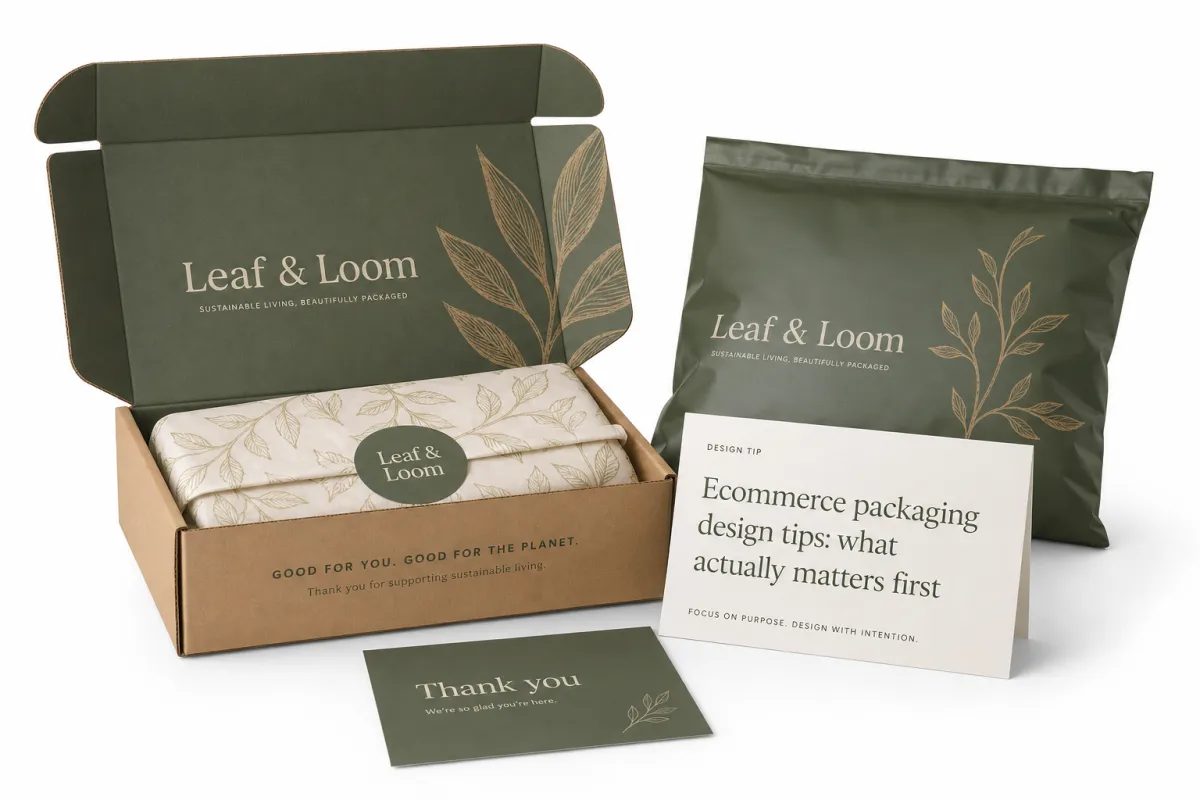
Start with the product, not the print file. Heavy items, fragile items, leak-prone items, temperature-sensitive items, and bundled products all have different packaging needs. A display-ready carton that collapses in transit does not count as a win; it counts as a replacement order with prettier graphics. The strongest ecommerce packaging design tips begin with protection and fit, then move outward to the visual layer.
Packaging has three jobs, and they are not equally important. It has to protect the contents, present the brand, and support the warehouse process. A design that overfeeds one job usually starves the others. Too much cushioning raises material and labor cost. Too little protection raises refunds and reships. Too much print coverage can look polished while adding expense that never improves conversion. That trade-off is the part many teams underestimate until the claims start stacking up.
A package does not need to be fancy. It needs to be intentional, repeatable, and hard to break.
The online setting makes packaging failures more visible because there is no in-store recovery moment. In a retail environment, a customer might forgive a scuffed edge if the product feels right in hand. In ecommerce, the carton or mailer becomes the first tactile proof of quality. A crushed corner, a torn seal, or a loose insert can signal carelessness even when the product inside is fine. That perception gap is exactly why ecommerce packaging design tips matter beyond logistics.
There is also a trust effect that shows up in repeat purchase behavior. A clean mailer, a tray that keeps the product from rattling, and a tidy opening sequence can make the order feel more valuable without changing the product itself. That effect is strongest in branded packaging, custom printed boxes, and giftable product packaging where the unboxing experience carries part of the promise. The box may be inexpensive in absolute terms, but the signal it sends is not.
A practical rule I use: if a packaging change does not reduce damage, improve fulfillment speed, or strengthen customer perception, it probably belongs in a later testing round. That keeps ecommerce packaging design tips grounded in outcomes instead of design theater. Lean teams especially benefit from that discipline because it keeps packaging from becoming a money sink with attractive renderings.
One more thing: the first version is almost never the final version. Packaging changes tend to reveal themselves in the warehouse, not the design review. That is where the truth lives.
What ecommerce packaging design tips reduce damage and improve the customer experience?
Packaging affects the entire journey, not just the unboxing photo. It starts at pick-and-pack, where the team needs a format that is easy to grab, load, label, and seal. It continues in transit, where compression, vibration, drops, and temperature swings can punish weak structures. Then it lands on the doorstep, where the customer makes a judgment almost immediately. Ecommerce packaging design tips are useful because they connect those moments instead of treating them as separate silos.
The chain reaction is easy to trace. A box arrives damaged, a service ticket gets opened, a refund or replacement follows, and a review may turn negative. Over a year, those costs can easily outrun the difference between a plain carton and a thoughtful one. One extra dollar spent on the right structure can be cheaper than absorbing a three-dollar replacement, plus support time, plus the second shipment. Packaging buyers who track total cost instead of unit price usually make better calls.
Not every category needs the same level of finish. A low-margin accessory may only need a clean stock mailer with accurate sizing and enough structure to hold the product in place. A premium skincare set or giftable apparel bundle may justify custom packaging because the perceived value rises with presentation. The point of ecommerce packaging design tips is not to force every brand into the same style. It is to match the packaging system to the product economics and buying behavior.
Inserts, tissue, labels, and opening order all shape how the order feels. A well-placed insert can stop movement inside the box. Tissue can soften the reveal without adding much cost. A compact printed card can sometimes do more for retention than a heavy sleeve or a coated exterior. Small choices stack up fast. That is why the best ecommerce packaging design tips often produce more value from fit and sequence than from flashy finishes.
Warehouse reality matters too. Teams often test packaging by looking at mockups on a table, which tells them very little. A better test is watching a packer build the order under time pressure, tape the carton, place the label, and move to the next unit. If the design looks polished but adds 12 to 18 seconds per order, labor eats the win. That kind of delay can matter more than the visual upgrade ever will.
I once sat through a packaging review where the “premium” version looked beautiful in a slide deck and then stalled the packing line in real life. The boxes needed an extra fold, the insert kept slipping, and the team was basically fighting the package every time they tried to close it. The sample looked expensive. The operation did not.
What factors drive ecommerce packaging design decisions?
Product characteristics come first. A ceramic mug, a vitamin bottle, and a folded T-shirt should not share the same packaging logic. Size, fragility, weight, leak risk, and temperature sensitivity all change the spec. Multi-part products may need dividers or inserts to keep components from colliding in transit. Good ecommerce packaging design tips treat the product as the blueprint, not the afterthought.
Brand goals shape the package just as much. A premium brand may want matte print, tighter tolerances, and a heavier feel in hand. A minimalist brand may prefer one-color graphics and recycled kraft texture. An eco-focused brand may want right-sized corrugated board, fewer coatings, and materials that are easier to recycle. A playful brand may use bold color or printed interiors. Each choice works, but each choice also changes sourcing, lead time, and cost.
Shipping conditions deserve more attention than they usually get. Parcel networks care about dimensional weight, stacking pressure, abrasion, and handling speed. A carton that grows by an inch in two directions can push shipping cost higher than the difference between a plain print spec and a more polished one. If a package moves through multiple handoffs, the outer structure has to survive before the customer ever sees the branding. The most useful ecommerce packaging design tips are rarely glamorous, but they save money where it counts.
Sustainability and compliance belong in the conversation too. Right-sized boxes, recyclable materials, and less filler can cut waste and reduce freight inefficiency. For claims and certifications, source documents should be close at hand. The EPA recycling guidance helps teams understand general material rules, and the FSC certification standards help verify paper-based sourcing claims. Claims need to be precise because trust is expensive to repair once it slips.
From a buyer’s standpoint, the best packaging choice usually balances the full set of constraints rather than maximizing one. A fragile item deserves protection first. A low-risk item with a high perceived value may justify a stronger presentation. A fast-moving SKU may need a simpler structure so the packing line does not slow down. Ecommerce packaging design tips become operational the moment the design meets the warehouse.
- Fragile or liquid products: prioritize structure, inserts, and closure integrity before print upgrades.
- Giftable products: prioritize opening sequence, color consistency, and internal presentation.
- High-volume SKUs: prioritize speed, stock availability, and repeatable assembly.
- Premium bundles: prioritize product retention, clean reveal, and tighter dimensional control.
Step-by-step ecommerce packaging design tips for a smoother rollout
Start with a SKU audit. Group products by protection need, order volume, margin, and size. A bestseller that ships thousands of times a month deserves a different spec than a seasonal item with modest demand. Ecommerce packaging design tips work best when the work is applied to the right segment instead of the entire catalog at once. Mass redesigns sound efficient; they often just create mass confusion.
Build from the inside out. Confirm product fit first. Add inserts, cushions, or dividers only if the product needs them. Select the outer carton or mailer after that. Branding should come last, because the visual layer needs to support the structure rather than fight it. That sequencing avoids a common mistake: a good-looking box that does a poor job holding the product still.
Prototype early, while changes are still cheap. Build two or three versions and test them with real products, real fulfillment staff, and simulated shipping conditions. Drop tests and vibration checks such as ISTA 3A can reveal weak points that a desk mockup will never show. A single sample can flatter a bad design. A dozen units through the pack station and carrier-style stress test usually tell the truth fast. Ecommerce packaging design tips should always include testing, not just concept review.
Once the structure works, write the spec down clearly. Record dimensions, board grade, flute type, print method, insert thickness, seal requirements, and approved artwork files. Custom Packaging Products can help teams compare options without losing track of the details. A clear spec sheet reduces procurement drift, where a reorder quietly comes back with a different board weight, coating, or color accuracy than the approved sample. That kind of drift is small on paper and irritating in practice.
Finish with a pilot. Start with a limited set of SKUs and watch what happens to damage rates, pack speed, and customer response. If the pilot lowers breakage and keeps the line moving, scale from there. If not, revise the weakest part of the system and test again. Ecommerce packaging design tips rarely work like a one-time decision. They work more like a loop: test, measure, adjust, repeat.
A practical rhythm helps:
- Audit: sort SKUs by risk and volume so the packaging budget goes where it matters most.
- Prototype: test two or three structures with real product weight and real packing staff.
- Validate: run the prototypes through shipping-style stress, not just visual review.
- Document: lock the approved dimensions, materials, and print specs into one source of truth.
- Launch: release the package in a small batch and watch returns, damages, and customer feedback.
Packaging costs, pricing, and timeline trade-offs to plan for
Cost is more than the number on the quote. The real figure includes printing, setup, minimum order quantities, fulfillment labor, damaged-product replacements, and the freight effect of the final dimensions. Ecommerce Packaging Design Tips That ignore any of those pieces are incomplete. A cheaper box can become the expensive box if it adds even a little dimensional weight or lets products break more often. Right-sized packaging usually wins this argument faster than glossy finishes do.
At scale, the pattern becomes obvious. A plain stock mailer might land around $0.12 to $0.40 per unit depending on size and quantity. A Custom Printed Corrugated mailer at 5,000 units might sit closer to $0.45 to $0.90 per unit. A rigid box with an insert can rise to $1.20 to $3.50 or more depending on board, finish, and complexity. Those numbers are not universal, but they explain why ecommerce packaging design tips have to be tied to product margin and customer promise rather than taste alone.
| Packaging option | Typical use case | Approx. unit cost at 5,000 units | Main trade-off |
|---|---|---|---|
| Branded poly mailer | Soft goods, apparel, low-fragility items | $0.12 - $0.30 | Low protection, strong efficiency |
| Stock kraft mailer | Simple DTC orders, starter packaging | $0.22 - $0.40 | Limited brand control |
| Custom printed corrugated box | Balanced protection and brand presentation | $0.45 - $0.90 | Higher setup and print complexity |
| Rigid box with insert | Premium kits, gifting, high perceived value | $1.20 - $3.50+ | Best presentation, highest cost |
Timeline matters just as much as cost. A simple redesign can move from brief to production in three to five weeks if the materials are available and the artwork is straightforward. Custom structures, new dies, special finishes, and multiple revision rounds can stretch that window much longer. The bottlenecks usually show up at proof approval, insert fit testing, and supplier scheduling. Ecommerce packaging design tips should always leave room for delay, because packaging rarely runs on the same clock as marketing.
A practical decision rule works well here: spend more where failure is expensive, and keep decorative upgrades where they improve conversion or retention. If a product is fragile, the money belongs in protection. If the product is stable but highly giftable, the money may belong in the reveal. If the SKU is low-margin, the smartest path is usually lean and repeatable. That keeps product packaging aligned with the actual economics of the order.
Procurement creates its own pressure. Minimum order quantities can trap teams inside a design before demand is stable. If volume is still uncertain, a simpler structure or a more flexible format may be the safer choice than a highly customized one. Ecommerce packaging design tips protect cash flow as much as they protect brand image, and sometimes more.
Here is the part that does not always make the sales deck: most packaging issues are not solved by a fancier material. They are solved by fewer mistakes, tighter dimensions, and clearer specs. Boring? A little. Effective? Very.
Common ecommerce packaging design mistakes to avoid
The most common mistake is oversized packaging. It seems harmless until the bill arrives. Larger cartons use more filler, push freight cost higher, and create a less precise brand impression. They also let the product move around more, which is bad news for damage rates. Good ecommerce packaging design tips usually begin with right-sizing the box before anything else.
The second mistake is choosing looks before drop protection. That is especially risky for liquids, glass, electronics, and premium products that create a high expectation gap if damaged. A customer paying more expects less risk, not more. A beautiful box that fails in transit turns the brand story into a complaint thread faster than most teams expect.
A beautiful box that arrives damaged usually costs more than a plain box that performs well.
Ignoring the fulfillment workflow is another common failure. Packaging that looks elegant in a mockup can become a headache on the packing line. Too many folds, awkward closures, or extra insert pieces slow down pick-and-pack operations. A ten-second delay per order sounds minor until it is multiplied across thousands of shipments. Ecommerce packaging design tips have to respect the people actually building the order, not just the art direction.
Too many variations can create inventory trouble as well. Multiple box sizes, insert shapes, or print versions may look flexible in a presentation, but they often complicate storage and reorder planning. Slow-moving packaging can sit on a shelf while the fast mover runs short. Simpler systems are usually easier to forecast, easier to train, and easier to scale. That matters more than most creative decks admit.
Another mistake is treating sustainability like a slogan instead of an engineering choice. If a box is technically recyclable but ships half-empty, the environmental story gets weaker, not stronger. A right-sized carton with fewer coatings often does more for waste reduction than a splashy claim printed on the lid. Trust me, customers are getting sharper about that stuff.
If conversion is the goal, package branding cannot turn into a decoration contest. The package has to earn its keep by reducing damage, supporting the brand promise, and fitting the fulfillment process. That is the core of ecommerce packaging design tips, and it is the part that often gets skipped when teams are under pressure to launch.
- Avoid: choosing a carton size before confirming product fit.
- Avoid: adding premium finishes that do not change customer perception.
- Avoid: designing a structure that slows the packing bench.
- Avoid: ordering too many versions before the design proves itself.
Expert ecommerce packaging design tips and next steps
Build a tiered system. High-risk products get more protection. Low-risk products stay lighter and more efficient. That keeps the packaging budget where failure costs are highest, which is one of the most practical ecommerce packaging design tips for growing brands. It also makes replenishment easier because the team is not trying to force one box to solve every problem at once.
Create a one-page scorecard for every packaging option. Rate each candidate on protection, brand fit, sustainability, cost, and fulfillment speed. Compare the options side by side instead of trusting first impressions. Packaging decisions get much clearer once the conversation shifts from “which looks nicer” to “which performs better across the full order journey.”
Review customer service tickets and return reasons every month. If the same complaint keeps showing up, the packaging is trying to tell you something. Maybe the insert is too loose. Maybe the box is too tall. Maybe the seal weakens under pressure. Small issues become expensive when they repeat. Ecommerce packaging design tips only stay useful when they are fed by real customer feedback.
For a practical 30-day plan, start with one SKU. Audit it. Prototype two options. Test them through packing and shipping. Lock the spec. Then roll it out and watch the data. If you need a starting point for sourcing, compare Custom Packaging Products against your current format and see where the structure, print, and price line up. The goal is not to make every box spectacular. The goal is to make every order predictable, protected, and worth opening.
That is the real value of ecommerce packaging design tips: they help online brands protect margin, cut damage, and create a stronger first physical impression without turning the system into a tangle. If the package can do those three jobs at once, it is doing what the business actually needs.
The most actionable move is simple: pick one high-volume SKU, measure its current damage rate, pack time, and freight cost, then redesign only the parts that improve those numbers. Everything else is noise. Do that well, and the rest of the catalog gets easier.
What are the most important ecommerce packaging design tips for small brands?
Start with correct sizing and product protection before adding branding extras. Choose one versatile system that can serve multiple SKUs, because simplicity keeps inventory and training under control. Track damage rates, customer complaints, and repeat purchase patterns so your ecommerce packaging design tips are based on real performance instead of guesswork.
How do I choose the right materials for ecommerce packaging design?
Match the material to the product's risk level: corrugated board for protection, mailers for lightweight items, and inserts for movement control. If sustainability matters to your audience, prioritize recyclable or right-sized materials. Test the material for strength, print quality, and packing speed before committing to a large order; that is one of the ecommerce packaging design tips that saves the most money later.
How much should ecommerce packaging design cost per order?
There is no single target, because the right number depends on margin, damage risk, and customer expectations. Use total cost, not unit price alone, since a cheaper package can create higher replacement and service expenses. The best ecommerce packaging design tips treat cost as part of the customer experience, not a separate line item.
How long does ecommerce packaging design usually take?
A simple update can move quickly, while custom structures, printing, and testing usually take longer. Plan for discovery, prototyping, revisions, sourcing, and production instead of assuming one design review will finish the job. If the project depends on new dies, special finishes, or multiple approvals, build extra time into the schedule; that is one of the most practical ecommerce packaging design tips for keeping launches on track.
What is the biggest mistake in ecommerce packaging design?
The biggest mistake is designing for shelf appeal instead of shipping reality. Packages have to survive handling, stacking, and transit before they can impress the customer. A beautiful box that arrives damaged usually costs more than a plain box that performs well, which is why ecommerce packaging design tips should always start with performance.


