Buyer Fit Snapshot
| Best fit | Custom Printed Corrugated Boxes Quote projects where brand print, material claims, artwork control, MOQ, and repeat-order consistency need to be specified before quoting. |
|---|---|
| Quote inputs | Share finished size, material target, print colors, finish, packing count, annual reorder estimate, ship-to region, and any compliance wording. |
| Proofing check | Approve dieline scale, logo placement, barcode or warning zones, color tolerance, closure strength, and carton packing before bulk production. |
| Main risk | Vague material claims, crowded artwork, missing packing details, or unclear freight terms can make a low unit price expensive after revisions. |
Fast answer: Custom Printed Corrugated Boxes Quote: What Affects Cost should be specified like a repeatable production item. The safest quote records material, print method, finish, artwork proof, packing count, and reorder notes in one written spec.
Production checks before approval
Compare the actual filled-product size with the drawing, then confirm tolerance on folds, seals, hang holes, label areas, and retail display edges. Reserve space for logos, QR codes, warning copy, and material claims before decorative graphics fill the panel.
Quote comparison points
Review material grade, print process, finish, sampling route, tooling charges, carton quantity, and freight assumptions side by side. A quote is only useful when the supplier can repeat the same color, closure quality, and packing count on the next order.
A custom Printed Corrugated Boxes quote can look neat on a screen and still miss the job by a mile. Two boxes with the same outside size can end up in very different price ranges once board grade, print coverage, tooling, freight, and inserts get involved. Packaging does not care about wishful thinking. It cares about specs.
Buyers who need a real number have to give enough detail for the quote to match the box they plan to ship, stack, and hand to a customer. Skip that part and the process turns into revision roulette. One missing detail becomes three emails, two corrections, and a budget that starts blinking in the dark.
I have seen this happen more times than I can count. A team asks for a “simple box quote,” then later discovers the box needs inside print, a white ink underbase, a foam insert, and a freight setup to three warehouses. That is not a quote. That is a surprise party nobody wanted.
Why a Custom Printed Corrugated Boxes Quote Can Change Fast
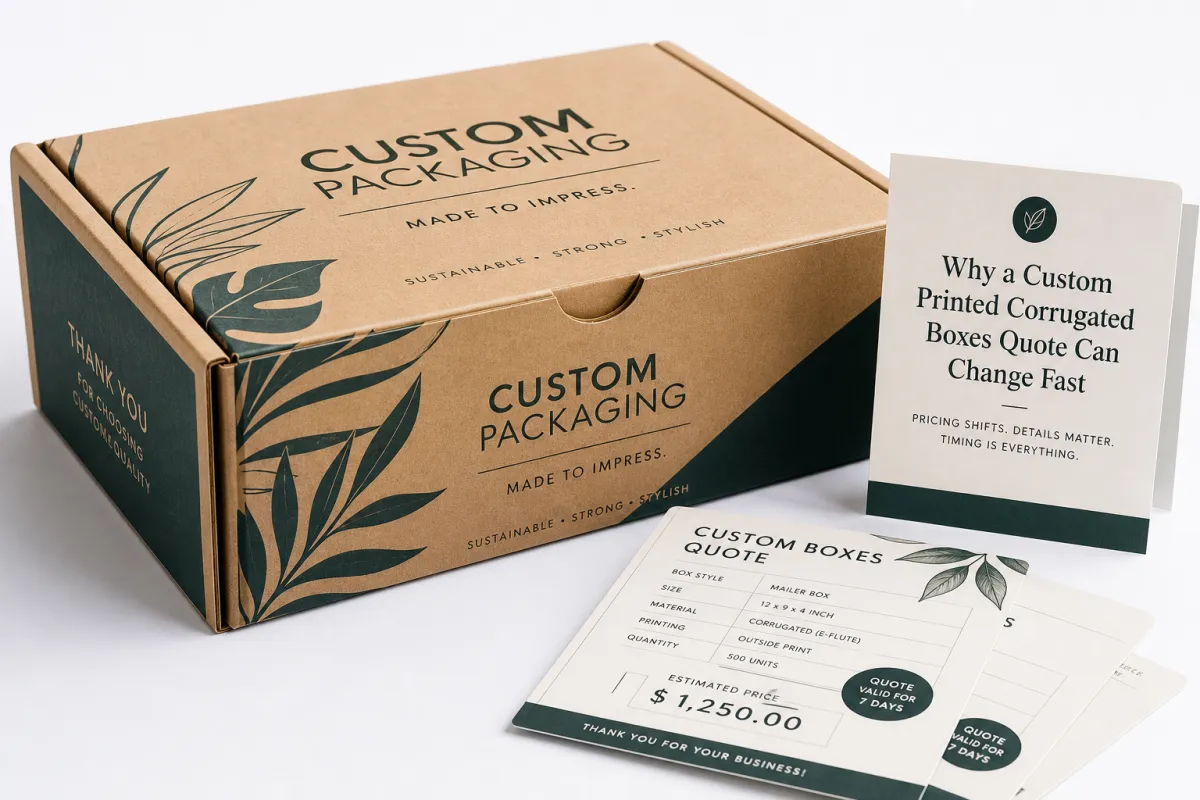
A Custom Printed Corrugated boxes quote changes fast because corrugated packaging is not one product. It is a mix of structures, board grades, print methods, and finishing choices, each with its own cost profile. A standard slotted carton for warehouse shipping is simple. A retail-ready mailer with full-color branding is not. A die-cut shipper with a specialty insert adds another layer. Treat them like the same thing and the quote gets fuzzy fast.
Scope is where most buyers get burned. One supplier may quote the shell only. Another includes inserts, tape strips, prepress, or freight. The low number looks friendly until the missing pieces show up later. Then the “cheap” quote stops being cheap. A custom printed corrugated boxes quote only means anything when everyone is quoting the same box.
The first round should stay grounded in the basics. Dimensions. Product weight. Quantity. Destination. Print needs. Closure style. If those are unclear, the supplier is guessing. Guessing is expensive, just not immediately. That part sneaks up on people.
Good buying starts with clean inputs. It saves time on both sides and keeps the conversation out of the swamp where one team thinks the box is for ecommerce, another thinks it is for pallet freight, and nobody notices the gap until the proof arrives. The quote will not magically bridge that gap.
For faster quoting, gather these details before you send the request:
- Inside dimensions and product weight, not just a rough outside size that feels close enough.
- Box style, such as mailer, slotted carton, die-cut retail box, or heavy-duty shipping carton.
- Print needs, including one-color flexo, full-color digital, or premium litho-lam graphics.
- Quantity bands, because 1,000 units and 10,000 units do not behave the same way.
- Freight destination, pallet requirements, and whether delivery needs to go to a warehouse or direct to store.
That list is basic for a reason. Still, a custom printed corrugated boxes quote often arrives with half of it missing. If you want a number that survives proof approval and production, give the supplier enough information to stop inventing assumptions.
“The cheapest quote is usually the one that forgot something.” That is not a joke. That is the invoice showing up later.
Custom Printed Corrugated Boxes Quote: Box Styles, Board Grades, and Print Methods
Box style drives a huge part of any custom printed corrugated boxes quote. A regular slotted carton is usually the most efficient to make. It cuts cleanly, folds easily, and ships flat. Mailer Boxes Cost more because the die-cutting is more involved and the presentation has to look better. Retail packaging with a custom opening, tear strip, or window can push the number higher again because every feature adds labor and setup.
Board grade matters just as much. E-flute gives a smoother print surface and a thinner profile, which works well for ecommerce and branded mailers. B-flute offers a stronger wall with solid printability. C-flute is a common shipping choice because it adds more crush resistance. Double-wall board brings more protection and more freight cube, which means more cost. That is not shocking. More paper means more money.
Print method is the other big fork. Flexographic printing is usually the practical route for larger runs and simpler graphics. Digital printing makes sense for shorter runs, fast changes, or variable artwork. Litho-lam is the premium option when shelf appeal matters and the box needs a smoother, retail-grade finish. If the box has to sell a product on a shelf, litho-lam can earn its keep. If it is just keeping parts from getting crushed, probably not.
Comparing a custom printed corrugated boxes quote across suppliers gets messy when print methods are mixed. One quote might cover a one-color logo on kraft board. Another might include full-coverage artwork, white ink, coatings, and inside print. Those are different jobs. “Basically the same” is not a specification. It is a lazy shortcut, and it usually costs money later.
Here is a practical way to think about it:
| Option | Typical Cost Effect | Best Use | Tradeoff |
|---|---|---|---|
| Regular slotted carton, flexo print | Lowest setup cost, lower unit price at volume | Shipping, warehouse, palletized product | Less shelf appeal, limited graphic detail |
| Mailer box, digital print | Moderate setup, better for shorter runs | Ecommerce, influencer kits, subscription boxes | Higher unit price than basic cartons |
| Die-cut retail box, litho-lam | Higher tooling and finishing cost | Retail packaging and branded displays | Premium appearance, premium price |
| Double-wall shipping carton | Higher board cost and freight impact | Heavy products, fragile goods, long-distance freight | More protection, more cube, more cost |
Coatings and structural extras need to be in the quote from the start. Gloss or matte varnish, soft-touch lamination, window patches, tear strips, hot foil, inserts, and partitions all add steps. Inside printing does too. Once the graphics move inside the box, the production path gets more involved. A custom printed corrugated boxes quote should say that clearly before anyone starts pretending the change is minor.
The question is not “Who is cheapest?” The better question is “Which quote matches the box I need without hidden compromises?” That is the difference between decent buying and expensive cleanup.
For broader packaging context, the ISTA testing standards are useful when shipping performance matters, especially if your boxes need to survive distribution abuse instead of just looking good in a mockup.
Specifications Buyers Should Lock In Before Requesting a Quote
If you want a reliable custom printed corrugated boxes quote, get the non-negotiables locked before you send anything out. The most important ones are inside dimensions, product weight, closure style, and whether the box ships flat or assembled. Those four shape the structure. The rest sits on top.
Inside dimensions matter more than most people expect. A box that is too tight slows packing and creates headaches on the line. A box that is too loose lets the product move around, which leads to dented corners or a sloppy unboxing experience. That matters in ecommerce and retail packaging, where the box is part of the product story. Bad fit shows up fast.
Tolerances are worth spelling out, especially if the box runs on a fulfillment line. A few millimeters can change pack speed or make automated boxing awkward. Fragile products need room for cushioning, inserts, or dividers. That is not a nice extra. It is damage control.
Artwork details matter just as much. Send the file format, color count, and bleed requirements. If Pantone matching matters, say it. If the design wraps across all four sides, say that too. Weak specs usually produce a weaker custom printed corrugated boxes quote because the supplier has to pad for unknowns or revisions.
Logistics should not be an afterthought. Tell the supplier the destination, pallet count, carton pack-out, and any freight limits. If the order has to fit a narrow receiving window, that matters. If it needs split shipments, that matters too. The box is not floating in a vacuum, no matter how often purchasing pretends it is.
One missing item causes more trouble than most people admit: inserts. Partitions. Dividers. Foam pads. Paperboard trays. If they are not quoted with the outer box, the price changes later and everybody acts shocked. The missing insert was never invisible. It was just ignored.
Use this checklist before you request pricing:
- Exact inside dimensions and acceptable tolerance.
- Product weight and any fragile points that need protection.
- Box style and closure type, including auto-lock, tuck-top, or tape seal.
- Artwork specs, file type, color count, and print coverage.
- Inserts or dividers if the product needs internal support.
- Destination and freight expectations.
A solid request saves time and helps the supplier make better recommendations. Sometimes a small structural change cuts waste. Sometimes a heavier board costs less than replacing damaged goods. A supplier who knows custom printed boxes should say that plainly.
If you are still shaping the structure, review our Custom Packaging Products and Custom Shipping Boxes pages first. It is easier to request a useful custom printed corrugated boxes quote when the category is already clear.
Custom Printed Corrugated Boxes Quote: Pricing, MOQ, and Real Cost Drivers
Here, the numbers stop being polite. A custom printed corrugated boxes quote is shaped by a handful of cost drivers, and most of them are obvious once you know where to look. Size comes first. Bigger boxes use more board and take up more freight cube. Board grade follows. Stronger board costs more. Then print complexity enters the picture, and that can move pricing fast if the design uses multiple colors, coatings, or specialty finishes.
MOQ, or minimum order quantity, is the lever buyers feel most clearly. Short runs usually carry a higher unit price because setup costs get spread across fewer boxes. Larger runs reduce the per-box price because those same setup costs are diluted over more units. That is why a quote for 500 boxes can look wildly different from one for 5,000. Same structure. Different economics.
As a rough planning range, simple corrugated mailers or shipping cartons can sometimes land around $0.18 to $0.45 per unit at higher quantities, depending on board grade and print coverage. Printed Mailer Boxes with heavier branding often run higher, especially when the order is small. Premium retail packaging with die-cuts, windows, or litho-lam can climb quickly into the $1.00 to $3.50+ range per unit, depending on quantity and finish. Those numbers are for planning, not promises. A custom printed corrugated boxes quote still needs real specs before it turns into real pricing.
Tooling is another place where budgets drift. Custom dies, print plates, and special cutting forms are setup costs that may appear once and then get spread across the run. Ask for revisions, swap artwork after approval, or change the structure late in the game, and the quote can move. That is not a supplier being difficult. That is production being production.
Freight is the part people ignore until the warehouse invoice lands. Box price alone is not landed cost. Ask for freight, packaging of the boxes themselves, sampling, and tooling to be listed separately. A lower unit price can be a worse deal if freight is padded or a needed step was left out. Compare the total, not the headline number.
Here is a simple comparison of how pricing behavior changes by order type:
| Order Type | Typical MOQ Behavior | Common Price Pressure | Buyer Advantage |
|---|---|---|---|
| Short-run digital mailers | Lower MOQ, higher unit price | Setup spread over fewer pieces | Good for launches and testing |
| Mid-volume flexo shipping boxes | Moderate MOQ, better unit economics | Plate and setup costs | Useful for steady replenishment |
| High-volume retail packaging | Higher MOQ, lower unit price | Tooling, board, and freight cube | Best for stable SKUs and repeat demand |
A smart buyer asks one blunt question: what changes the price the most if we need to hit budget? That forces the supplier to point to the real drivers, whether that is board grade, print coverage, or structure. Most of the time, the answer is not “everything.” It is one or two main variables.
For environmental and material decisions, you can also review the EPA’s packaging-related waste reduction resources at EPA recycling guidance if your team is trying to reduce excess material without weakening performance. That tradeoff matters in product packaging, especially at scale.
A strong custom printed corrugated boxes quote is not the cheapest number on the page. It is the one that holds together once production starts.
How the Quoting Process Works and When Boxes Ship
The quoting process should be predictable, even if the final number shifts after artwork or structural review. A solid custom printed corrugated boxes quote usually follows the same path: submit specs, confirm feasibility, receive pricing, approve artwork, review proof, and release production. Skip a step and the timeline slides. No mystery there. Printing and converting work on sequence, not wishful thinking.
An estimate is not the same thing as a final quote. An estimate is a first pass based on the information in front of the supplier. A final quote comes after the structure, board grade, and print method are confirmed. If the artwork is still rough or the dieline is not settled, the number can move. That movement is normal. What should not move is the explanation.
Lead times depend on complexity. A simple corrugated mailer with clean artwork can move fairly quickly. A custom die-cut retail box with a new structural layout takes longer because tooling, proofing, and sample checks add steps. If a supplier claims both take the same time, they are either guessing or not paying attention. Neither one helps you.
For a straightforward run, the timeline may be around 12 to 15 business days after proof approval. More complex packaging can stretch to 3 to 6 weeks or longer if tooling or sample approval is involved. Freight booking and peak season demand can add more time. Packaging lives in the real world, not the fantasy version where every department signs off on Tuesday.
A few bottlenecks show up over and over:
- Prepress checks when the artwork needs cleanup, font fixes, or color adjustments.
- Tooling approval when a new die or custom cut pattern is required.
- Sample sign-off if the buyer wants to check fit, print alignment, or closure performance.
- Freight booking when the order needs coordinated delivery to a warehouse or fulfillment center.
You can speed things up by sending clean dielines, print-ready files, a clear quantity, and one decision-maker on the buyer side. That last one matters more than people want to admit. Three internal approvals can do more damage than a missing measurement ever will.
If the packaging has to hold up under distribution stress, ask about test methods such as ASTM D642 for compression strength or common ISTA test protocols for shipping performance. Not every order needs formal testing, but the option matters when the product is heavy, fragile, or expensive to replace. For sourcing background, the FSC site is worth checking if certified materials matter for your branded packaging program.
Buyers who request a custom printed corrugated boxes quote with complete details usually get a cleaner timeline and fewer proof revisions. That part is almost annoyingly consistent.
Why Choose Us for Custom Packaging That Actually Arrives on Spec
Custom packaging should not feel like a gamble. A good supplier gives you a custom printed corrugated boxes quote that is clear, itemized, and tied to the structure you actually need. That means honest material guidance, realistic lead times, and support before production starts. Pretty language is nice for a brochure. It does not make a box fit.
What buyers usually want is simple: no surprise charges, no vague specs, and no box that looks fine in a render but shows up with weak board or sloppy fit. That is not a big ask. It is the baseline. In branded packaging, the difference between a professional result and a mess often starts with the quoting process. If the quote is sloppy, production usually follows the same script.
We focus on practical packaging design, not fantasy. That means helping you Choose the Right board grade, the right print method, and the right structure for the way the box will actually be used. A display-style carton for retail packaging needs different priorities than a shipping box for a fulfillment center. A box carrying fragile glass has different needs than one holding apparel. A decent quote should reflect those differences instead of flattening everything into one generic number.
That kind of support matters even more when you are managing custom printed boxes across multiple SKUs. If one product needs shelf appeal and another only needs transit protection, the packaging plan should not look the same. Otherwise, you overpay on the easy jobs and underbuild the hard ones. Neither outcome is clever.
What good quoting support should include:
- Spec checks before pricing so the quote is based on real requirements.
- Artwork review to catch file issues before production starts.
- Material guidance so board choice matches product weight and shipping conditions.
- Freight awareness so cube, pallet count, and delivery method are not ignored.
- Manufacturability advice when a feature looks good on paper but causes problems on press or on the folder-gluer.
That is where most packaging suppliers earn their keep. Not by saying yes to everything. By telling you what works and what wastes money. A good custom printed corrugated boxes quote should make the decision easier, not turn it into a scavenger hunt through five rounds of emails.
If you are comparing options across product categories, use our Custom Packaging Products catalog and the Contact Us page to start the conversation with the right specs in hand. The faster the inputs are clear, the faster the custom printed corrugated boxes quote becomes useful.
How to Request a Custom Printed Corrugated Boxes Quote the Smart Way
The smartest request is the one that removes guesswork. Start with the essentials: inside dimensions, quantity, board grade, print sides, packaging weight, artwork file, shipping address, and target launch date. If you are unsure about any one of those items, say so. A supplier can work with a partial spec sheet. What they cannot work with is vague hope dressed up as procurement.
When you send the request, ask for a line-item breakdown. You want to see unit price, tooling, sampling, freight, and any optional upgrades separately. That habit makes a custom printed corrugated boxes quote much easier to compare. If one supplier says the box is $0.62 and another says $0.79, the difference may be sitting in freight or setup. Without the breakdown, you are comparing shadows.
Reference photos help when the structure is unusual. A physical sample helps too if you already have a box that is close to what you want. Samples speed the conversation because they show the supplier what “close enough” actually means. That cuts down on structural mistakes and stops the team from inventing box features nobody asked for.
There is one blunt question I always recommend asking: What changes the price the most if we need to hit budget? That question surfaces the real levers. Sometimes it is board grade. Sometimes it is print coverage. Sometimes it is the closure style or insert count. Rarely is the answer “nothing,” which would be convenient for exactly no one.
Use this request checklist before you send your next inquiry:
- Measure the product and specify inside dimensions.
- State the quantity and any tiered volume targets.
- Identify the box style and closure method.
- Attach print-ready artwork or the best available file.
- Note any inserts, partitions, coatings, or windows.
- Provide the shipping destination and delivery window.
- Ask for a clear custom printed corrugated boxes quote breakdown.
If your program includes retail packaging, branded packaging, or variable SKUs, send those differences up front. It is easier to quote a family of products correctly than to redo a single quote later because one item was missing a key detail.
Bottom line: lock in the inside dimensions, board grade, print method, quantity, freight destination, and insert needs before you ask for pricing. Then compare the custom printed corrugated boxes quote against the real job, not a guessed version of it. That is how you keep custom printed boxes from turning into expensive guesswork.
What do I need for an accurate custom printed corrugated boxes quote?
You need inside dimensions, product weight, and the required box style as the minimum. Add print method, color count, artwork files, quantity, and shipping destination. If you need inserts, coatings, or special closures, include them up front or the custom printed corrugated boxes quote will drift after the first pass.
How does MOQ affect a custom printed corrugated boxes quote?
Lower quantities usually carry a higher unit price because setup costs get spread across fewer boxes. Higher quantities reduce unit cost, but only if storage and cash flow make sense. Ask for tiered pricing so you can see the breakpoints before you overcommit, then choose the MOQ that fits your actual demand instead of your optimism.
Can I get a sample before approving a full order?
Yes, and for custom packaging it is usually worth it when structure or print alignment matters. A sample helps confirm fit, board strength, and finish before production starts. Ask whether the sample is structural, printed, or both, because those are very different costs and very different approval stages in a custom printed corrugated boxes quote.
Why do two custom printed corrugated boxes quotes look so different?
One quote may include tooling, inserts, freight, or proofing while the other leaves them out. Board grade, print coverage, and box style can move pricing more than most buyers expect. Compare line items, not just the final number, or you are not comparing the same product. That is how people end up picking the wrong supplier for the wrong reason.
How long does a custom printed corrugated boxes quote take?
Simple requests can come back quickly if the specs are complete and the artwork is clean. Complex structures, special printing, or unclear requirements slow the process down. The fastest path is a complete spec sheet, a print-ready file, and one decision-maker. Get those lined up and the custom printed corrugated boxes quote usually moves at a sane pace instead of dragging through endless clarification emails.

