If you are building an electronics cuffed knit Beanies Material Sample guide, the first thing to accept is that a beanie can look finished long before it is actually ready. Knit texture, cuff recovery, and logo scale all change once the item leaves a flat mockup and goes onto a real head. That is where sample approval earns its keep. It is not a formality. It is the only practical way to see whether the beanie still looks intentional after the material stretches, folds, and moves.
For electronics brands, the standard is slightly harsher than for generic merch. The item is usually tied to a product launch, a trade show, or a premium giveaway. That means the beanie has to carry the brand without feeling overdesigned. If the knit is scratchy, the cuff collapses, or the patch looks oversized, the piece stops reading as considered and starts reading as leftover inventory.
The cheapest mistake in this category is the one you catch early. The expensive mistake is approving from photos, then discovering after bulk production that the logo sits too high, the cuff twists, or the color shifts once the yarn is knit at scale. A sample exists to surface those problems before the order becomes real money.
“A good sample does not try to flatter the brand. It exposes what production will actually do.”
Why electronics cuffed knit beanies material samples matter
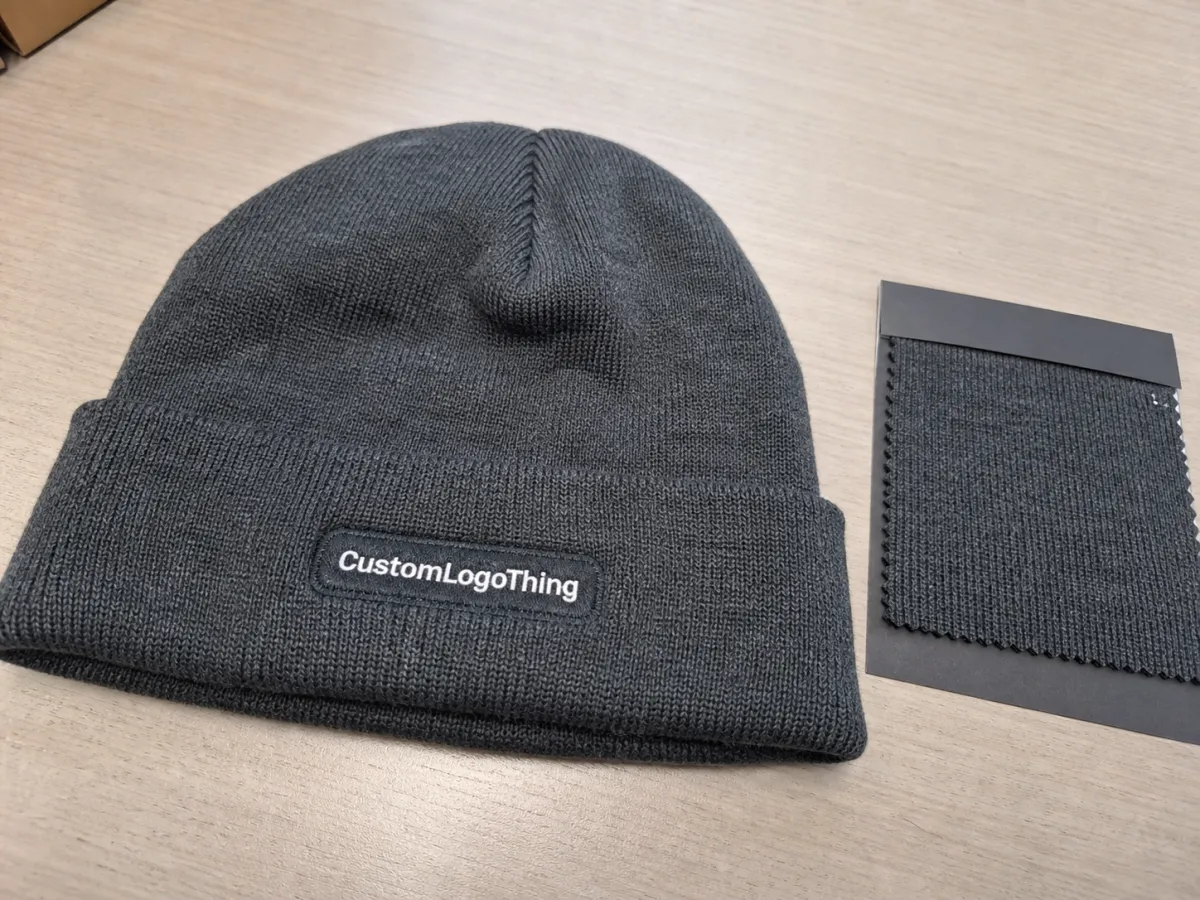
Photos are useful, but they can be misleading in a category like Cuffed Knit Beanies. Texture hides things. A knit that looks smooth on screen may be loose in the hand. A cuff that appears neat might roll after a few minutes of wear. Patch edges can look crisp in a close-up while sitting awkwardly once the beanie stretches across a forehead.
That is why buyers who work with apparel or promotional merchandise usually treat the sample as a technical check, not a visual courtesy. The goal is not to admire the object. The goal is to confirm the fabric behavior, the stitch density, the cuff structure, and the decoration method under real conditions.
For electronics brands, this matters because the beanie often sits beside higher-spec products. A charging cable, a speaker, or a launch kit can survive scrutiny on design and packaging. A beanie has less surface area to work with, so every millimeter counts. The cuff height affects logo position. The yarn choice affects comfort. Even the fold line changes the way the brand mark reads.
There is also a practical production reason to sample early. Yarn lots vary. Knit tension varies. Decoration placement varies more than people expect, especially on textured surfaces. A sample is where those variables become visible enough to fix.
One more thing gets overlooked: wear time. Many buyers judge the sample in the first thirty seconds. That is too shallow. Ask someone to wear it for 20 to 30 minutes. That short test reveals whether the cuff digs in, whether the crown slouches too much, and whether the yarn starts to feel itchy once body heat enters the picture.
What the sample should prove
The best electronics cuffed knit Beanies Material Sample guide should force the sample to answer specific questions. Does the yarn feel appropriate for the use case? Does the cuff hold shape after stretching? Does the branding remain readable on a textured surface? If the sample does not answer those questions cleanly, it is incomplete no matter how nice the photo looks.
Material choice is the first variable. Acrylic is common because it is predictable, affordable, and holds color reasonably well. Polyester can be useful when durability matters more than softness. Wool blends feel warmer and more premium, but they can raise cost and introduce itch or shrink concerns if the blend is not handled properly. Recycled yarns can support sustainability claims, but they still need to meet the same basic comfort and recovery standards. A “green” yarn that pills quickly is still a poor buy.
The cuff deserves its own inspection. It needs enough structure to support a woven label, embroidery, or patch, but not so much rigidity that it presses into the forehead. A cuff that looks tidy on a flat table can feel harsh on a real wearer if the rib structure is too tight. For outdoor events, travel kits, or winter giveaways, that kind of discomfort gets noticed fast.
Decoration is another fault line. Knit texture compresses detail. Very small text disappears. Overly large patches can make the beanie look top-heavy. Embroidery works best when the artwork is simplified and the stitch count is kept realistic for the fabric. Woven labels give cleaner edges on small logos. Silicone patches can create a sharper graphic read, but they add weight and can distort on a stretchy surface if the placement is off.
Color needs to be reviewed in context, not in isolation. A PMS reference on paper does not guarantee the same appearance once the yarn is knitted into loops and shadows. Dark colors can read flatter. Light colors can show knit irregularities more clearly. If the supplier cannot explain the yarn lot and decoration color together, there is still work to do.
Packaging should be part of the sample review too. If the beanies are meant to ship folded, ask how they are packed and whether the presentation matches the final order. Corrugated cardboard mailers, kraft paper sleeves, and low-ink inserts often make more sense than glossy extras. If the brand claims sustainability, specify recycled materials and ask for FSC certified paper components where applicable. If the packaging is supposed to be biodegradable packaging, that claim needs written support. Otherwise it is just a marketing sentence.
Cost, MOQ, and quote math
Sample pricing usually comes down to five variables: yarn, knit complexity, decoration method, finishing, and shipping speed. The numbers are not arbitrary. They reflect machine time, setup effort, and how much handwork the sample requires.
A basic blank sample often falls around $25-$60. Once decoration enters the picture, a decorated sample can move into the $60-$140 range. If the supplier has to revise the knit, adjust the cuff, or rebuild the artwork for a pre-production version, $80-$180 is normal. Rush timing can push those figures higher.
MOQ math deserves the same attention. Low minimum order quantities are attractive, but they usually mean one of three things: simpler decoration, fewer yarn options, or higher unit cost. That is not a trick. It is production reality. Short runs spread setup costs across fewer units, so the quote has less room to absorb extras.
Sample fees also vary by supplier model. Some charge a flat sample fee and credit it back against bulk production. Some separate tooling from the sample itself. Some do not credit anything. None of these structures is inherently bad. The problem starts when the quote hides the logic or leaves repeat-sample charges unspoken.
The most useful comparison is not “cheap versus expensive.” It is what each quote includes. If one supplier is quoting a lighter yarn, a simpler label, and no custom packaging, and another is quoting a denser knit with a patch and folded insert, those are not equivalent options.
| Sample type | Typical price | Usual timing | What it proves | Best for |
|---|---|---|---|---|
| Blank knit sample | $25-$60 | 5-10 business days | Gauge, fit, yarn feel, cuff recovery | Early material screening |
| Decorated sample | $60-$140 | 7-14 business days | Logo scale, placement, edge quality, visual balance | Brand approval |
| Revised pre-production sample | $80-$180 | 10-18 business days | Final fit, final decoration, production readiness | Bulk signoff |
That table is useful because it exposes a common trap: a lower quote can become the more expensive choice once you factor in revisions, repeat samples, or hidden simplifications. If the decoration method or yarn spec changes quietly, the sample is the only place you can catch it before the purchase order hardens.
Process and timeline for sample approval
The process should be plain enough to follow without a project manager translating it. The usual sequence is spec request, material selection, mockup confirmation, sample build, photo check, shipment, review notes, and revision if needed. That sounds basic because it is. Basic is good in production.
Timing depends on complexity. A plain knit sample may move quickly. A decorated cuffed beanie takes longer because the supplier has to source the yarn, set the machine, produce the knit, and then apply the branding. If the patch supplier is slow or the embroidery thread is unavailable, the delay should be identified early, not after your internal launch date is already published.
Most sampling delays come from avoidable confusion. Missing vector art. Unclear patch size. A logo file in the wrong format. Two different people sending two different color references. A buyer approves one cuff direction, then marketing changes the placement after the sample is already made. The factory is rarely the only slow part of the chain.
Use a signoff rule with teeth. The sample is approved only after fit, cuff behavior, color, logo placement, and surface finish all pass. “Close enough” is how rushed orders get locked in too early. It sounds flexible. It usually turns into rework.
For transit, ask how the sample will be packed and whether the packaging mirrors the final order. If durability matters, basic ISTA guidance is useful for thinking about shipping stress. If presentation materials are part of the package, verify that insert stock and mailers can be made from FSC certified paper. A sample that arrives well but the packaging falls apart in transit still signals a problem.
Step-by-step sample review checklist
Start with measurements. Confirm flat width, cuff height, seam neatness, and decoration placement against the approved spec sheet. A sample review should feel like inspection, not impression management. A ruler and a marked reference point solve more arguments than opinions do.
Then test the fit on a real head. Not on a box. Not on a desk. The stretch recovery is often where a sample proves itself or fails quietly. Watch the cuff after it is pulled on and off a few times. If it loosens too fast or twists sideways, the bulk run will likely do the same.
Check the branding in daylight and indoor light. Knit texture changes how the eye reads edges and color. A logo that looks sharp near a window may soften under overhead office lighting. If the graphic only works under one condition, it is too fragile for production.
Do a simple durability pass. Pull the cuff. Press the patch. Rub the surface lightly. The point is not to destroy the sample; it is to see whether the knit distorts, threads open, or the decoration starts to peel. Trouble here is a warning, not an edge case.
Document issues in a way the factory can use. Name the problem, give the measurement, and state the change required. “Lower the patch by 6 mm” is useful. “Make it more balanced” is not. Vague feedback tends to create the same bad sample twice.
“A revision note should contain one problem, one measurement, and one specific fix. Anything else turns into noise.”
Common mistakes that blow up beanie orders
The biggest mistake is approving from images alone. Photos do not reveal hand feel, stretch recovery, or true scale. They can hide surface irregularities and make a logo look more stable than it really is. If nobody touched the sample, there was no real approval.
Another common failure is pairing the wrong decoration method with the wrong knit. Thick embroidery can compress a soft knit. Loose knitting can make a patch sit unevenly. Some artwork needs a woven label because it carries detail better. Some logos need a simpler treatment because the material will not support fine lines after stretch.
Cuff height causes more trouble than buyers expect. A small shift can move the logo enough to make a whole order feel inconsistent. That matters even more on cuffed styles, where the cuff itself is part of the design, not just a functional fold.
Skipping wear tests is another easy way to miss a problem. A beanie that feels fine on one head size can feel tight on another or slouch in a way that looks sloppy. Try more than one head size if you can. Variation matters here.
The last mistake is giving vague feedback. “Make it nicer” does not translate into production instructions. Neither does “less cheap-looking.” Ask for softer yarn, lower logo placement, cleaner patch edges, or a tighter cuff if that is the actual issue. The supplier can work with a measurement. They cannot work with a feeling.
Faster approvals and cleaner repeats
Use a simple scorecard with the same categories every time: fit, finish, color, branding, and packaging. That keeps the conversation grounded and stops the team from drifting into side debates. Five criteria are usually enough. More than that and the review starts to blur.
Ask for a reference sample or prior production photo if the supplier says a yarn or patch is the same as another style. “Same” is a slippery word in manufacturing. Same supplier does not mean same lot. Same yarn name does not mean same hand feel. Same patch style does not guarantee the same edge quality.
Freeze decoration size before bulk production. Small changes can shift the visual balance once the knit stretches. A logo that looks fine at one size may feel crowded or too sparse when the cuff is worn. Once that dimension is locked, the rest of the order becomes easier to repeat.
Keep one approved sample in-house and label it clearly. Reorders move faster when the team has a physical standard instead of an old thread buried in email. Save measurements, photos, and final color references in one place. Memory is not a spec sheet.
If a change request is still unclear, ask for a second sample with only one adjustment. One change at a time is the fastest way to know whether the fix improved the product or introduced a new problem. Multiple changes at once produce confusion, and confusion gets expensive quickly.
What to do next
If the sample passes, confirm the final spec sheet in writing. Yarn, gauge, cuff height, decoration method, artwork placement, color references, and packaging should all be locked before bulk production starts. A verbal yes is not enough once the order is moving.
If the sample fails, isolate the issue that matters most and request a revision instead of restarting everything. Maybe the fit is correct and the logo just needs to move. Maybe the yarn is acceptable and the cuff is too rigid. Fix the actual fault. Do not throw away a mostly good sample because one detail is off.
Compare the approved sample against the quote one more time. Make sure the bulk run still matches the expected price and MOQ. This is where hidden assumptions usually surface. If the quote depended on a lighter yarn, a simpler label, or less finishing work, that needs to be explicit before the PO is released.
Set an internal decision date and keep it. Sample approval drifts when marketing wants one more look, merch wants a slightly different color, and procurement wants to save a few cents. The calendar will always win if nobody owns the cutoff.
Save the approved sample photos, notes, and measurements for the next order. A clean reorder starts with the version that already passed, not a hazy memory of what “looked right.” That is the real value of an electronics Cuffed Knit Beanies Material Sample guide: it reduces guesswork, keeps the production standard visible, and protects the bulk order from avoidable corrections.
What should an electronics cuffed knit beanie sample prove before bulk order?
It should confirm fit, cuff recovery, yarn feel, and whether the logo or patch still reads clearly on a textured knit surface. It should also match the agreed color, decoration size, and placement. If any of those fail, the sample has done its job by preventing a larger mistake.
How many sample rounds are normal for cuffed knit beanies?
One round can be enough for simple styles with straightforward branding. Two rounds is common when artwork is detailed, cuff placement is sensitive, or the yarn color needs correction. More than two usually means the spec is still too loose or the supplier needs tighter direction.
What affects the cost of a knit beanie sample most?
Material choice, knit complexity, and decoration method are the main drivers. Rush timing, custom packaging, and shipping can raise the cost faster than buyers expect. If tooling or setup is involved, ask whether that charge is one-time, refundable, or separate from the sample itself.
How long does the sample process usually take?
Simple samples may take only a few business days, while decorated beanies usually need extra time for knitting setup and branding approval. Delays most often come from missing files, unresolved colors, or revisions after the first build. Ask for both sample lead time and bulk lead time so the two do not get confused.
What files should I send for a beanie material sample request?
Send vector artwork for the logo, clear size notes, Pantone references if available, and a simple placement mark. Add a spec sheet with cuff height, preferred yarn direction, and any packaging requirements. The cleaner the file set, the fewer back-and-forth rounds you will need.

