Buyer Fit Snapshot
| Best fit | Embossed Kraft Sleeves With Logo projects where brand print, material claims, artwork control, MOQ, and repeat-order consistency need to be specified before quoting. |
|---|---|
| Quote inputs | Share finished size, material target, print colors, finish, packing count, annual reorder estimate, ship-to region, and any compliance wording. |
| Proofing check | Approve dieline scale, logo placement, barcode or warning zones, color tolerance, closure strength, and carton packing before bulk production. |
| Main risk | Vague material claims, crowded artwork, missing packing details, or unclear freight terms can make a low unit price expensive after revisions. |
Fast answer: Embossed Kraft Sleeves With Logo: Benefits and Process should be specified like a repeatable production item. The safest quote records material, print method, finish, artwork proof, packing count, and reorder notes in one written spec.
Production checks before approval
Compare the actual filled-product size with the drawing, then confirm tolerance on folds, seals, hang holes, label areas, and retail display edges. Reserve space for logos, QR codes, warning copy, and material claims before decorative graphics fill the panel.
Quote comparison points
Review material grade, print process, finish, sampling route, tooling charges, carton quantity, and freight assumptions side by side. A quote is only useful when the supplier can repeat the same color, closure quality, and packing count on the next order.
Embossed kraft sleeves with logo can change how a package feels before a shopper reads a single word. A plain kraft sleeve already suggests natural material and restrained branding, but embossed kraft sleeves with logo add a tactile cue that people notice with their fingers as much as their eyes. That is why they suit products that need quiet confidence rather than loud decoration.
For Custom Logo Things, the appeal is straightforward. Embossed kraft sleeves with logo add shelf presence, a better hand feel, and a clearer brand story without forcing the design into heavy ink coverage or glossy finishes. That balance matters for brands that want recycled content, a less processed appearance, and packaging that still feels deliberate the moment a customer picks it up.
What follows is a ground-level look at how embossed kraft sleeves with logo are made, how long the process usually takes, what drives price, and where buyers tend to run into trouble. If the goal is a sleeve That Feels Premium while staying practical and paper-forward, the details below are the ones worth paying attention to.
What Embossed Kraft Sleeves With Logo Do for Packaging
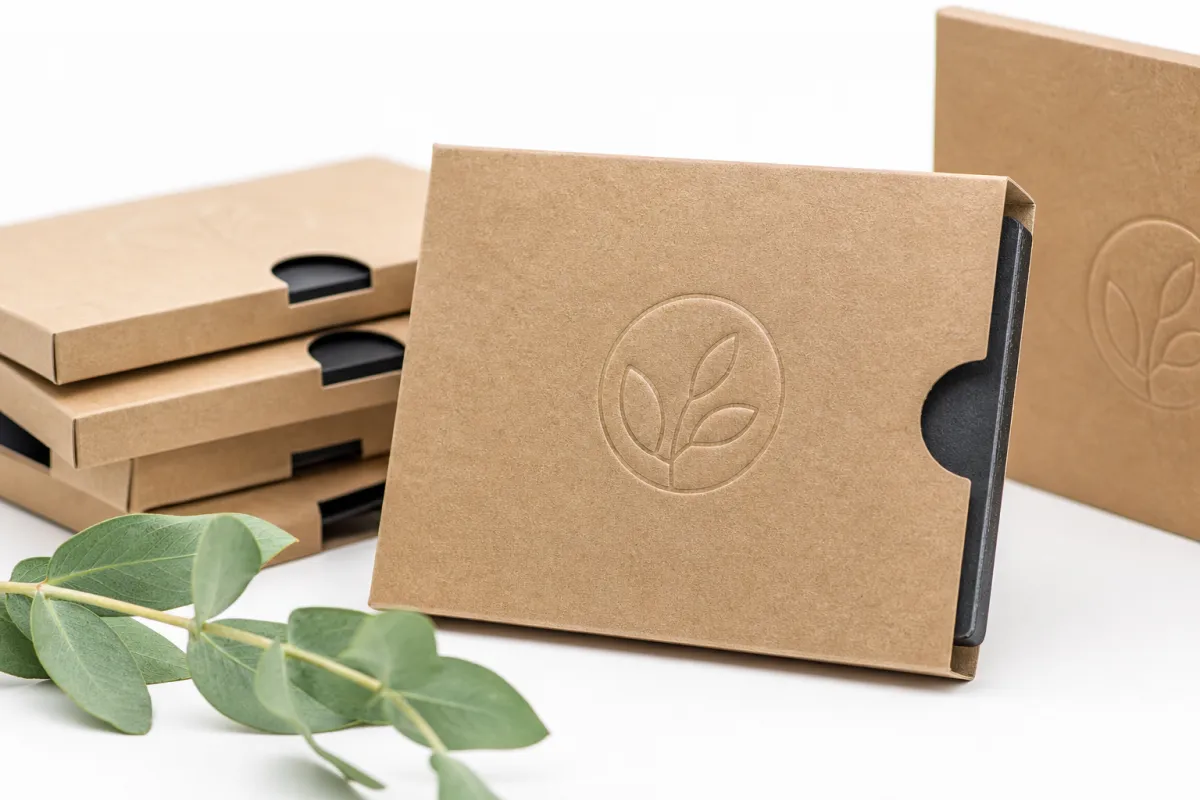
Picture a simple kraft sleeve around a candle box or a soap carton. It does the job, but the package can still fade into the background on a crowded shelf. Press the logo into the fiber surface, though, and the whole piece changes. Embossed kraft sleeves with logo create a small rise or recess in the paper that catches light differently, so the brand reads as more deliberate even before any color is added. That small shift is often the gap between “basic wrap” and “finished presentation.”
Embossing raises the image above the surface, while debossing pushes it inward. Printing works differently because it adds ink rather than moving the material itself. On embossed kraft sleeves with logo, those effects can work together, yet they do not behave the same way. A printed logo gives color contrast. An embossed logo gives texture and shadow. A debossed logo gives a quieter, pressed-in look that can feel more restrained. The right choice depends on whether the package needs visibility, tactility, or both.
Kraft paper suits this kind of branding because the natural fiber structure carries a warm, honest look that works with cleaner design systems. In practice, embossed kraft sleeves with logo fit brands that want a recycled or low-finish aesthetic without appearing unfinished. They show up on food sleeves, cosmetic wraps, candle boxes, retail inserts, subscription mailers, and gift-ready product presentations because they bridge function and presentation so well.
From a packaging buyer’s point of view, the value is not only visual. A tactile logo can make a product easier to remember when customers handle several items in one shopping trip. That does not guarantee a sale, of course, but it does improve the odds that the package feels worth a second look. With embossed kraft sleeves with logo, that second look often starts with the fingertips.
There is a sustainability angle too, and buyers should stay practical rather than romantic about it. Paper-based sleeves can be a smart choice when the construction stays simple and the finish does not introduce unnecessary layers. If the sleeve uses recyclable kraft stock and modest ink coverage, it can support a low-waste story without much drama. The FSC offers useful guidance on responsibly sourced fiber, which is worth checking whenever the packaging brief includes chain-of-custody requirements.
Bottom line: embossed kraft sleeves with logo work best when the brand wants quiet premium cues, honest materials, and a package that still feels useful after the customer has seen it many times in the market.
How Embossed Kraft Sleeves With Logo Are Made
The production path for embossed kraft sleeves with logo usually starts with the dieline, not the artwork. That distinction matters. A sleeve only works if it folds correctly around the product, so the panel sizes, glue flap, score lines, and any opening cutouts need to be settled before the design gets locked in. Once the dimensions are stable, the artwork can be placed with real structure in mind instead of being squeezed into a shape that only looks good on screen.
From there, the print or emboss strategy gets mapped. Some embossed kraft sleeves with logo are printed first and embossed later, which helps when the brand needs a small amount of color or a single spot ink. Others rely on the emboss impression itself as the main branding device, with little or no ink at all. That second approach can be especially effective on natural kraft because the light and shadow from the raised detail do much of the work. It feels clean, restrained, and often more economical than layered decoration.
The embossing tool is the heart of the process. A matched die and counter-die press the paper fibers into a raised or recessed form under controlled pressure. Paper weight matters here. Moisture content matters too. Grain direction matters as well. If the sheet is too light, the detail can flatten or distort. If the paper grain runs against the fold in the wrong way, the sleeve may crack along a score line. Good vendors pay close attention to these details because embossed kraft sleeves with logo depend on crisp fiber response, not just a strong press.
After embossing comes cutting, scoring, folding, and assembly. Clean die-cut edges matter because sleeve fit is unforgiving; a small error can throw off the wrap, make the glue flap misalign, or leave the package looking slightly twisted on the shelf. For embossed kraft sleeves with logo, that fit matters as much as the logo itself. A beautiful emboss on a crooked sleeve still looks like a mistake. I have seen that happen on press checks, and it is never the paper’s fault alone.
Material choice also affects the finish stage. Uncoated kraft gives the most natural appearance and tends to show the emboss detail clearly. Heavier cover stocks or liner boards can improve stiffness and make the sleeve feel more substantial. In some cases, especially for food or high-touch retail use, a light protective coating may be added to improve handling or moisture resistance. The goal is to choose only what the application truly needs, because every added layer changes recycling behavior and can mute the tactile effect that made embossed kraft sleeves with logo appealing in the first place.
For products that will be shipped in cartons or distributed through fulfillment centers, transit testing deserves attention. Packaging teams often refer to ISTA test methods to check how packaging holds up under handling, vibration, and compression. That does not mean every sleeve needs a full test program, but it does mean the structure should be treated like a real package, not just a printed wrap.
Production sequence in plain terms: layout, tooling, proofing, emboss setup, cutting, folding, and final assembly. The better those pieces line up, the better embossed kraft sleeves with logo will look in hand.
Timeline for Embossed Kraft Sleeves With Logo Projects
The timeline for embossed kraft sleeves with logo is usually longer than a simple print-only sleeve, but it stays manageable when the project is planned early. A straightforward run can move through artwork setup, tool creation, proofing, and production in roughly 2 to 4 weeks after approval, while more complex jobs may stretch beyond that if the sleeve needs special coatings, tight color matching, or a custom structural change.
The first stage is usually file review and dimensional confirmation. That is where the supplier checks whether the logo art is sized correctly, whether the artwork sits inside safe areas, and whether the emboss location will interfere with folds or seams. If the sleeve is especially tight around the product, even a few millimeters can matter. That is one reason embossed kraft sleeves with logo should never be ordered from a generic print file without a real dieline review.
Tooling and sampling are the parts that most often surprise buyers. A custom emboss die must be made, and depending on the shop and the size of the mark, that can add a few days and a separate setup charge. After the tool is ready, the first sample or proof run checks depth, registration, fold behavior, and edge alignment. That is the moment to verify that embossed kraft sleeves with logo still look clean after the paper has been pressed and folded, not just before.
Here is the practical rule I would give any packaging team: if the sleeves are tied to a launch, event, or seasonal promotion, build in extra buffer time. Revisions happen. Couriers take time. Production queues fill up. A project that feels quick at the quoting stage can slow down fast if the artwork changes after the emboss tool is already in motion. For that reason, embossed kraft sleeves with logo should be scheduled with the same discipline as cartons or labels, not as a last-minute decorative add-on.
One more point that buyers sometimes overlook: approval timing affects cost. When sample approval drags on, the project may miss a production window and move into a higher-rate slot or a freight-expedite scenario. That is not unique to sleeves, but it shows up often enough to be worth saying plainly. A smooth approval cycle usually saves more money than a small price negotiation ever will.
Useful planning window:
- Artwork and dieline review: 1-3 business days for a clean file, longer if the structure is still changing.
- Emboss tooling and sample prep: 3-7 business days depending on the supplier and tool complexity.
- Production after approval: often 7-15 business days for standard quantities.
- Freight and delivery: add time for transit, customs if relevant, and receiving at your warehouse.
That schedule is not universal, but it is realistic enough to help a buyer plan responsibly. Embossed kraft sleeves with logo reward early coordination; rushed coordination usually shows up in the final finish.
Design and Material Factors That Shape the Result
Material selection is where a lot of sleeve projects succeed or fail. Heavier kraft stock generally holds emboss detail better because the fibers have enough body to take a clean impression without collapsing. Lighter stock can still work, but embossed kraft sleeves with logo on thin material may show softer edges, slight cracking at the fold, or a flatter tactile effect than the design team expected. In practice, something in the 250 to 400 gsm range is often a reasonable starting point, though the right number depends on sleeve size, folding direction, and whether the package needs extra stiffness.
Logo design matters just as much as paper weight. Bold shapes, clean letterforms, and balanced spacing usually emboss more clearly than thin strokes or highly intricate line art. If the artwork is too detailed, the pressure of the emboss can blur the image slightly, especially on textured kraft. That does not mean simple art is boring. Far from it. It often means embossed kraft sleeves with logo can look more expensive when the logo is edited down to its strongest visual elements instead of trying to show every tiny feature at once.
Emboss depth is another meaningful choice. A shallow relief can look elegant and restrained, with just enough shadow to catch the eye. A deeper emboss creates a stronger hand feel and a more obvious visual punch, but it also places more stress on the sheet. For embossed kraft sleeves with logo, the right depth usually depends on the stock and the sleeve geometry. If the product is handled often, a slightly shallower impression may hold up better over time and still look refined.
Finish choices change the character of the sleeve in a very real way. Natural kraft gives warmth and a raw fiber look. Bleached or lighter-toned kraft can make the embossed area pop more clearly, but it also changes the tone of the entire package. Recycled-content boards can support an environmental story, though the surface may be a little less uniform, which affects how sharp the logo reads. The best choice for embossed kraft sleeves with logo depends on whether the brand is aiming for rustic, clean, premium, or utilitarian.
Sustainability should be treated as part of the design brief, not a line item at the end. A sleeve that uses paper-based construction, moderate ink, and no unnecessary mixed materials is easier to explain to a packaging buyer and easier to recover in recycling streams. If the job needs claims or certification language, the supplier should be able to trace the material source and explain whether the stock is certified. That is where documents from organizations like FSC become more useful than marketing language.
A sleeve should do more than wrap a product; it should tell the buyer, with one touch, that the brand paid attention to the details.
That idea is simple, but it is the right lens for embossed kraft sleeves with logo. The material, the artwork, and the folding structure should all support the same message. If one part feels cheap, the whole sleeve loses credibility.
Cost and Pricing for Embossed Kraft Sleeves With Logo
Pricing for embossed kraft sleeves with logo is shaped by a handful of predictable variables: stock choice, sleeve size, artwork complexity, emboss tooling, print setup, finishing, and quantity. If a project has one logo impression on a standard kraft stock, the cost structure is usually much cleaner than a design with multiple inks, foil, spot UV, and custom structural features. More effects can be attractive, but each layer adds time and setup.
Tooling is often the first cost buyers notice, and for good reason. A custom emboss die can add a meaningful upfront charge, often somewhere in the low hundreds depending on size and detail. That cost is easy to feel on a small run, but it becomes easier to absorb as volume goes up. This is why embossed kraft sleeves with logo usually make the most financial sense when the buyer has a realistic quantity forecast, not just a one-time need.
For rough budgeting, a simple project might come in around $0.18 to $0.35 per unit at several thousand pieces, while more complex sleeves with heavier stock, tighter tolerances, or print-plus-emboss combinations can rise from there. Small orders often cost more per unit because the setup cost is spread across fewer pieces. That does not make small runs a bad idea. It just means embossed kraft sleeves with logo should be priced with the total project structure in mind, not only the piece price.
Need a cleaner way to compare options? This table gives a practical view of how different sleeve approaches usually stack up.
| Option | Typical Use | Cost Pressure | Notes |
|---|---|---|---|
| Plain kraft sleeve | Basic wrapping and product bundling | Lowest | Good for simple presentation, but limited brand impact |
| Printed kraft sleeve | Logo, message, or color branding | Moderate | More setup than plain stock, strong for visual clarity |
| Embossed kraft sleeves with logo | Tactile premium packaging and restrained branding | Moderate to higher | Tooling adds upfront cost, but the tactile effect often justifies it |
| Print plus emboss | Premium retail, gift, and launch packaging | Highest | Best for stronger shelf presence, but setup and registration are more demanding |
There are a few hidden drivers worth watching. Tight registration between print and emboss can increase setup time. Food-contact expectations may require specific stocks or coatings. Rush schedules can force expedited freight or overtime on press time. If the sleeve needs a very clean fit around the product, tolerance requirements can become stricter, which affects how much labor is needed to get the job right. None of these issues are unusual, but they do change the final number for embossed kraft sleeves with logo.
The best budgeting habit is to separate the quote into three buckets: prototype or sample cost, one-time setup cost, and run cost. That makes it easier to see what changes with quantity and what stays fixed. A buyer who understands that structure can compare suppliers fairly, and more importantly, can tell whether embossed kraft sleeves with logo fit the product margin before the order is placed.
Step-by-Step Guide to Ordering Embossed Kraft Sleeves With Logo
The cleanest orders start with the product itself. Before any artwork is discussed, the buyer should measure the carton, jar, tin, tray, or box the sleeve will wrap. Length, width, depth, seam location, and any opening tab all affect the dieline. With embossed kraft sleeves with logo, structure is not a background detail; it is the base that decides whether the sleeve feels crisp or sloppy.
- Gather dimensions. Measure the product carefully, including the areas that will be hidden or exposed once the sleeve is wrapped.
- Prepare artwork. Supply vector logo files, color references, and any copy that needs to appear on the sleeve.
- Choose the tactile treatment. Decide whether the logo should be embossed, debossed, or paired with print.
- Request a dieline. Build the design around the actual structure instead of guessing panel sizes.
- Review the proof. Check fold lines, safe areas, logo placement, and emboss scale at full size.
- Approve a sample. Handle the physical sample whenever possible so you can judge texture, stiffness, and fit.
- Confirm quantity and timing. Lock the order size around launch needs, storage space, and reorder expectations.
That sequence sounds basic, but it prevents most of the expensive mistakes I see on sleeve jobs. If the logo is approved before the structure is checked, the sleeve may end up too busy or too small. If the structure is approved before the physical sample is reviewed, the fold behavior may surprise the buyer. With embossed kraft sleeves with logo, the order only feels simple after the proof and sample stages have both been respected.
Good briefs also name the finish preference clearly. “Natural kraft” is helpful but not enough. A supplier needs to know whether the brand wants a rougher recycled look, a tighter premium grain, a fully uncoated surface, or a light protective treatment for handling. The more concrete the brief, the easier it is to make embossed kraft sleeves with logo that look right the first time.
One more ordering tip: ask how the sleeve will be packed for shipment. A flat-packed sleeve can save space, but it still has to hold its score lines and embossed detail after transit. A well-designed sleeve can survive that journey, yet it is worth confirming whether the final pack-out aligns with your warehouse setup. The best sleeve is not only attractive; it is easy to receive, store, and use.
If the project is for a launch, I would also recommend a simple checklist before release: confirm measurements, approve the proof, verify the sample, check the production window, and only then release the final quantity. That keeps embossed kraft sleeves with logo tied to the business plan instead of forcing the business to react to the packaging.
Common Mistakes With Embossed Kraft Sleeves With Logo
The most common error is choosing stock that is too light for the design. Thin kraft can look fine in a mockup, then lose definition once the emboss pressure hits it. It may also crease too easily along the folds. If embossed kraft sleeves with logo need a strong tactile impression, the stock has to be chosen for that purpose, not just for the lowest quote.
Another frequent mistake is overcomplicating the logo artwork. Fine lines, tiny text, and crowded detail often blur once the paper fibers are compressed. That is especially true on natural kraft, which already has visual texture of its own. A cleaner mark usually performs better. The same is true for embossed kraft sleeves with logo that combine print and emboss; too much information can make the sleeve look busy instead of premium.
Skipping the physical sample is a risk, and not a small one. A PDF can show placement, but it cannot show how the paper feels in hand, how the emboss catches light, or how the sleeve behaves when it is folded around the actual product. That is where buyers often get tripped up. The sample is the truth test for embossed kraft sleeves with logo, especially when the package needs to travel through retail, shipping, or repeated handling.
Another issue is adding unnecessary coatings or laminations in the name of “protection” without thinking through the recycle path. Sometimes that extra layer is justified, especially for moisture or grease resistance. Often it is not. If the package is meant to look natural and paper-forward, a heavy film can work against the brief and weaken the tactile effect that makes embossed kraft sleeves with logo stand out.
Lead time is the last big mistake, and it causes a chain reaction. If the buyer underestimates the schedule, proofs get rushed, sample approval gets compressed, and freight choices get more expensive. That pressure usually lands on the final quality. A better approach is to plan with a cushion. The packaging never gets easier once the launch date is fixed, so embossed kraft sleeves with logo should be treated as an early production task, not a late design flourish.
- Avoid thin stock if the emboss needs depth or the sleeve will be handled heavily.
- Avoid crowded artwork if the logo must remain readable after compression.
- Avoid skipping samples when fit, texture, or shelf appearance matter.
- Avoid unnecessary layers if recyclability and fiber feel are part of the brief.
- Avoid compressed schedules unless everyone involved agrees on the risk.
Expert Tips and Next Steps for Embossed Kraft Sleeves With Logo
My strongest advice is to let the embossing support the brand message instead of treating it like ornament. A well-placed logo impression can say “careful” or “crafted” without shouting. That is the real strength of embossed kraft sleeves with logo: the design can feel premium while staying grounded in paper, structure, and restraint.
Negative space matters more than many teams expect. Kraft paper already carries texture, so a sleeve packed with copy, icons, and multiple callouts can start to feel crowded fast. A disciplined layout with a strong logo mark usually performs better. In retail lighting, on a product photo, and in a customer’s hand, embossed kraft sleeves with logo tend to look strongest when the composition gives the eye room to rest.
It also helps to test how the sleeve reads in different settings. A texture that looks subtle on a desk can become much more visible under bright store lighting. The same sleeve may feel understated in a product image but surprisingly rich in hand. That variability is not a defect; it is part of why embossed kraft sleeves with logo can be such an effective packaging choice. Tactile design always has a physical presence that flat graphics cannot fully duplicate.
For teams planning a launch, here is a simple sequence that keeps the project moving:
- Lock the product dimensions.
- Decide whether the logo should be embossed only or paired with print.
- Request the dieline and build the art around it.
- Review the proof with the sleeve folded in mind, not just flat.
- Approve the sample before release.
- Confirm quantity based on launch demand and reorder plans.
That checklist may sound practical to the point of being plain, but plain is often what keeps packaging projects on track. Buyers who handle embossed kraft sleeves with logo well tend to treat them like part of the product system, not like decoration added at the end. That mindset usually leads to better fit, better cost control, and a more convincing shelf result.
If you are getting ready to spec a sleeve, the next move is straightforward: gather product measurements, define the logo treatment, ask for a material sample, and request a quote based on a realistic quantity. With those pieces in hand, embossed kraft sleeves with logo become much easier to evaluate, and the final choice is usually clearer than the first round of concept sketches suggests.
For brands that care about presentation, recyclability, and a tactile first impression, embossed kraft sleeves with logo remain one of the simplest ways to make a paper package feel finished without overcomplicating the structure. That is why they keep showing up on retail shelves, gift sets, and subscription products: they do a lot with very little.
FAQ
Are embossed kraft sleeves with logo recyclable?
Yes, they can be recyclable when they use paper-based construction and avoid plastic-heavy coatings or mixed materials. The most recyclable versions usually stay simple: kraft stock, minimal ink, and no extra laminate unless the application truly needs it. For embossed kraft sleeves with logo, the cleaner the material mix, the easier the recovery path usually is.
How much does embossed kraft sleeves with logo pricing depend on quantity?
Quantity matters because emboss tooling and setup costs are spread across the run, so larger orders usually lower the per-unit cost. Small runs can still work for launches or limited editions, but the unit price is typically higher because the setup is the same. That is a normal part of pricing embossed kraft sleeves with logo.
What logo styles work best on embossed kraft sleeves with logo?
Bold marks, clean type, and simple icon shapes usually emboss more clearly than tiny text or intricate line art. If the logo has fine details, consider simplifying the artwork so the texture reads well on kraft paper after compression. That adjustment often helps embossed kraft sleeves with logo look sharper and more intentional.
How long does the process take for embossed kraft sleeves with logo?
Lead time usually includes artwork setup, tooling, proofing, sample approval, production, and shipping, so the total depends on complexity. Adding a custom emboss die or requesting revisions can extend the timeline, so it helps to plan early and approve quickly. That is especially true for embossed kraft sleeves with logo tied to a launch date.
Do embossed kraft sleeves with logo work for food or cosmetic packaging?
Yes, they are commonly used for food, candles, skincare, and gift packaging when the sleeve size, material, and finish match the product needs. For food or skin-contact applications, confirm material compliance, grease resistance, and any coating or liner requirements before ordering. A supplier should be able to explain whether embossed kraft sleeves with logo fit the application safely and practically.
Related packaging resources
Use these related guides to compare specs, costs, quality checks, and buyer decisions before making the final call.


