Buyer Fit Snapshot
| Best fit | Embossed Logo Packaging Boxes projects where brand print, material claims, artwork control, MOQ, and repeat-order consistency need to be specified before quoting. |
|---|---|
| Quote inputs | Share finished size, material target, print colors, finish, packing count, annual reorder estimate, ship-to region, and any compliance wording. |
| Proofing check | Approve dieline scale, logo placement, barcode or warning zones, color tolerance, closure strength, and carton packing before bulk production. |
| Main risk | Vague material claims, crowded artwork, missing packing details, or unclear freight terms can make a low unit price expensive after revisions. |
Fast answer: Embossed Logo Packaging Boxes: Board, Finish, Dieline, and Unit Cost should be specified like a repeatable production item. The safest quote records material, print method, finish, artwork proof, packing count, and reorder notes in one written spec.
Production checks before approval
Compare the actual filled-product size with the drawing, then confirm tolerance on folds, seals, hang holes, label areas, and retail display edges. Reserve space for logos, QR codes, warning copy, and material claims before decorative graphics fill the panel.
Quote comparison points
Review material grade, print process, finish, sampling route, tooling charges, carton quantity, and freight assumptions side by side. A quote is only useful when the supplier can repeat the same color, closure quality, and packing count on the next order.
Embossed Logo Packaging Boxes: A Practical Brand Guide
Embossed logo packaging boxes do one thing exceptionally well: they make a package feel designed the moment someone picks it up. A plain carton can look polished in a mockup and still feel ordinary in hand. Raised lettering changes that. Light catches the surface, the logo gains shadow, and embossed logo packaging boxes move the brand from background noise into something people notice without being told to notice it. For many buyers, embossed logo packaging boxes are the fastest route from ordinary packaging to something that feels deliberately made.
What Embossed Logo Packaging Boxes Actually Do
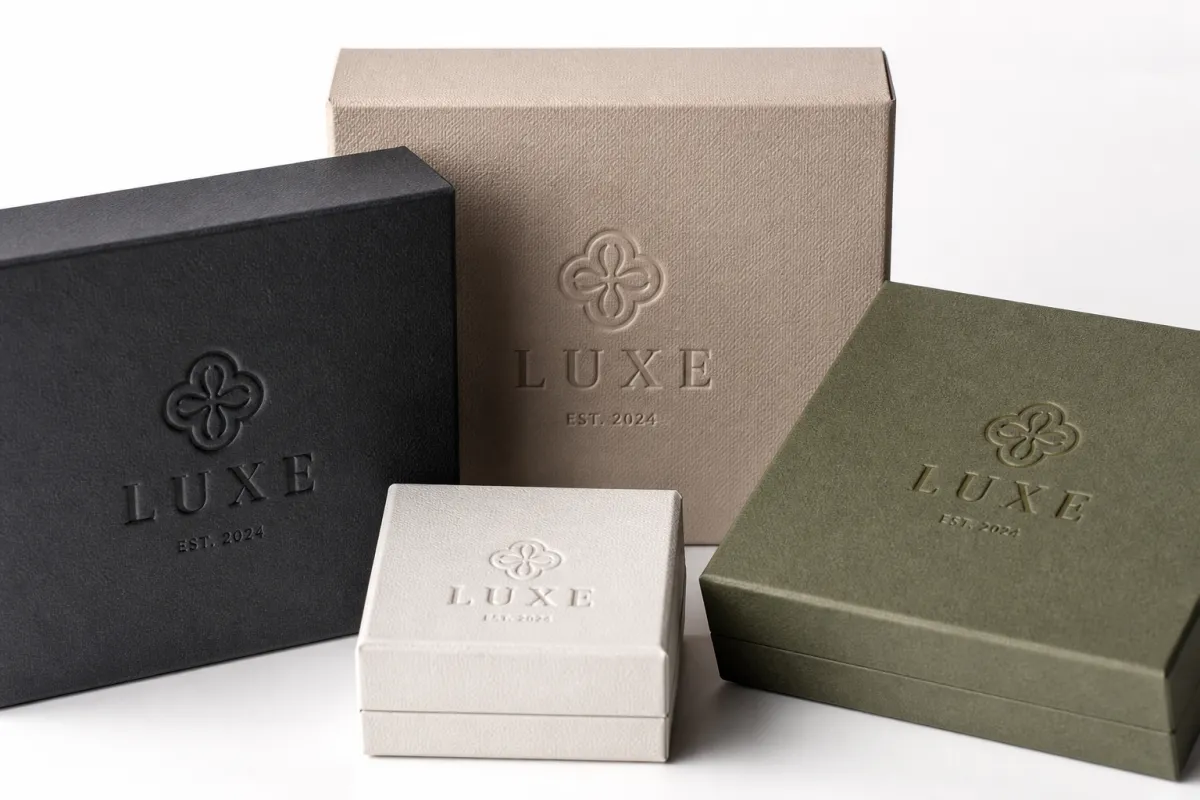
There is a familiar packaging problem: the box looks neat, but it could belong to almost any brand. Then a raised logo catches the light, the surface changes under your fingers, and the package stops feeling generic. That tactile shift matters more than most buyers expect. Embossed logo packaging boxes are not just ornament. They are a physical cue that the brand paid attention all the way through the last detail.
Embossing means pressing the logo up from the surface of the board or paperboard so it forms a raised texture. The mark is not simply printed on top; it is shaped into the material. That depth creates a shadow line, and shadow does a lot of the visual work here. Good embossing gives a premium impression without relying on loud ink coverage or a crowded layout. For brands that want restrained package branding, that quiet confidence is the whole appeal.
Embossed logo packaging boxes fit especially well with luxury retail, cosmetics, candles, gift sets, subscription boxes, and Product Packaging That benefits from a slower reveal. A full-gloss graphic can feel aggressive. A raised logo feels deliberate. If the brand story leans on craft, restraint, or higher perceived value, embossing usually supports that story more convincingly than another layer of color. Ink can only mimic depth so far. Texture does the rest.
Practical rule: embossed logo packaging boxes should make the box feel more expensive in hand, not merely different in a render.
The tradeoff is straightforward. Embossing is quieter than a full-color design, but that restraint is often what makes the result feel expensive. A strong logo gets stronger. A weak logo gets exposed. Texture does not rescue poor hierarchy. It simply reveals the design as it is, which is why packaging decisions need to account for the product, the shelf, and the unboxing moment instead of the screen alone.
For a buyer, the question is not whether embossing can improve a box. Of course it can. The real question is whether embossed logo packaging boxes support the right perception for the product price, sales channel, and customer expectation. A $12 candle and a $120 serum should not wear the same packaging logic, even if both want to feel elevated.
How Do Embossed Logo Packaging Boxes Improve Brand Perception?
They improve brand perception by making the box feel intentional before the product is even opened. Embossed logo packaging boxes add texture, light, and a clear sense of craft, which helps customers read the package as higher value. That matters in retail packaging, where shoppers compare products quickly and form opinions from touch, not just color.
The effect is partly psychological and partly physical. A raised mark signals effort. It also slows the hand for a second, which gives the brand a little more time to register. In categories crowded with similar cartons, embossed logo packaging boxes can create the difference between a package that disappears on shelf and one that gets remembered after the purchase.
I have seen that happen at press checks. A logo that looked clean on screen suddenly gained presence the moment the die hit the board and the light raked across it. The difference was not dramatic in a flashy way. It was sharper, quieter, and somehow more expensive-looking. That kind of change is easy to miss on a monitor and obvious in the hand.
How Embossed Logo Packaging Boxes Are Made
Embossed logo packaging boxes begin with tooling. A metal die and a matching counter-die press the logo into the material so the shape rises above the surface. Pressure, board thickness, and finish all affect how crisp the result looks. A logo with clean vector edges and enough line weight usually embosses sharply. A logo packed with tiny detail often loses definition once the press starts working. The machine does not care how pretty the artwork looked on a monitor, which is why embossed logo packaging boxes reward disciplined artwork more than decorative complexity.
Two versions come up most often. Blind embossing creates texture only, with no ink or foil in the raised area. It is subtle and often the cleanest option for embossed logo packaging boxes. Foil embossing combines the raised impression with metallic foil, adding shine and contrast. That can help retail packaging stand out under store lighting, but it also moves quickly toward excess if the design is already busy.
Material choice Shapes the Final result more than many buyers realize. Rigid board usually produces the cleanest raised effect because it has enough body to hold the form. Folding carton stock can work well for lighter product packaging, especially when the design stays simple and the board has enough caliper. Kraft can emboss nicely, though its natural texture can soften fine detail. Coated paperboard often delivers the sharpest edges, while heavily textured paper can blur the impression. Crisp embossing starts with a surface that cooperates.
Here is a practical production flow for embossed logo packaging boxes:
- Artwork prep in vector format, usually AI, EPS, or PDF.
- Die creation for the emboss plate and counter-plate.
- Digital mockup or layout proof to confirm position and size.
- Physical sample or pre-production proof for depth and alignment.
- Production, embossing, finishing, inspection, and packing.
- Shipping, often after a final quality check against approved specs.
The steps that sound quick are not always the ones that control the schedule. Embossing itself moves fast once tooling exists. The slower parts are artwork cleanup, die making, sample approval, and any change to structure or finish after proofing. A project can lose several days because someone decides the logo should be 8 percent larger after the sample is already in motion. That is how timelines get messy, and why embossed logo packaging boxes need a final approval point before production starts.
Simple jobs with standard materials can move in roughly 12 to 15 business days after proof approval, depending on queue and freight. More complex embossed logo packaging boxes, especially rigid boxes with special coatings or inserts, can stretch into 3 to 5 weeks. If a supplier says tooling is included, ask what that actually covers. Die work, counter-die work, and sample rounds are different line items, and those details decide whether the schedule stays reasonable.
If the goal is a soft premium feel, embossed logo packaging boxes usually pair best with materials that hold pressure well and finishes that do not fight the texture. Soft-touch laminate can look refined, though it may reduce sharpness if the board or artwork is off. A good supplier should flag that early, before a weak material choice turns into a costly rerun. Production rarely rewards wishful thinking, and embossed logo packaging boxes are no exception.
For sourcing standards and material claims, I prefer independent references over brochure language. The FSC certification site helps clarify responsible fiber sourcing, and the ISTA testing framework is worth reviewing if the box needs to survive shipping stress, stacking pressure, and the occasional rough handoff.
What Affects Embossed Logo Packaging Boxes Pricing
Pricing for embossed logo packaging boxes usually has little to do with embossing alone. Setup, tooling, board choice, finish selection, and order quantity do most of the lifting. Small runs feel expensive because the fixed costs do not shrink just because the order is small. A logo die, sample set, and press setup still happen whether the order is 500 boxes or 10,000. In other words, embossed logo packaging boxes are priced by process as much as by decoration.
At lower quantities, tooling can matter more than unit price. If a customer wants a simple raised logo on 300 boxes, the per-unit number can look high because the one-time cost gets spread over fewer pieces. At 3,000 or 5,000 units, that same tooling becomes far easier to absorb. That is one reason embossed logo packaging boxes often make more sense once the brand has some volume. The math is plain, even when the quote is not.
Design complexity also Changes the Quote. Large, bold logos are easier to emboss cleanly. Tiny serifs, hairline strokes, crowded icons, and nested details increase the chance of a soft or muddy impression. If the die needs extra care or multiple proofs, the price rises. Strong package branding is usually simple enough to survive pressure. If the artwork needs a microscope, the press will probably punish it.
Material choice pushes cost in both directions. Thicker, smoother, higher-grade boards usually hold a better emboss, but they are not the cheapest option. Kraft paper can lower cost in some cases, although it may soften detail. Coated artboard often gives the cleanest finish, especially for retail packaging where the raised logo needs to stand out under store lighting. If the brand wants a more premium feel, the substrate cannot be an afterthought.
| Option | Typical Use | Setup Cost | Unit Cost at 5,000 pcs | Notes |
|---|---|---|---|---|
| Blind emboss on rigid board | Luxury gift boxes, cosmetics, premium kits | Moderate | $0.28-$0.65 | Clean, tactile, understated; best with simple logos |
| Foil emboss on coated paperboard | Retail packaging, holiday sets, visible shelf impact | Moderate to high | $0.22-$0.55 | More visual contrast; foil can hide some detail if overused |
| Emboss plus spot UV | High-impact product packaging and presentation boxes | High | $0.35-$0.80 | Needs careful proofing; extra effects can look busy fast |
Those numbers are ranges, not promises. Freight, inserts, structure style, coating, and proof rounds all shift the total. Extra proofs are a common hidden cost, especially when a buyer changes the logo size after the first sample. Rush production is another easy way to make the invoice awkward. If a supplier has to pull a rush slot or ship air freight, the “cheap” quote stops being cheap very quickly. For embossed logo packaging boxes, the final number often reflects logistics more than the emboss itself.
My rule is blunt: compare total landed cost, not just the unit quote. Embossed logo packaging boxes that look inexpensive on paper can become costly once tooling, shipping, correction rounds, and insert work are added. If a quote leaves out the boring line items, assume they are not gone. They are just waiting to show up later.
For buyers comparing Custom Packaging Products, the best quote is rarely the lowest one. The best quote is the one that separates tooling, materials, finishing, and freight so you can see where the money is actually going.
Step-by-Step Ordering Process for Embossed Logo Packaging Boxes
The ordering process should begin with a useful brief, not a vague wish. State what the box is for, what the product weighs, what size it needs to hold, how premium it should feel, and what the budget ceiling is. If the emboss should be subtle, say that. If it needs to read clearly in retail packaging, say that too. Embossed logo packaging boxes are easier to get right when the supplier does not have to decode your brand personality from a mood board and guess the rest. A clear brief also helps embossed logo packaging boxes stay on budget and on schedule.
Artwork prep is where many problems start. Embossing likes clean vector files, simple outlines, and consistent line weight. If the logo has tiny type or uneven paths, the die maker has to simplify it or the press will distort it. I prefer to see the emboss artwork isolated from the print artwork so no one confuses the raised area with a standard print layer. Cleaner files mean fewer chances for the sample to come back looking awkward.
Proofing should happen in layers. A digital mockup confirms placement, size, and orientation. A physical sample shows how the board reacts, how deep the impression feels, and whether the logo looks sharp under real light. That second step is the one people skip when they want to save time. Then the finished embossed logo packaging boxes feel flatter than expected. Paper behaves differently in real life. That detail keeps surprising teams that only look at renders.
Here is the approval sequence that usually keeps a job under control:
- Confirm structure, dimensions, and insert needs.
- Approve logo size, placement, and emboss depth direction.
- Confirm coating, laminate, or foil choice if used.
- Review physical sample or production proof.
- Sign off on final tooling and full production.
Production is usually straightforward after approval. Tooling happens first, then material sourcing, then embossing, then finishing, then inspection, then final packing. The speed of the project often depends on how standard the box structure is. A simple tuck-end folding carton moves faster than a rigid setup with magnetic closures and custom inserts. That is not a judgment. It is just how production works, and it is why embossed logo packaging boxes need the structure decided early.
If you are comparing options and want to keep the process practical, it helps to look at the box style before falling in love with the emboss. For many brands, Custom Packaging Products give enough flexibility to choose a structure that supports the raised logo instead of fighting it. That is a better move than forcing a beautiful effect onto the wrong box.
Timelines are easier to predict when the artwork is already final. Standard structures with ready-to-go vector files can move quickly. Custom structures, special coating combinations, or a late request to shift the logo by a few millimeters can add several business days. That is why a sensible supplier asks questions up front instead of nodding politely and creating headaches later.
Common Mistakes That Ruin the Embossed Effect
The quickest way to ruin embossed logo packaging boxes is to overcomplicate the logo. Too much detail turns into a soft, muddy patch once pressure hits the board. Thin fonts, intricate line art, and tiny decorative marks are the usual suspects. A raised logo needs breathing room. If the mark only looks good when zoomed in on a screen, it is probably too fussy for embossing. That is the point where embossed logo packaging boxes stop looking premium and start looking crowded.
Weak board choice is another common problem. Thin or flimsy stock collapses under pressure and loses the crisp edge that makes embossing feel premium. The result is a dull impression that looks tired instead of elevated. If the board cannot hold shape, the emboss is gonna look flat. That is a bad trade, especially for branded packaging that is supposed to justify the price point.
Placement matters more than people expect. Put the emboss too close to a fold, seam, glue flap, or edge, and the material can distort or crack. On rigid boxes, bad placement can also interfere with assembly. On folding cartons, it can create an impression that looks uneven once the box is folded and shipped flat. Good packaging design leaves the emboss in a stable area, not in a structural danger zone.
Another mistake is assuming embossing can rescue a weak brand system. It cannot. A bad logo, sloppy spacing, and awkward proportions still look bad with texture added. Embossed logo packaging boxes are not magic. They make the existing design more visible, which is why the foundation has to be right before anyone starts picking finishes. If the identity is weak, embossed logo packaging boxes will simply expose the weakness faster.
Finish selection can also flatten the effect. Some laminations and coatings reduce contrast or soften the raised edge. That does not mean finishing should be avoided. It means the finish has to support the emboss, not bury it. If the surface is too glossy, the relief can disappear under reflections. If the surface is too soft and thick, the edges can lose sharpness. There is a reason sample boards exist.
Short version: if the artwork is busy, the board is weak, or the finish is fighting the impression, embossed logo packaging boxes will look more expensive in the spec sheet than in the hand.
Expert Tips for Better Embossed Logo Packaging Boxes
Keep the logo bold. That is the easiest advice and still the one people ignore most often. Embossing rewards strong shapes, clear spacing, and confident lines. It punishes fussy design. If the mark can be recognized from across a room and still read at arm’s length, it is probably a good emboss candidate. If it needs a caption, simplification should happen first. That rule holds especially true for embossed logo packaging boxes used in retail packaging.
Use surface contrast strategically. Matte, soft-touch, and uncoated surfaces often make embossed logo packaging boxes feel more premium because the raised area catches light against a calmer background. That contrast is subtle, but it does the work. The box does not need to shout. It only needs enough difference for the eye and hand to register it. Quiet can be expensive.
Test the logo at real size under real lighting. A mark that looks perfect on a monitor can disappear in dim retail conditions or glare under display lights. That is especially true for blind embossing on lighter colors. If possible, check the sample from different angles and at different distances. A good emboss should still read when the customer is not staring directly at it like a quality inspector.
Think carefully before stacking effects. Foil stamping, spot UV, embossing, debossing, and heavy print coverage can all work together, but only if each effect has a reason for being there. If the goal is a quiet luxury look, too many effects will make embossed logo packaging boxes look busy instead of refined. The smartest packaging choices usually stop one step earlier than the excited marketing meeting wanted.
A simple comparison helps:
- Blind emboss for restraint and tactile depth.
- Foil emboss for contrast and shelf visibility.
- Emboss plus spot UV for selective shine, but only with strong artwork discipline.
Choose the box style around the emboss, not the other way around. A rigid setup may be the right home for a premium cosmetics kit, while a lighter folding carton may suit a retail SKU that needs efficient shipping. When the structure supports the logo, the package feels intentional. When the structure fights it, the result feels like a compromise dressed up as a strategy.
For practical product packaging, handling matters too. Will the box be opened once and displayed, or shipped, stacked, and opened repeatedly? If the box gets handled often, embossed logo packaging boxes need enough board strength and finish durability to keep the raised mark looking sharp. A beautiful sample is nice. A beautiful sample that survives distribution is better, and embossed logo packaging boxes should be judged on that standard.
One more thing: ask for a sample before committing to full production. That sounds obvious, yet it is still skipped. The sample shows whether the emboss depth is too shallow, whether the logo is too small, and whether the finish works with the board. It is the cheapest way to catch the expensive mistake.
What to Decide Before You Order Embossed Logo Packaging Boxes
Before placing an order, lock the basics down. You need box size, material, logo placement, emboss depth direction, quantity, finish, and target budget. If those decisions are vague, the quote will be vague too. Vague quotes are how projects drift. Embossed logo packaging boxes are much easier to buy when the supplier knows what the job is supposed to do, not just what it is supposed to look like. That clarity also helps embossed logo packaging boxes arrive with fewer surprises.
Ask useful questions. What board does the supplier recommend for the emboss? Is a die required, and is it reusable for repeat orders? How many proof rounds are included? How long does tooling take? What happens if the sample needs a second adjustment? Those questions expose whether a vendor understands production or just likes to say “premium” a lot.
If budget gets tight, decide what matters most. Do you want a larger logo, better board, faster lead time, or extra finish details? Usually, all four cannot be maximized at once without paying for the privilege. In practice, the best embossed logo packaging boxes often come from making one strong choice instead of five half-choices. A clean logo on better board usually beats a cluttered design with too many extras.
It also helps to map the risk. If the product is a first launch, choose the least risky version first: simple artwork, stable material, and a finish that will not interfere with the emboss. Once the product proves itself, the packaging can become more ambitious. That path is more sensible than spending too much on a concept that has not earned its budget yet.
If you are still narrowing structure and finish options, browse Custom Packaging Products and compare what each format can realistically support. Some box styles are naturally better for rigid premium presentation, while others work better for efficient shipping and lighter product packaging. The box should serve the emboss, not bully it into the wrong shape. That is especially true when the goal is embossed logo packaging boxes That Feel Premium without becoming fragile.
The best embossed logo packaging boxes are the ones that fit the product, survive production, and look intentional in hand. That is the whole job. Not more. Not less.
FAQ
Are embossed logo packaging boxes worth it for small orders?
Yes, if the box is part of the brand experience and you want a premium look without loud graphics. Small orders do cost more per unit because tooling and setup get spread across fewer boxes. If the budget is tight, keep the logo simple and avoid stacking too many finishing effects. That usually gives the best return for embossed logo packaging boxes without turning the order into an expensive experiment.
What is the difference between embossing and debossing on packaging boxes?
Embossing raises the logo above the surface, while debossing presses it inward. Embossing usually feels more tactile and noticeable under light, especially on rigid or thicker board. Debossing can look cleaner and more understated when the brand wants a minimal, low-gloss feel. Both can work well in branded packaging if the artwork and material are chosen properly.
How long do embossed logo packaging boxes usually take to produce?
Simple projects can move quickly if the material is standard and the artwork is ready in vector format. Tooling, sampling, and proof approval are the main timeline drivers, not the embossing itself. Custom structures, complex artwork, or rush changes usually add the most delay. For many embossed logo packaging boxes, a realistic range is about 12 to 15 business days after proof approval, then shipping on top of that.
What materials work best for embossed logo packaging boxes?
Thicker rigid board and quality paperboard usually hold the cleanest emboss. Very thin stock can flatten or warp, which makes the logo look soft or uneven. Smooth surfaces show detail well, while heavily textured surfaces can reduce sharpness. The better the board supports pressure, the better embossed logo packaging boxes tend to hold their shape in hand.
Can embossed logo packaging boxes include foil or spot UV?
Yes, but only when the extra finish supports the design instead of competing with it. Foil adds shine and contrast, while spot UV adds selective gloss on top of the raised area. The more effects you combine, the more you need to test the sample before committing. If the goal is premium packaging rather than decorative noise, embossed logo packaging boxes should use those effects with restraint.
Actionable takeaway: simplify the logo, choose the board that can hold the impression, request a physical sample under real lighting, and only approve production once the raised mark still reads cleanly from a few angles. That is the shortest path to embossed logo packaging boxes that feel deliberate instead of merely decorated.


