Embroidered Beanies Print Method Comparison for Buyers
An embroidered beanies Print Method Comparison gets complicated fast because a beanie is not a flat canvas. Knit stretches, seams shift, cuffs fold, and those changes can affect how a logo reads once it is worn. The same artwork can look crisp in embroidery, softer as a patch, or less stable as a transfer print if the fabric moves.
For buyers, the real question is not which decoration looks best on a mockup. It is which method holds up on the actual cap at the right cost, MOQ, Lead Time, and inspection standard.
A beanie mockup can be flattering in exactly the wrong way. The real test is whether the logo still reads clearly after the knit stretches, the cuff folds, and the product gets worn.
Embroidered Beanies Print Method Comparison: What Actually Changes the Result
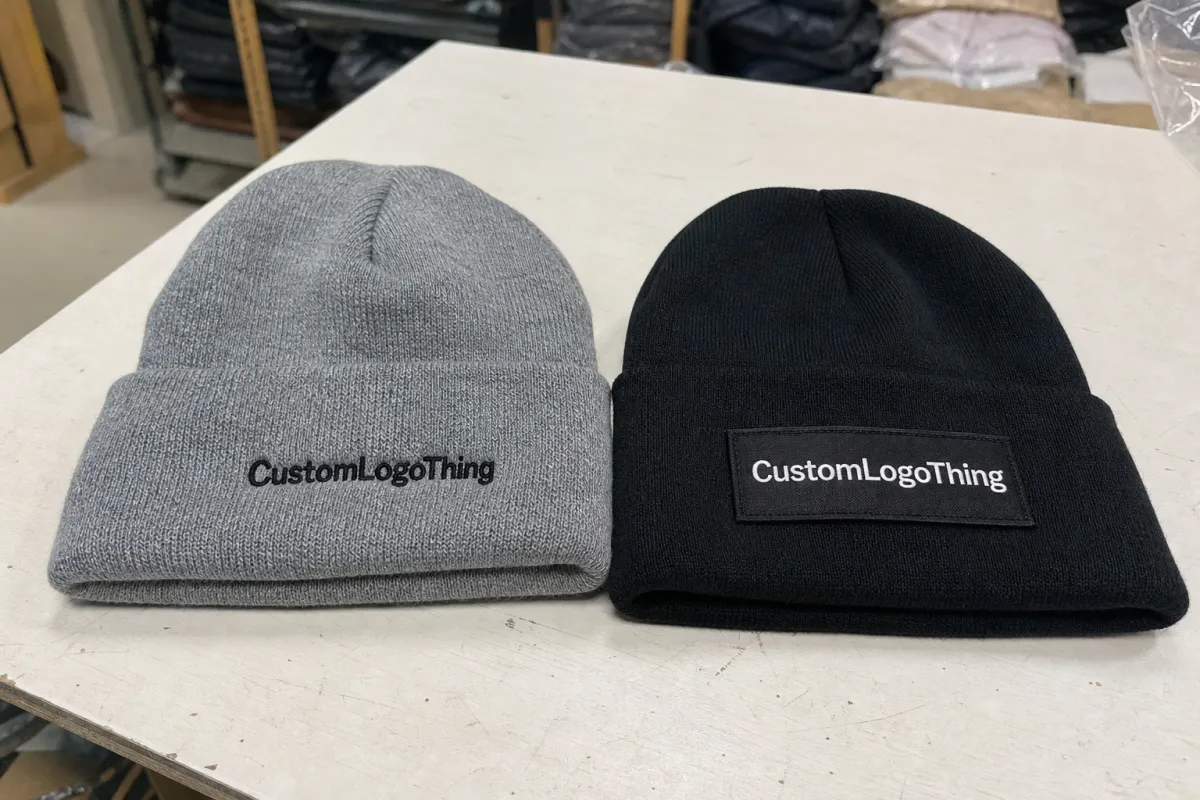
The biggest mistake buyers make is treating the logo as the only variable. On a knit cap, the fabric structure matters just as much as the decoration method. Ribbing can swallow thin strokes, loose gauge can soften edges, and a seam through the placement area can split a design into uneven planes.
That is why the best method depends on the program. Retail orders usually want a clean, premium look. Uniform buyers tend to care more about repeatability and wash resistance. Promo buyers often prioritize budget and fast approval. The best choice is the one that survives production without damaging the brand mark.
Distance matters too. A logo that looks strong up close can fall apart from a few feet away if it is too small, too thin, or too busy. The comparison is not about which method is best in general. It is about which one preserves clarity on a stretched, textured beanie.
How Embroidery, Transfer Print, and Patches Behave on Knit Fabric
Embroidery builds shape with thread
Embroidery creates a raised structure by stitching directly into the fabric. That gives it dimension and a premium feel, especially on simple logos, initials, and short wordmarks. The tradeoff is detail. Thin serifs, tiny counters, and fine gradients do not translate well because stitches have width and density. A logo that looks elegant in vector form may need simplification before digitizing.
On beanies, that simplification is part of the process. Dense fills can make a cap stiff in the decorated area, and very small text may close up as the knit relaxes. Good embroidery on a beanie usually relies on a clean outline, enough negative space, and a stitch plan that respects stretch.
Transfer print places ink or film on top of the knit
Direct screen print is uncommon on many beanies because the surface is uneven, but transfer methods are used often. That can include heat-applied printed graphics, digital transfers, or similar film-based applications. Knit texture makes any print behave less predictably than it would on a smooth tee. Stretch can distort shapes slightly, and heavier layers can feel stiff.
Transfers can work well for small runs, tight deadlines, or artwork that is too detailed for embroidery. They are especially useful when the graphic has fine lines, gradients, or multiple colors that would drive stitch count too high. The main caution is wear: repeated folding, abrasion, and washing can expose edge lift or cracking if the application is not matched to the fabric and care expectations.
Patches add a separate face layer
Patches solve a different problem by giving the logo a controlled surface first. Woven patches are strong for detail, embroidered patches add texture, PVC gives a modern look, and leather creates a more understated premium finish.
The edge finish matters here too. Merrow borders, laser-cut edges, and sew-on versus heat-applied backs all change the final feel. A patch can rescue complex artwork, but it also introduces another production step. Buyers should ask how it is attached, whether the cap can handle the extra thickness, and whether the patch size is proportionate to the cuff height.
Across all three methods, ribbed cuffs, stretch, and seam placement affect legibility more than many buyers expect. A centered logo on a flat mockup can shift once the beanie is worn, so placement should be checked on a real sample.
Cost, MOQ, and Unit Price: What Really Moves the Quote
Price on headwear is usually driven by setup, logo complexity, and volume. In an Embroidered Beanies Print method comparison, embroidery often has the clearest setup line because of digitizing. A simple logo might cost $25-$75 to digitize, while denser or more detailed art can cost more if it needs multiple stitch paths or special fills. After setup, unit price usually drops as quantity rises.
| Method | Typical setup | Common MOQ | Typical unit price range | Buyer note |
|---|---|---|---|---|
| Embroidery | $25-$75 digitizing, sometimes more for dense art | 24-48 pieces | $1.75-$5.50 per unit depending on run size and stitch count | Strong balance of durability and perceived value |
| Transfer print | $20-$60 art prep or transfer setup | 25-100 pieces | $1.25-$3.50 per unit | Best for detailed art or simple graphics that do not embroider cleanly |
| Patch application | $30-$80 patch development, plus attachment method | 50+ pieces | $2.50-$6.50 per unit | Good for detailed logos and a more finished retail look |
Those ranges move quickly if the logo is dense, oversized, or uses several thread colors. A 5,000-stitch logo and a 12,000-stitch logo can land in different price brackets even when the artwork looks similar at first glance. Stitch count is one of the biggest cost levers.
MOQ also shifts by method. Embroidery often works at lower minimums because the machines are flexible, while patches and some print applications may push the threshold higher. A larger order can still lower landed cost enough to justify the inventory if the program is stable.
Watch the hidden costs too:
- Sample fees for sew-outs, strike-offs, or patch proofs
- Rush production charges when the approval window is tight
- Shipping for mixed-size or split-location orders
- Special threads such as metallics or high-sheen yarns
- Attachment upgrades like heat-seal backing, merrow borders, or custom labels
If the order also includes hang tags, belly bands, or retail cartons, the print conversation broadens. Short-run inserts often favor digital printing, while longer runs may justify offset printing. Flexographic printing is common on labels and polybag applications. For paper components, asking for FSC-certified stock is a practical sourcing check, not just a marketing line: FSC.
Process and Turnaround: From Art File to Finished Beanie
The fastest orders are usually the ones with the cleanest artwork. In an embroidered beanies print method comparison, the production flow is similar at the start and different later on. First comes art intake. Then the supplier converts the logo into a production file, either through digitizing for embroidery or through print or patch artwork setup. After that comes proofing, sample approval, bulk production, inspection, and packing.
- Art submission: vector files are best, especially AI, EPS, or a properly built PDF.
- Proof or digitizing: the supplier shows stitch direction, patch outline, or print placement.
- Sample approval: sew-out, mockup, or first article review catches scaling issues.
- Bulk run: decoration happens, then pieces are checked for color, placement, and tension.
- Inspection and packing: final counts, folding, and carton labeling close the job.
Turnaround varies by method. Embroidery on a straightforward logo often lands in roughly 7-12 business days after proof approval for moderate quantities. Patch orders can take 10-15 business days because the patch itself may need a separate manufacturing step. Transfer-based options can move faster, sometimes 5-10 business days, if the artwork is clean and the application method is simple.
There are three easy ways to shorten the schedule. Submit vector art instead of a low-resolution JPG. Reduce revisions by approving one clear placement. Reply to proof questions quickly. That last step often decides whether a job ships in one week or two.
Material, Placement, and Stitch Count: The Specs That Matter Most
Material changes how the logo sits
Acrylic beanies usually hold shape well and give embroidery a predictable base. Wool blends feel softer and can look richer, but fuzz and loft may blur small details. Recycled yarns vary more than buyers expect, so gauge and finish should be checked before approving a tight design. On a finer knit, a logo can look sharper because the surface is more stable.
Fabric weight matters too. A thick cuff can support a larger embroidered mark, while a lightweight slouch cap may need a smaller treatment so the decoration does not pull the knit out of shape.
Placement changes visibility and comfort
The cuff is still the safest placement for readability because it gives a stable surface and sits where the eye naturally lands. Body placement can work well on slouch styles, but the logo may distort more when the cap is worn. A logo crossing a seam or fold line risks uneven tension and poor symmetry.
Comfort should not be ignored. A very dense patch or thick embroidery on the front center can feel fine on a sample table and irritating after a few hours outdoors. Buyers sourcing winter crews or recurring daily wear usually notice this quickly once they compare wearability against decoration style.
Stitch count and line weight control the finish
Stitch count is the hidden price lever in an embroidered beanies print method comparison. A simple logo may need 3,000-5,000 stitches, while a broader mark with fill areas can climb toward 8,000 or more. Thin lines under about 1.5 mm are risky on many knits, especially if the artwork contains small reversed text. Simplifying the logo often improves the final result.
Thread type matters as well. Standard polyester embroidery thread is common because it holds color and handles wear well. Rayon can look glossy but is less forgiving under repeated handling. Metallic thread creates a premium look, but it raises breakage risk and usually slows the machine.
And if the order includes retail packaging, it helps to think like a packaging buyer for a minute. Ask whether cartons or mailers have been tested to ISTA practices if the shipment is sensitive, and whether the printed insert uses CMYK or spot color for brand control.
Common Mistakes That Make Beanie Decor Look Cheap
Most bad beanie decoration is not caused by the machine. It is caused by a logo that was never suited to knit in the first place. In a real embroidered beanies print method comparison, the same mistakes come up repeatedly.
- Tiny logos: a mark that is too small becomes unreadable after the fabric stretches.
- Thin lettering: fine text fills in, breaks apart, or disappears against textured yarn.
- Low contrast: tone-on-tone combinations look subtle on screen and muddy in hand.
- Too much detail: gradients, micro-shapes, and layered icons lose clarity fast.
- Poor placement: seams, folds, and curved crown areas distort what looked centered in the proof.
Mockups are useful, but they can hide problems. A logo can look balanced on a flat digital beanie and still fail once the knit opens and closes under tension. That is why a sew-out or physical sample matters more than a polished render. On screen, the eye reads color and composition. In hand, the eye reads edge quality, stitch density, and whether the logo still feels like the brand.
Another common mistake is approving decoration before considering wear frequency. A beanie for a one-time promo giveaway can tolerate more compromise than a beanie for a retail shelf or daily workwear. If the product needs to survive repeated use, choose the method that protects legibility first.
There is also a finishing issue that gets overlooked: trimming and backing. Loose thread tails, crooked patch edges, or adhesive bleed around a transfer can make an otherwise solid cap look rushed. Quality control on beanies is where the difference between a decent sample and a bad bulk order becomes obvious.
Decision check: if the logo must stay clear after stretch, repeated wear, and close inspection, choose the method that gives the strongest shape control, not the fanciest mockup.
What should I compare in an embroidered beanies print method comparison?
Compare durability, logo clarity, cost per unit, minimum order quantity, and turnaround time. Then check how each method behaves on a stretchy knit surface, not just how it looks in a mockup.
Which decoration method lasts longest on knitted beanies?
Embroidery usually holds up best because the stitches are mechanically secured into the fabric. Patches can also last well if they are stitched or heat-applied correctly and the edges are finished cleanly. Transfer methods can perform well too, but they depend more heavily on the film, adhesive, and care instructions.
How much should I budget for custom beanie decoration?
Budget for setup or digitizing, unit decoration cost, and shipping rather than only the headline price. Smaller orders usually have a higher per-unit cost because setup is spread across fewer beanies. For many buyers, the real budget question is whether the artwork needs simplification before production.
What affects turnaround time for custom beanies the most?
Art readiness, sample approval speed, and production method are the biggest timeline variables. Rush orders often slow down when the logo needs revision, color matching, or extra proofing. Even a small change to placement can add a day or two if the sample must be reworked.
Can I use the same logo for embroidery and print on beanies?
Usually yes, but the artwork often needs to be simplified for embroidery and adjusted for knit texture. Thin lines, small type, and gradients may need a separate version for each method. In practice, the best results come from building one master logo and then preparing production-specific versions from it.