Ribbed Winter Hats Print Method Comparison for Buyers
Ribbed Winter Hats look straightforward until the knit starts pushing back. The raised texture, stretch, and cold-weather wear pattern change how ink, thread, and heat behave on the surface. A logo that looks crisp on a flat beanie can blur, crack, or pucker as soon as it lands on a rib knit that moves with the wearer.
That is why the ribbed winter hats Print Method Comparison matters so much for buyers. The decoration choice is not just about appearance on a screen. It is about how the hat feels in hand, how it wears after repeated stretching, and whether the decoration still looks intentional after the product has been packed, shipped, and worn for a few weeks. The right method saves more than money. It prevents the kind of small quality issue that quietly drags down the whole item.
The most common mistake is starting with price instead of structure. Buyers often ask for the lowest decoration quote first, then discover that the method they chose does not suit the knit, the artwork, or the intended use. On ribbed hats, that shortcut usually costs more later in sampling, rework, or a second production round.
What Makes Ribbed Winter Hats Hard to Print?
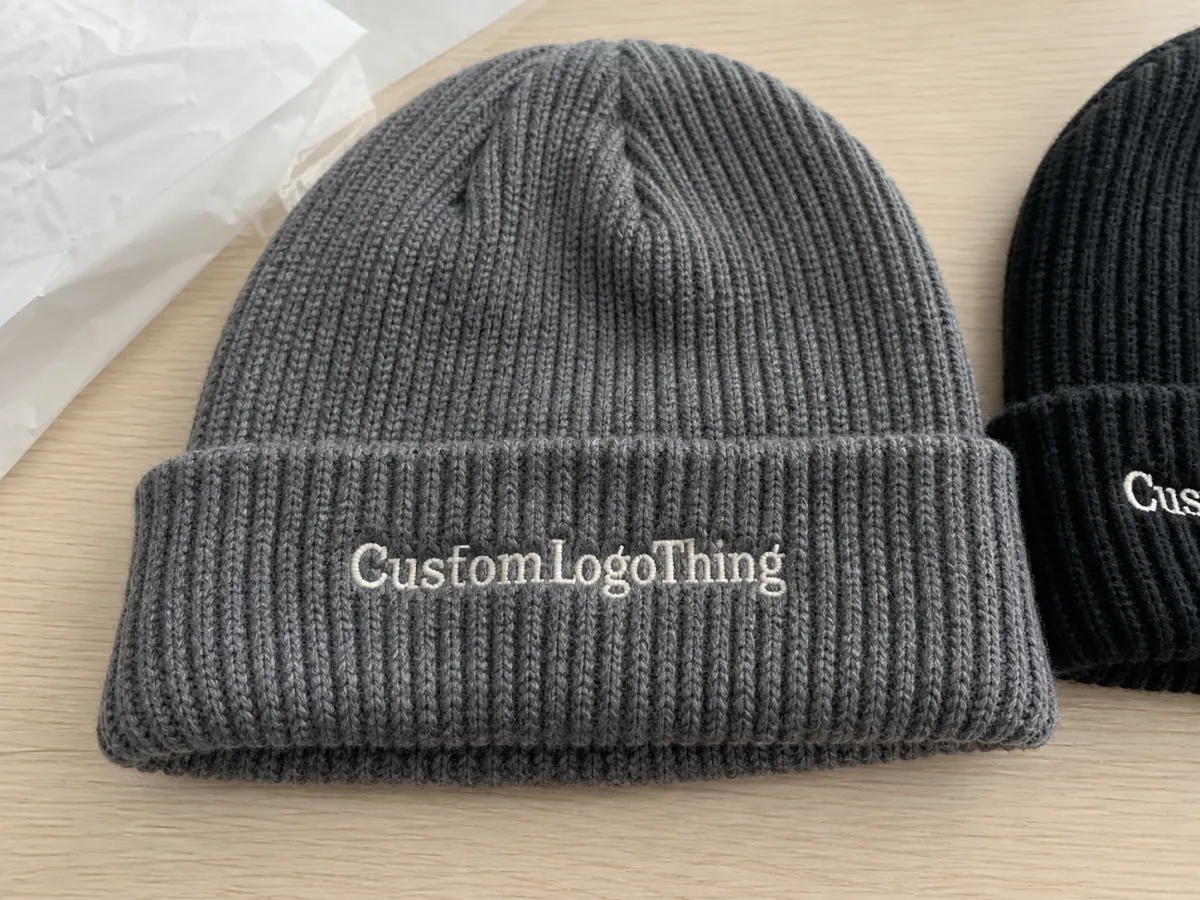
Ribbed Winter Hats are textured, elastic beanies with vertical channels that rise and fall across the fabric. Those ridges create uneven pressure points. Instead of a smooth face, the decoration has to sit across a surface that stretches in one direction, compresses in another, and rarely stays perfectly flat for long.
That matters because decoration methods behave differently on knit. Thread needs enough stability to hold stitch tension. Heat-applied graphics need a landing area that is flat enough for full contact. Direct ink needs enough surface consistency to stay readable instead of sinking into the texture. On ribbed fabric, none of those conditions is guaranteed.
Artwork also changes once it meets knit. Thin letters close up, fine outlines soften, and large graphics can pull the hat out of shape. A logo that seems modest on a blank art file may be too delicate once it has to survive the movement of a real garment. A simple ribbed beanie can make a clean vector mark look overworked if the method is wrong.
The texture is only part of the story. Fiber content affects results too. Acrylic, polyester, wool blends, and recycled yarns do not all respond the same way to heat, pressure, or stitch density. A decoration that works well on one hat can behave differently on another, even if the exterior looks nearly identical. That is why sample approval is not a formality. It is the point where assumptions get checked against material reality.
For buyers, the practical questions are simple: how much does the hat stretch, how large is the logo, what is the fabric blend, and how much wear will the item take after sale? Those four details usually tell you more than a generic product description ever will.
If the design depends on hairline detail, do not expect rib knit to behave like paper. The knit will always show its structure, even under the best decoration.
How Decoration Methods Behave on Rib Knit
On rib knit, the main method families are embroidery, screen print, heat transfer, patch work, and woven labels. Each one interacts with the hat differently because the decoration either sits above the surface, bonds directly to it, or creates its own layer that bridges the texture.
Embroidery is the default for many ribbed hats because it is durable, visible, and forgiving on stretch. The stitch structure sits above the knit, so the logo stays readable even when the hat flexes. It also gives the product a stronger retail feel. The limits show up in detail. Tiny text, thin outlines, and overly dense fills can close up or create puckering if the digitizing is not careful.
Screen print can work, but only on the right art and the right hat. It is better for bold, simple graphics than for detailed logos or soft gradients. On ribbed knit, the print has less tolerance for stretch than it would on a flatter textile. That does not make it unusable. It means the design has to be built for the fabric instead of borrowed from another product category.
Heat transfer is often the best choice for artwork that needs fine detail, small type, or clean edges. It holds more information than embroidery and is usually more flexible than direct print on knit. The tradeoff is application quality. A transfer applied with weak pressure, uneven heat, or poor surface prep can lift at the edges or feel less premium after repeated use. The visual result depends heavily on production discipline.
Patches solve a lot of texture problems because they create a separate decoration surface. Woven patches, embroidered patches, faux leather patches, and silicone patches all give the logo a controlled shape that is less affected by the knit below it. They also add depth. For many buyers, that extra dimension is exactly what makes a ribbed hat look finished rather than merely decorated.
Woven labels are strong for crisp branding, especially when the logo is small or the text is tight. They are useful on front badges and inside branding details, where sharp edges matter more than raised texture. They are not the answer for large statement graphics, but they are often the cleanest option when the design needs precision more than volume.
Each method has a ceiling. The most durable option is not always the most detailed. The most detailed option is not always the best at surviving stretch. Buyers run into trouble when they assume one decoration style can handle every kind of art. Rib knit usually exposes that assumption quickly.
Ribbed Winter Hats Print Method Comparison: What Wins When?
Here is the practical version of the ribbed winter hats Print Method Comparison. Not the polished sales version, but the one that helps a buyer avoid obvious mistakes.
| Method | Detail | Stretch Tolerance | Typical Unit Cost | Best For | Main Watch-Out |
|---|---|---|---|---|---|
| Embroidery | Good for bold logos; weak on tiny text | High | $1.20-$2.80 plus setup | Premium branding, 1-3 color logos | Can pucker if oversized or too dense |
| Heat transfer | Very good for fine detail and small type | Medium | $0.90-$2.20 | Complex art, gradients, micro logos | Edge lift and feel depend on application quality |
| Screen print | Strong on simple shapes, weaker on detail | Low to medium | $0.70-$1.60 | Flat graphics, simple promo runs | Can crack or distort on highly stretchy knit |
| Patches | Excellent shape control and dimension | High | $1.50-$3.50 | Retail looks, heritage branding | Adds weight and a more structured feel |
| Woven label | Excellent crisp edges, limited depth | High | $0.80-$2.00 | Clean logos, small branding marks | Not ideal for large art or bold textures |
If the logo is small and clean, embroidery is usually the first method to consider. It handles cold-weather wear well, gives the hat a finished appearance, and does not depend on a perfectly flat knit face. For a retail beanie or a higher-end corporate gift, that combination is hard to beat.
If the artwork has fine detail, gradients, or small text, transfer-based methods or woven labels tend to perform better. A transfer behaves more like a high-resolution print than thread does, so it can preserve sharper information. The drawback is that the hat surface still sets the limits. Ribbed knit can soften even a strong graphic if the application is not controlled.
For simple promotional art, screen print can be a good fit if the design is bold and the beanie has enough surface stability. The issue is not whether print can technically work. The issue is whether the final piece still looks good after the hat stretches, gets folded, and spends time in real use. Cheap decoration on the wrong fabric is the kind of savings that disappears as soon as the first bad sample arrives.
Patches are often the most forgiving visually. They bridge some of the unevenness of the rib knit and create a more deliberate brand mark. That is why they show up often in retail collections, holiday merchandise, and other programs where the hat needs to feel like a finished product rather than a giveaway item with a logo attached at the last minute.
If the goal is durability under regular wear, choose the method that fails least on stretched fabric, not the one that looks best in an overly tidy mockup. Ribbed winter hats reward methods that respect the structure of the knit.
Cost, Pricing, MOQ, and Unit Cost
Buyers usually ask for a unit price first, and that makes sense. The problem is that decoration pricing is built from several parts: setup, labor, material, and per-piece production. Leave one of those out of the conversation and the quote will look better than the real landed cost.
For a small to mid-size order, embroidery often includes a digitizing fee in the range of about $35-$75, then roughly $1.20-$2.80 per hat depending on stitch count, logo size, and color changes. A simple one-color mark can sit near the low end. Dense fills, multiple colors, or oversized placement move the number up quickly.
Transfers and patches often have lower setup friction for complex artwork, but the per-unit cost can be higher on small runs. A transfer may sit around $0.90-$2.20 per piece, while a woven or embroidered patch can land in the $1.50-$3.50 range depending on size, shape, and how the patch is attached. Sewing, heat application, and finishing add their own labor costs.
MOQ pressure is real. A method that looks affordable at 1,000 pieces may be inefficient at 100 because the setup gets spread too thin. On the other hand, a method that seems expensive at first can be the better value for a small batch if it avoids heavy setup charges or a second sample round. That math matters more than the sticker price.
Hidden costs usually show up in three places. A poor method choice can create rejects. A weak sample can force rework. A rushed schedule can add rush charges or split shipments. On ribbed winter hats, the cheapest quote is not always the cheapest order.
If the project also includes hangtags, carton labels, or packaging inserts, the artwork discipline matters there too. Packaging teams think in terms of print compatibility, color control, and substrate choice. The same logic applies to hats. Clean vector art and sensible color separation save time later, especially if the decoration has to coordinate with retail packaging or paper components. For packaging sustainability claims, use real certification references such as FSC instead of vague green language: FSC.
Production Steps, Timeline, and Lead Time
The production path is usually simple on paper: artwork review, method selection, sampling, approval, production, finishing, and packing. In practice, one unclear file or one rushed approval can stretch the schedule. The process is not complicated, but it does reward clean decisions.
Embroidery needs digitizing first, since the art has to become stitches that hold up on knit. Transfer jobs may require print setup and application testing. Patch work needs shape approval, border approval, and sometimes backing approval. If the logo is hard to interpret, the sample round gets longer because the supplier has to protect the order from avoidable errors.
For a simple embroidered run, production often takes around 10-15 business days after proof approval. Transfer-based or patch-based orders can move on a similar timeline, but custom shapes, special backings, or extra test rounds can add several days. If the order also includes packaging or retail finishing, expect that workstream to add time rather than run automatically in the background.
Seasonality has a bigger effect than many buyers expect. Winter hat orders stack up quickly once cold-weather buying begins. If the order supports a launch, employee program, or holiday promo, the most important question is not whether one method saves thirty cents. It is whether the job will actually ship before the window closes.
If the hats are packed for retail or e-commerce, ask about carton strength and pack-out early. For bulk shipping or mailer programs, it helps to know whether the cartons are being checked against a shipping standard such as ISTA protocols: ISTA. That is especially useful when decorated hats are stacked tightly, compressed in transit, or going through multiple handling stages before they reach the end customer.
Key Factors That Decide the Best Decoration Method
The right answer is rarely about one feature. It is usually a combination of size, detail, fabric, wear, budget, and timing. If you sort those factors in the right order, the best method usually becomes obvious.
- Logo size: Small logos favor embroidery, woven labels, or patches. Oversized graphics need more caution on ribbed knit.
- Detail level: Tiny text and thin lines are better suited to transfers or woven labels than to embroidery.
- Stretch tolerance: If the hat will be worn hard, folded often, or packed tightly, choose a method that stays stable under movement.
- Hand feel: Some buyers want soft and subtle. Others want a raised, tactile look. That changes the method more than most people expect.
- Fabric type: Acrylic, polyester, wool blends, and recycled yarns all react differently to heat and stitch tension.
- Order purpose: Retail merchandise, employee gifts, sports promos, and cold-weather giveaways each push the decision in a different direction.
The artwork file matters just as much as the hat. A logo built for a website is not automatically ready for decoration. Clean vector artwork, sensible line weights, and separated spot colors make approvals smoother and reduce the chance of a costly correction later. If the art file is weak, someone has to clean it up. That work costs time, and time shows up in the quote.
I also look at what the decoration has to communicate. A mark meant to feel premium can handle a raised method like embroidery or a patch. A logo that must carry tiny text, a web address, or a fade cannot always survive that treatment. The best method is the one that makes the message readable and the product believable at the same time.
Use-case matters more than ego. A retail hat should feel polished. An internal giveaway can be simpler if the budget is tight. Team merch often needs strong contrast and clear visibility. A field-use cold-weather cap may need a decoration that still reads well after repeated stretching, stuffing into pockets, and general rough handling. The job defines the method.
Common Mistakes That Ruin Ribbed Beanie Orders
The worst orders usually fail in predictable ways. Not because the equipment is mysterious. Because the brief was built on assumptions that never matched the fabric.
First, overcomplicated art. Thin lines, microscopic text, and tiny gradients do not improve on ribbed knit. They become harder to read, not easier. If the design depends on tiny detail, it probably needs a different method or a simplified version.
Second, bad sizing. A logo that is too large pulls the knit and makes the hat look tense. A logo that is too small gets swallowed by the texture. On many ribbed beanies, a front decoration around 2.25-3.5 inches wide is a safer starting point, but the real limit depends on the hat profile, placement, and decoration method.
Third, approving only from a flat mockup. A screen render helps with layout, but it does not show how the decoration sits on the actual knit. A physical sample, or at least a sample on the same hat color and fiber content, is much better for spotting puckering, contrast issues, and edge behavior.
Fourth, choosing the method that looks cheapest on paper. If the lower quote comes from skipping proper setup or forcing a weak method onto the wrong fabric, the final piece will show it. The buyer saves a little on decoration and loses the premium feel of the product. That trade rarely pays off.
Fifth, ordering too late. Ribbed winter hats are seasonal, and the calendar gets crowded fast. Sampling, decoration setup, and finishing all need time. A rushed order has less room for corrections, and corrections are often the step that blows up the budget.
One more mistake deserves a mention: treating direct print on knit like offset printing on paper. The materials do not behave the same way. Knit stretches. Paper does not. That sounds obvious, but it still shows up in orders that were approved from art files alone, with no real testing.
Next Steps for a Clean, On-Budget Order
Start with the logo file and the end use. Then narrow the field to two methods, not six. Too many options slow the decision and usually lead to a weaker choice. If the logo is simple, compare embroidery against patches. If the logo is detailed, compare transfers against woven labels. That is usually enough to get to a solid answer.
Before requesting quotes, confirm these items:
- Budget target: Set both the unit-cost ceiling and the total run budget.
- Minimum quantity: Some methods only make sense once the order size rises.
- Turnaround window: Leave time for sampling and approval.
- Fabric type: Acrylic, polyester, wool blend, or recycled yarn changes the recommendation.
- Final look: Decide whether you want soft, flat, raised, or premium-looking decoration.
If this is the first order, ask for a sample or mockup on the actual hat color before approving the full run. White-on-black and black-on-heather can behave very differently. So can a ribbed acrylic beanie and a softer wool blend. The knit is not a footnote. It is half the decision.
Keep the packaging simple, but not careless. If the order needs branded hangtags, sleeve cards, or carton labels, specify them early so they match the decoration style. That keeps the full product line feeling consistent instead of assembled from unrelated decisions.
Bottom line: the best ribbed winter hats print method comparison is the one that matches the method to the knit, the logo, and the wear pattern. Not habit. Not guesswork. Not the cheapest quote with the cleanest spreadsheet.
Which print method is best for ribbed winter hats with small logos?
Embroidery usually works well for small, clean logos because it stays visible on textured knit. If the logo has fine detail or very small text, a transfer or woven label may preserve the artwork better.
Does embroidery stretch ribbed beanies too much?
It can if the design is oversized or placed on a weak area of the knit. A properly digitized, modest-size embroidery design is usually stable and durable on ribbed hats.
What is the average lead time for decorated ribbed winter hats?
Simple orders can move quickly, but sampling and setup often add several days. Seasonal demand can extend lead times fast, so build in extra buffer whenever possible.
How much do ribbed winter hats usually cost to decorate?
Cost depends on method, logo size, setup needs, and order quantity. Embroidery often has setup charges but can be economical at larger runs, while transfers may be better for detailed art in smaller batches.
Can I print detailed artwork on ribbed beanies?
Yes, but detailed artwork usually performs better with transfer-based methods or woven labels than with direct embroidery. The tighter the lines and smaller the type, the more important sampling becomes.


