Embroidered Beanies Sample Approval Checklist for Buyers
Why an embroidered beanies sample approval checklist matters
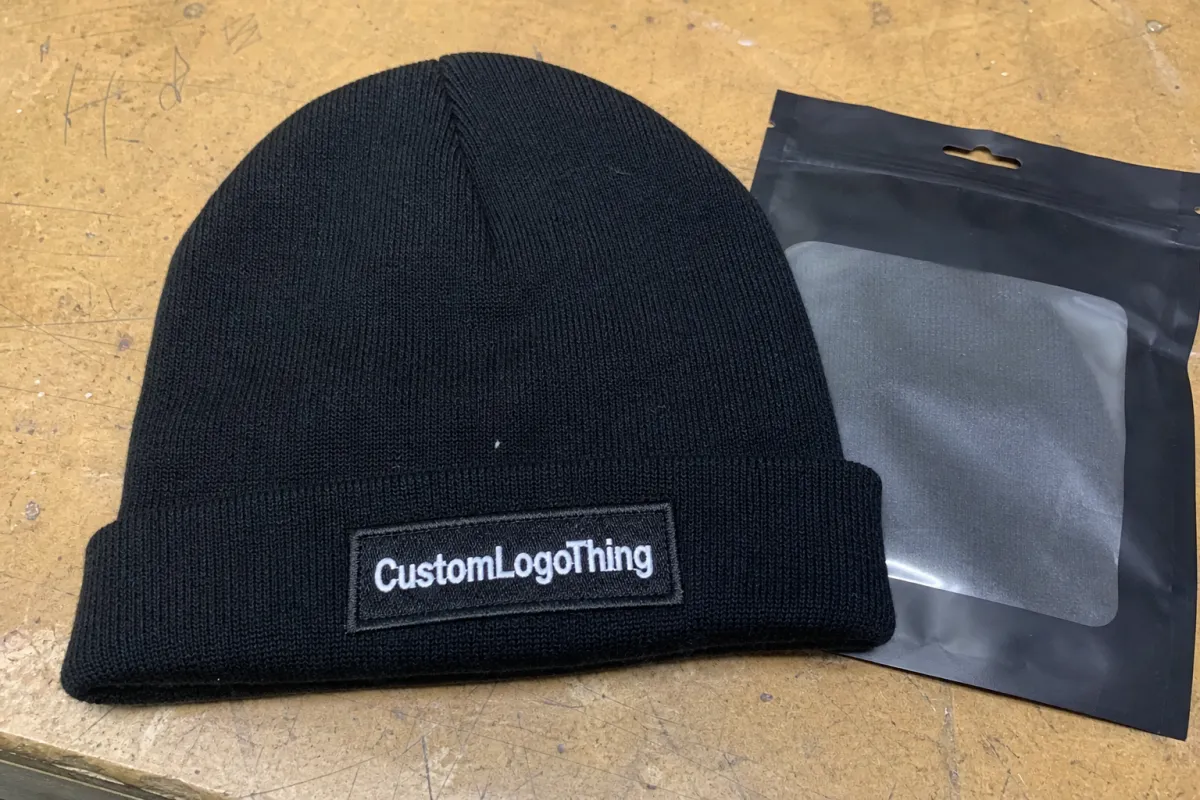
Five hundred beanies arrive for a winter campaign. The yarn feels fine. The embroidery looks clean enough. Then someone tries one on and the logo sits about 8 mm too high on the cuff. Not dramatic. Still a problem. That small miss can turn useful merchandise into dead stock, which is why an embroidered beanies Sample Approval Checklist belongs in the buying process before bulk production starts.
Beanies look simple from a distance: knit body, folded cuff, stitched logo. Plenty can still go wrong. Rib knit stretches under the needle. Dense embroidery can pull the fabric inward. A cuff can roll differently after steaming. A flat digitized proof can look sharp while the real logo stitched through acrylic yarn looks swollen, tilted, or muddy.
For buyers, beanies sit in an awkward category. They are wearable apparel, branded merchandise, and sometimes a packed promotional item all at once. One order may need individual polybags, UPC stickers, event kitting, carton labels, hangtags, or retail-ready presentation. A weak sample approval can affect product quality, receiving, carton counts, freight cost, and the way the item looks in someone’s hand.
A good checklist does not slow the order down. It removes guessing. It forces the buyer, designer, supplier, and production team to agree on what “approved” means before anyone starts making thousands of units.
Most buyers under-check samples because they are trying to be reasonable. They do not want to sound difficult over a 2 mm shift or a thread shade that looks slightly dull. Fine. But small differences multiply. On 100 units, a defect is annoying. On 5,000 units, it becomes a budget conversation nobody enjoys.
How the sample approval process and timeline usually works
The sample process usually begins after the artwork, beanie style, yarn choice, and rough quantity are confirmed. The supplier needs enough information to make something close to final: logo file, embroidery size, thread colors, cuff height, label position, packing method, and target delivery date.
For a standard acrylic cuff beanie with embroidery, sampling often takes 5-10 business days if the yarn color is in stock and the design is not unusually dense. Add 2-4 days if a new digitized embroidery file is needed. Add more time for custom-dyed yarn, private-label trims, retail packaging, lab testing, or anything that requires material sourcing instead of pulling from stock.
Bulk production commonly runs 12-25 business days after sample approval for standard promotional quantities. Larger programs, custom knits, strict retail compliance, and multi-component packaging can take longer. Shipping is separate. Air freight may take 3-7 days after release. Ocean freight can turn a simple delivery plan into a calendar problem.
Approval pressure creates bad decisions. A late buyer may approve a weak sample and hope production improves. It usually does not. Production copies the approved sample more efficiently, not more thoughtfully.
What counts as a real approval sample
A photo is not a sample. A digital mockup is not a sample. A loose embroidered patch is not a beanie sample either, though it can help review stitch direction and thread colors early.
A useful pre-production sample should show the final knit type, cuff structure, embroidery placement, logo size, and finishing method. If the order includes a woven label, hangtag, belly band, barcode sticker, header card, warning statement, or individual polybag, review those pieces too. Packaging errors love to hide until the receiving team is already annoyed.
There are reasonable exceptions. If the buyer is reordering an identical item from a previously approved run, a retained reference sample and production photo may be enough. Not always. If the yarn lot, embroidery vendor, thread color, or packing specification changed, ask for a fresh sample or at least a confirmed top-of-production piece.
Who should review the sample
Do not leave approval to one person if the beanie affects several teams. Design should check the logo. Marketing should check brand presentation. Procurement should confirm cost assumptions. Operations should review packing, carton count, and delivery requirements. If the item will be sold, compliance should check labels and claims.
A practical embroidered beanies Sample Approval Checklist gives each reviewer a defined job. Otherwise everyone stares at the logo and nobody checks the care label. That is how silly mistakes survive.
Logo placement, stitch quality, and fit checks buyers should make
Embroidery on knitwear is not the same as embroidery on a structured cap or woven tote. Knit moves. The needle pushes between loops. Dense stitching can create puckering around the design. A logo that looks balanced on a flat table may tilt once the cuff wraps around a head.
Start with placement. Measure from the bottom edge of the folded cuff to the bottom of the embroidery. Then measure from the top of the cuff to the top of the embroidery. Check side-to-side centering against the front center or seam, if the style has one. For many adult cuffed beanies, logos sit centered on the front cuff and run about 35-50 mm tall, depending on the cuff height and artwork. That is a common range, not a universal rule.
Numbers matter. “Logo centered on cuff” sounds clear until an operator has to hoop thousands of pieces. Better: “Embroidery centerline aligned to front center, bottom of logo 18 mm above cuff fold edge, tolerance +/- 3 mm.” Now quality control has something measurable.
Inspect stitch quality under normal light and close light. Look for thread breaks, skipped stitches, loose ends, gaps in filled areas, uneven satin borders, and thread tails longer than 3 mm. Turn the cuff inside out. The backing should not feel bulky, sharp, scratchy, or poorly trimmed. For children’s items, comfort and safety need stricter review.
Dense embroidery causes plenty of disappointment. Tiny text, gradients, shadows, distressed textures, and thin outlines may look clean in a PDF and clumsy in thread. Small letters under about 5-6 mm high often lose clarity on rib knit. Trademark symbols can become dots. Thin lines may sink into the yarn.
Use the checklist to compare the stitched result against the approved artwork, but stay realistic. Thread is not ink. A clean embroidery version often protects the brand better than a literal copy of a complicated print logo.
Fit and stretch checks
Put the sample on a head form if one is available. If not, use a person with an average head size and then someone with a larger head size. The logo should remain readable when stretched. The cuff should not flare, twist, collapse, or pull the embroidery into a curve that looks accidental.
Measure the beanie flat: width at opening, total height, cuff height, and weight in grams. Common adult acrylic cuff beanies may sit around 20-22 cm wide flat and 20-23 cm high, depending on knit structure, yarn count, gauge, and styling. Do not treat those numbers as fixed specs. Treat the approved sample as the control.
Check recovery too. Stretch the opening by hand for a few seconds, release it, and see whether the beanie returns close to its original width. Poor recovery makes a low-cost beanie feel tired before the first proper wear. Nobody needs promotional merchandise that gives up immediately.
Color, materials, labels, and packaging details to verify
Color approval gets messy because buyers often approve from screens, supplier photos, or office lighting. None are reliable on their own. If brand color matters, request Pantone matching for thread and, where possible, yarn. For stock yarn beanies, expect “closest available” unless the supplier offers custom dyeing.
Thread colors can shift visually against dark knit. White thread on black acrylic looks crisp. Pale gray on navy may disappear. Metallic thread can look premium, but it may feel rougher, run slower, and cost more. A 10,000-stitch logo in standard polyester thread can price very differently from the same design using metallic or specialty thread.
Material claims need discipline. Acrylic, recycled polyester, wool blend, organic cotton, and rPET all carry different cost, hand-feel, performance, and documentation expectations. If the beanie is marketed as recycled, ask for supporting documents such as supplier declarations, transaction certificates where applicable, or other chain-of-custody records. If paper packaging uses FSC-certified board, confirm the claim applies to the actual material and printer chain, not just a generic vendor brochure.
Testing may be needed for retail or regulated programs. Textile tests can cover colorfastness, flammability, fiber content, dimensional stability, and restricted substances depending on the market. ISTA-style packaging review may matter if the beanies ship in display-ready cartons, kits, or ecommerce packs. Promotional orders do not always need formal lab testing, but the choice should be deliberate.
Labels and compliance details
Labels are small. That does not make them harmless. Check fiber content, country of origin, care instructions, brand label orientation, and required distributor information. A woven label sewn crookedly into the cuff can make an otherwise decent beanie look cheap.
For private-label programs, compare the label sample to the art file. Confirm font size, fold type, stitch position, edge finish, and placement. If the label is heat-transferred instead of sewn, test stretch and wash resistance. Heat transfers on rib knit can crack or peel when the wrong material or adhesive is used.
Ask whether the same label will be used across all colors and sizes. A label that looks fine on black may look weak on heather gray because the contrast changes. Small issue. Real consequence.
Retail and shipping packaging
Packaging is not decoration. It controls presentation, scanning, counting, moisture protection, and receiving labor. A simple promotional beanie may be packed one per clear polybag with a size sticker. A retail beanie might need a belly band, hangtag, UPC barcode, carton label, master carton markings, and a warning statement on the bag.
Typical individual polybags for beanies may cost about $0.03-$0.08 per unit, depending on thickness, adhesive strip, vent holes, print, and recycled content. A printed belly band could add $0.12-$0.35 per unit at moderate volumes, depending on board weight and print coverage. A custom hangtag with string might add $0.08-$0.20. These numbers move with market conditions, but they show why packaging has to be approved before the purchase order is locked.
Review the folded size inside the bag. If the beanie is compressed too tightly, the embroidery can leave pressure marks or the cuff can crease. If the bag is too large, cartons cube out fast and freight gets wasteful. Soft goods still punish sloppy packing.
Cost, pricing, MOQ, and unit cost questions before approval
Sample approval should confirm quality. It should also protect the budget. The sample may include details that quietly change unit cost: higher stitch count, larger logo, extra backing, custom label, specialty yarn, individual bagging, carton inserts, barcoded stickers, or added quality checks.
A basic embroidered acrylic cuff beanie at 1,000-5,000 pieces might land around $2.20-$5.50 per unit before freight, depending on yarn, weight, logo complexity, labor market, packaging, and margin structure. Smaller runs can be much higher. Premium wool blends, recycled yarn documentation, custom dyeing, and retail-ready packaging can push the price up fast.
Embroidery pricing often relates to stitch count. A 5,000-stitch logo is not priced like a 15,000-stitch logo. Some suppliers bundle a standard stitch count into the unit price. Others charge setup plus stitch-based running costs. Ask for the final stitch count after digitizing, not only the original artwork size.
MOQ is another pressure point. Stock beanie colors may start around 100-300 units through many promotional suppliers. Custom knit colors or fully custom patterns may require 500, 1,000, or more. Custom packaging can carry its own MOQ, sometimes higher than the beanie order. That mismatch leaves extra bands, tags, stickers, or labels sitting in a carton for the next “maybe someday” project.
Before approving the sample, ask four blunt questions:
- Does this sample exactly match the quoted unit price?
- Does the quote include embroidery digitizing, setup, labels, and packaging?
- What tolerance applies to quantity, dimensions, color, and placement?
- What changes would trigger a revised price or delayed ship date?
The embroidered Beanies Sample Approval Checklist should include commercial checks beside physical checks. Quality and cost are connected. Approving a sample without confirming the price impact is how teams get hit with a revised invoice after everyone has already decided they love the product.
Step-by-step approval workflow for a clean production handoff
A clean approval workflow is boring in the best possible way. It records decisions, reduces email archaeology, and gives production a stable reference. The goal is not paperwork for its own sake. The goal is fewer avoidable defects.
Step one: freeze the specification
Create a one-page spec before sampling. Include beanie style, material, gauge if known, color, flat measurements, cuff height, logo size, embroidery location, thread colors, label details, packaging, carton pack, and testing requirements. If the supplier has its own spec sheet, use it. Just do not let empty fields stand in for decisions.
Attach artwork in usable formats. Vector files such as AI, EPS, or clean PDF usually work better than low-resolution PNG files. If the logo has small text or thin lines, ask the digitizer to flag risk before stitching.
Step two: review the digital proof
The digital proof should show logo size, thread colors, placement, and any label or packaging layout. It is a checkpoint, not final approval. Use it to catch obvious issues before time and sample fees go into a physical piece.
Watch for scale problems. A logo that looks tasteful on a large mockup may be unreadable on a 45 mm cuff. Ask for actual dimensions, not only images.
Step three: inspect the physical sample
Use consistent lighting and a ruler. Photograph the front, back, inside, label, packaging, and any defects. Compare the sample against the spec, not memory. If several people review it, collect feedback in one document instead of letting comments scatter across messages.
Mark each line as approved, approved with change, or rejected. That distinction matters. “Approved with change” should describe exactly what changes and whether a second sample is required.
Step four: approve in writing
Written approval should include the sample date or version, approved photos, final spec sheet, quantity, price, delivery terms, packing method, and agreed tolerances. If the supplier keeps a signed physical sample, ask them to label it clearly and retain it until bulk production is complete.
Do not approve with vague language such as “looks good” unless every spec is already documented. Better wording: “Approved for bulk production based on attached sample photos and spec sheet, with logo lowered by 4 mm and thread color changed to the Pantone-matched shade listed in the revised proof.” Dry? Yes. Useful? Also yes.
Step five: check top-of-production output
For larger orders, ask for top-of-production photos or a physical TOP sample before the full run continues. The first production pieces confirm that the approved sample translated correctly to the actual production line.
Some suppliers resist this because it adds coordination. Fair enough. For high-visibility campaigns, retail shipments, or tight brand standards, that small pause often beats sorting bad units later.
Common sample approval mistakes that create bulk order problems
The first mistake is approving color from a phone photo. Cameras brighten, screens shift, and supplier lighting can hide differences. If color is brand-critical, get physical thread references or a stitched sample under consistent light.
The second is ignoring embroidery backing. Buyers look at the front. Wearers feel the inside. Scratchy backing, thick stabilizer, or poor trimming can turn a good-looking beanie into something people avoid wearing.
The third is treating the first sample as a suggestion instead of a production control. If the sample has twelve issues, do not approve it while asking the supplier to “fix in bulk.” That phrase should make buyers nervous. Bulk production needs an approved standard, not a wish list.
The fourth is leaving packaging until the end. Packing decisions affect carton size, warehouse handling, retail readiness, and sometimes compliance. If each beanie must arrive in a barcoded bag, the supplier needs to know before the production handoff.
The fifth is failing to define tolerances. Textile products are not machined metal parts. Some variation is normal. The question is how much variation the buyer can accept. For embroidery placement, +/- 3-5 mm may be practical on many knit items. For color, visual tolerance should be tied to approved standards. For dimensions, define flat measurement points.
The sixth is forcing a print logo into embroidery without adapting it. Gradients, tiny slogans, distressed textures, and hairline outlines often stitch poorly. A simplified embroidery version can look more professional than a faithful version that turns into thread soup.
Finally, buyers skip the retained sample. Keep one approved sample in the office or warehouse. If a dispute comes up later, that physical reference is more useful than a chain of cropped photos. It also helps with reorders, especially if a new supplier, yarn lot, or production batch is involved.
Next steps: turn the approved sample into a production-ready order
Once the sample is approved, the job is not finished. It shifts from development to control. Send a final production pack that includes the approved spec, artwork, digitizing file reference, thread colors, packaging instructions, carton markings, delivery address, and inspection requirements.
If third-party inspection is planned, define the AQL level and defect categories before production finishes. Major defects might include wrong logo, wrong color, severe puckering, missing label, open seam, stains, or incorrect packaging. Minor defects might include small thread tails or slight measurement variation within tolerance. The exact structure depends on the order value, sales channel, and risk level.
Think about transit too. Beanies are soft, but embroidery can be crushed, hangtags can bend, paper bands can scuff, and polybags can trap moisture if goods are packed too warm or too tightly. If cartons will move through parcel networks, consider compression, drop risk, moisture exposure, and label readability. The product may be textile, but the failure may be packaging-related.
Be careful with sustainability claims. Recycled polybags, FSC paper bands, recycled yarn, and reduced packaging all sound positive. Each needs verification if the claim appears in marketing or retail copy. Vague eco-language creates risk. Specific claims with documentation are safer.
Keep a post-order record. Note actual production time, defect rate, freight cost, carton dimensions, customer feedback, and changes needed for reorder. The data does not need to be fancy. A spreadsheet is enough. Buyers who keep these notes stop repeating the same preventable mistakes.
The strongest approval systems are practical. They ask simple questions before those questions become expensive: Is the logo readable? Does the beanie fit? Is the label correct? Does the packaging match the sales channel? Is the supplier producing exactly what the buyer approved?
FAQs
How many embroidered beanie samples should a buyer request?
For a simple order, one physical pre-production sample may be enough if it uses final materials and final embroidery. For multi-color orders, request at least one sample in the most difficult color combination, such as light thread on dark yarn or tone-on-tone embroidery. For retail programs, review packaging and label samples as well.
Should buyers approve a sample if only small changes are needed?
Sometimes, yes. If the change is measurable and low-risk, such as lowering the logo by 3 mm, written approval with change may be acceptable. If the issue affects stitch quality, fit, color, material, or compliance labeling, ask for another sample or a top-of-production confirmation.
What is a normal embroidery placement tolerance on beanies?
Many buyers use +/- 3-5 mm for logo placement on knit beanies, but the right tolerance depends on the design, cuff height, and production method. A tiny centered logo may need tighter control than a large patch-style embroidery. Put the tolerance in writing.
What file format is best for embroidered beanie artwork?
Vector artwork is usually best for embroidery digitizing. AI, EPS, or clean PDF files help the digitizer interpret shapes accurately. The final machine file will be a stitch format used by the embroidery equipment, but buyers should approve the stitched sample, not only the digitized preview.
Can a supplier match exact Pantone colors in embroidery thread?
They can often get close, but exact matches are not guaranteed unless the thread supplier has a direct equivalent. Yarn color is harder if the beanie uses stock material. For brand-sensitive programs, approve physical thread cards or stitched samples under consistent lighting.
What should be included in an embroidered beanies sample approval checklist?
Include artwork version, logo size, embroidery placement, stitch quality, thread colors, backing comfort, beanie material, fit, flat measurements, cuff height, labels, care instructions, packaging, carton pack, unit cost, MOQ, production timeline, tolerances, and written approval status. That sounds like a lot. It is cheaper than sorting defective beanies later.
A final note: the embroidered beanies Sample Approval Checklist is not about mistrusting suppliers. Good suppliers appreciate clear approvals because they reduce rework, disputes, and rushed decisions. For buyers, the checklist turns a soft product with hidden variables into a controlled production order. That is how a basic winter beanie becomes merchandise people actually want to wear.


