At a crowded booth with the temperature climbing and the line moving faster than the staff can restock, hats usually beat tees. A shirt is a maybe. A cap is immediate. That difference matters because the item people wear first becomes the item other attendees see first, too. For outdoor activations, sponsor tables, music festivals, and trade show floors with bad air conditioning, event merch Mesh Trucker Hats MOQ is often the phrase that determines whether a program is practical or merely attractive on screen.
The real decision is not whether the mockup looks strong. It is whether the hat body, decoration method, and minimum order quantity can survive the event schedule, the budget, and the handout plan. A buyer can love a design and still order the wrong thing if the front panel is too soft for embroidery, the logo is too small for distance viewing, or the available quantity pushes the price past the usable range.
That is why caps deserve more scrutiny than they usually get. They are small, but they carry a lot of technical decisions: crown height, mesh density, bill shape, closure type, decoration method, carton pack-out, and lead time. Each one can change how the hat wears, how it photographs, and how much the order costs.
Why event merch mesh trucker hats outlast tees at hot events
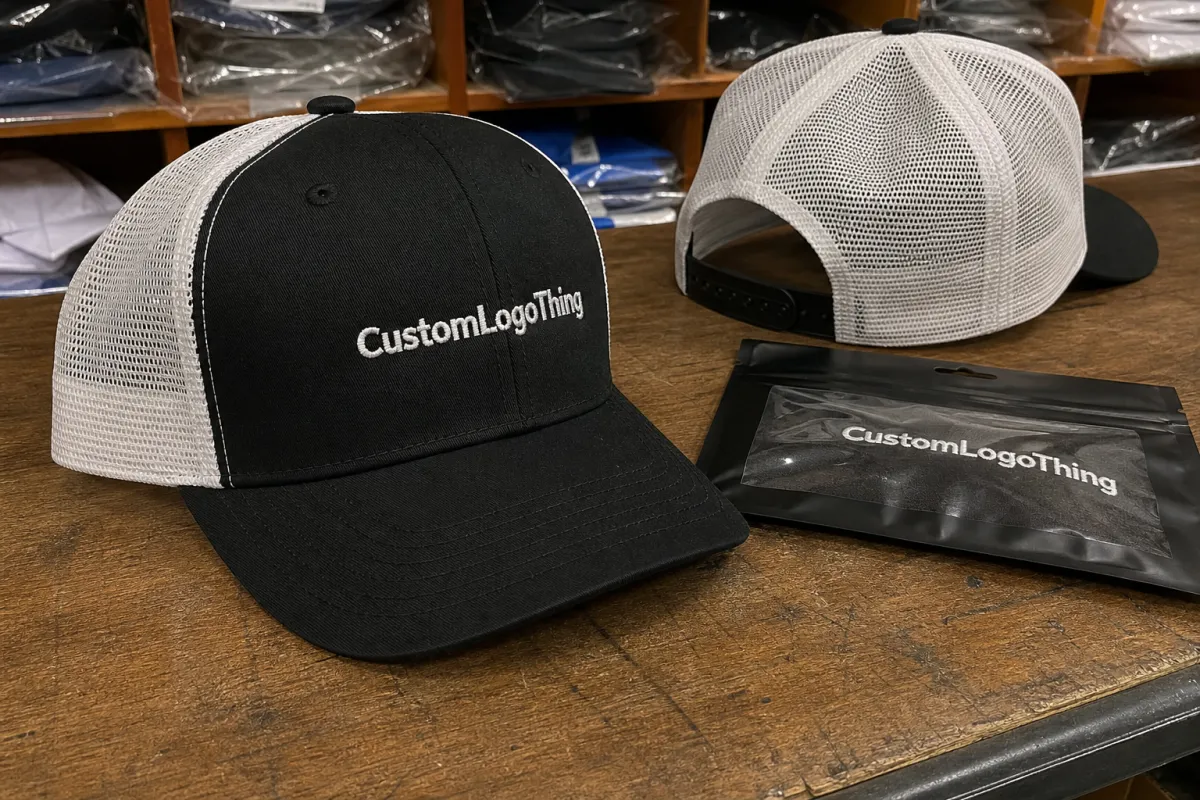
Heat changes buying behavior in a predictable way. On a 90-degree expo floor or a sunlit sponsor activation, people want shade and airflow, not another folded item to carry around all day. Mesh Trucker Hats solve that problem without asking the wearer to make a sizing decision, and that lowers friction at the point of distribution. For event merch, that is a real advantage.
The cap also works harder once it leaves the booth. A hat can stay on a head for six to ten hours, which means the logo travels through queue lines, meals, parking lots, after-parties, and social photos. A tee may not get worn until later, and many never make it out of the bag. That gap changes return on investment in a way buyers feel but do not always calculate. One visible hat can produce far more impressions than a shirt that sits untouched until laundry day.
A useful event cap does not need persuasion. It just needs to fit well enough that people stop thinking about it.
That is why planners use hats as visibility tools rather than souvenirs. They fit sponsor programs, golf outings, volunteer crews, outdoor concerts, and trade show staff kits. They also photograph cleanly. A structured front panel with strong contrast holds up in group shots far better than a tee folded under a lanyard strap or half hidden behind a tote bag.
There is another practical advantage: caps are less size sensitive than apparel. Mixed audiences create less distribution friction when the item is one-size-adjustable. Fewer size runs means fewer leftover units, fewer split SKUs, and less guessing about who can wear what. For large events with varied attendance, that simplicity often matters more than any embellishment detail.
Still, not every cap is a good event cap. A loose, flimsy front panel may look fine in a thumbnail but feel underbuilt in hand. A heavy foam front may photograph well yet run too warm for all-day wear. The right answer depends on how long the hat will be worn, how far away the logo must read, and whether the program is designed for giveaway volume or for a more polished branded finish.
Mesh trucker hat construction, fit, and decoration options
Not all Mesh Trucker Hats are built the same way. Buyers usually start with the silhouette and then work backward into decoration. A standard build includes a structured front, mesh rear panels, a curved or slightly pre-curved bill, and an adjustable closure. Low-profile caps sit closer to the head and read more casual. Mid-profile caps leave more room for a logo and tend to feel safer for event merch because they look familiar and photograph well.
The body material changes the feel more than many buyers expect. Foam fronts deliver the classic retro trucker look and hold shape without much effort. Cotton twill feels more substantial. Brushed polyester can look cleaner in retail-style merch and often handles color consistency well. Six-panel structured crowns usually support embroidery better than soft, unstructured builds. Four-panel or five-panel versions can work, but the front area needs to be considered carefully because the available stitch field is different.
Mesh density also affects wearability. Tighter mesh looks cleaner and often feels a little more refined. Looser mesh breathes more easily, which can be useful for long outdoor shifts or hot summer activations. For staff that will wear the cap all day, that difference is not cosmetic. It is the difference between an item people keep on and an item they adjust every ten minutes.
Decoration choices shape both price and durability:
- Embroidery suits simple logos, bold lettering, and designs that need texture and long wear.
- Woven patches handle small text and detail better than direct stitching on a curved crown.
- PVC patches create depth and a more tactile finish, but they usually add tooling and extra production time.
- Print can work on some front materials, though it is usually less durable for repeated event use.
Color contrast is not a style preference alone. It is a visibility issue. Dark logos on dark bodies can disappear in shade, under stage lights, or in event photography. Light logos on navy, black, or deep green fronts usually read better from across a booth line. If the cap has to communicate quickly, the front panel should do most of the work. The mesh back is there for airflow, not for carrying the message.
Key specs buyers should confirm before ordering
The fastest way to avoid rework is to agree on the spec sheet before anyone prices the job. For caps, a few details change the whole order: panel count, structure, fabric weight, mesh density, visor curve, crown height, and closure type. If those details are assumed instead of written down, the sample may look close enough while the production run misses the real requirement.
Here is the checklist worth confirming before approval:
- Panel count: five-panel styles give a cleaner front for larger graphics; six-panel styles are more common and easier to source.
- Front structure: structured fronts hold shape better and are usually safer for embroidery.
- Bill shape: curved bills feel classic; flatter bills read more retail and can suit younger audiences.
- Closure: snapback is the usual event choice, while fabric straps or hook-and-loop closures can work for staff uniforms.
- Logo placement: center front, left panel, and patch placement all change how the cap reads at distance.
- Artwork size: logos need enough field space to stay legible after stitching or patch conversion.
Different use cases call for different builds. Sponsor programs usually want the most visible front panel possible. Retail-style merch often needs a cleaner silhouette and a more refined patch finish. Staff uniforms care more about comfort, repeatable color, and fit consistency than novelty. A buyer who knows the primary use can skip features that add cost without adding value.
One common error is requesting tiny embroidery on a low-front crown. Another is choosing a dark logo on a dark body because the proof looks sophisticated on a monitor. In daylight, the cap has to work from six feet away, not from a design review at arm's length. Production teams see this problem constantly, and it usually shows up as artwork that was technically approved but visually weak once stitched.
Small details also affect how a cap feels after a full day of wear. The closure should adjust without pinching. The front panel should stand tall enough to keep the logo off the brow. The mesh should feel light but not flimsy. Those are not luxury features; they determine whether the cap becomes everyday gear or leftovers in a storage box.
What actually drives event merch mesh trucker hats moq, pricing, and unit cost
Pricing usually comes down to three variables: how custom the cap is, how many units are needed, and how much work the decoration adds. A stock mesh trucker style with one-color embroidery can land far below a fully custom patch build with color matching and special packaging. The minimum order quantity, or MOQ, sits right in the middle of that equation.
For event merch Mesh Trucker Hats moq, lower quantities are often possible on stock-supported bodies, but the economics improve quickly as the order gets larger. Bulk pricing is not only about getting more hats for less. It is also about spreading digitizing, setup, sample approvals, and freight prep across more units. That spread can make the difference between a workable program and one that looks too expensive on paper.
| Order tier | Typical MOQ | Cost per piece | Common setup charges | Best fit |
|---|---|---|---|---|
| 100-149 pieces | Low to moderate | $6.50-$9.50 | $35-$95 digitizing; patch tooling fees may apply | Small sponsor runs, VIP kits, staff pilots |
| 250-499 pieces | Moderate | $4.25-$6.75 | $35-$95 digitizing; $60-$150 for molded patch tooling if needed | Regional events, merch tables, mixed-audience giveaways |
| 500-999 pieces | Moderate to higher | $3.10-$5.10 | Setup spread across the run; rush fees still possible | Trade shows, festivals, field teams |
| 1,000+ pieces | Higher, but often better value | $2.45-$4.25 | Per-unit setup impact drops sharply | Multi-event programs, national rollouts, recurring merch |
Those ranges assume stock bodies, standard closures, and one decoration location. A more custom build can move the numbers quickly. Two-color patches, specialty threads, custom inside labeling, and retail-style packaging all add cost. Freight matters too. A low unit price can stop looking low once cartons, domestic re-ship, and event-dated delivery are included.
The smarter comparison is not just price; it is price against risk. If a buyer orders 1,000 caps but only needs 600, leftover inventory can erase the savings. If the event is not fully locked, a 250-piece run with a clean repeat-order path may be the better move. The best quote is the one that balances MOQ, lead time, and likely usage instead of chasing the lowest line item.
Unit cost also depends on what the decoration has to do. A simple one-color logo on a standard front panel is efficient because the art translates cleanly. Fine detail raises risk. The more the design depends on tiny lines, small type, or multiple color breaks, the more likely it is to need a patch, a larger stitch field, or a simplified redraw. That is why the cheapest-looking artwork on a screen can become the most expensive to produce.
Production steps, proofing, and lead time
A clean order follows a familiar sequence: quote, artwork review, digital proof, sample approval if required, production, packing, and shipment. Each step takes time. Buyers who answer quickly usually keep the calendar in hand, while slow approvals push the order toward rush fees or tighter freight options.
Standard production for stock-based mesh trucker caps often runs 10-15 business days after proof approval. Patches, color matching, or custom packaging can push that closer to 15-20 business days. If a supplier has to source a new body color, wait on tooling, or hold materials for artwork changes, add more time. Rush work is sometimes possible, but only if current capacity allows it.
Two things speed the process more than anything else:
- Vector artwork in AI, EPS, or SVG format.
- Pantone targets confirmed early, before proof approval locks the color path.
Artwork revisions are one of the main sources of delay. A logo that looks fine in a PDF may still be too detailed for embroidery once the stitch count is mapped. Tiny text, thin outlines, and gradient effects are common trouble spots. A good production team should flag those issues early, but it helps if the buyer sends the right file format and knows the intended decoration size from the start.
Lead time should also include the event calendar, not just the factory schedule. A cap that arrives three days before load-in is not the same as a cap that arrives three days before handout. Transit, receiving, and sorting take time, especially if the order must be split across multiple locations or packed into kits.
For packaging and shipping decisions, the same discipline used for broader freight work applies here. The ISTA framework is useful for thinking about carton durability and handling stress, even if the project does not require formal testing. If recycled paper inserts or cartons matter to the program, FSC certification is a clean benchmark for material sourcing.
That level of planning is not overkill. It is the difference between a polished handout and a late arrival packed in a way that slows the booth down.
Quality controls, packaging, and repeat-order advantages
The best cap program does not depend on luck. It depends on checks. Before shipment, the supplier should verify stitch consistency, logo placement, color match, closure function, and carton counts. If patches are used, edge finish and attachment strength matter as much as the artwork itself. A crooked patch on a trucker hat is visible from across the room.
Practical quality control usually includes more than a quick glance. Production teams should confirm that the front panel sits evenly, the bill is aligned, the mesh is not distorted, and the decoration is centered relative to the crown. If the order uses multiple colorways, every color should be checked against the approved proof rather than assumed to match because it looked right on screen.
Packaging choices affect how fast the team can deploy the order. Bulk cartons are efficient for warehouse storage and large event handouts. Individual polybags make sense when hats need to stay clean, be distributed one by one, or be included in a kit with other merch. Retail-style presentation can use insert cards or barcode labels, but each extra step adds labor and can lengthen the ship date.
There is also a repeat-order advantage that many buyers underuse. If the spec sheet is documented well, the same cap can be reordered with fewer revisions, fewer proof cycles, and fewer surprises. That matters for recurring conferences, seasonal sponsor programs, and field teams that need the same look across multiple cities. A well-run first order becomes the template for the next three.
Order history also matters because it exposes weak points. If the first run had a closure issue, the next run should not repeat it. If the patch edge was too stiff, the artwork or patch material should be adjusted before the next batch ships. Good vendors treat that feedback as part of the process, not as a complaint to work around.
Common mistakes that raise cost or hurt wearability
The same mistakes show up again and again. They are usually not dramatic, just expensive.
One is over-designing the logo. A cap front is a small field, and embroidery has physical limits. Fine detail that works on a digital ad may disappear once stitched. Buyers often discover this after the proof, which is the most expensive time to simplify artwork.
Another is choosing a build that fights the use case. Foam front caps can feel too warm for long outdoor wear. Soft unstructured caps can look casual but may not hold a patch cleanly. A low-profile cap with a large logo can look cramped. A tall crown with a tiny logo can look underfilled. The cap should match the event, not just the art.
Color mistakes are common too. High-contrast combinations photograph better and make distribution easier. Low-contrast combinations can look elegant in a mockup and weak in real life. Buyers sometimes chase a muted palette because it feels premium, then discover that the logo vanishes under the lighting at the venue.
Packaging mistakes create friction at the point of handout. If the order is bulk-packed but the team expected individual bags, the booth staff spends time repacking. If the order is polybagged but only needed for backstock, the buyer pays for labor that delivers no benefit. The pack-out should follow distribution, not habit.
And then there is the quiet cost of vague direction. A brief that says "make it look good" usually turns into extra proof rounds. A brief that says "single-color embroidery, front center, for outdoor staff at a July event" gives the production team enough information to recommend the right body, the right stitch size, and a realistic delivery window. Specific input is cheaper than guesswork.
What to prepare before you request a quote
A precise quote starts with precise input. Before reaching out, gather the quantity, target delivery date, destination ZIP code, decoration method, and logo files. If the order must arrive by a specific handout window, include that date early. If the program has a budget ceiling, say so. Those details change both cost and the recommended build.
These decisions speed up the quote:
- Base hat color and whether one colorway or multiple colorways are needed.
- Front panel style: structured, low-profile, or classic mid-profile.
- Decoration preference: embroidery, woven patch, PVC patch, or print.
- Packaging needs: bulk cartons, polybags, inserts, or retail-ready packing.
- Budget target so the supplier can recommend the most efficient build.
One more detail helps more than buyers expect: explain how the hat will be used. Staff uniform, attendee giveaway, sponsor merch, and resale item are not the same project. The right crown height, decoration method, and carton plan changes with each one. A cap meant for a 20-person crew can be very different from a cap meant to move 1,000 units from a merch table.
Send those details together, and the answer is usually cleaner. Send them in fragments, and the quote tends to drift through revisions. For event merch mesh trucker hats moq, the fastest path is a complete brief: quantity, art, color, deadline, destination, and intended use. That gives a supplier enough context to price the order correctly and flag problems before they become expensive.
What is the typical MOQ for custom mesh trucker hats for events?
MOQ depends on the decoration method and how custom the build is. Stock-supported blanks can start lower, while embroidered or patched runs often need a larger quantity to keep the unit price practical. For event merch mesh trucker hats moq, buyers usually compare 100, 250, and 500-piece tiers before settling on the final count.
Can I mix colors in one event merch mesh trucker hats order?
Sometimes, yes. Mixed colors can increase the effective MOQ because each colorway may need its own production run. If the style is already in stock, mixing may be easier. If the cap needs a separate build per color, pricing usually changes quickly.
Which decoration method is best for mesh trucker hats with logos?
Embroidery works well for simple logos and bold branding. Woven patches or PVC patches handle detail and texture better. The right choice depends on logo size, edge complexity, the hat color, and how far away the logo needs to read at the event.
How long does production usually take after proof approval?
Standard production commonly takes 10-15 business days after proof approval for stock-based builds. More custom patch work, color matching, or special packaging can add time. Shipping time is separate, so the full schedule should include proofing, manufacturing, and transit to the event location.
What information do I need for an accurate hat quote?
Provide quantity, decoration method, artwork file, color preferences, deadline, packaging needs, and destination ZIP code. If you have a budget target, include it up front so the supplier can recommend the most efficient build. That keeps pricing aligned with the actual event instead of forcing a guess.


