Pricing fitness Logo Patch Beanies unit cost sounds simple until the quote starts to split into pieces. The beanie itself is only part of the story. Knit construction, patch material, cuff style, artwork complexity, and order size can move the final number more than most buyers expect. A clean-looking order on paper can turn into three different cost profiles once setup, sampling, and freight are added.
That is why experienced buyers look at the whole spec instead of chasing the lowest sticker price. A patch beanie can earn its keep if people actually wear it in winter, on the way to training, or after a class. That repeated use matters more than a one-time giveaway photo. A cheaper item that disappears into a drawer is not cheap for long.
There is another reason this category deserves a close read: small decorative choices can have outsized effects on perceived quality. A 20mm difference in patch size, a tighter cuff, or a better yarn finish can change how premium the beanie looks in hand. On a product this compact, the eye notices everything.
Why patch beanies keep cold-weather branding visible
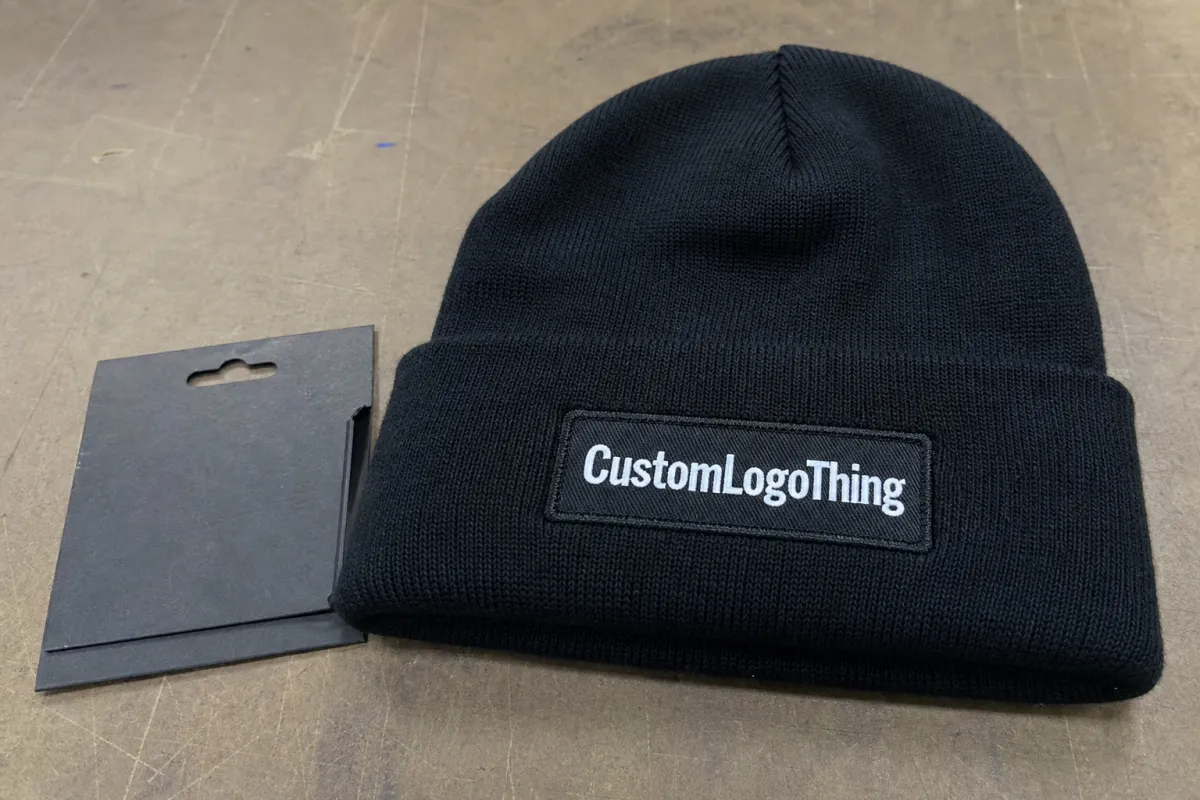
Patch beanies work because they stay in circulation. A launch-table item may get a burst of attention and then vanish. A good winter beanie keeps moving through commutes, errands, outdoor classes, and post-work workouts. For gyms, studios, running clubs, and wellness brands, that longer wear cycle creates more brand impressions than a short campaign ever could.
The patch itself solves a practical knitwear problem. Direct embroidery can pucker soft rib knit. Print methods can age badly on stretch fabric. Heat transfers often crack or soften after repeated wear. A woven, embroidered, leather, or PVC patch gives the logo its own structure, so the mark remains readable even when the body of the beanie stretches. That extra stability is one reason buyers accept a slightly higher unit cost.
There is also a visibility advantage that plain apparel does not always provide. A cuffed beanie puts the logo near face level in crowded settings. On a front cuff, the brand reads immediately. On a side placement, it feels quieter and more retail-driven. Both work, but they send different signals. For a staff kit, bold can be useful. For consumer merch, restraint often sells better.
The best comparison is not “beanie versus no beanie.” It is “what kind of cold-weather item gets worn repeatedly and still looks intentional.” A scarf is less visible. A cap is less useful in real winter. A patch beanie sits in the narrow middle where function, cost, and branding all line up.
A beanie worn ten times usually outperforms a cheaper item that gets forgotten after one photo.
That is the lens worth keeping: cost per piece matters, but cost per wear matters more. Once a buyer thinks that way, the order gets easier to specify and much easier to justify internally.
Patch styles, placement, and knit choices that fit fitness brands
Patch style is the first major decision because it affects the look, the production method, and the quote. Woven patches are strong when a logo has thin lines or small lettering. Embroidered patches bring texture and a more athletic feel. Leather patches read premium and clean. PVC patches look modern and durable, especially for brands that want a tougher outdoor edge. None of those choices is neutral; each one points the buyer toward a different price band.
Patch style signals
For fitness brands, woven and embroidered patches are usually the safest starting points. They photograph well, they feel familiar on headwear, and they tend to fit the category without overthinking it. Leather can be strong for boutique studios or lifestyle-driven labels, but it can also push the product too far into fashion territory if the audience expects performance gear. PVC works best on bold marks, thick outlines, and limited color counts. If the logo relies on delicate type, woven is usually the cleaner choice.
Placement changes perception
Front-cuff placement gives the strongest brand read, which is why it shows up so often. Side placement creates a quieter, retail-friendly look. Low-cuff placement can work for brands that want the logo visible but not loud. The right answer depends on use case, not preference alone. A staff issue needs fast recognition. A retail product often needs the logo to feel integrated rather than promotional.
Beanie structure matters just as much. A rib-knit cuffed beanie gives the patch a stable surface and keeps the mark readable. Slouch beanies have more style, but they can distort a patch if the attachment lands on a softer area. Fisherman knits are dense and visually strong, yet they raise complexity and sometimes the cost. If the logo is detailed, choose a body shape that keeps the patch flat. A patch that buckles on the curve of a knit body usually looks worse than it did in the proof.
Color strategy should be deliberate. High contrast makes the patch pop on retail shelves and in photos. Tone-on-tone combinations feel more premium and tend to suit studio members, corporate wellness programs, and private-label merch. There is no universal best answer. The audience decides whether the beanie should look energetic, understated, or utilitarian.
One useful rule: if the patch carries the design, keep the beanie body simple. If the knit texture is the main visual feature, scale the patch back so it does not fight the fabric. Trying to make every part loud usually increases cost without improving the product.
Specs that change durability, comfort, and the final hand-feel
The spec sheet decides the product more than the mockup does. Yarn content, knit gauge, cuff depth, patch size, stitch density, and attachment method all affect how the beanie feels, how long it lasts, and how it prices out. Buyers who skip those details often end up comparing two items that only look similar on screen.
Acrylic remains the workhorse material because it is warm, common, and cost-controlled. Recycled acrylic usually costs a bit more, but it can support a better sustainability story without pushing the product into a luxury tier. Wool blends feel more natural and generally retain warmth well, yet they raise the unit cost and can require clearer care labeling. For some programs, that tradeoff is worthwhile. For others, it is unnecessary.
Knit gauge changes both appearance and comfort. A tighter gauge usually gives a cleaner face and a better landing zone for a patch. A looser gauge can feel softer, but it may stretch more and make the logo look less stable over time. Cuff depth matters too. A deeper cuff gives more room for a larger patch and makes the beanie feel more substantial in the hand.
Patch attachment is another hidden variable. Stitched-on patches generally hold up well under repeated wear. Heat-applied methods may be acceptable for some materials, but they are more sensitive to washing, heat, and abrasion. If the beanie is supposed to survive a winter of regular training, ask how the patch is attached instead of assuming all methods behave the same.
Small artwork choices can save a great deal of trouble later. Clean vector files, Pantone references when available, and exact patch dimensions reduce revision cycles. If the logo includes thin lines or tiny text, ask for a proof at true size. A patch that looks crisp at 200 percent on screen may fail once it shrinks to headwear scale.
Packaging deserves attention too. If the beanies will ship in retail cartons, gift boxes, or welcome kits, the spec affects carton count, pack-out speed, and freight weight. Bulkier knit and larger patches can change how many pieces fit into a carton. For buyers thinking through general packaging standards, the resources at packaging.org are useful without being overly technical.
There is also a simple comfort test that gets overlooked: edge feel. A patch with a stiff backing or rough border can bother the wearer when the beanie sits low on the forehead. That does not show up on a product sheet, but it shows up immediately in use. If a sample feels scratchy at the seam, the full run will feel the same.
Fitness logo patch beanies unit cost: pricing, MOQ, and quote drivers
This is the number buyers want first, and fairly so. The complication is that fitness logo patch Beanies Unit Cost depends on more than one lever. Quantity matters most, but patch material, knit complexity, sampling, artwork prep, and packaging all shape the final number. In smaller runs, fixed charges often make the per-unit price 25% to 60% higher than the same spec at a 1,000-piece quantity.
The quote usually moves for predictable reasons: how much customization is involved, whether the supplier needs to digitize artwork, whether tooling is needed for a molded patch, whether yarn colors are stock or custom, and whether the order needs extra finishing. None of that is padding. It is where labor and setup show up. The cleaner the spec, the easier it is to keep the price honest.
| Order size | Typical cost per piece | Common extra charges | Best use case |
|---|---|---|---|
| 100-250 pieces | $6.50-$10.00 | Digitizing, sampling, rush fees | Event drops, short staff runs |
| 300-750 pieces | $4.80-$7.20 | Setup charges, freight, carton upgrades | Studio merch, mid-size retail tests |
| 1,000+ pieces | $3.40-$5.80 | Less per-unit overhead, possible tooling fees | Seasonal programs, wholesale, chain orders |
Those ranges are directional, not universal. A simple acrylic cuff beanie with a woven patch can land toward the low end. A wool-blend body, dense embroidery, or custom molded PVC patch will move the number up. If a supplier quotes only the beanie body and leaves out decoration, freight, or packaging, the landed cost is incomplete.
That is why two quantity tiers are so useful. Comparing 250 pieces and 1,000 pieces often reveals whether the business case works better as a test run or a larger seasonal buy. In many programs, the higher order is less expensive than buyers expect because setup gets spread out so effectively.
Watch for line items that are easy to miss. Digitizing is usually manageable, but custom tooling for molded patches can be real money. Sampling is worth paying for when the logo has fine type or exact color requirements. Rush production nearly always costs extra. Freight can look fine on a quote and become painful once the carton count grows. Ask for the landed price, not just the factory price.
The sharpest comparison is often the most boring one: same artwork, same patch style, two quantities, one landed total. That usually shows whether the quote is genuinely competitive or merely underbuilt.
Production steps and lead time from artwork to delivery
A clean production path keeps an order from drifting. The sequence should be straightforward: artwork review, material selection, proof approval, production, inspection, packing, and shipment. If a supplier cannot explain that path clearly, delays tend to appear later between sales, sampling, and factory scheduling.
Lead time depends on how much customization sits in the order. A stock beanie body with a standard patch moves faster than a fully custom knit color, custom patch shape, and special packaging bundle. Clean vector art and fast proof sign-off help more than many buyers realize. A delayed approval can push a shipment a week or more.
For a straightforward order, 12-15 business days after final approval is a common production window, then transit time on top. More complex programs can take longer if patch samples, color matching, or packaging approvals are involved. That is normal. The mistake is planning as though the first estimate already includes every revision.
If the beanies are tied to a launch date, race kit, or seasonal retail drop, build in time for proofing and freight. A schedule with no buffer is not a schedule. It is a wish.
Ask for milestones in writing: proof approval date, production start, inspection window, and ship date.
Packaging should not be an afterthought. If the beanies are going into gift boxes or retail mailers, the pack-out method affects damage risk and carton utilization. Some suppliers can run transit checks against common shipping profiles; that is where ISTA standards become useful, especially for orders moving through parcel networks or warehouse handling.
Even simple folding and polybagging can change landed cost on a larger order. If the buyer wants a cleaner presentation, ask whether the supplier can include tissue, insert cards, or recycled mailers. For paper components, FSC-certified board is often the cleanest sustainability request because it is easy to verify and easy to explain to retail customers.
The best production plans are quiet. They have a clear sample path, a known approval chain, and a shipping method chosen before the order enters production. That is usually the difference between a smooth arrival and a week of avoidable follow-up emails.
How to judge a dependable headwear supplier for repeat orders
A strong sample matters. A repeatable second order matters more. That is the real test. The supplier who can recreate the same patch placement, knit tone, and pack-out standard six months later is the one worth keeping. Reorders expose the things first samples hide: color drift, patch variation, stitch tension changes, and inconsistent folding.
Ask how the supplier manages consistency. Do they keep the original spec sheet? Can they match previous patch dimensions? Are yarn lots recorded? Is the artwork file saved in a usable format? Those answers matter more than a polished pitch deck. Buyers managing retail merch or member kits need predictability, not improvisation.
Quality control should cover more than the final carton. Yarn consistency, patch adhesion, stitch alignment, fold consistency, and label placement all affect how the product arrives. If the beanies are being shipped in unit packs, ask for a pack-out standard so the pieces do not shift in transit. One loose bag can turn a premium-looking order into a rework.
Communication matters because the decision is rarely made by one person. Marketing wants the logo to look right. Procurement wants the price to stay inside budget. Operations wants the delivery date to hold. A supplier that can answer all three clearly is worth more than a cheaper quote that creates delays later.
There is also a practical sustainability question. If the program includes recycled yarns, recycled mailers, or paper inserts, ask for documentation. If hang tags or cartons need board certification, FSC claims should be clear and traceable. That does not make the product magical. It makes the file easier to defend internally.
For repeat orders, the hidden cost is inconsistency. A buyer may save a small amount on paper and lose more time trying to fix mismatched colors, uneven patches, or a changed pack-out. The dependable supplier is the one that reduces that risk.
What to send for a fast quote and the right next move
The fastest quote comes from complete inputs. Send the logo file first, then the target quantity, preferred beanie color, patch style, and delivery date. If the audience is known, include that too. Retail resale, staff gifting, and event giveaways often justify different specs even when the artwork stays the same.
If you are still deciding, ask for two quantity tiers and two patch materials. That shows how fitness logo patch Beanies Unit Cost changes with scale and decoration choice. A 250-piece test order may protect cash flow, while a 1,000-piece order can make the cost per piece much more attractive. The right answer depends on sell-through and inventory risk, not just curiosity.
For the clearest comparison, Request a Quote that separates the beanie body, patch decoration, setup charges, sampling, packaging, and freight. That format makes supplier comparisons honest. It also makes it easier to spot where a low quote is missing something.
Before production starts, ask for a sample or digital proof if the logo has thin details or exact brand colors. A little extra review now is cheaper than correcting a run after shipment.
The most practical next move is simple: confirm the artwork, lock the spec, compare the landed price, and place the order while the schedule is still manageable. That is how buyers keep the cost predictable instead of letting it creep through last-minute changes.
For this category, the best result usually comes from choosing the spec that fits the audience and the wear pattern, not the cheapest line on the quote. That is where margin and actual use finally meet.
What affects fitness logo patch beanies unit cost the most?
Quantity is usually the strongest lever because setup charges spread out as the run gets larger. Patch material, knit style, artwork complexity, and packaging also change the price. Rush timing, sampling, and freight can shift the landed cost, so ask for a full quote instead of a per-piece number alone.
What MOQ should I expect for custom patch beanies?
MOQ depends on the patch type, body color, and whether the factory is adapting a stock beanie or building a more custom order. Smaller runs almost always cost more per unit. If you need a short run, ask whether a stock color with custom patching can lower the entry point.
Which patch style looks best for fitness branding?
Woven patches work well when the logo has fine detail and needs a clean retail look. Embroidered patches add texture and feel more athletic. Leather and PVC can read more premium or more modern. The best choice depends on brand position, not just the artwork file.
How long does production usually take after approval?
Simple orders often need around 12-15 business days after final approval, then transit time on top. More complex orders can take longer because there are more variables to check. Ask for a milestone schedule so you know when proofing, production, inspection, and shipment will happen.
Can I reorder the same beanie style later?
Yes. Reordering is easier when the original art file, color references, and spec sheet are saved. A good supplier should be able to match the previous style closely, though dye lot or material availability can create small differences. Keep the prior quote and sample notes on hand so the next order is easier to compare.


