Apparel Premium Cuffed Beanies unit cost is rarely determined by the knit alone. The hat body is only the starting point. Decoration, label work, packaging, and the number of handling steps usually move the final number more than the yarn choice does.
That is the part many buyers underestimate. Two quotes can describe the same “premium cuffed beanie” and still land miles apart because one includes a woven label, retail fold, and polybag while the other is only a basic knit cap with a small logo. The difference is not cosmetic fluff. It is labor, setup, materials, and inspection time showing up where they should.
A cuffed beanie with a clean logo on the cuff reads like merchandise. The same beanie packed loosely in a plain bag reads like a giveaway. Same yarn, very different perception.
That gap matters because buyers do not purchase fabric weight in isolation. They buy fit, finish, shelf presence, and how easily the piece can be handed to a customer without apology. A premium cuff gives the product structure, a reliable branding surface, and a more intentional silhouette. It also makes pricing easier to defend when the spec is clear.
Why the cuff decides whether a beanie feels premium
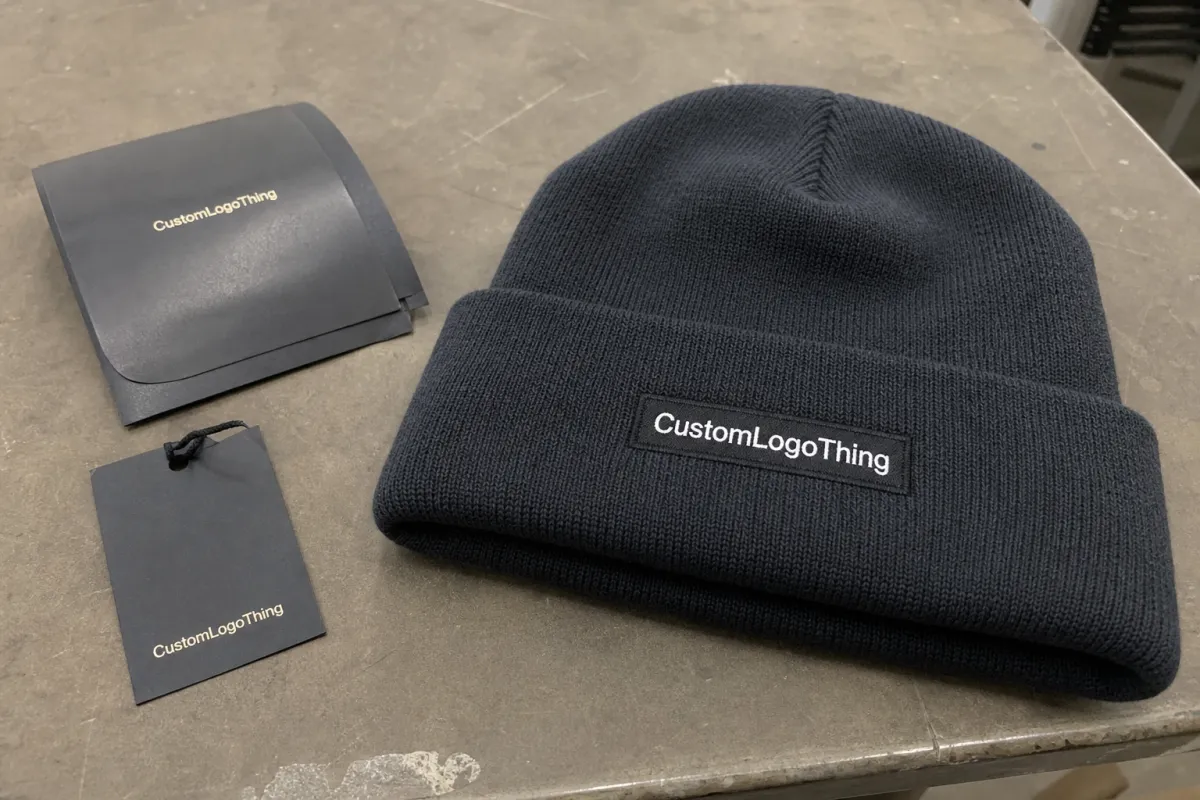
The cuff is the most useful part of the hat. It creates a flat zone for decoration, keeps the logo readable, and helps the beanie sit with more structure than a loose knit body ever will. On a retail table, that difference is obvious within seconds. On a corporate gifting desk, it is even more obvious because the fold and logo are the first things people touch.
Buyers often talk about “premium” as if it were a single material upgrade, but the cuff is what gives the product its polish. A shallow cuff can look casual and athletic. A deeper cuff usually looks more intentional, especially when the logo has room to breathe. That extra surface area is not just aesthetic; it affects stitch placement, patch size, and whether the design feels cramped.
Presentation changes value too. A retail-folded beanie with a hang tag and inside label feels complete. A similar hat delivered in bulk with no labels can feel unfinished even if the yarn is identical. This is one reason apparel premium cuffed Beanies Unit Cost rises faster than some buyers expect once the order moves from “just a hat” to a branded item with packaging standards.
For planning purposes, it helps to think in rough bands. A simple cuffed beanie with restrained embroidery might sit around $2.80-$4.00 per piece at higher quantities. Once you add a more polished label set, retail fold, or branded packaging, the range often moves into $4.50-$7.00. Those numbers are not universal, but they are close enough to explain why two quotes can look incompatible even before freight is added.
Product details that separate a standard beanie from a premium run
Three construction details do a lot of work before decoration even enters the conversation: yarn blend, stitch density, and cuff depth. Acrylic remains common because it is consistent, widely available, and easier to control on cost. Acrylic-wool blends usually feel warmer and denser, but they tend to push unit cost higher and can add variability if the fiber mix is not tightly specified. Tighter gauge knitting improves the visual surface and makes logos sit cleaner, though it can slightly reduce stretch.
The crown finish matters more than most spec sheets admit. If the seam is clumsy or the top shaping is uneven, the entire hat can look less polished, even with a good logo. On samples, that flaw is easy to miss if you only check the front view. Hold the hat, turn the cuff, and look at the crown from a few angles. Poor finishing shows up quickly on a premium item.
Decoration choice changes the price tier as much as the yarn does. Small embroidery is the simplest route and usually the easiest to control. Woven labels look neat, especially on a cuffed shape where the branding area is limited. Leather, PU, or silicone patches create a stronger fashion read, but they also add material cost and one more application step. Inside labels and hang tags finish the item for retail, though they can trigger setup charges and extra packing time.
| Decoration method | Typical added cost | Look and use | Notes |
|---|---|---|---|
| Small embroidery | $0.35-$1.20 | Clean, direct, budget-friendly | Best for simple logos and low stitch counts |
| Woven label | $0.20-$0.65 | Flat, tidy, retail-safe | Strong option for smaller branding on the cuff |
| Leather or PU patch | $0.60-$1.80 | Premium, textured, fashion-led | Material choice and application method change pricing quickly |
| Silicone badge | $0.75-$2.00 | Bold, modern, dimensional | Higher cost, strong shelf presence |
| Hang tag and inside label set | $0.15-$0.60 | Retail-ready finish | Useful for merchandising, barcodes, and compliance labeling |
Color strategy also affects the result more than many briefs suggest. A single solid color keeps production simpler. A contrast cuff, custom-dyed yarn, or two-tone build can lift the perceived quality, but each added color or specialty yarn increases the chance of shade variation and can complicate reorders. If the goal is control over apparel Premium Cuffed Beanies unit cost, restraint usually wins.
Fit is another detail worth locking early. A beanie that is too tight loses comfort. A beanie that is too loose can sag and distort the logo. The best samples usually balance stretch recovery with enough body to hold shape after wear. That balance is not glamorous, but it is one of the clearest markers of a piece that has been spec’d with care.
Specifications to lock before you request quotes
Pricing only becomes useful after the spec stops moving. Without a fixed brief, quotes drift because suppliers are pricing different products. The essentials are material blend, gauge, cuff height, decoration method, logo size, packaging format, and target quantity. If those are not set, the unit cost conversation is mostly guesswork.
Cuff depth deserves its own line in the brief. A deeper cuff gives more space for branding and usually makes the beanie feel more finished. A shorter cuff can look cleaner on some heads and feels less heavy, but it limits logo placement. That tradeoff should be deliberate, not accidental.
Logo specs need the same discipline. Give the exact artwork file, define embroidery size or patch dimensions, and set the placement on the cuff. If the design needs one location, say that. If it needs front and side branding, say that too. Every extra assumption becomes a cost later, usually in sample revisions or production delays.
Packaging belongs in the quote request from the start. Bulk pack, retail fold, barcode sticker, hang tag, and polybagging all influence both labor and carton count. If the order is headed to a warehouse, ask whether the packout should match retail receiving requirements or simple bulk shipment. For paper components, FSC-certified options are easy to specify through FSC. If the order will travel through multiple handling points, transit profiles from ISTA are useful for thinking about carton strength and damage risk.
Ask for sample, production, and freight as separate numbers. A blended quote hides where the real cost sits. Once those pieces are separated, it becomes easier to see whether the issue is the knit, the decoration, or the packing standard.
One more practical detail: confirm how color approval will work. Pantone matches on knitwear are approximate, not identical to printed substrates, and small shade variation is normal between dye lots. Buyers who expect a perfect hard match on textured yarn often end up disappointed. It is better to agree on an acceptable tolerance before production starts.
Apparel premium cuffed beanies unit cost: what moves the number
The unit cost changes for ordinary reasons, and they are easy to trace once the quote is broken apart. Quantity is the biggest lever. Yarn choice is next. Decoration, packaging, sampling, freight, and factory setup fees sit on top. If the run is small, apparel premium cuffed Beanies Unit Cost rises quickly because fixed costs are spread over fewer pieces.
That is why MOQ matters so much. A 50-piece order almost always carries a higher unit cost than a 500-piece order, even if the hat body never changes. The machinery still has to be set, the logo proof still has to be approved, and the hats still have to be inspected and packed. Those steps do not become cheaper just because the order is small.
Price breaks usually come in steps rather than a smooth curve. A supplier might quote one level at 100 pieces, another at 250, and a more efficient tier at 1,000. The improvement comes from less wasted setup time and a steadier production rhythm. If you want a cleaner number, ask exactly where the break points are and what changes at each tier.
There is also a difference between cheap and controllable. A standard acrylic cuffed beanie with small embroidery is one of the least expensive premium-looking options. Add a woven label and a retail fold, and the price rises, but the product still stays manageable. Add a patch, inside label, barcode sticker, and individual polybagging, and the quote climbs because each feature requires more material or labor.
The most useful quote comparison is line-by-line. Separate the hat body, the decoration, the packaging, and the shipping. Then compare like for like. A quote that looks lower on paper may actually exclude labels, exclude freight, or assume a smaller stitch count. That is how mismatched offers slip through and create problems later.
- Ask for line-item pricing so you can see the hat body, decoration, packaging, and freight separately.
- Confirm MOQ because some vendors quote a low entry number that carries a much higher unit cost.
- Check sample fees since some suppliers credit them back while others treat them as sunk cost.
- Ask about tooling fees for patches, labels, or molds before approving artwork.
- Confirm shipping terms so the landed cost is real, not theoretical.
For a practical cost check, a few common runs tend to fall into these bands:
| Run type | Typical quantity | Indicative cost per piece | Notes |
|---|---|---|---|
| Simple embroidered cuffed beanie | 100-250 | $3.20-$5.20 | Lowest complexity, good for basic branded merch |
| Woven label + retail fold | 250-500 | $3.80-$5.90 | Balanced finish and unit cost |
| Patch, hang tag, and polybag | 250-1,000 | $4.75-$7.50 | Higher perceived value, more handling steps |
| Custom knit details and specialty packout | 500+ | $6.00-$9.50 | Better suited to retail lines and seasonal launches |
Those ranges are wide because the spec is wide. They should be read as a sanity check, not a promise. If a quote comes in far below that band, check what has been omitted. If it comes in far above it, the run may include custom yarn, dense embroidery, special packaging, or a low-volume surcharge that has not been spelled out yet.
There is a hidden cost that buyers sometimes miss: rework. A slightly unclear logo file, a late color change, or a vague packaging instruction can create delay and waste. It is usually cheaper to spend ten minutes clarifying the brief than to pay for corrected labels or repacked cartons later.
Process and timeline: from artwork approval to ship date
The production sequence is simple on paper: request intake, mockup or proof, sample approval if needed, knitting, decoration, quality control, packing, and shipment. The machines are not usually the slow part. Delays tend to come from artwork revisions, approval lag, missing shipping details, or a material choice that was never fully specified.
For a straightforward run using stock colors and a small logo, a realistic timeline is often 12-15 business days after proof approval. Add custom yarn, specialty labels, or multiple decoration stages, and one to three weeks can disappear quickly. Sampling takes a few days for simple embroidery and longer if a patch, mold, or label tool has to be made first.
Late approvals cause more trouble than most buyers expect. So do color changes after the proof is already circulating. If carton marks, barcode placement, or destination details are missing, the shipment can stall near the end of the process, which is the worst moment for it to stall. The order is finished, the inventory is sitting there, and the paperwork is what holds it up.
Rush production exists, but it is not free and it is not always a smart trade. Faster schedules often mean higher labor charges, fewer decoration choices, and less room for revision. If the deadline matters more than the extras, keep the construction simple and make decisions early.
Quality control should not be a vague promise. For cuffed beanies, the practical checks are straightforward: logo placement within tolerance, stitch quality, cuff symmetry, color consistency, seam finish, measurement against spec, and carton count accuracy. On retail runs, it also helps to verify fold direction and barcode readability. These are basic checks, but they prevent the annoying kind of problem that only appears once the goods are already in the warehouse.
It is also useful to ask whether the supplier can reserve inventory for repeat orders. That matters for seasonal programs and replenishment buys, where the next order should match the first as closely as possible. A stable repeat run reduces the odds that the same beanie will need to be re-approved from scratch every time.
Why repeat buyers stick with well-built cuffed beanies
Repeat buyers care less about novelty than consistency. They want the cuff depth to stay the same, the logo to land in the same place, the color to stay close to the last run, and the packaging to look identical from carton to carton. If those details drift, the product feels unreliable and the brand gets blamed for it.
That is why quality control is not an afterthought. Better inspection, tighter carton labeling, and accurate pack counts reduce headaches for teams that store inventory or fulfill in batches. One wrong insert or a miscounted case seems minor until a warehouse opens it and the pieces no longer match the booking sheet.
There is a pricing reason repeat buyers stay loyal too. A beanie that looks polished and holds up in wear is easier to sell again. Customers may not know the stitch count, but they do notice whether the hat keeps its shape, whether the logo stays readable, and whether the cuff feels substantial. Those small impressions protect margin better than dramatic claims ever do.
Stable vendors also help with forecasting. If the same style can be reordered with minimal variance, apparel premium cuffed Beanies Unit Cost becomes easier to predict on the next buy. That matters in seasonal programs where a few cents one way or the other can turn into a real budget issue once the order scales.
Practical rule: a beanie that looks premium but is built on unclear specs usually stops being cheap the moment rework, confusion, or poor presentation enters the picture. The lowest quote is rarely the lowest total cost.
Next steps for a clean quote and a faster approval
Send the information that actually helps pricing: logo file, target quantity, preferred color, decoration method, packaging requirements, and the date the goods need to arrive. That short list cuts most of the back-and-forth that slows quoting down.
Ask for two versions if you need a meaningful comparison. One should be the lowest unit price. The other should be the fastest turnaround. Those are often different builds, and the difference matters. A simpler spec may save time more effectively than squeezing the decoration package harder.
Before you approve anything, confirm size, cuff height, brand colors, label style, and freight destination. If the order is for retail, also confirm barcode placement and fold standard. If it is for a corporate kit, decide whether each beanie needs an individual polybag or a bulk pack. These are small choices, but they shape both cost and the final presentation.
The cleanest way to manage apparel premium cuffed beanies unit cost is to treat the spec like a production document, not a brainstorming note. Tight brief, focused decoration, sensible packaging, and line-item pricing. That combination does more for the final number than chasing tiny discounts on an unclear order ever will.
What drives cuffed beanie unit cost the most?
Order quantity is the biggest lever because setup costs spread faster on larger runs. Decoration method, yarn blend, and packaging choice can move the price more than the hat body itself. A line-item quote is the easiest way to see where the money is actually going.
What MOQ should I expect for premium cuffed beanies?
Practical MOQs often start around 50 to 100 pieces, but the floor depends on material choice and decoration complexity. Custom labels, patches, or specialty yarns usually need a higher minimum than stock-color embroidery. If you are testing a design, ask for the smallest viable run and compare it to the next price tier.
How long does production take for custom cuffed beanies?
Simple orders can move in a few weeks after artwork is approved, while custom knit details or special packaging add more time. Sampling, proof changes, and material sourcing usually drive the timeline, not the knitting itself. If timing is tight, reduce the number of variables before you place the order.
Which decoration method keeps the price closest to budget?
A small woven label or restrained embroidery is usually easier to control than dense stitching or large patches. Patches can look premium, but the material and application method affect the price quickly. If the budget is fixed, keep the logo simple and avoid stacking multiple decoration methods unless they serve a clear purpose.
How can I lower apparel premium cuffed beanies unit cost without cheapening the product?
Use one clean logo placement, standard packaging, and a simple colorway instead of adding extra features everywhere. Increase quantity where possible because larger runs usually reduce unit cost more effectively than minor spec tweaks. Protect the yarn quality, fit, and logo clarity, and the product can still read as premium without unnecessary cost.


