A wine club beanie can look straightforward from a distance, but the wine club cuffed knit beanies Unit Cost Review changes quickly once decoration, packaging, and freight are on the table. A blank hat price is only the first number. The finished item is a different calculation, and that is where better buying decisions happen.
cuffed knit beanies earn their place in wine programs because they are useful, seasonal, and easy to ship with a membership packet or holiday release. They feel more substantial than a flat insert, and they are one of the few promo items that can carry a logo without looking like an afterthought. Members tend to wear them, which gives the brand more mileage than a novelty gift that stays in the box.
That practical value matters. A hat that looks premium in a proof but feels flimsy in hand will disappoint a club audience faster than almost any other apparel item. The reverse is also true: a well-built knit with a simple, clean mark can feel more valuable than a more expensive item with poor proportions or awkward branding.
Why a Knit Beanie Quote Changes Once Decoration Is Added
The most common pricing mistake is treating the blank beanie as the full cost. It never is. The finished unit cost depends on the base hat, the decoration method, the number of colors, the size of the logo, setup charges, packaging, and freight. If the quote does not show those parts separately, the buyer is not seeing the real number.
Wine clubs usually want one of three outcomes: a polished member gift, a tasting-room retail item, or a seasonal promo piece that ships well with other club materials. Cuffed Knit Beanies work for all three, but the spec changes depending on the goal. A member gift usually needs a better hand feel and a cleaner decoration zone. A retail item needs stronger shelf presence. A promo item needs dependable stock and fast turnaround.
The right way to review pricing is to compare finished cost per piece, not blank cost alone. A thicker cuff, denser knit, larger embroidery area, or custom patch can move the number more than many buyers expect. So can individual bagging, printed inserts, or a special fold. Those details are small in isolation and significant in aggregate.
Here is the shortest honest version of what shapes the quote:
- Base beanie price is only the starting point.
- Decoration changes labor, appearance, and sometimes the minimum quantity.
- Setup charges can apply to embroidery, woven labels, or custom patches.
- Packaging adds cost, but it can also protect the piece and improve presentation.
- Freight matters because knit goods are bulky compared with many other promo items.
That is why a useful wine club Cuffed Knit Beanies Unit Cost review has to be built from line items, not assumptions. Once the lines are visible, it becomes much easier to compare suppliers, adjust quantity, or trim features that do not actually help the program.
Cuffed Knit Beanie Formats That Work Best for Wine Clubs
Most wine club orders end up in a narrow set of constructions, which is a good thing. The options are specific enough to compare without getting lost in marketing language. Standard acrylic cuffed beanies remain the workhorse because they are affordable, warm enough for most climates, and available in enough stock colors to match club branding without custom dye work.
Blend yarns, such as acrylic with polyester or a small wool content, change the feel. They can look a little richer and hold their shape better, but they also raise the price. For clubs that want a more retail-minded look, that can be worth it. For a large seasonal mailer, a dependable stock acrylic option usually makes more sense.
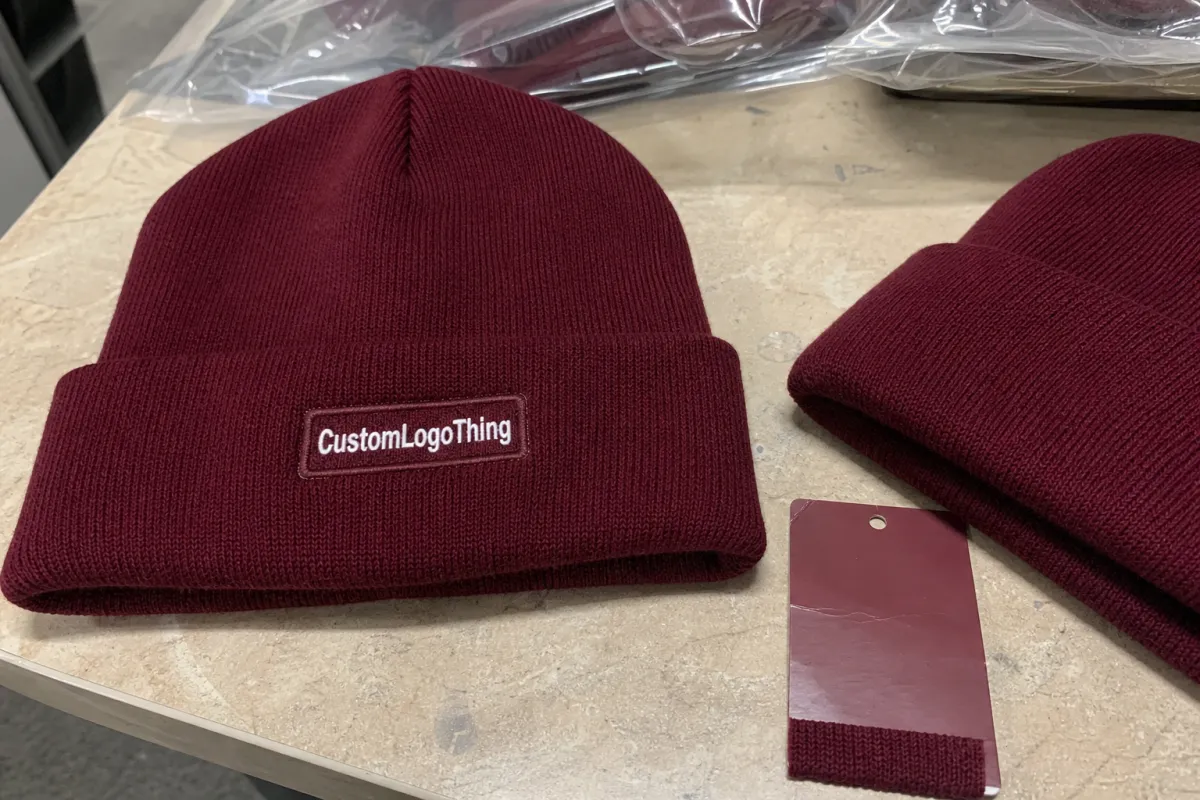
There is also a real difference between a promotional fit and a retail-style fit. Promotional beanies are often lighter and more forgiving, which helps price and inventory flexibility. Retail-style beanies usually have a deeper cuff, cleaner stitch definition, and a more controlled silhouette. For wine clubs, the cuff is especially important because it is the branded area. If the cuff is too short or too loose, the logo loses impact.
Decoration choices are usually limited to a few practical methods:
- Embroidery for durable branding, lower setup burden, and simple logos.
- Woven patches for finer detail and a more finished retail look.
- Faux leather patches for a warmer, premium lifestyle feel.
- Heat-applied labels for small marks, secondary messaging, or simpler decoration needs.
Each method changes the balance between cost and presentation. Embroidery is usually the cleanest solution for short text or a small mark. A patch makes more sense when the art contains fine detail that would get crowded in thread. Faux leather reads well on dark knits and can signal a higher-end club tier, but it is not the best choice for very small type or artwork that relies on fine lines.
For welcome gifts, a cleaner and more polished build usually works best because the first shipment sets the tone for the program. For tasting-room retail, style and margin carry more weight. For a holiday promotion, stock color and turnaround often matter more than anything else. That is why the same hat can be the right answer in three different ways, depending on the use case.
| Beanie Format | Typical Blank Range | Decoration Notes | Best Use |
|---|---|---|---|
| Standard acrylic cuffed knit | $1.60-$2.80 | Best for embroidery or a small woven patch | Member gifts, bulk club shipments |
| Heavier retail-style cuffed knit | $2.40-$4.20 | Cleaner stitch definition, better cuff presentation | Premium club tiers, tasting-room retail |
| Acrylic-blend winter weight | $2.20-$4.60 | Stronger hand feel, often better for larger patches | Colder regions, higher perceived value |
Those figures are starting points, not a universal quote. Still, they help separate a low-cost novelty hat from a beanie that can support a wine label with a premium story. A cheap knit can work for a seasonal giveaway. A better cuff, tighter gauge, and cleaner decoration area usually make more sense when the item is tied to membership value.
Spec Sheet: Yarn, Gauge, Size, and Decoration Limits
The spec sheet is where the useful decisions happen. Yarn choice is the first fork. Acrylic is standard because it balances price, warmth, and color consistency. A blend can feel softer or heavier, but it may also shift the hand feel enough that the quote and lead time move with it. If the club wants a more premium touch, that should be discussed early instead of being discovered after proofs are out.
Gauge matters more than most buyers expect. A tighter gauge gives a cleaner surface and usually supports embroidery or patches more evenly. A looser gauge can feel warmer and more relaxed, but it may not hold a sharp logo as well. On knit goods, the decoration zone is never perfectly flat, so the construction underneath the art affects readability.
Fit is another practical issue. Most cuffed knit beanies are built around adult sizing with stretch recovery, but not every style wears the same. A deeper cuff gives more space for a logo and tends to read more intentional. A shorter cuff looks more casual. Slouch profiles can work if the club wants a fashion-forward piece, but they are not always the best choice when the goal is consistency across multiple tiers or reorder cycles.
Decoration limits are easy to underestimate. A patch that is too wide can crowd the cuff seam. Embroidery that is too dense can stiffen the front panel and make the hat less comfortable. Large artwork also increases stitch count, which can slow production and raise price. The most useful feedback from a production team is not whether the logo technically fits, but whether it fits cleanly and wears well.
Production buyers also need to think about transit. If the beanies are being shipped with bottles, printed materials, or other club goods, the packout has to survive normal parcel handling. For shipping standards and carton testing, the International Safe Transit Association at ista.org is a practical reference point. A hat can be made correctly and still arrive poorly if the packout was not designed for the route.
Paper components matter too. Clubs that want a cleaner material story can review FSC certification guidance at fsc.org when choosing inserts, hang tags, or gift cards. That does not change the knit itself, but it can improve the credibility of the overall package.
The best spec sheets are plain. Yarn type, gauge, cuff depth, fit profile, logo size, decoration method, and any packaging notes should be visible at a glance. When that information is clear, the buyer can compare options on substance instead of trying to decode vague language.
Unit Cost, Pricing Breaks, and MOQ Planning
The unit cost of a cuffed knit beanie is built from several moving parts: the blank hat, the decoration method, setup charges, packaging, and freight. If the item includes a custom patch, tooling may be added. If the order needs polybagging, inserts, or retail folding, labor increases. The quote should separate those costs so the buyer can see what is fixed and what scales with quantity.
For a stock cuffed beanie with one logo location, these planning ranges are common:
- Blank beanie: $1.60-$4.60 depending on yarn and density.
- Embroidery add-on: $0.35-$1.10 per piece, depending on stitch count.
- Patch application: $0.55-$1.60 per piece, depending on patch type and size.
- Setup charges: $35-$125 for embroidery or simple patch runs.
- Tooling fees: $60-$200 if a custom patch die or mold is needed.
- Individual packaging: $0.15-$0.85 per piece.
Those figures are not theoretical. They reflect the way a typical order is built in practice. A stock beanie with a small embroidery hit and simple carton packing usually lands on the lower end. A custom color, larger patch, printed insert, and individual mailer can move the price much higher, even before freight is counted.
Quantity breaks matter a lot. Fixed costs spread out as the run gets larger, so a 250-piece order almost always carries a higher per-piece burden than a 1,000-piece order. That is normal. Setup work, proofing, and production planning take nearly the same effort whether the run is small or large. The bigger order simply absorbs more of that work.
Here is a practical comparison using a standard stock beanie, one logo location, and basic carton packing:
| Quantity | Embroidery Finished Cost | Patch Finished Cost | Typical MOQ Pressure |
|---|---|---|---|
| 250 | $3.75-$5.50 | $4.25-$6.20 | Higher per-piece cost, limited color options |
| 500 | $3.10-$4.65 | $3.65-$5.35 | More workable for most club launches |
| 1,000 | $2.65-$4.05 | $3.15-$4.85 | Better bulk pricing and smoother reorders |
| 2,500+ | $2.35-$3.75 | $2.85-$4.30 | Best leverage on setup and freight spread |
The MOQ question depends on construction. A stock beanie with embroidery usually allows a lower minimum than a custom-knit or custom-color program. Add multiple logo placements, special yarn, or a nonstandard cuff treatment, and the minimum can climb. That is not a sales trick; it is tied to inventory planning, machine time, and labor scheduling.
A buyer-friendly pricing checklist should include the sample or proof cost, production cost at the target quantity, setup charges, packaging cost, freight, and any rush fee if the delivery date is tight. If those six items are visible, the quote is usable. If they are not, the buyer is still guessing at the finished number.
Artwork Process, Proofing, and Lead Time Expectations
Good production starts with clean art. The sequence is simple: artwork intake, digital proof, sample or pre-production approval, bulk decoration, finishing, and final packing. The better the artwork arrives, the less time gets wasted on redraws and clarifying notes. That matters because knitwear can require more handoff than a basic print job.
Lead time depends on the decoration method and the factory workload. Simple embroidery on stock beanies is usually the fastest route, sometimes landing in the 12-15 business day range after proof approval if inventory is already available. Patch applications can be similar, though custom patch production adds time. A custom-knit beanie or a heavier spec build usually takes longer because the knitting itself is more specialized.
What slows orders down most is not the machine work. It is the approval cycle. Logo placement, thread colors, cuff height, patch size, and packaging details should all be confirmed before the run begins. A small change in cuff depth can change the balance of the mark. A thread color that is close but not quite right can make a logo look muddy instead of crisp.
Shipping time needs to be separated from production time. A 2-week run is not the same as a 2-week delivery. If the beanies are tied to a club shipment, work backward from the mail date, not from the day the goods leave production. That distinction prevents the kind of schedule miss that only shows up once the bottles are already boxed.
“The strongest orders are the ones where the art is clean, the quantity is final, and the cuff spec is agreed before production starts.”
That matters even more when the beanies are part of a larger kit with tasting notes, inserts, or a bottle sleeve. In those cases, the proof should show how the logo sits on the cuff and how the item will move through the packout. Small spacing mistakes are easy to catch on a proof and annoying to correct after the line has started.
How We Keep Custom Beanie Orders Easy to Approve
Procurement teams and marketing teams usually want the same thing: fewer surprises. Clear proofs, consistent specs, and simple communication reduce back-and-forth and keep the order moving. For a wine club, that matters because the beanie often has to match a broader brand system across several shipments, colorways, or membership levels.
Repeatability is underrated. A member who receives the same logo placement and cuff depth across repeated shipments sees a program that feels organized. That kind of consistency strengthens the brand and makes future reorders easier because the approved dimensions do not need to be rebuilt from scratch.
Practical quality checks are better than abstract promises:
- Stitch consistency across the body and cuff.
- Patch alignment so the logo sits straight, not twisted.
- Logo readability at normal viewing distance.
- Carton inspection before ship-out for count accuracy and packing quality.
For paper inserts or gift cards bundled with the beanies, FSC-certified stock is worth considering when the brand wants to make a sustainability claim with some substance behind it. It also helps the club packet feel more deliberate. If the knit item is premium, the supporting materials should not feel like a generic afterthought.
Reorder planning is another place where disciplined process pays off. If the original order used approved artwork, known decoration dimensions, and a packaging format that worked, the next run can move faster with fewer corrections. That is especially useful for clubs that bring back a winter item annually or rotate between tiers without changing the core design.
Next Steps: Send Your Quantity, Logo, and Target Date
If you are pricing a wine club gift, send the basics first: estimated quantity, preferred color, logo method, delivery window, and ship-to location. That is enough to build a real quote instead of a placeholder. If there is a target club release date, include that too. The date determines how much room there is for proofing, production, and freight.
Ask for a mockup and a line-item quote. The mockup should show logo placement on the cuff, and the quote should separate the blank beanie, decoration, packaging, and freight. That makes it easier to compare unit cost across options without losing track of what is actually included.
A sensible decision order looks like this:
- Confirm specs and decoration method.
- Approve the proof.
- Lock production quantity.
- Plan delivery around the club shipment or retail launch.
If you need a clear wine club cuffed knit beanies Unit Cost Review, the most useful inputs are the quantity, the logo file, the preferred finish on the cuff, and the date the hats need to land. With those details, the quote can be broken into blank cost, setup charges, decoration, packaging, and freight. That is the cleanest way to price the order without surprises later.
What drives the unit cost for wine club cuffed knit beanies?
The main cost drivers are the blank beanie style, decoration method, setup charges, packaging, and shipping. Heavier yarns, denser stitch patterns, larger logo applications, and custom patches usually increase the price. Higher quantities help because they spread fixed costs across more pieces and lower the cost per item.
What MOQ should I expect for custom cuffed knit beanies?
MOQ depends on whether the order uses a stock beanie or a custom color, trim, or knit-in detail. Decoration-only orders usually allow lower minimums than fully custom knit programs. The exact minimum changes with the logo method, the number of colors, and whether separate inventory is needed for different tiers.
Which logo method looks best on a wine club beanie?
Embroidery is usually the cleanest option for simple marks and small cuff space. Woven patches and faux leather patches can create a more retail finish and help detailed logos read clearly. The best choice depends on the size of the logo, the yarn weight, and the overall brand look.
How long does production usually take after proof approval?
Lead time varies by decoration method, order size, and current production load. Stock beanies with simple decoration usually move faster than custom-knit or heavily specified orders. Buyers should also include time for proof revisions and shipping after production is complete.
Can we split one beanie order across multiple colors or wine club tiers?
Yes, if the total quantity still meets the MOQ and the decoration plan stays consistent. Color splits can change unit cost when they require separate inventory pulls or different dye lots, so it is best to confirm whether one artwork setup can cover every tier without extra charges.