Buyer Fit Snapshot
| Best fit | folding cartons practices what really for packaging buyers comparing material specs, print proof, MOQ, unit cost, freight, and repeat-order risk where brand print, material, artwork control, and repeat-order consistency matter. |
|---|---|
| Quote inputs | Share finished size, material target, print colors, finish, packing count, annual reorder estimate, and delivery region. |
| Proofing check | Approve dieline scale, logo placement, barcode or warning zones, color tolerance, and any recyclable or compostable wording before bulk production. |
| Main risk | Vague material claims, crowded artwork, or missing packing details can create delays even when the unit price looks attractive. |
Fast answer: Folding Cartons Practices What Really: Dieline, Finish, Proof, and Buyer Review should be specified like a repeatable production item. The safest quote includes material, print method, finish, artwork proof, carton packing, and reorder notes in one written spec.
What to confirm before approving the packaging proof
Check the product dimensions against the actual filled item, not only the sales mockup. Ask for tolerance on folds, seals, hang holes, label areas, and retail display edges. If the package carries a logo, QR code, warning copy, or legal claim, reserve that space before decorative graphics fill the panel.
How to compare quotes without losing quality
Compare board or film grade, print process, finish, sampling route, tooling charges, carton quantity, and freight assumptions side by side. A lower quote is only useful if the supplier can repeat the same color, closure quality, and packing count on the next order.
Folding Cartons Best Practices: What Really Works
The most expensive folding carton problems rarely begin on press. They usually begin much earlier, with a spec that looks neat on paper and falls apart the moment the carton meets a real product, a real line, or a real shipping lane. Folding cartons best practices start with the product itself, the way it will be packed, and the kind of handling it will see after the sample leaves the table. When those pieces are out of alignment, even a polished prototype can become a production headache.
From a packaging buyer’s point of view, a carton has four jobs that cannot be separated for long: protect the product, run cleanly on the pack line, sell the item on shelf, and do all of that at a cost that leaves room for margin. That sounds straightforward, yet weak decisions keep slipping through because one of those jobs gets pushed aside during design. I trust the fold line, the score, and the closure fit long before I trust a pretty render, because that is usually where the truth shows up.
For a custom branding project, the right answer is seldom the most elaborate one. Folding cartons best practices tend to reward discipline: choose the structure first, then the board, then the finish. Add foil, embossing, coatings, or special effects only if they earn their place. That order keeps the project grounded, especially when different teams all want a little more of something.
Here is the shortest version. If a carton has to move through a standard pack line, the score needs to stay crisp, the glue areas need enough contact to hold at production speed, and the board has to keep its shape without cracking at the folds. If the product sits in a crowded retail category, shelf presence matters, but not at the expense of closure fit or transit durability. The best carton is not the most dramatic sample; it is the one that holds protection, print quality, price, and repeatable production together.
Quick Answer: Folding Cartons Best Practices
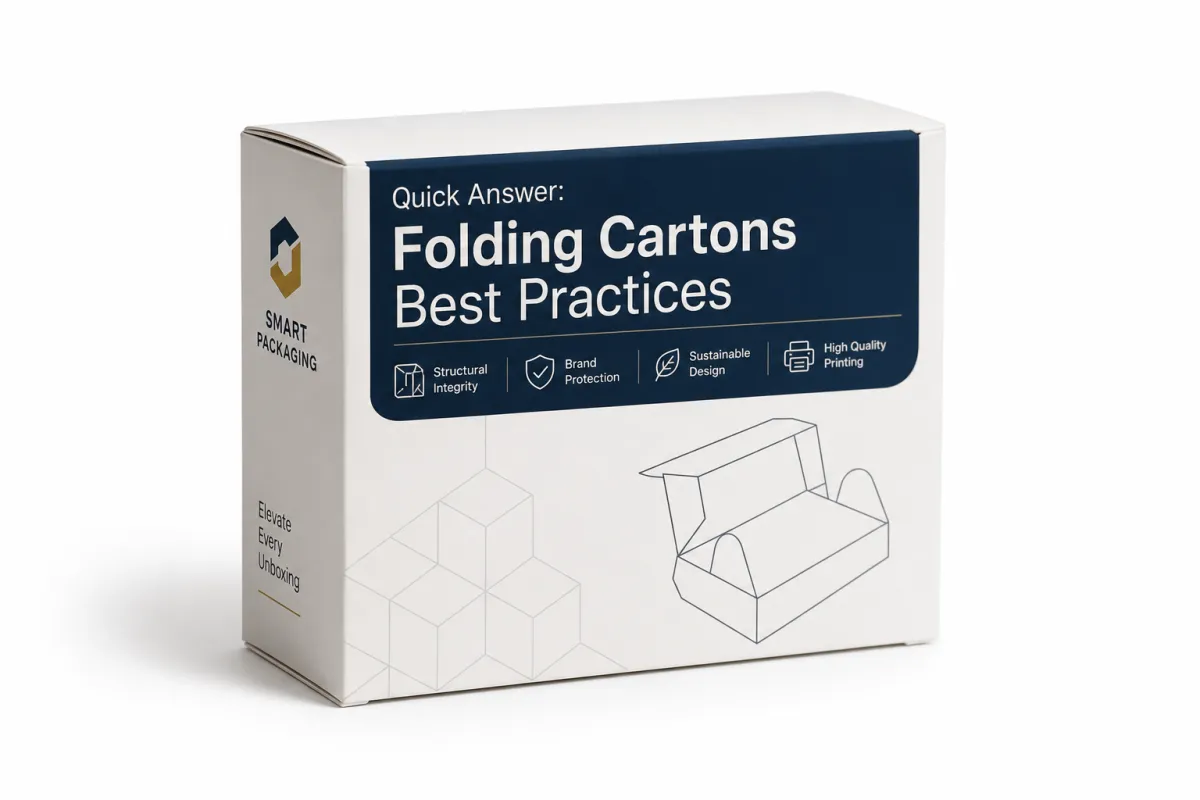
The fastest route to folding cartons best practices is to stop treating the carton like decoration and start treating it like a working part of the product system. Most failures come from a poor spec, not from one bad supplier. A carton that falls short usually does so because the product is too heavy for the structure, the score is too tight for the board, or the finish looked fine in a mockup but could not survive handling in the warehouse or on the line.
The first decision that matters is matching carton style to product weight, retail display needs, and shipping stress before anyone starts debating foil, embossing, or specialty coatings. A lightweight serum can sit comfortably in a straight tuck end carton. A heavier supplement bottle or device accessory often calls for an auto-lock bottom or a reinforced base. That order of decision-making sits at the heart of folding cartons best practices: structure before decoration.
If the carton has to move through a standard pack line, three things need attention right away. Clean folds that do not spring open after creasing. Glue areas with enough surface contact to hold at production speed. Board grade that survives repeated handling without cracking at the scores. A line running 40 to 80 cartons per minute leaves very little space for a weak design, and that is usually where buyers lose time, labor, and stock.
A carton that looks premium but cracks at the score is not a premium package. It is a marketing cost with a structural flaw.
The review frame should stay simple. The best carton protects the product, looks credible on shelf, prints cleanly, and can be reproduced on the next order without surprises. That is why folding cartons best practices begin with the sample, not the sales pitch. When you inspect a sample, check the dimensions against the fill, study the score quality, test the closure fit, and open and close it several times after folding. If the carton loosens after a few handlings, that is a warning sign, not a minor detail.
A careful buyer also asks one blunt question: what will this carton cost in real use? That means damage rate, line speed, storage space, and rework risk, not only the quoted unit price. In practice, folding cartons best practices are about avoiding surprises, because surprises are where budgets go to disappear.
Top Folding Carton Options Compared
Choosing a carton style is less about taste and more about how the product behaves in the real world. Weight distribution, opening direction, shelf orientation, and the amount of handling the pack will see all shape the right answer. Treat every carton as though it works the same way and the bill shows up later in damaged goods, slower pack-out, or a package that simply feels off in the hand. That is why folding cartons best practices begin with structure.
Straight tuck end cartons are the workhorse for lightweight goods. They are simple, economical, and common when the product does not require a reinforced bottom. The tuck flaps close in the same direction, which helps create a clean front panel and a familiar opening experience. They are usually a sensible choice for cosmetics, small personal care items, and retail goods that do not need much base support.
Reverse tuck end cartons fit well when production efficiency matters more than the opening direction. The top and bottom tuck in opposite directions, which can make folding easier in some setups. They are common when the carton needs a tidy shelf face and a predictable pack-line rhythm. For many buyers, this is one of the safest starting points in folding cartons best practices.
Auto-lock bottom cartons become important when weight changes the equation. They cost more, but they often lower the risk of failure during packing and transit because the bottom locks into place more securely. For bottles, jars, parts, or dense contents, that extra support can save money by reducing crushed corners and rework. The carton may take a little longer to set up, yet that delay is usually cheaper than a damaged shipment.
Sleeve-style cartons create a strong premium impression, especially when the item inside already has a tray or inner pack. They work well for high-touch retail, gift sets, and promotional kits. The tradeoff is plain: the sleeve can look elegant, but it offers less protection unless it is paired with an insert or a rigid inner component. If the product needs real containment, the sleeve alone is not enough. Folding cartons best practices mean being clear about that limitation instead of hoping the design will compensate.
Display-ready cartons are built for retail environments where shelf appeal drives conversion. They can perform well for club stores, specialty retail, and high-visibility launches. They also bring complexity in scoring, die cutting, and opening perforations. More moving parts mean more places for quality to slip if the spec is careless. A display feature that tears too early or opens unevenly causes more trouble than having no display feature at all.
Here is a quick comparison that buyers can use to narrow options before requesting samples:
| Carton style | Best for | Typical strengths | Typical tradeoffs | Indicative unit cost at 5,000 units |
|---|---|---|---|---|
| Straight tuck end | Lightweight retail goods | Simple structure, efficient print layout, easy assembly | Not ideal for heavier items or high stack loads | $0.18-$0.32 |
| Reverse tuck end | General-purpose retail packaging | Predictable folding, clean shelf presentation | Bottom support is limited for heavier contents | $0.19-$0.34 |
| Auto-lock bottom | Heavier products | Better base strength, faster setup on some lines | Higher die complexity and higher unit cost | $0.24-$0.45 |
| Sleeve with tray | Premium kits and gift sets | Strong visual appeal, strong unboxing impression | Less protection unless paired with an inner structure | $0.30-$0.60 |
| Display carton | Retail conversion | More shelf theater, can support merchandising | More scoring and tear-point complexity | $0.28-$0.55 |
The buying lens should stay practical. The best option depends on product weight, hand feel, retail visibility, and how much time the pack line can spare. That is the real center of folding cartons best practices: a carton must work in the factory before it earns its place in the store.
Folding Cartons Best Practices for Materials and Print
Board choice is where a lot of projects quietly go wrong. Buyers often focus on the front-panel artwork and leave the substrate as an afterthought. That is risky. SBS, recycled board, and specialty substrates all solve different problems, and the wrong board can make a good design feel fragile, dull, or hard to fold. If a carton looks sharp on screen but sags in the hand, the material was wrong from the start. Folding cartons best practices depend on choosing a board that fits the product and the handling it will face.
SBS, or solid bleached sulfate, usually gives the cleanest print and the brightest white surface for premium graphics. It is common in cosmetics, personal care, and food packaging that needs vivid color reproduction. Recycled paperboard often makes more sense when sustainability claims, cost control, or a more natural look matter. Specialty substrates can be the right choice when moisture resistance, stiffness, or unusual converting behavior matters, but they should be chosen for a reason, not because the spec sheet sounds impressive. The board needs to support the structure, not just the brand mood.
Caliper and score performance deserve more attention than they usually get. A carton can appear strong on paper and still split at the fold if score depth, board thickness, and fold direction are not balanced. That becomes more obvious on higher-caliper stocks, where too much pressure can crush the fibers and leave a white crack at the bend. From a buyer’s perspective, that crack is not cosmetic trivia; it is a sign that the carton may not survive repeated handling. This remains one of the most overlooked pieces of folding cartons best practices.
Print quality has to be judged against durability, not only the first unboxed impression. High-end graphics help, but if the finish scuffs before the carton reaches the shelf, the package loses value quickly. A glossy carton can show scratches more readily than a matte one. Soft-touch feels expensive, yet it is kinda easy to oversell if the run will be handled heavily in a warehouse. If the package is likely to move through distribution centers or through many hands, ask how the finish behaves after abrasion, not only how it looks on the sample board.
Common coating choices each serve a different role. Aqueous coating is a practical default for many folding cartons because it dries quickly and adds useful scuff resistance. Gloss coating increases color saturation and shine, which can help a retail SKU stand out from a distance. Matte creates a quieter, more contemporary feel and can hide fingerprints better than gloss. Soft-touch adds a tactile premium effect, but it increases cost and can be less forgiving when the carton is handled heavily. None of these is universally best. Folding cartons best practices mean matching the coating to the actual use case.
Windows, inserts, embossing, foil, and spot effects are conversion tools, not extra decoration. They should earn their place. A window can lower friction by showing the product, but it can also weaken the carton if the cutout is too large or too close to the score. An insert can stabilize a bottle or device, but it adds material and assembly labor. Embossing can raise perceived value, yet it should not interfere with readability or barcode placement. Every add-on should solve a business problem. If it does not, it is usually noise.
For sustainability language, precision matters. If a carton uses recycled content, say what percentage and what standard supports the claim. If FSC-certified fiber is part of the story, make sure the certification chain is actually in place. Buyers should also check whether the design supports recycling after use, because complicated laminates and mixed materials can make recovery harder. Two useful references are the ISTA testing procedures for distribution performance and FSC certification guidance for responsible fiber sourcing. Those standards do not replace judgment, but they give the conversation a firmer shape.
Quality control should ask one blunt question: does the carton still look and function the same after folding, filling, stacking, and shipping? If the answer changes after each step, the spec is not stable enough yet. That is the real measure of folding cartons best practices.
Price Comparison: What Folding Cartons Actually Cost
Cost gets fuzzy fast because a carton quote is never only a carton quote. Setup and tooling often drive the budget more than the unit price itself. That is why low-volume projects can look expensive even when the structure is simple. On a short run, the die, plates, proofing, and make-ready charges can outweigh the board cost by a wide margin. Folding cartons best practices include judging the full cost stack, not only the line item on the quote.
When I break pricing down for buyers, I look at seven variables: board choice, print method, number of colors, coatings, special cuts, inserts, and finishing. Each one nudges the number up or down. A one-color black print on a basic tuck end carton sits in a very different cost class from a six-color carton with soft-touch coating, foil, and a custom insert. That difference can be modest at 50,000 units and sharp at 2,500 units. The smaller the run, the more setup matters.
Here is a practical pricing view for common commercial runs. These are not universal rates, because region, board availability, and design complexity all move the number, but they are close enough to help a buyer compare options intelligently:
| Spec type | Typical run size | Approx. unit price | What drives the cost | Best use case |
|---|---|---|---|---|
| Basic tuck end, 1-2 colors | 5,000-10,000 | $0.16-$0.28 | Simple print, minimal finishing, standard board | Lightweight retail items |
| Premium print, aqueous coat | 5,000-10,000 | $0.22-$0.40 | More ink coverage, coating, tighter register control | Cosmetics and personal care |
| Auto-lock bottom, custom die | 5,000-10,000 | $0.28-$0.52 | Stronger base, more complex conversion, extra setup | Heavier products |
| Sleeve with insert | 3,000-5,000 | $0.35-$0.75 | Multiple components, assembly labor, specialty finishing | Gift sets and premium kits |
| Display-ready carton with special finish | 10,000+ | $0.30-$0.60 | Complex scoring, tear features, premium coating or foil | Retail launch programs |
There are hidden costs buyers miss more often than they should. Freight can matter when cartons ship flat but occupy a lot of cubic space. Extra proofs and late artwork changes add both time and money. Reorders caused by unclear specs can quietly erase the savings from a low quote. Then there is waste. A carton that jams on line or cracks at the score may look inexpensive on paper and costly in real life.
That is why landed cost matters more than unit price. If two samples look close, compare not only what you pay per thousand, but what you actually keep after waste, damage, and packing time. A cheaper carton that slows the line by even a few seconds per unit can become the most expensive choice very quickly. That is one of the less comfortable truths in folding cartons best practices: the better commercial option often costs a little more up front and less later.
One more point: custom engineering can save money later if it reduces rework or protects the product better. Buyers sometimes resist that idea because the quote looks higher on day one. If the carton reduces damaged goods, protects the print, or packs faster, the payback can be real. In practice, folding cartons best practices are about spending where failure is costly and simplifying everywhere else.
Process and Timeline: From Dieline to Delivery
The carton timeline looks simple from a distance, then it gets complicated fast once artwork, structural design, and launch timing collide. The cleanest projects usually follow the same path: brief, dieline, structural review, artwork, proofing, sample approval, production, finishing, packing, and shipping. Skip a step and the schedule usually reminds everyone why that step existed. Folding cartons best practices depend on respecting the process instead of rushing past it.
Most delays come from issues that could have been caught early. Missing dimensions are common. Late artwork changes are common. Barcode requirements are often missed until the end, which is especially painful because it can trigger a full proof revision. Approval bottlenecks create another kind of delay. A designer may be ready, the packaging team may be ready, and legal may still be reviewing claims. Meanwhile, the production slot waits. That kind of gap is where launches drift.
Sampling deserves real attention. Structural prototypes can move quickly, especially when the carton is plain or the dieline is already known. Printed proofs usually take longer because color, finish, and text accuracy matter. Corrected samples take longer again if the brand team wants changes after seeing the first proof. If the carton carries regulated information, such as ingredient panels or warning copy, the review window narrows further. I have seen teams treat the proof phase like a formality. It is not. It is the last low-cost chance to catch a mistake.
A typical custom run for a standard carton can move in roughly 10 to 15 business days after proof approval if the spec is straightforward and the supplier already has the board in stock. Add specialty finishes, inserts, or complex folds, and the timeline can stretch by another week or two. That is not a failure; it is the normal price of more setup, more handling, and more quality checks. Folding cartons best practices mean building buffer time into the launch plan so packaging does not become the reason the product slips.
Here is a practical rule: when packaging touches filling, retail compliance, and freight booking at the same time, assume the schedule will be tighter than anyone first says. If the carton is needed for a product launch, start the carton project early enough that one sample revision will not break the calendar. Buyers who understand folding cartons best practices usually protect themselves with one extra approval window, not because they expect failure, but because they expect reality.
On day one, send your supplier a brief with the following details:
- Exact product dimensions and weight
- Fill method, including whether packing is manual or automated
- Retail display requirements and shelf orientation
- Target print finish and any special effects
- Shipping conditions, including stacking and transit expectations
- Barcode, regulatory copy, and sustainability claim requirements
- Target delivery date and preferred proofing timeline
That level of clarity shortens the loop for everyone. It also improves the odds that the first sample is useful instead of decorative. The best projects are not the ones with the most back-and-forth. They are the ones that start with enough detail to make folding cartons best practices usable from the first quote.
How to Choose Folding Cartons Best Practices for Your Product
The right carton choice starts with product fit. Fragile items need protection and controlled movement. Lightweight items can favor branding and fast assembly. Dense items need stronger base support and more forgiving board behavior. If the product is likely to move through distribution centers, travel by parcel, or sit under stack pressure, the carton needs to behave like packaging, not a display card. That is where folding cartons best practices become product-specific instead of generic.
Then comes shelf impact versus production speed. If the product sits in a crowded category, visual differentiation may matter more than a small unit-cost saving. A clean front panel, a controlled matte finish, or a well-placed window can change how fast a shopper understands the offer. If the line is already stretched, a complicated structure can slow pack-out enough to wipe out the marketing gain. Buyers often pretend they do not have to choose. They do. Folding cartons best practices are about deciding which constraint matters most.
Retail and compliance needs should be checked early. Barcode placement, ingredient panels, warning copy, and reseller or distributor rules can reshape the carton faster than design preferences can. A brand team may love a full front panel, but if the regulatory text crowds the SKU code or the shelf-facing layout, the package is not ready. That is especially true for food, supplements, and products sold through strict retail channels. A compliant carton that looks slightly less exciting is still better than a beautiful carton that gets rejected.
I also recommend a decision matrix. Rank protection, appearance, cost, and timeline from one to five. Give the highest weight to the category that matters most for the launch. That sounds simple, but it keeps taste from overpowering judgment. A luxury skincare line may care most about appearance. A hardware accessory may care more about protection and speed. A mass retail item may care most about cost and line efficiency. Folding cartons best practices become much easier once the priorities are visible on paper.
Sustainability claims need careful handling. Recycled content, recyclability, and certification language must be accurate and supportable. Buyers should ask whether the board supplier has documentation, whether the claims match the actual fiber mix, and whether the printed finish interferes with end-of-life recovery. Responsible sourcing matters, but vague statements create risk. I would rather see a modest, accurate claim than a bold one that cannot be proven. That approach reads more credibly and usually proves safer.
A useful mental test is simple: will this carton help the product ship safely, look credible on shelf, and stay efficient on the pack line? If the answer is yes to all three, you are close to a sound choice. If the answer is yes to only one, the spec still needs work. That is the practical center of folding cartons best practices.
Our Recommendation and Next Steps
If you are starting a new carton project, begin with a quick audit of the current pack. Identify where it fails and rank those failures by cost, damage, or brand impact. A carton that opens too easily is a nuisance. A carton that cracks at the score or crushes in transit is a more serious problem. A carton that costs too much for the value it creates is a margin issue. Sorting those failures gives you a better brief than a vague request for “something premium.”
Next, request three quotes with the same spec. Do not change the board, the coating, or the dimensions between suppliers. If the numbers are not apples to apples, they are not useful. Compare construction, finish, and timeline on equal footing rather than on vendor claims. A lower quote only matters if the carton still meets line speed, print quality, and transit needs. That is one of the simplest folding cartons best practices, and one of the easiest to ignore.
Order both a structural sample and a printed proof before full production. The small upfront cost is usually cheaper than one bad launch. A sample lets you test the fold, the closure, the stiffness, and the way the package behaves in real hands. A proof lets you catch text errors, barcode issues, color drift, and finish problems before they grow into production waste. If possible, run the carton through the actual fill and pack process before approval. That test tells you more than a polished render ever will.
Build a one-page carton brief that includes dimensions, product weight, filling method, desired finish, shipping conditions, and target date. Keep it plain and specific. The brief is not a marketing document; it is a production tool. The better the brief, the less likely you are to chase avoidable revisions later. That turns folding cartons best practices into something the whole team can use, not just a line on a checklist.
Then test the carton in the real world. Fold it. Fill it. Stack it. Ship it. Open it under normal handling conditions. If it is a retail item, place it on a shelf and view it from five feet away, because that is closer to the shopper’s experience than a design table will ever be. If it is a transit pack, check how it behaves under vibration, compression, and repeated handling. Standards from organizations such as ISTA and ASTM exist for a reason: distribution is rarely as gentle as the sample room.
Our recommendation is straightforward. Keep the structure simple until the product proves it needs more. Use premium finishes only when they support the sale or the brand story. Choose board and coating for performance first, beauty second. That is how folding cartons best practices stay useful instead of turning into packaging jargon. If you want fewer surprises, better quotes, and a cleaner launch, test one current carton against the actual product, the actual line, and the actual shipping path, then revise the spec before the next run goes to press. That is the move that usually pays off.
What are folding cartons best practices for heavy products?
Choose a stronger board grade and an auto-lock or reinforced bottom when the product weight puts real stress on the base. Ask for a sample filled with the actual product so you can test score cracking, bottom hold, and hand feel before you place the order. Check shipping conditions too, because a carton that holds up on a desk may fail inside a stacked shipper during transit. For heavier items, folding cartons best practices are mostly about load control and base strength.
How do I choose the right board for folding cartons best practices?
Match the board to product weight, print quality needs, and the amount of handling the carton will see before purchase. If shelf appearance matters, ask how the board takes ink, coating, and folding so the final result does not look dull or brittle. Request samples of two or three board options and compare fold quality, not just the printed front panel. That is a more reliable way to apply folding cartons best practices than choosing from a spec sheet alone.
What should I ask a supplier before ordering folding cartons?
Ask about dieline accuracy, board availability, finishing options, and whether they can support your target timeline. Confirm minimum order quantity, proofing steps, and what happens if artwork changes after approval. Request a clear spec sheet so both sides agree on dimensions, coatings, and tolerances before production starts. Clear questions make folding cartons best practices easier to execute and much harder to misread.
How long does a folding cartons project usually take?
Expect extra time for structural design, proofing, and approval if the carton is fully custom or has special finishes. Simple repeat orders can move faster than new launches because the dieline and print setup are already approved. Build buffer time into the schedule so packaging does not become the reason a product launch slips. That timing discipline is a core part of folding cartons best practices.
How can I lower folding carton costs without hurting quality?
Simplify the structure first, because removing unnecessary folds, inserts, or finishes usually saves more than bargaining on unit price. Reduce artwork changes and proof cycles, since rework adds cost fast and can delay production. Compare landed cost, not only the quote, so freight, waste, and damage risk are included in the decision. Smart savings are a key piece of folding cartons best practices, especially on repeat programs.
Related packaging resources
Use these related guides to compare specs, costs, quality checks, and buyer decisions before making the final call.
- Display Boxes Wholesale: Pricing, Specs, and Process
- Custom Rigid Gift Boxes with Logo: A Practical Guide
- Custom Zip Pouches With Logo: Practical Packaging Guide
- Custom Kraft Gift Bags Bulk: Pricing, Specs, and Lead Times