Frosted zipper bags low MOQ order for retail launches
Frosted Zipper Bags low MOQ order for retail launches is a practical packaging choice when the product is new, the sell-through is uncertain, and the buyer cannot justify a large inventory commitment. The appeal is not abstract. A frosted bag gives a retail item a cleaner visual field, softens what sits inside, and still keeps the product visible enough to feel honest on shelf.
That matters in categories where packaging is part of the first sale. Accessories, beauty kits, small apparel items, stationery sets, and giftable add-ons all depend on presentation as much as product function. If the bag looks temporary, the item can feel temporary. If the bag looks too polished, the order minimums usually climb. Low MOQ sits in the middle, where the launch can be tested without overbuilding the pack.
There is a simple financial reason buyers keep returning to this format: packaging mistakes are easier to absorb in the hundreds than in the thousands. A small run reveals whether the size is right, whether the label reads clearly, and whether the product sits well inside the bag. A big run only reveals those problems after the money is already spent.
For buyers who need a broader starting point, the FAQ and Wholesale Programs pages are useful references for common order terms and production questions.
The quoted unit price is only part of the cost. For low-volume packaging, the real number is unit cost plus setup, freight, sample charges, inspection, and the expense of a delay.
Why the frosted finish works on retail shelves
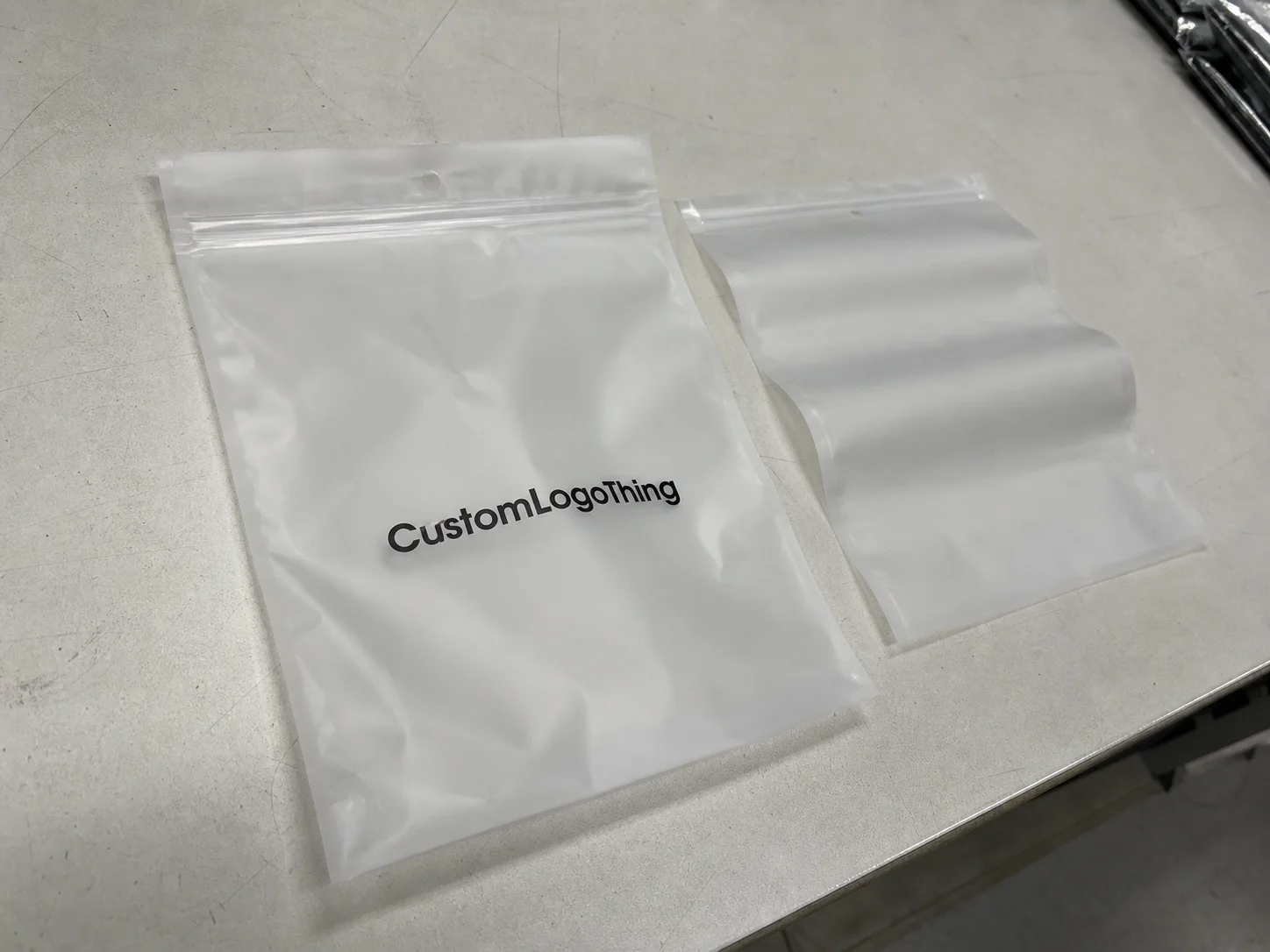
The frosted surface does more than look neat. It controls glare under retail lighting, which is one of the reasons it often photographs better and reads better from a few feet away. Clear poly can expose every fold, insert, or uneven edge inside the pack. Fully opaque film hides the contents too much. Frosted film occupies the middle ground, and that middle is commercially useful.
Retail buyers tend to underestimate that effect. Under fluorescent or LED lighting, a clear bag can look harsher than expected, especially when the contents are colorful or busy. Frosted film reduces that visual noise. The product still shows through, but the eye lands on the whole item instead of on each internal detail.
That visual restraint also helps the pack feel more premium without requiring an expensive print program. For some launches, the bag only needs a clean zipper, accurate sizing, and a label. The finish does the rest. A startup brand may be selling a $12 item; a bag that looks intentional can make that price point feel more defensible.
The zipper matters too. A standard bag suggests storage. A zipper suggests repeated use. That may sound minor, but the customer reads it fast. In low-MOQ retail launches, those quick signals are doing more work than most buyers expect. A good package does not need to shout. It needs to avoid looking improvised.
The best results usually come from packaging that supports the product story instead of competing with it. The frosted finish keeps the pack clean, but it does not hide the contents so aggressively that the buyer has to guess what is inside. That balance is why the format holds up across categories.
Material choices that affect price and performance
Most Frosted Zipper Bags are made from PE or a similar flexible film. Material choice is not just about feel; it affects opacity, fold memory, scuff resistance, and how the bag behaves once it is filled. The same size bag can feel entirely different depending on gauge and zipper construction.
For low-volume orders, buyers often compare film thickness in the 80 to 150 micron range, depending on product weight and the amount of handling the pack will see before purchase. Thinner film lowers unit cost, but the savings disappear quickly if the bag creases badly, collapses under product weight, or scuffs in transit. A cheap bag that looks tired at arrival is not cheap.
Closure style changes both function and price. A standard zipper is usually sufficient for apparel accessories, small merchandise, and general retail packs. A slider zipper feels easier to use and can read as more premium, but it often pushes the order into a different cost bracket. Child-resistant or tamper-evident closures belong in regulated categories, and they increase both price and minimum quantity.
Other physical details also matter in practice:
- Hang holes let the product display cleanly on peg hooks without additional secondary packaging.
- Tear notches improve opening behavior and reduce the awkward tearing that often leads to complaints.
- Gussets add depth for bulkier items and help the bag hold shape better.
- Reinforced seams reduce split risk during packing, shipping, and retail handling.
That is the point to keep in mind: every small feature changes the economics. If the category does not need a premium zipper, do not pay for one. If the bag is only holding a flat accessory, a heavy gusset may be unnecessary. Spec discipline is what keeps a low-MOQ order from drifting into a high-cost custom project.
For buyers who need quality references, the Institute of Packaging Professionals and ISTA standards library are useful benchmarks for transit and pack performance. They are not marketing material. They are guardrails against obvious mistakes.
Specifications to lock before requesting quotes
Before any supplier can quote accurately, the dimensions need to be fixed. A bag that is even slightly too narrow can change fill appearance, freight volume, carton count, and how the item sits on shelf. Vague descriptions such as “roughly this size” usually produce vague quotes. Precise measurements produce useful answers.
Thickness should be stated in one unit only, and the buyer should clarify whether that number is nominal or minimum. Microns and mils are both used in the market, but mixing them invites confusion. A supplier can quote a thinner film without technically lying if the specification was never made exact. That is how small misunderstandings turn into expensive revisions.
Print requirements need the same level of discipline. The quote should spell out:
- Print method.
- Number of colors.
- Front-only or front and back coverage.
- Whether the print must avoid the zipper area, seal area, barcode zone, or warning text area.
For some categories, compliance outweighs aesthetics. Food contact, cosmetic contact, and general merchandise each carry different expectations, and supplier claims are not interchangeable. If the bag will touch a regulated product, ask for written support early. A vague assurance is not documentation.
Pack-out details also need to be written into the request. State how many bags go into each outer carton, whether inserts are included, and whether the product ships flat or pre-packed. Many delays are not caused by the bag itself. They start when two teams assume different definitions of “one unit.”
A concise spec sheet also makes pricing conversations more honest. If one quote looks high, the answer is often in the spec, not the supplier. More material, tighter tolerance, more print coverage, or better zipper hardware all move the number. Clear documentation removes guesswork from that comparison.
What low MOQ pricing really looks like
Low MOQ does not mean simple pricing. In fact, the smaller the order, the more visible setup charges become. Tooling, print preparation, artwork adjustments, and sample handling are spread across fewer units, so the unit price can look high even when the supplier is competitive.
That is why every quote should be broken into the same buckets: material, printing, setup charges, packing, samples, and freight. A single lump-sum number is hard to compare and easy to misunderstand. Line items create friction, but they also create clarity. For a launch budget, clarity matters more than a tidy quote sheet.
Typical low-volume pricing for Frosted Zipper Bags often falls within these ranges, though size and print coverage can move the number significantly:
| Option | Typical MOQ | Unit cost range | Setup / tooling fees | Best fit |
|---|---|---|---|---|
| Blank frosted stock bag | 200-500 pieces | $0.12-$0.28 | $0-$75 | Test launches, simple retail trials |
| One-color custom print | 500-1,500 pieces | $0.22-$0.55 | $80-$250 | Brand-led launches with modest volume |
| Multi-color or larger format | 1,000-3,000 pieces | $0.35-$0.90 | $150-$500 | Higher-visibility retail programs |
| Special zipper or custom hardware | 2,000+ pieces | $0.45-$1.10 | $200-$700 | Premium lines, recurring orders, stricter use cases |
Those ranges are not a promise. They are a practical benchmark. If a price falls far outside them, either the materials differ from what you think you are buying or the quote excludes costs that will appear later. The right follow-up questions are simple: Does the number include freight? Are samples credited against production? What is reorder pricing? Reorders are where the launch program starts to make financial sense.
Bulk pricing only matters if the product can sell through. A lower unit cost on 5,000 bags is irrelevant if the launch only needs 700 units. The better question is how much flexibility the order preserves if demand comes in below forecast. That is the real discipline behind low MOQ purchasing.
Lead time from artwork to shipment
A low-MOQ order moves quickly only when the process is tightly managed. The usual sequence is straightforward: inquiry, spec confirmation, quote, artwork review, sample or proof, approval, production, inspection, packing, and shipment. If a supplier skips a step, ask why. Hidden steps tend to surface later as delays or rework.
It also helps to separate approval time, production time, and freight time. Those are different clocks. A domestic blank-bag order and an overseas custom print job do not move on the same schedule. A project can be “in production” for a week and still miss the launch date if proofing was slow or freight was not built into the calendar.
Artwork changes are one of the easiest ways to lose time. A late size correction, a missed barcode clearance, or a print shift can reset the job. The shortest lead times usually belong to buyers who know the spec before the first proof arrives. That sounds obvious, but it is where many launch orders slip.
For planning purposes, a clean low-MOQ frosted zipper bag order often takes 12 to 20 business days after proof approval, with freight added on top depending on destination and transport mode. A simple blank run may move faster. A new zipper style, unusual dimensions, or custom print coverage will usually stretch the schedule. Honest lead time beats optimistic lead time every time.
Transit validation deserves a place in the timeline too. If the bags are being carton-packed and shipped through a distribution network, ask whether the packaging profile has been considered against an ISTA-style transit assumption or a comparable shipping test standard. Compression, puncture, and scuffing are common failure points in retail packaging, and they rarely show up in the sample alone.
Supplier checks that reduce launch risk
For a small launch, supplier selection matters more than squeezing the quote by a few cents. A responsive vendor with a clear QA process is usually more valuable than a slightly cheaper one that answers slowly and changes the spec midstream. Delay is expensive. Confusion is expensive too.
Ask for samples or recent photos of similar Frosted Zipper Bags. Not a generic brochure, and not a staged product shot. Actual comparable work is better evidence. Look for finish consistency, zipper alignment, seam quality, and whether the bag still looks clean after handling. If the sample is uneven, the run is likely to be uneven as well.
Repeatability is another test. A 500-piece launch order may become a 5,000-piece reorder if the product sells. That growth should not change the feel of the bag, the clarity of the print, or the way the zipper closes. If it does, the launch may have succeeded despite the packaging, not because of it.
Quality control should be specific. Good answers sound like this:
- Seam checks on every lot.
- Zipper function testing.
- Visual inspection criteria for print placement and surface defects.
- Carton protection to reduce scuffing and compression during transit.
Communication cadence also matters. One account owner who knows the order history and replies quickly is worth more than a small price discount. A low-MOQ launch leaves little margin for back-and-forth. If basic questions take days to answer, the packaging project may be more fragile than the quote suggests.
Use the same scrutiny on sustainability claims. If the supplier mentions recycled content, degradability, or paper-based secondary components, ask for written support. Claims are cheap. Documentation is not. Buyers do not need a larger set of claims; they need evidence they can rely on during a launch review.
How to place the order with fewer surprises
The cleanest way to order Frosted Zipper Bags for a retail launch is to send a short but complete spec sheet. Include dimensions, film thickness, zipper style, print requirements, carton counts, pack-out details, and the launch date. If the supplier has to infer any of those items, the quote will be less useful than it should be.
Request at least two pricing tiers. One should reflect the smallest practical launch quantity. The second should show the next step up, where unit cost starts to improve. That comparison is more useful than a single quote because it shows whether a slightly larger order produces meaningful savings or only a cosmetic change in the unit price.
Before confirming the job, ask for four numbers in writing:
- Sample charge.
- Tooling fees or setup charges.
- Landed cost.
- Reorder pricing.
Then review the proof against a written checklist. Check copy, dimensions, zipper placement, color, barcode placement, and any warning or compliance text. One approved proof is more useful than three opinions and a last-minute change request. Late changes are where budgets start to lose control.
The value of this format is straightforward. It gives a shelf-ready look without forcing a large commitment, and it keeps the brand in position for a smarter reorder once real sales data appears. For retail teams that need to balance presentation, cash flow, and speed, a frosted zipper bags low MOQ order for retail launches is often the most defensible first move.
What is the minimum order for frosted zipper bags for retail launches?
Minimums vary by size, print method, and zipper hardware, but low-MOQ programs often start in the hundreds rather than the thousands. Blank stock bags are usually easier to source at a lower MOQ than custom printed versions. If budget is tight, ask for tiered pricing so you can compare a test run with the next production tier.
Can a frosted zipper bags low MOQ order include custom printing?
Yes. Custom printing is common, but print method and color count affect both setup charges and minimum quantity. Single-color artwork with limited coverage is usually the easiest path for a low-volume launch. If the design is complex, ask whether the artwork can be simplified without changing how the pack reads on shelf.
How long does a low-MOQ frosted zipper bag order usually take?
Lead time depends on proof approval, production capacity, and freight method, so the schedule should be split into stages. A clean spec and fast approval can shorten the timeline materially. International shipping often adds more time than production, so confirm both before committing to a launch date.
Are frosted zipper bags suitable for apparel, beauty, or food products?
They are commonly used for apparel accessories, beauty items, samples, and gift sets because the frosted finish looks clean and premium. Food use depends on the material, safety documentation, and the supplier’s compliance claims, so do not assume interchangeability. For sensitive categories, request written confirmation of the exact use case before ordering.
What should I compare in low-MOQ quotes besides unit price?
Compare setup fees, sample charges, freight, carton specs, tooling fees, and any plate or mold costs. Check whether the quoted MOQ includes the same size, thickness, print coverage, and zipper style across vendors. Review reorder pricing too, because the launch order is only the first transaction.


