custom Frosted Zipper Bags for wine clubs solve a narrow but important packaging problem: the outer shipper protects the bottle, while the inner pack is what members actually notice, open, and keep. That inner layer has to do several jobs at once. It needs to hold a bottle, keep inserts from drifting around, fit inside a mailing system without wasting space, and still look intentional instead of improvised.
The frosted finish is part of the appeal. Clear bags expose every edge, sleeve, and card, which can make a club shipment look busy. Fully opaque bags hide the contents too aggressively. Frosted film sits between those extremes. It softens the view, adds a little suspense, and still lets the packaging feel organized. For clubs shipping monthly or quarterly, that middle ground is useful because it works across different releases without forcing a full redesign each time.
There is also a practical reason buyers keep coming back to this format: it scales. A well-specified zipper bag can hold tasting notes, membership cards, a corkscrew, or a small gift without requiring custom rigid packaging for every shipment. Compared with a fully custom presentation box, the bag is simpler to source, easier to store, and usually less expensive to replenish. That matters when a program moves from a one-off promotion to a recurring membership system.
Why custom frosted zipper bags for wine clubs stand out
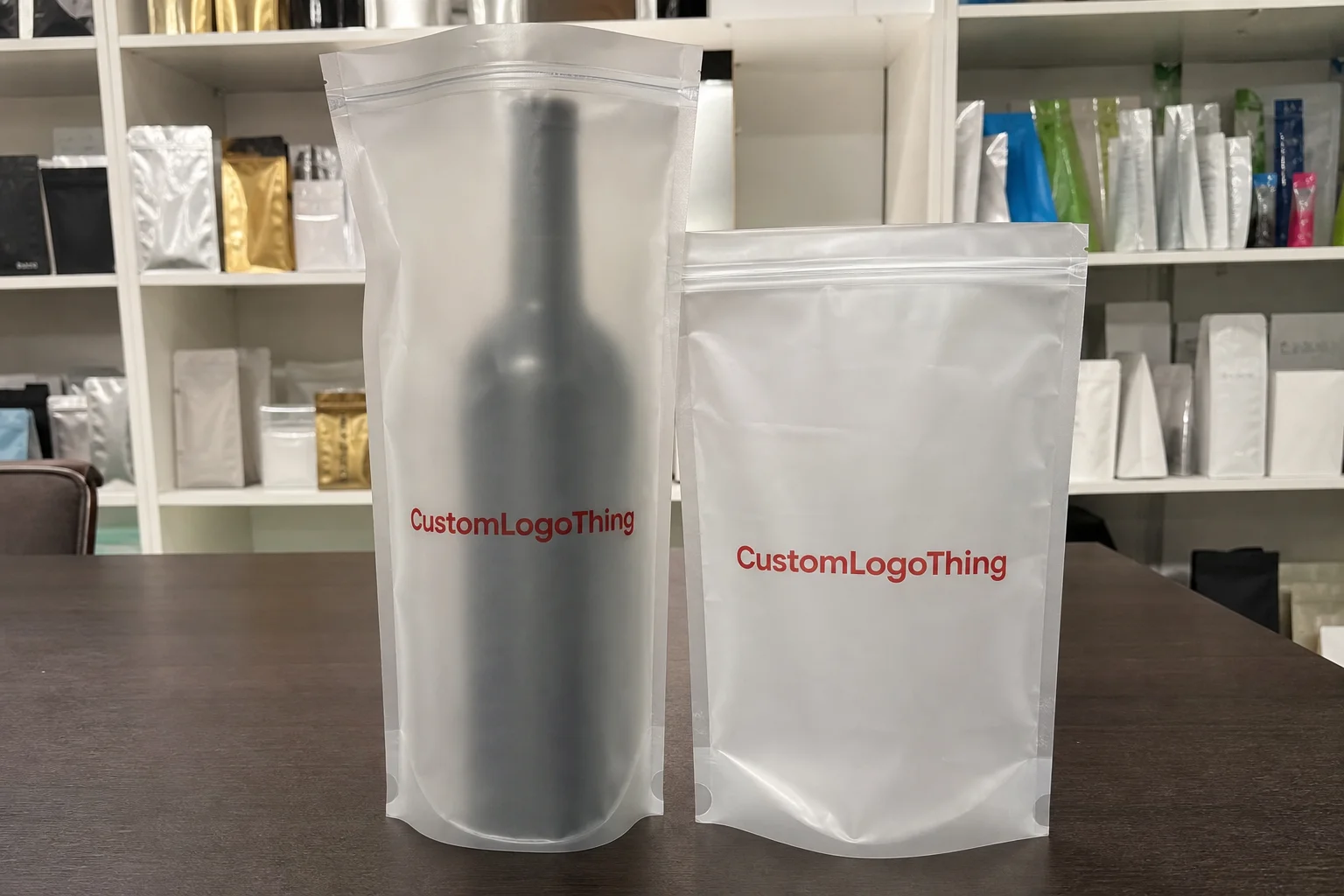
Wine club packaging is judged twice. First by the shipping carton, which has to survive transit. Then by the inner presentation, which has to carry the brand. If the outer box arrives intact but the inside feels loose or generic, the member experience drops fast. The bag does not replace protective packaging, but it closes the gap between safe arrival and thoughtful presentation.
That gap is bigger than many buyers expect. A carton can pass transit requirements and still look disappointing once opened. The bag helps create a defined inner bundle, which makes the shipment feel assembled on purpose. It also reduces visual clutter. Instead of loose inserts sliding around the box, everything sits inside one unit. That is easier for fulfillment teams and easier for the customer to understand.
Frosted film also photographs better than many buyers predict. It tends to mute glare and reduce the harsh, clinical look that plain clear poly can create under indoor lighting. For wine clubs that rely on social sharing or unboxing content, that slight improvement matters. Members are not grading the packaging with a spreadsheet, but they do react to finish, order, and how much effort the pack appears to contain.
"The package does not need to be ornate to feel premium. It needs to look deliberate, survive handling, and fit the actual contents without forcing the bag into a shape it never wanted."
In practice, custom Frosted Zipper Bags for wine clubs are used for single bottles with inserts, two-bottle club packs with divider cards, and accessory bundles that need to stay together through packing and transit. The bag is especially effective for hybrid shipments where the product mix changes from month to month. If the structure is stable, the contents can vary without forcing the entire packaging system to change.
Compared with other Custom Packaging Products, the bag sits in a very efficient middle zone. It is more branded than a plain poly sleeve and less costly than a full printed box. That tradeoff explains why it shows up in practical club programs rather than only in high-end gift sets.
How frosted zipper bag packaging works in a club shipment
A frosted zipper bag is usually a resealable polyethylene bag with a translucent, matte-like finish. The structure is simple. The performance comes from how it behaves inside a larger pack. It keeps the contents together during kitting, makes the bundle easier to handle, and prevents small items from moving around while the order is being assembled.
The zipper matters more than the surface finish. A poor closure wastes time on the line and creates a weak point during packing. A bag that opens cleanly, closes with consistent pressure, and stays shut through handling is worth more than a bag with attractive graphics but a sloppy track. In a fulfillment environment, the bag has to work for the person packing it first and the member opening it second.
It is a mistake to treat the zipper bag as the main protective layer. It is not a transit solution by itself. Outer corrugated, partitions, and void-fill still do the real shock protection. If the wine shipper is not tested as a system, the inner bag cannot fix that. Packaging programs that ship regularly should still use recognized transit methods, including testing frameworks such as ISTA, because the presentation layer only matters after the contents survive the trip.
Used correctly, the bag simplifies packing. It gives the team one unit to load instead of several loose items. That saves time, reduces missing inserts, and makes the shipment easier to standardize across members. If the club uses a third-party fulfillment partner, the bag also reduces ambiguity. A packed unit is easier to verify than a stack of pieces spread across a box.
Key specs that affect fit, print, and durability
The most important spec is size, and the most common mistake is sizing for the bottle only. A club shipment usually includes more than glass. There may be a sleeve, tasting notes, a membership card, tissue, or a small accessory. The bag should be sized to the full loaded bundle, not the bottle standing alone on a desk.
Film thickness comes next. Light insert packs can often use a thinner gauge, while bottle bundles, heavier accessories, or repeated handling call for more material. In the industry, common ranges often sit around 2.5 to 4 mil for this type of bag, though exact recommendations depend on the weight and shape of the contents. Thicker film usually improves puncture resistance and gives the bag a more substantial hand feel, but it also raises cost and can make opening slightly stiffer.
Print area matters more on frosted film than buyers expect. The surface already diffuses contrast, so tiny type, thin strokes, and cluttered layouts get harder to read. One-color logos, a short line of copy, or a repeat mark often outperform dense artwork. A restrained layout usually looks cleaner once it is filled and photographed under mixed light. Overdesigned bags tend to look worse in real use than they do in a proof.
Zipper placement and closure height also affect presentation. If the pack is too tall for the bag, the closure line looks stressed. If the bundle sits too low, the empty headspace makes the bag appear oversized. Both problems are visible. Neither one helps the customer experience. Fit should allow the contents to sit naturally without forcing the material to bow, wrinkle, or pull.
For buyer reference, these are the specs worth checking before approving a run:
- Finished size - based on the fully packed bundle, not the bottle alone.
- Film gauge - matched to the weight, sharp edges, and handling stress of the contents.
- Zipper quality - smooth closure, consistent lock, no snagging during repeated use.
- Print contrast - artwork still readable through frosted film.
- Headroom - enough clearance at the top to close the bag without distortion.
If the same bag family will be used across multiple club tiers, keep the base structure stable and vary only the insert set or artwork panel. That reduces reorder confusion and gives the fulfillment team a repeatable process. It also makes it easier to compare one shipment against the next without rebuilding the spec every quarter.
Custom frosted zipper bags pricing and MOQ basics
Pricing for custom Frosted Zipper Bags for wine clubs is driven by a small set of variables: size, film thickness, print method, artwork complexity, and order quantity. Material cost is only part of the picture. Setup, proofing, and freight can have a noticeable effect on the first order, especially when the run is small.
For rough budgeting, plain Frosted Zipper Bags are usually the lowest-cost option. Add a custom logo and the price rises, then add heavier gauge film or more complicated artwork and it climbs again. Small printed runs often fall somewhere in the approximate range of $0.40 to $1.50 per bag, but that range can move quickly depending on spec and vendor structure. Larger orders usually reduce unit cost, sometimes by a lot.
MOQ is the other number buyers have to watch. A wine club with seasonal artwork may not want a deep inventory commitment, while a recurring membership pack can often justify a larger run. Standard sizes and simpler print layouts typically help lower the minimum. Custom shapes, unusual dimensions, or multi-color artwork tend to push it back up.
| Option | Typical Use | What Drives Cost | Budget Impact |
|---|---|---|---|
| Unprinted frosted zipper bag | Basic bundling and internal organization | Film gauge and bag size | Lowest |
| Frosted zipper bag with one-color logo | Core club shipments and insert packs | Setup, print registration, MOQ | Moderate |
| Heavy-gauge frosted bag with custom artwork | Premium club tiers or gift-style bundles | Thicker film, more ink coverage, proofing | Higher |
| Custom printed boxes plus inner bag | High-touch presentation programs | Board stock, structural design, multiple components | Highest |
A useful sourcing habit is to compare the bag system against the cost of a full printed box. In some cases, the bag delivers most of the presentation value at a much lower total spend. That is especially true if the outer shipper already handles transit well and the club only needs a more organized inside.
Cost control usually starts with standardization. If the size is stable, the artwork is simple, and the print location stays fixed from reorder to reorder, the packaging program is easier to forecast. Unnecessary variation is expensive in packaging. It creates more proof rounds, more inventory fragmentation, and more chances for a production mistake.
Production steps and turnaround for wine club orders
The production path is usually straightforward: final dimensions, artwork submission, proof review, sample approval if needed, production, and freight. Delays happen when the inputs are incomplete. A spec written around bottle size alone, or artwork sent in a low-resolution format, often creates a second round of proofing that nobody budgeted for.
For a first order, the best practice is to measure the actual packed bundle. Include the bottle, any sleeve, cards, tissue, and accessories. Then allow for a little clearance so the zipper can close without compressing the contents. That extra few millimeters often prevents a lot of friction later.
Timelines vary by supplier and quantity, but a common planning window looks something like this: digital proof in a few business days, sample development in roughly one to two weeks if a physical sample is needed, and production after approval in another two to four weeks. Freight can add time, especially on international orders. Those numbers are not universal, but they are realistic enough to keep a club calendar honest.
Quality control should not stop at the artwork. A proper check includes zipper function, print alignment, seal strength, bag dimensions, and whether the loaded pack still fits the intended shipper. If a sample is available, test it with the real contents and the real packing sequence. A bag that looks fine flat on a table can behave differently once it is loaded and handled repeatedly.
Warehouse conditions matter too. Heat, humidity, and storage compression can affect how a bag opens and how the zipper feels. If the order will sit in inventory, ask how it should be stored and whether the material is sensitive to pressure or prolonged stacking. These details are easy to ignore until the first pallet arrives and the team has to pack with it.
Packaging teams that also source paper components should verify claims against the relevant standards. If a supplier says a paper insert or sleeve is certified, check the chain of custody and the standard at fsc.org. A club shipment often mixes materials, and each piece should be documented correctly.
Common mistakes when ordering club packaging
The first mistake is simple: ordering to the bottle and not to the bundle. Once inserts, tissue, and accessories enter the pack, dimensions change. A bag that fits a naked bottle may pinch at the zipper or leave the contents loose enough to slide. Both problems show up fast in a club program because the same mistake repeats every cycle.
Another common error is trying to print too much. Frosted film already has a visual texture. If the artwork fills every space, the bag starts to look busy rather than premium. A cleaner design usually ages better and reads more clearly across different lighting conditions. That is especially important for shipments photographed at home, where member lighting is unpredictable.
Skipping samples is a false economy. A sample shows whether the zipper pulls cleanly, whether the opacity is right, and whether the logo still reads at normal viewing distance. It also reveals handling issues that are invisible in a proof. If the bag feels awkward during packing, that inefficiency will show up on the line long before members complain.
Another issue is inconsistent specs across club tiers. If the standard club, reserve club, and holiday release all use slightly different sizes without a strong reason, inventory gets messy and reorder mistakes multiply. A cleaner approach is to keep the base bag consistent and change only the insert content or exterior branding where necessary.
Handling stress is the one buyers often underestimate. Repeated loading, cold storage, and shipment vibration can expose weak seals or thin film quickly. A bag that passes a desk check is not automatically ready for mass fulfillment. It needs to be tested in the real sequence: packing, closing, stacking, shipping, and opening.
Finally, avoid assuming that the inner bag can compensate for weak outer packaging. It cannot. If the shipper does not protect the bottle, the presentation layer becomes irrelevant. The right packaging hierarchy is basic but easy to lose sight of: the outer pack protects, the inner pack organizes, and the brand details make the shipment feel intentional.
Expert tips for smoother reorders and better presentation
The best reorder system is stable. Keep one master spec with the final size, material, print placement, and zipper style. That sounds dull, but it prevents the kind of variation that slows down fulfillment and creates unforced errors. Packaging teams that keep a clean spec library usually move faster on the second and third order than on the first.
Modular artwork helps as well. Leave a reserved area for vintage names, membership notes, or seasonal messaging, and the same base bag can carry multiple programs. That reduces redesign work and keeps the packaging line looking consistent even when the content changes. Consistency is underrated because members notice patterns long before they notice specifications.
It is also worth testing the bag with the actual packers, not only the packaging buyer. If loading takes too long, or the zipper is difficult to close under pressure, the bag may be acceptable on paper but inefficient in production. Efficiency affects labor cost, and labor cost affects the real price of packaging more than a pretty proof ever will.
Small safety stock is a practical buffer for wine clubs with seasonal spikes, holiday releases, or unpredictable renewal volume. A modest reserve can absorb a surprise reorder without forcing a rush fee or a compromise on spec. Inventory carrying cost is real, but so is the cost of missing a ship date.
One more point: treat the bag as part of the full package architecture. The outer shipper, the inserts, the frosted zipper bag, and the brand marks should all pull in the same direction. If one piece looks temporary while the others look finished, the whole shipment loses balance.
Next steps for a first wine club order
Start with the contents. List every item the bag needs to hold, then measure the fully assembled bundle. Include the bottle size, insert dimensions, accessory thickness, and any sleeves or wraps. A precise pack size eliminates most of the guesswork before quoting even begins.
Next, prepare the artwork in a print-ready format and make sure the logo will hold up through a frosted layer. Fine details, thin fonts, and low-contrast colors can disappear more quickly than expected. If the design is dense, simplify it before production rather than discovering the issue on a physical sample.
Ask for either a sample or a detailed proof before committing to volume. The purpose is not just to approve the artwork. It is to confirm how the zipper feels, how the film behaves under light, and whether the bag still looks balanced once the real contents are inside. That test is especially useful if the club has a mix of bottle shapes or plans to switch products mid-season.
Then map the calendar backward from the ship date. Build in time for proofing, possible revisions, production, freight, and kitting. The earlier these steps are locked, the less likely the order is to collide with a launch, a renewal wave, or a holiday deadline.
For a wine club, custom Frosted Zipper Bags for wine clubs are not a decorative extra. They are a controlled, repeatable part of the shipping system. The best versions hold the pack together, improve the first impression, and keep the program easy to run month after month.
How do custom frosted zipper bags for wine clubs compare with clear poly bags?
Frosted bags hide less than opaque packaging but more than clear poly, which gives them a better balance for club shipments. Clear bags expose every insert and edge, so they can look messy when the contents vary. Frosted film softens the view and usually reads as more deliberate.
What size should I choose for a single-bottle wine club insert?
Base the size on the fully loaded bundle, not the bottle alone. Measure the bottle, any sleeve, tasting notes, and small accessories together, then leave enough room for easy loading and zipper closure. A sample fit is the safest way to confirm the final dimensions before production.
Can the bag hold tasting notes, merch, or a corkscrew with the bottle?
Yes, if the bag size and film gauge are chosen for the actual load. Flat inserts are easy to accommodate, but bulky or sharp accessories may require a larger size or heavier material. The full bundle should be packed and tested before the order is approved.
What affects pricing the most on frosted zipper bag orders?
Size, material thickness, print complexity, and quantity are the main cost drivers. The first order usually carries extra setup and proofing expense, while higher volumes reduce unit pricing. Rush schedules and specialty artwork can raise the price faster than buyers expect.
How far ahead should a wine club order be placed before shipment?
Plan backward from the ship date and include time for proofing, sampling, production, and freight. A small order may move quickly, but larger or more customized runs need a longer runway. Extra buffer is cheaper than a rush order.


