Frosted Zipper Bags low moq order for ecommerce stores are a practical packaging choice for brands that need a clean, retail-ready look without committing to a large inventory run. The frosted finish gives a matte, semi-translucent appearance that reads more controlled on camera than plain clear film, while the zipper closure keeps the pack tidy through picking, packing, returns, and repeat handling.
The business case is less about trend and more about risk management. A low-MOQ program lets a store test presentation, check sell-through, and refine size or print choices before tying up cash in a larger order. That matters most for apparel, accessories, sample kits, and subscription add-ons, where packaging can influence conversion but demand can still be unpredictable.
The part that usually gets overlooked is fit. A bag that matches the flat product on paper can still be wrong once folds, inserts, zipper clearance, and warehouse packing habits are included. Most quote problems start there, not with the price.
If you need a broader buying frame, our Wholesale Programs page outlines common order structures, and our FAQ covers standard ordering questions before artwork is submitted.
Why frosted zipper bags low MOQ order for ecommerce stores make sense
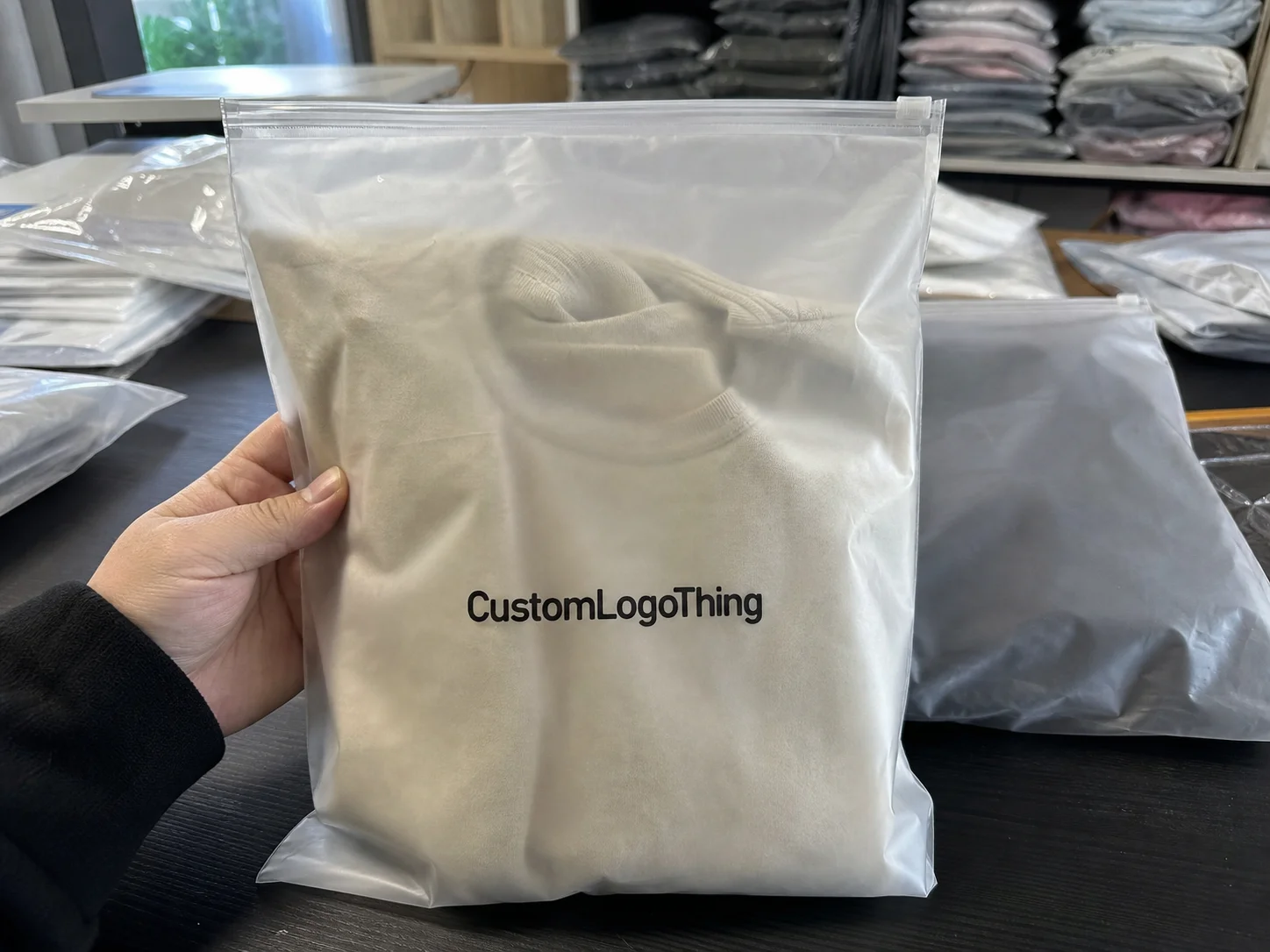
Frosted Zipper Bags work well for ecommerce brands that want the pack itself to support the product story. The matte surface softens glare, hides minor scuffs better than high-gloss film, and still leaves enough visibility for the customer to identify the contents without opening the pouch.
That visual balance is useful on product pages and in unboxing content. Clear polyethylene can look functional but plain; the frosted version tends to feel more deliberate because the surface diffuses light rather than reflecting it aggressively. The effect is subtle, but subtle is often what makes a package look more expensive than it is.
The zipper adds operational value, not just convenience. A press-to-close closure reduces the need for tape, speeds pack-out, and helps the bag survive repeated opening during returns, exchanges, or inspection. For items that are handled more than once, that matters as much as the first impression.
Low MOQ is useful because ecommerce demand rarely behaves in clean, stable lines. A seasonal color, a limited drop, or a new SKU can sell well, stall, or split across sizes in ways that are hard to predict. Ordering only what is needed for the test period lowers exposure if the design misses or the size needs adjustment.
A low MOQ only works if the bag still fits cleanly, closes without strain, and survives packing. A cheap bag in the wrong spec costs more than a better bag in the right one.
Material, closure, and finish options that affect performance
Most frosted zipper bag programs use polyethylene film, often in a PE or PE/CPP style structure depending on how much stiffness, clarity control, and closure feel the pack needs. The exact blend affects how the bag drapes, how the zipper behaves, and how much surface rigidity the finished piece has in hand.
Finish matters more than many buyers expect. A true frosted film creates a softer light response and usually makes restrained branding look more intentional. Heavy ink coverage can work, but many brands get a better result with limited print zones, a logo lockup, or a short size mark instead of covering the whole bag.
Closure selection should follow the product, not the other way around. A standard press-to-close zipper is enough for many apparel and accessory orders. A slider zipper can make sense for heavier kits or premium packs, but it adds cost and sometimes a little more complexity at the factory and in receiving inspection.
Feature choices help only if they solve a real packing or retail problem:
- Hang holes are useful if the bag needs to display on hooks or peg walls.
- Tear notches improve first-open convenience on tightly packed items.
- Side gussets add depth for folded apparel or thicker bundles.
- Slider zippers can improve repeat opening on larger or premium packs.
Print placement needs the same discipline. Keep artwork away from seals and zipper tracks so the design does not feel cramped and the usable interior remains clean. A mockup can look balanced while the actual bag feels crowded once the product is inside.
For programs that include paper inserts, kraft sleeves, or outer cartons, FSC documentation may be relevant for the paper components, but it should be requested only where certification claims are actually being made. For transit durability, some teams also reference ISTA testing standards so they can check whether the packed item is likely to hold up under handling and shipping stress.
Sizing and specification choices that keep the fit right
Start with the packed product, not the product in isolation. A folded shirt, a boxed accessory, or a sample bundle needs room for seams, fold tolerance, zipper width, and any insert that ships with it. The same item can require two different bag sizes depending on how the warehouse actually packs it.
Before requesting a quote, confirm the internal width and height, film thickness, zipper style, and whether there is any reinforced area near the closure. If tissue, cards, labels, or sample inserts are part of the final pack, include those dimensions too. Thin extras change the fit more than people expect.
Film thickness should rise with weight and with the sharpness of the contents. Soft goods like tees, scarves, and leggings can usually work in lighter film, while boxed components or harder corners need more structure. A bag that feels acceptable in the hand can still split at the seam if the contents press outward during transit.
Sample testing should use the real packed configuration. That means the actual product, the insert if there is one, and the closure routine the warehouse will follow. If the zipper binds, the fit is sloppy, or the pack looks swollen, adjust the spec before the run starts. A few millimeters can decide whether the bag reads polished or improvised.
Consistency matters once the order reaches fulfillment. One size may work for a single folded shirt, then fail when the same bag is used for a thicker bundle, a bonus sample, or a product in a rigid inner box. A good specification should state the finished pack count and packing method, not just the product category.
Pricing, MOQ, and unit cost drivers to compare
Frosted Zipper Bags low moq order for ecommerce stores usually cost more per piece than larger production runs, but that does not automatically make them poor value. The real question is whether the bag improves presentation, reduces pack-out friction, and keeps inventory risk low enough to justify the cost per piece.
The main cost drivers are predictable: bag size, film thickness, frost level, zipper type, print coverage, pack format, and freight. MOQ usually follows the same logic. A plain stock bag may qualify for a very small test order, while a printed or specially finished version may require a higher minimum because of setup and material sourcing.
It helps to break a quote into line items rather than reading only the headline unit price. Ask for product cost, any setup charges, proof cost, sample cost, and freight. On some custom builds there may also be tooling fees for unusual features, although many standard zipper bag orders only carry light print-related setup instead of major tooling.
Bulk pricing usually improves sharply once the job moves from trial quantity to reorder quantity. That said, the lowest unit cost is not always the best landed cost if the order will sit in storage too long or force you to buy more inventory than demand can absorb.
| Order Option | Typical MOQ | Indicative Unit Cost | Setup Charges | Best Use |
|---|---|---|---|---|
| Plain stock frosted zipper bag | 100 to 500 pieces | $0.12 to $0.24 | Usually none | Fast test orders, basic ecommerce packing |
| Lightly customized bag with logo print | 500 to 2,000 pieces | $0.18 to $0.36 | Screen or plate setup may apply | Brand launches, add-on packaging, sample kits |
| Fully branded bag with special finish or extras | 2,000 pieces and up | $0.28 to $0.55 | Higher setup and possible tooling fees | Established SKUs, premium presentation, recurring volume |
Those are working ranges, not fixed market prices. Exact numbers depend on dimensions, print coverage, film specification, and freight route. Storage space and reorder cadence also matter; the cheapest quote on paper can become the most expensive choice if it forces overbuying or ties up capital for too long.
A sensible first order usually focuses on the sizes that actually move, uses the lightest film that still passes the handling test, and reserves heavier print coverage for proven SKUs. That keeps cash available while preserving the packaging upgrade where it has the most effect.
Process and lead time from quote to shipment
The cleanest ordering flow is straightforward: request quote, confirm specs, review artwork or sample, approve the proof, manufacture, inspect, and ship. None of those steps is complicated on its own. Delays usually come from missing measurements, late artwork changes, or shipping details that were never confirmed.
Lead time depends on whether the bags are stock or custom, how complex the print is, and how quickly approval moves. A plain stock order can move fast. Once the bag needs a logo, a special size, or a tighter closure spec, expect more time for proofing and inspection.
Many delays are self-inflicted. Artwork gets revised after proof approval, dimensions are described loosely, or the receiving warehouse hours were never shared. Production may still be efficient, but the order can slip because the approval loop is incomplete.
It also helps to separate production time from transit time. Inland freight, ocean freight, and air freight all produce very different delivery windows. A two-week production target means very little if the cartons still need another week or more to reach the fulfillment center.
Ask for checkpoints before production starts. A pre-production confirmation, a sample approval when possible, and a stated tolerance for print or dimension variance can prevent a lot of downstream friction. If the sample is off, fix it before the run begins rather than after cartons are already packed.
Frosted Zipper Bags low moq order for ecommerce stores are easier to manage when the supplier documents each stage clearly. That turns a packaging purchase into something closer to a controlled supply line and much less like guesswork.
What a dependable packaging supplier should document
A dependable supplier puts the spec in writing instead of leaving it in email shorthand. The buyer should get a clear material description, exact dimensions, zipper style, thickness, print method, carton count, and MOQ. The sample should match those details closely enough that fit, closure feel, and finish can be compared without interpretation.
Communication matters as much as price. A better partner will flag tolerance limits, point out when artwork is too close to the seals, and suggest a different size if the current plan is likely to be too tight or too loose. That kind of feedback saves money by preventing rework and avoiding a first order that cannot be used cleanly.
Documentation also speeds up reorders. Ecommerce teams often return months later and need the same bag for a new production batch. If the carton labels, pack counts, and print references are clean, the reorder moves faster and warehouse intake becomes easier to manage.
Inspection standards should be discussed openly. Ask whether zipper function, seal integrity, and print alignment are checked before shipment. If the order includes paper inserts or cartons with certification claims, request the relevant FSC paperwork for those paper components only, not as a blanket assumption for the entire package. For shipping-sensitive goods, a supplier who can reference ISTA-style transit checks is usually more useful than one who offers vague assurances.
Strong documentation cuts hidden cost. It reduces overbuying, avoids specification drift, and keeps the paperwork clear enough for warehouse receiving and future orders. That discipline is one of the real advantages of low-MOQ packaging programs, provided the supplier treats detail control as part of the job.
Ordering mistakes that create extra cost or delays
The most common mistake is measuring only the product face instead of the packed item. Once folds, inserts, and zipper clearance are included, the final bundle can need noticeably more room. A bag that seems close on a flat sample can be too tight once the real product is packed.
Artwork placement causes its own problems. If print sits too close to the seals or zipper track, the design can look cramped, or the supplier may need to shift the layout and remake the proof. That is avoidable if the safe margin is set early and the artwork is built for the actual bag structure.
Thickness is another frequent miss. Heavy or sharp-edged items can split a light film, or they may close poorly because the bag cannot absorb the packed volume. Thin film is fine for many soft goods, but not every SKU should be treated the same way.
Buyers also mix use cases too casually. A bag that works for an accessory line may be too plain for premium apparel, or too small for a kit with a box, card, and insert. The bag has to support the selling role, not just the dimensions on a spec sheet.
Use a short checklist before production starts:
- Final dimensions of the packed item.
- Quantity by size or SKU.
- Artwork files and print location.
- Ship-to address and receiving hours.
- Target delivery date and reorder plan.
That list may look basic, but it saves money. It keeps the order moving, lowers the chance of reprint, and avoids the kind of back-and-forth that can turn a simple bag order into a long production cycle.
Next steps for samples, artwork, and your first PO
Send the supplier the finished product dimensions, estimated weight, target quantity, print requirement, and preferred finish. The cleaner the starting brief, the better the first quote will reflect the actual job instead of a guess.
Ask for more than one option if the budget allows it. A stock low-MOQ bag, a thicker premium version, and a printed version give you a direct comparison of landed cost, appearance, and lead time. That side-by-side view is more useful than chasing the lowest line item without context.
Check the sample under real packing conditions, not just in your hand. The zipper feel, the fit around the product, and the shelf appearance all matter more once the item is packed the way your warehouse will actually ship it. If the sample looks good but closes hard, or if the product shifts too much inside, adjust the spec before the PO goes out.
Plan the reorder point early. Low MOQ is useful for testing, but once the winning size or SKU mix is clear, the next order should be easier to place and quicker to approve. That is the practical value of Frosted Zipper Bags low moq order for ecommerce stores: lower launch risk first, then a cleaner path for scale once the packaging proves itself.
If the bag is being used for a launch, a seasonal drop, or a new collection, the first order should be designed to teach you something. The goal is not to buy the most packaging at the lowest unit rate. It is to find the size, finish, and closure that hold up through fulfillment and make sense to repeat.
What MOQ should I expect for frosted zipper bags for ecommerce stores?
MOQ usually depends on whether the bag is stock, lightly customized, or fully printed. Ask whether the minimum is tied to size, color, or artwork version, because that changes the actual threshold. For low-MOQ programs, compare the smallest usable run against expected sell-through and storage space.
Can frosted zipper bags be printed with my logo and SKU details?
Yes, many programs support logo print, size labeling, or simple brand marks on frosted film. Confirm the print method, ink coverage, and safe margin from the seals and zipper track. Request a proof or sample so the contrast can be checked before production starts.
How do I choose the right thickness for a frosted zipper bag?
Match thickness to product weight, edge sharpness, and how often the bag will be reopened. Lighter apparel and soft goods can often use thinner film, while heavier or sharper items need more structure. If the pack feels loose or fragile in sample testing, move up one spec tier before ordering volume.
What information do I need for an accurate quote on frosted zipper bags?
Send the finished product dimensions, estimated weight, target quantity, and whether the bag needs print or a plain finish. Include ship-to location and target delivery date so freight and schedule can be quoted realistically. If you have a sample photo or existing packaging, include that too because it reduces back-and-forth on fit.
How long does a low-MOQ frosted zipper bag order usually take?
Lead time depends on stock availability, customization level, and how fast artwork and samples are approved. Simple stock orders can move quickly, while printed or highly specific builds need more time for proofing and production. Ask for a schedule that separates production time from transit time so warehouse planning stays accurate.


