Frosted Zipper Poly Bags for coffee brands moq planning sounds like a narrow packaging topic. It is not. It touches shelf appeal, fill performance, shipping durability, and cash flow all at once. That is why the quote changes the second someone adds a valve, a bigger zipper, or one more print color.
The appeal of frosted poly is straightforward. It looks cleaner than plain clear film, hides handling marks better, and gives coffee a more deliberate presentation without pushing the bag into full opacity. For specialty coffee, that matters. The packaging is doing sales work before anyone opens the bag.
Good packaging choices are rarely dramatic. They are mostly decisions about what to standardize, where to spend, and what to leave alone. A frosted zipper bag can make a small run feel intentional. A vague spec can make a premium product look like a rushed reorder from a calendar crisis.
Why frosted zipper bags stand out on crowded shelves
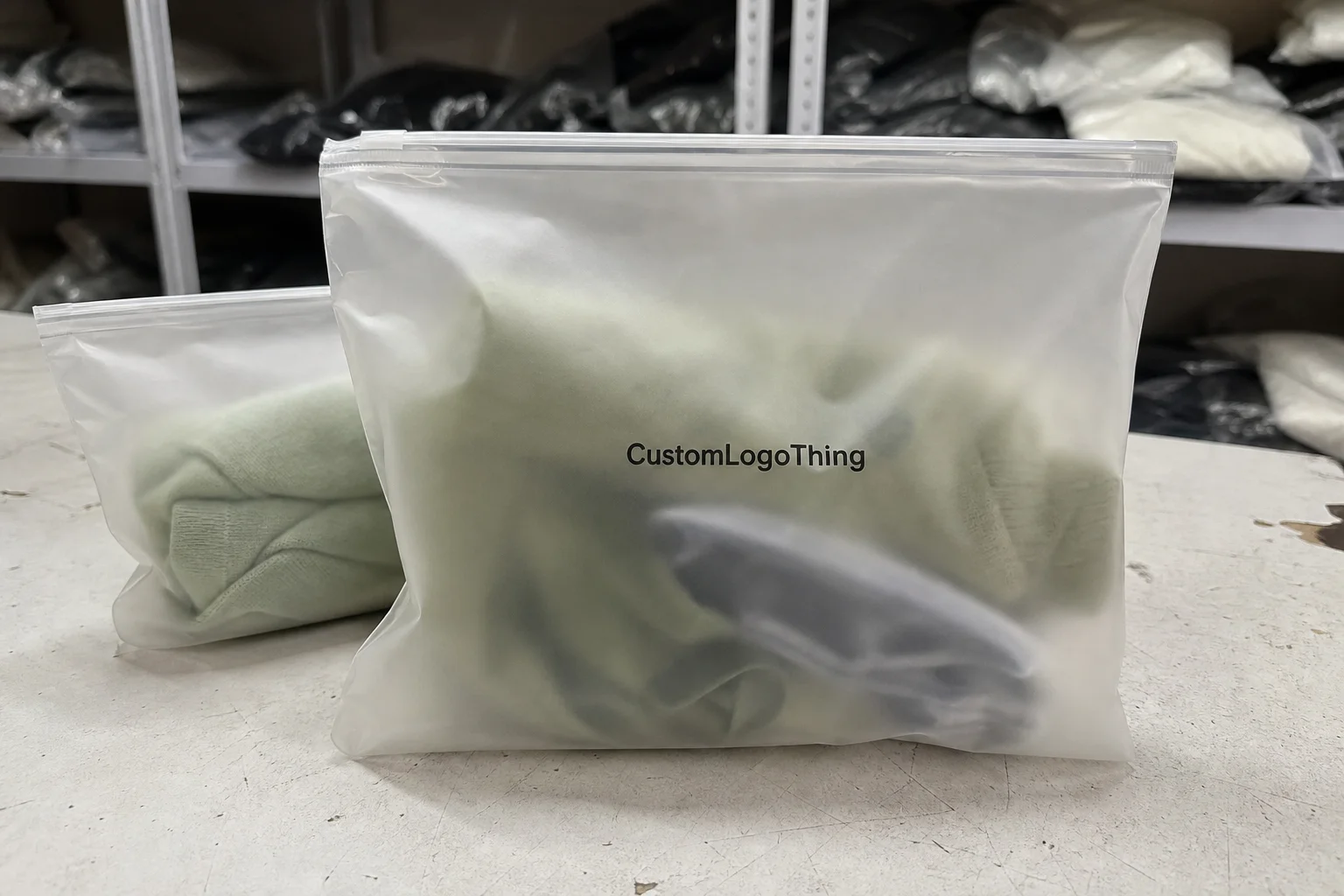
Frosted Zipper Bags work because they cut visual noise. The finish softens glare and makes the surface look calmer under retail lighting, in warehouse light, and on a product page. That matters for coffee because the category is crowded and a lot of bags read the same from three feet away.
The surface also hides the usual wear that shows up fast on plastic packaging. Fingerprints, minor rub marks, and scuffs are less obvious than they are on glossy film. For a DTC shipment or a shelf display, that helps the bag arrive looking like the brand knew what it was doing.
There is another reason brands like this format for launches and seasonal lines. Frosted Zipper Poly Bags for coffee brands moq planning often starts with test runs, small retail programs, or subscription bags that need a better first impression without forcing a huge upfront commitment. A frosted finish gives more polish than stock packaging, but it does not require the brand to lock into a full custom structure on day one.
The mistake is to treat appearance as separate from function. If the bag looks good but does not stand, seals poorly, or opens awkwardly, the buyer notices all of it. So does the customer. A premium surface cannot compensate for a weak spec. Packaging is rude that way.
The bag does not need to shout. It needs to look deliberate and survive handling.
For e-commerce, the finish also photographs better than many glossy options. It has a softer light response, so labels and roast information stay readable instead of fighting reflections. That is not glamorous. It is useful. Useful usually wins.
Material, zipper, and finish details to specify
Do not start with artwork. Start with the structure. Buyers need to define the outer finish, the barrier layer, zipper type, and whether the bag needs a one-way degassing valve. If those parts stay fuzzy, the quote will stay fuzzy too, and fuzzy quotes are where budgets go to hide.
There is a real difference between a bag that only looks frosted and a bag that holds up in use. Ask for the film stack, not just the marketing label. Most coffee programs need a multi-layer structure with a good moisture and oxygen barrier, because roasted coffee is not forgiving. If the barrier is weak, freshness drops. If the seal area is sloppy, the bag looks cheap even if the front panel is nice.
Zipper choice matters more than people expect. A resealable zipper should open cleanly, close with enough resistance to feel secure, and keep working after repeated use. The wrong zipper can make a premium bag feel annoying on day one. That kind of friction does not show up in a mockup. It shows up when the bag is on a kitchen counter.
Ask about tear notch placement, zipper height, and whether the closure is compatible with the fill volume. A bag that is too short above the zipper can be hard to seal. A bag that is too tall can waste material and create a clumsy look. Small details, large consequences. Packaging likes that sort of thing.
If the bag includes a valve, check whether it conflicts with print placement or label space. The valve may only be a small component, but it changes the layout. On coffee bags, that can affect the front panel, back panel, and even where the roast date stamp lands.
For larger programs, ask whether the structure has been tested for shipping and handling conditions that match your route to market. Organizations such as ISTA publish useful test methods for package durability. If the project also includes paper cartons, inserts, or secondary packaging, sourcing standards like FSC are worth checking because procurement teams will ask sooner or later.
Full frost and partial frost each have a role. Full frost gives a consistent premium look across all fill levels. Partial transparency can help if the beans themselves are visually strong or the brand wants more product visibility. Neither is automatically better. The right choice depends on whether the bag is trying to sell the roast, the brand, or both.
Sizes, gauges, and print specs that affect yield
Size should be driven by fill weight and bean behavior, not by the name on a stock catalog. An 8 oz bag, a 12 oz bag, a 1 lb bag, and a 2 lb bag all need different headspace, different gusset depth, and often different zipper placement. Whole bean and ground coffee do not sit the same in a pouch either. Roast level changes volume. Density changes. The bag still has to stand up and look presentable.
Film thickness affects feel, stiffness, seal reliability, and the way the bag behaves on a packing line. Too thin, and the pouch wrinkles easily or feels flimsy. Too thick, and you are paying for stiffness you may not need. In most cases, the smarter move is to match thickness to the fill weight, shipping conditions, and the retail environment. Chasing the thickest spec usually just makes the quote louder.
Print specs can turn a simple quote into a mess if they are not defined early. Before requesting pricing, clarify the dieline, print area, color count, white ink underprint, barcode area, roast date panel, and any matte or spot finish. If the bag needs a clean front panel for branding and a functional back panel for legal or origin copy, say that up front. Revisions after proofing slow everything down and usually cost more than they should.
Packaging yield also depends on carton packing and overrun tolerance. A bag that looks cheap in the spreadsheet can become expensive once freight, warehouse space, and extras are included. Unit price alone is not enough. It never is. The landed cost is the number that matters.
- 8 oz: useful for samples, gift sets, and smaller roast programs.
- 12 oz: common for specialty retail and many DTC coffee lines.
- 1 lb: practical for household use and repeat buyers.
- 2 lb: better for value-focused SKUs and customers who buy in volume.
Heavy coverage printing, multiple colors, and white ink layers affect both setup time and waste. If the design can be simplified without harming the brand, the production side usually rewards that. Simpler artwork often prints cleaner too. There is a reason so many packaging teams quietly prefer restraint.
Frosted zipper poly bags for coffee brands MOQ planning: cost, pricing, and tradeoffs
This is the part that decides whether the packaging plan works. Frosted Zipper Poly Bags for coffee brands moq planning is not just about hitting the lowest supplier minimum. It is about choosing an order size that protects margin without stuffing the warehouse with inventory you are not ready to move.
The MOQ usually shifts with bag size, print complexity, tooling, and whether you are ordering one SKU or several. One color on one size is simpler. Add a second size, another print version, or extra finish effects, and the minimum climbs. That is normal. Fixed setup work does not care how optimistic the forecast was.
Most buyers underestimate the charges outside the unit price. Sample fees, proof revisions, freight, duties, plates or cylinders if applicable, and tolerance ranges all affect landed cost. A quote that only shows the per-piece number is incomplete. It may be polite, but it is not complete.
| Order level | Typical use | Cost per piece | Unit cost behavior |
|---|---|---|---|
| Launch quantity | Test run, first retail release, seasonal blend | $0.22-$0.38 | Higher because fixed setup costs are spread across fewer units |
| Mid-run quantity | Small brand with steady monthly demand | $0.15-$0.26 | Better balance between price and inventory risk |
| Reorder quantity | Established SKU with predictable turns | $0.11-$0.20 | Best pricing, assuming storage and cash flow can handle it |
Those ranges are directional, not universal. They move with film structure, valve use, print coverage, and market conditions. Still, they are useful because they force the right question: do you want the lowest MOQ, or do you want the best landed cost over time? Those are different answers.
A clean way to compare suppliers is to request pricing at three break points: launch quantity, mid-run quantity, and reorder quantity. That shows where bulk pricing starts to improve and where the unit cost begins to flatten. In practice, that flattening point is often where a second production run starts to make more sense than a tiny reorder.
For brands with uncertain demand, it can be smarter to accept a slightly higher unit cost and reduce inventory exposure. For a proven SKU, the better play is often to order larger and let the fixed costs spread out. Packaging is not supposed to be a guess. It is supposed to support the sales plan. Too many people reverse that order and then act surprised when cash gets tight.
Ask for a line-by-line quote. You want to see tooling assumptions, art revisions, freight terms, sample cost, and overrun or underrun policy. If those items are missing, the quote is incomplete. The cheapest quote is often the one with the most unfinished math.
Production process and lead time from proof to shipment
The production path should be ordinary. Quote review, artwork check, dieline confirmation, proof approval, sample review if needed, production, inspection, packing, and shipment. If a supplier cannot explain that sequence cleanly, there is usually a reason. Sometimes it is disorganization. Sometimes it is worse.
Most delays are basic. Missing artwork elements. Late changes to dimensions. Confusion over color targets. A surprise request for sample approval. None of that is mysterious. All of it is avoidable if the buyer keeps the spec package tight.
Lead time usually splits into two parts. Prepress moves quickly when the files are right. Production and freight take longer, especially once printing, finishing, inspection, and shipping get involved. Busy seasons add friction. So do larger runs and more complicated print specs.
For planning purposes, a custom printed frosted zipper coffee bag often takes about 12 to 18 business days after proof approval before shipping, with freight added on top. Faster is possible. Slower is also possible. It depends on run size, finish selection, valve requirements, and how many revisions the artwork needs before it is truly ready.
If the launch date is fixed, build in a buffer. That buffer should cover proofing delays, transit time, and receiving. A quote without timing detail is a nice-looking number with no operational context. It can still miss the shelf date by a week, which is exactly the kind of delay that creates expensive annoyance later.
- Send clean artwork and the exact dieline or target dimensions.
- Confirm zipper type, valve requirement, finish, and fill weight before proofing.
- Check a filled sample with the actual coffee, not an empty mockup.
- Hold time for freight, customs, and warehouse receiving.
That sequence is not fancy. It is simply the sequence that avoids preventable problems.
Quality checks that protect freshness and retail presentation
Freshness starts with the seal. If the seal fails, the coffee suffers and the brand absorbs the complaint. A good-looking bag does not fix a weak closure. It just delays the bad news.
Check the run for film consistency, zipper function, and valve placement if the bag uses one. If the frosted finish varies too much from bag to bag, the lineup will look uneven under retail lighting. That kind of inconsistency is easy to miss on a flat sample and easy to see once the bags are filled and standing side by side.
Fill samples matter more than flat samples. A bag can look perfect on the table and then behave strangely once it is filled. Maybe the headspace is wrong. Maybe the bottom panel sits crooked. Maybe the zipper is too close to the top edge. Those are the problems that show up after production if nobody checks the real thing first.
Inspect the package the way a warehouse worker or end customer will handle it. Open it. Reseal it. Stack it. Put it in a carton. If it feels flimsy in your hand, it will not feel better in transit. Coffee packaging gets judged quickly and without mercy. That is part of the job.
For a new SKU, a pilot run is usually worth it. It costs less than reworking a full inventory block, and it exposes problems before they spread across the supply chain. A small batch can tell you if the zipper feel is right, if the print placement is centered, and if the stand-up shape is stable enough for the shelf.
A coffee bag can look premium and still be the wrong buy if it fails on seal, stack, or fit.
That is why the quality check has to include use, not just appearance. Visual approval is part of the job. It is not the whole job.
Next steps for a clean quote and faster reorder
Send the supplier the facts that affect production: target size, fill weight, closure type, valve yes or no, print count, artwork file, preferred finish, ship-to location, and delivery window. If the reorder target is already known, include that too. It helps separate launch pricing from repeat-order pricing, which is where many quotes get messy.
Ask for a quote that shows price breaks, tooling assumptions, sample cost, freight terms, and tolerance ranges. If the supplier only sends one number, ask for the rest. A quote should explain the cost, not conceal the inputs behind tidy formatting.
For reorders, lock one spec sheet and keep it stable. Zipper type, film weight, artwork placement, and finish should not drift unless the product itself is changing. Spec drift is a quiet cost leak. It also creates confusion in operations, and operations already has enough to manage.
Use the rest of your packaging stack to keep the rollout clean. If you are comparing formats, browse our Custom Packaging Products and review related shipping options like Custom Poly Mailers for outer packaging needs. If you want to see how other packaging programs were handled, our Case Studies page shows what actually shipped instead of what only looked good in a mockup.
For common procurement questions, the FAQ page covers the basics without making you dig through a dozen PDFs.
Frosted Zipper Poly Bags for Coffee brands moq planning works best when the launch quantity, proof process, and reorder path are set before production starts. Pick the first run based on demand, check the filled sample, compare landed cost, and move only when the spec and the numbers both make sense. That is the boring version. It is also the one that holds up.
FAQ
What MOQ should I plan for frosted zipper poly bags for coffee launches?
Plan MOQ by SKU, not by brand. Each size, print setup, or finish change can reset the minimum. Ask for pricing at several break points, because the lowest MOQ often comes with the worst unit cost. If the launch is uncertain, a lower MOQ may be worth the higher price per piece, but only if inventory risk stays under control.
Can frosted zipper poly bags include a degassing valve and custom print?
Yes, if the structure supports it and the valve does not interfere with artwork, seals, or label space. Confirm whether the valve is meant for whole bean coffee only or whether the same pouch will also carry a different roast profile later. Custom print usually adds proofing steps, lead time, and minimum quantity, so get those details before artwork approval.
How do I choose the right size for 12 oz, 1 lb, or 2 lb coffee?
Start with fill weight and product density. Whole bean, ground coffee, light roasts, and dark roasts do not occupy the same volume. Leave enough headspace for sealing and for the zipper to function cleanly. A sample filled with the actual coffee is the fastest way to catch a bad fit before the full order runs.
How do I compare pricing on frosted zipper coffee bags without hidden costs?
Compare landed cost, not just the unit price. Include freight, duties, sample charges, proofing, and any tooling or setup fees. Make sure every quote uses the same spec: size, thickness, zipper type, finish, print count, and quantity. Ask for the overrun or underrun policy so the final invoice does not surprise you.
What files do you need to quote frosted zipper poly bags quickly?
Send the dieline or target dimensions, artwork file, fill weight, closure type, valve requirement, and target quantity. Include the ship-to location and deadline so the quote reflects real freight and timing constraints. If you already know the reorder target, send that too. It helps separate launch pricing from repeat-order pricing.


