Frosted Zipper Poly Bags for corporate buyers moq planning starts with a packaging brief, but the real decision is operational. The bag has to look clean, close reliably, survive handling, and keep the pack-out line moving. If any one of those fails, the unit price stops mattering.
That is why buyers should begin with the use case, not the quote. Is the bag for onboarding kits, samples, event handouts, internal distribution, or customer-facing inserts? Each use puts pressure on a different spec. A bag that works for an internal kit may be wrong for a launch pack, and a bag that looks good on screen can still be awkward to fill on the floor. For teams comparing formats, it helps to review Custom Packaging Products before locking the bag specification.
Why frosted zipper bags reduce pack-out friction
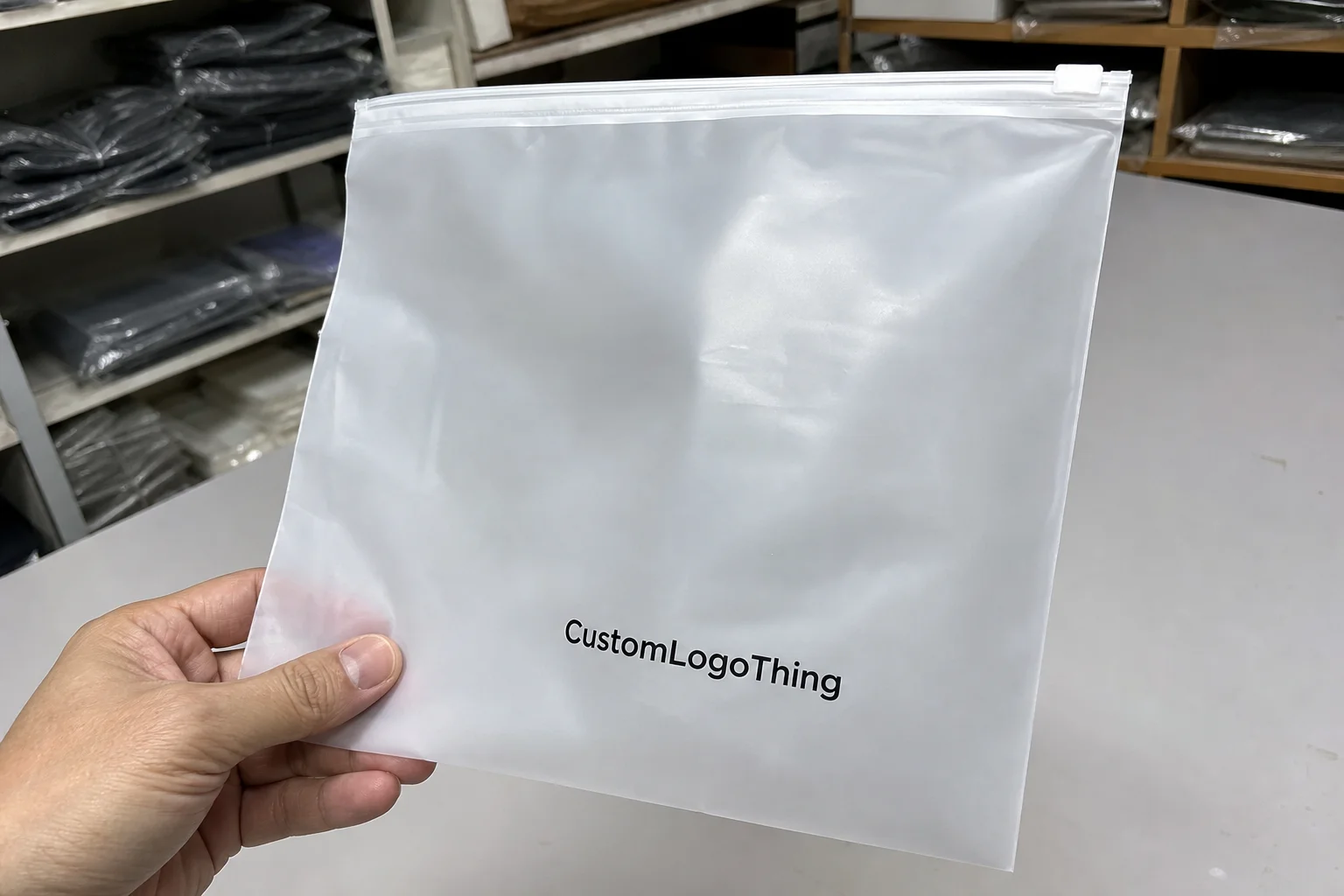
Frosted zipper bags are useful because they combine presentation and speed. The zipper closes the bag in one motion, so the line does not need heat sealing, tape, or extra adhesives. That reduces labor touches and lowers the chance of pack-out errors.
The frosted finish softens glare and hides fingerprints, minor scuffs, and uneven folds better than clear film. Real pack-outs are rarely perfect. Inserts shift, apparel wrinkles, and contents vary slightly from unit to unit. Frosted film makes those variations less obvious, which is valuable in corporate programs where appearance matters but speed still drives cost.
The finish also changes how the contents are perceived. Instead of broadcasting every detail, the bag frames the kit and makes the package feel more intentional. That is useful for onboarding materials, samples, and branded handouts where the package should support the message rather than distract from it.
The zipper adds another practical benefit: reusability. End users can open and close the bag without destroying it, which helps with samples, documents, and accessory kits that may need to be inspected or reused. That same feature makes the bag easier for staff to verify, store, and redistribute.
For teams that also need a shipment-ready outer package, compare the bag spec with a mailer format such as Custom Poly Mailers. The applications are different, but the same rule applies: choose the format that matches the job.
Frosted finish, zipper style, and branding details
Clear, matte, and frosted bags solve different problems. Clear film gives full visibility. Matte film reduces glare. Frosted film sits between the two and gives a cleaner, more controlled look without fully hiding the contents. For corporate programs, that middle ground is often the best fit.
That is why Frosted Zipper Poly Bags for corporate buyers moq planning usually centers on the finish as much as the closure. The bag is not just a container. It shapes how the program is perceived internally and externally.
Zipper choice matters as well. A standard press-to-close zipper is usually the lowest-cost option and works for routine internal packaging. Slider zippers are easier to open and close, which helps when the bag will be reused or handled repeatedly. Tamper-evident closures are more specialized and should be used only when first-opening control justifies the added cost and possible lead-time impact.
Branding should be designed around the film, not forced onto it. A simple logo often performs better than crowded artwork because frosted material already softens the visual field. Overdesigned graphics can make the bag look busy and reduce the clean effect that makes the finish useful in the first place.
Labels and insert cards also need to be matched to the bag size. On frosted film, they can look more deliberate, but only if the insert stays centered and the layout leaves enough breathing room. If the content is too tight, the whole package looks forced.
Buyers should request a sample or proof before release. A bag can look fine in a PDF and still feel wrong in hand. Opacity, zipper feel, and the way the film catches light are difficult to judge on screen, so physical review is where the final decision should happen.
For the broader packaging mix, compare bag specs with the rest of the program at Custom Packaging Products so the format stays consistent across the order.
Size, gauge, and print specs buyers should lock in
Quotes get vague when the specification is vague. To avoid back-and-forth and rework, lock in width, length, gusset depth, thickness, zipper style, and print coverage before requesting pricing. A supplier cannot quote accurately if those details are still moving.
For frosted zipper bags, three dimensions matter most: finished size, opening width, and the space required for the contents to sit flat without stressing the zipper line. A bag that is exact-fit may sound efficient, but in practice it is often harder to load. Most pack-out teams benefit from a little clearance, especially for folded apparel, literature stacks, and multi-item kits.
Thickness also affects handling. A 2 mil bag may be enough for flat inserts or lightweight items. A 3 mil or 4 mil bag usually feels sturdier and tolerates transit and repeated opening better. Buyers often focus on the unit-price difference and ignore the cost of damage or repacking later.
- Width and length: confirm the item fits without stressing the zipper edge.
- Gusset depth: needed for bulkier kits, apparel, or mixed packs.
- Film gauge: choose the lightest grade that still survives handling and transit.
- Print coverage: larger coverage increases setup work and can shift color expectations.
- Artwork placement: keep the logo readable after the contents are inserted.
Print complexity affects both cost and approval speed. A one-color logo is usually cheaper and faster to approve. Multiple colors, edge-to-edge artwork, or tight registration requirements increase setup time and the risk of mismatch. For high-visibility launches, that added cost may be worth it. For routine internal use, simpler layouts usually make more sense.
Standardizing a small set of sizes across a corporate packaging program also helps later. Reorders become easier, artwork stays consistent, and the team stops re-litigating the same decisions every quarter. That is one of the strongest forms of cost control in packaging.
Cost, pricing, MOQ, and quote variables
The main cost drivers are straightforward: material grade, bag size, thickness, zipper style, print complexity, order quantity, and freight. MOQ is usually tied to setup economics and run length, not a random sales threshold. Smaller orders spread setup cost across fewer units, which raises the unit price quickly.
Broad budgeting ranges can help early planning, but they only work when the spec is comparable. Plain frosted zipper bags at higher volumes often fall around $0.08 to $0.16 per piece. Single-color branded versions may run roughly $0.12 to $0.24. More complex multi-color print can reach $0.18 to $0.32 or more on smaller runs. Slider and tamper-evident closures usually increase cost as well.
Setup charges matter more on small orders. Print plates, special zipper components, nonstandard film handling, and proofing can all add one-time fees. On a larger program, those fees may be absorbed easily. On a short run, they can change the economics of the whole order.
| Option | Typical MOQ | Typical Unit Cost | Best Use | Cost Notes |
|---|---|---|---|---|
| Unprinted frosted zipper bag | 500-1,000 pcs | $0.08-$0.16 | Internal kits, samples, apparel inserts | Lower setup charges, quicker approval |
| Single-color branded frosted bag | 1,000-3,000 pcs | $0.12-$0.24 | Corporate giveaways, onboarding packs | Artwork proof and print plates may add fees |
| Multi-color printed frosted bag | 3,000+ pcs | $0.18-$0.32 | Customer-facing kits, retail support | Higher tooling fees and a longer proofing cycle |
| Slider or tamper-evident zipper | 1,000+ pcs | $0.15-$0.35 | Repeated opening, compliance-focused packs | Closure choice can add cost and lead time |
Ask for line-by-line quotes every time. Size, thickness, finish, zipper style, print coverage, freight terms, and setup charges should all be visible. If any of those are missing, the quotes are not comparable yet. One supplier may be pricing a thinner bag or a simpler closure while another is quoting the sturdier spec.
For larger corporate programs, the most efficient path is to standardize one or two approved sizes and a limited set of print layouts. That usually improves pricing and makes later reorders easier to manage.
Process and timeline from sample to production approval
The workflow is simple on paper: spec review, quote, proof or sample approval, production, inspection, packing, and shipment. The delays usually happen before production starts, not during manufacturing.
Fast internal sign-off matters more than almost anything else. If artwork needs several reviewers, or if procurement waits on a final purchase number, the schedule stretches even when the factory is ready. For a simple custom run, production may finish in about 12 to 15 business days after proof approval. More complex artwork, specialty closures, or larger quantities can add time.
Buyers should ask for the right sample at the right stage. A digital proof confirms layout and print placement. A physical sample confirms feel, opacity, zipper action, and appearance under real light. A preproduction check catches spec drift before the full run starts. Skipping those steps saves only a little time if nothing goes wrong, and something often does.
Pack-out testing is worth doing when the bag will move through distribution channels. If the program needs formal transit validation, reference ISTA test methods. If the broader program includes fiber-based inserts or cartons with certified sourcing, FSC documentation may be part of the approval file.
Freight timing deserves the same attention as artwork timing. A correct order can still miss a launch if the delivery window is too tight or the receiving team is not ready. Build buffer into the schedule and confirm the receiving plan before releasing the PO.
Keep the approved spec on file. If dimensions, film, zipper, and print layout are already locked, a reorder stays a reorder instead of becoming a new project. That is the simplest way to reduce risk on recurring programs.
Why procurement teams choose us for repeat orders
Repeat orders depend on consistency. Procurement teams want the same dimensions, the same finish, the same closure feel, and the same print quality every time. Small changes in film thickness or zipper action can create repacking, complaints, or internal re-approval work that costs more than the difference on the PO.
Clear communication matters just as much as the product. A buyer needs a supplier who can explain why a quote changed, what the setup fee covers, and whether lead time shifted because of artwork, material, or capacity. Specific answers are easier to approve and easier to defend internally.
For recurring programs, the value is repeatability, not novelty. The approved spec should move into the next order without redoing the whole process. That matters for onboarding kits, event distribution, sample mailings, and regional rollouts where the bag is only one part of a larger workflow.
If you are comparing packaging assets across a broader program, apply the same discipline at Custom Packaging Products. Not every job needs the same format, and not every format needs branding.
For common reorder questions, FAQ is the fastest place to check the basics before the next purchase order is issued.
frosted zipper poly bags for corporate buyers moq planning
For Frosted Zipper Poly Bags for corporate buyers moq planning, the next step is to lock the spec before asking for the final quote. Gather the dimensions, target quantity, finish preference, zipper style, print requirements, and shipment destination. If the bag will hold multiple items, include the full pack-out contents in the request.
Send the brief once, cleanly, and in full. That cuts back-and-forth and makes it easier to compare bids because everyone is pricing the same job. If the packaging is customer-facing or tied to an executive distribution, ask for a proof or sample before release. That step usually pays for itself by catching opacity issues, bad contrast, or an opening-size mismatch early.
Confirm the production window, shipping method, and reorder contact before approval. Those details are administrative, but they prevent avoidable delays later. A clean handoff between procurement and receiving keeps the order from getting stuck in someone’s inbox.
That is the practical value of disciplined Frosted Zipper Poly Bags for corporate buyers moq planning: fewer surprises, fewer revisions, and a packaging format that works on the first run and the next one.
What affects MOQ for frosted zipper poly bags for corporate buyers?
MOQ is usually driven by setup time, material run length, and print complexity. Standard sizes and unprinted bags often support lower minimums than custom-printed or specialty zipper versions.
How do I compare quotes without missing hidden cost differences?
Use the same spec sheet for every quote: size, thickness, zipper type, finish, print coverage, freight, and setup charges. A lower unit price can disappear if the bag is thinner, smaller, or slower to pack.
Can frosted zipper poly bags be used for branded internal kits?
Yes. The frosted finish works well for onboarding kits, event packs, sample programs, and retail support materials. The zipper closure helps staff pack quickly while keeping the kit presentable and reusable.
What timeline should corporate buyers expect before delivery?
Timeline depends on approval speed, artwork changes, production capacity, and shipping distance. For simpler custom runs, production after proof approval is often around 12 to 15 business days, but larger or more complex orders can take longer.
What should I prepare before requesting a quote?
Have product dimensions, quantity, zipper preference, print requirements, and shipping details ready. If possible, include a reference photo or sample bag so the supplier can quote the closest match.


