A gift set Recycled Poly Mailers quote should show more than unit price. It should tell you whether the mailer fits the packed set, protects it in transit, and presents it cleanly when it reaches the customer. If the bag is thin, oversized, or hard to seal, the packaging cost is only part of the problem.
For gift programs, the outer mailer is part of the product experience. Buyers usually need to know four things fast: finished dimensions, film thickness, closure style, and print coverage. Those details drive the quote, reduce revision loops, and make it easier to compare suppliers on equal terms.
Recycled Poly Mailers are often a practical middle ground for gift sets. They are lighter than cartons, easier to store, and simple to standardize across multiple SKUs. If the set also includes inserts or labels, the outer mailer should fit the whole packaging system instead of working against it.
Gift Set Recycled Poly Mailers Quote: What Buyers Miss
Most buyers start with unit price, but that is only one part of the decision. A lower quote does not help if the mailer needs double taping, causes damage, or slows pack-out. The real cost includes labor, rework, freight, and returns.
The bigger miss is treating the mailer as an afterthought. For a gift set, the outer bag has to seal straight, hide the contents, and look deliberate. It does not need to be flashy. It does need to look planned.
“If you cannot describe the finished pack-out, the quote will be vague. Dimensions beat adjectives every time.”
Clean inputs produce clean quotes. Suppliers need finished size, film thickness, print coverage, and closure type. Say whether the bag ships flat or pre-opened, and whether the seal is adhesive, tamper-evident, or open-top. Those details affect labor and freight as much as material cost.
Recycled content also does not automatically mean better performance. A good recycled film can work very well, but the blend, gauge, and seal design still matter. Ask for the exact material spec rather than a general sustainability claim. That is how you separate a real quote from a marketing answer.
Material and Print Options for Recycled Gift Mailers
Recycled-content mailers are not all the same. You will usually see post-consumer recycled content, post-industrial recycled content, or a blend. Post-consumer content matters most when a brand needs stronger recycled-content claims. Post-industrial content can still be useful, but documentation should match the claim.
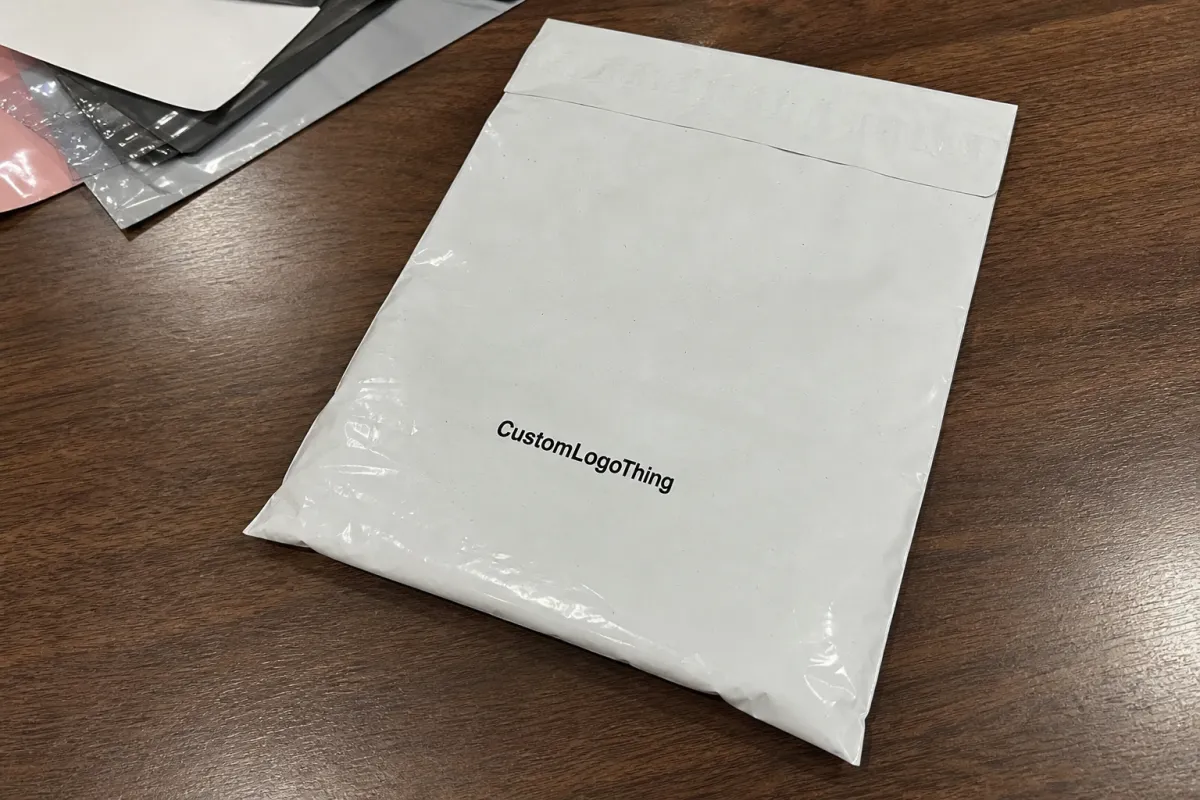
Finish affects perceived quality more than many teams expect. Opaque mailers hide contents and usually look more polished for gift sets. Matte surfaces tend to hide scuffs better than gloss, while gloss can make simple graphics pop but shows handling marks faster. If the pack is meant to feel premium without overspending, matte or soft-sheen is often the safer choice.
Print should follow the brand, not the other way around. One- and two-color runs usually keep setup simpler and help control cost. Full-coverage graphics can create a stronger unboxing moment, but they also increase plate cost and proofing complexity. A clean logo and disciplined typography often work better on recycled film than a crowded layout.
Functional add-ons matter because they change the user experience. A tamper-evident seal improves confidence. A tear strip makes opening easier. Reinforced seams reduce split risk when the set has rigid pieces or sharp corners. If the kit includes paper inserts, ask whether the supplier can coordinate paper components with FSC-backed sourcing through FSC. For transit performance, check whether the package has been tested against methods referenced by ISTA.
In practice, the best spec balances three things:
- Appearance that fits the gift set positioning.
- Performance that holds through handling and transit.
- Documentation that supports recycled-content and quality claims.
Sizing and Performance Specs That Matter
Start from the finished kit, not the loose parts. Measure the packed set after inserts, tissue, boxes, and seals are included. Then add only the clearance needed for a smooth slide-in. Oversizing costs more in film and makes the package look careless.
Thickness has real consequences. Lightweight gift kits often work in the 2.5 to 3.5 mil range. Heavier kits or sets with sharper corners may need 4.0 mil or more. Seal width matters too; a wider seal can improve hold when the contents are dense or boxed. If the mailer carries a rigid gift set, stronger seam construction is usually worth the extra cost.
Puncture resistance is the spec that prevents problems on the dock. Cart edges, conveyor friction, and delivery bins can turn a marginal film into a failure. If the kit includes corners, metal accents, or anything that presses outward, ask for a sample with the actual product inside. A spec sheet is useful, but a real sample is better.
For rigid or semi-rigid sets, a gusseted or wider format can reduce seam stress and make pack-out easier. That can matter more than it looks on paper because awkward bags slow labor. If the contents are unusual, do not estimate. Freeze the final dimensions, sample the build, and then approve the spec. That gives you a more reliable gift set Recycled Poly Mailers quote and reduces the chance of tooling or artwork changes later.
A practical sizing workflow helps keep the order clean:
- Confirm finished dimensions after all inserts and wraps are included.
- Request a sample or dieline for the actual pack-out.
- Test closure, seal strength, and fit with the real contents.
- Approve the final spec only after the sample passes handling checks.
Quality control should also cover registration, seal integrity, and thickness consistency. Recycled feedstock can vary slightly across runs, so ask what tolerances the supplier holds and whether in-process checks happen before final inspection. That tells you more about the supplier's capability than a polished sales deck does.
Pricing, MOQ, and Unit Cost Drivers
Price depends mostly on size, thickness, print colors, recycled content, and volume. Once those are fixed, the quote becomes much easier to read. For blank recycled mailers, working prices often land around $0.10-$0.18 per unit at moderate volume, depending on gauge and format. Simple printed orders are often closer to $0.14-$0.28 per unit at around 5,000 pieces. Full-coverage branded runs, specialty finishes, or heavier films can cost more.
MOQ shifts with customization. Blank or lightly branded stock-style mailers usually carry lower minimums. Once the order needs custom print, special sizing, or tighter recycled-content documentation, the minimum rises because setup work does. Plates, color matching, proofing, and run calibration all add cost.
Larger runs spread setup cost across more units, so unit price often drops faster than teams expect. Short runs pay for proofs and tooling over fewer bags. If procurement wants a fair comparison, ask for tiers at 1,000, 3,000, 5,000, and 10,000 units. That shows the real curve instead of hiding it behind one number.
| Option | Typical MOQ | Typical Unit Cost | Best For | Main Tradeoff |
|---|---|---|---|---|
| Blank recycled mailer | 500-1,000 | $0.10-$0.18 | Internal kits, simple gift orders | Less brand impact |
| 1-2 color custom print | 1,000-3,000 | $0.14-$0.28 | Retail gift sets, promo mailers | Setup and plate cost |
| Full-coverage branded mailer | 3,000-5,000+ | $0.22-$0.40 | Premium launches, stronger unboxing | Higher prep, tighter color control |
| Heavy-gauge specialty run | 5,000+ | $0.28-$0.50+ | Sharp-edged boxes, rough transit | More material cost |
Watch the hidden costs. Tooling, sampling, freight, and pallet configuration all affect landed cost. A low per-unit quote with expensive shipping can lose to a slightly higher quote that ships more efficiently. A good gift set Recycled Poly Mailers quote should specify destination, shipping method, and whether pricing is EXW, FOB, or delivered.
Lead time also affects real cost. A lower unit price matters less if the order misses the launch window and forces rush freight. Paying more for a supplier with steadier throughput can be cheaper than absorbing seasonal delays. Timing risk is part of the decision.
Process and Timeline for a Custom Quote
A workable quote process is simple: inquiry, spec confirmation, artwork review, proof approval, production, shipment. The teams that move fastest send complete information the first time. The teams that slow things down send half a dimension, a fuzzy logo screenshot, and a recycled-content request that sounds optional.
Stock-style recycled mailers can move quickly, often 7-12 business days after proof approval if inventory is available and the artwork is simple. Custom printed runs usually take 12-18 business days after proof approval, not counting transit. Special film, heavier gauge, or new tooling adds time. Rush options may exist, but they usually cost more and leave less room for correction.
The delays are predictable. Missing dimensions trigger fit questions. Low-resolution art creates redraws. Unclear recycled-content requirements lead to substitution or documentation questions. Late proof edits reset the clock. None of that is mysterious, but it still slows launches.
To get a stronger first-pass quote, send these items together:
- Finished product dimensions and packed weight
- Quantity and target tier, not just one number
- Print file or logo artwork in vector format
- Recycled-content preference and documentation needs
- Closure type, finish, and any tear-strip or tamper-evident request
- Shipping destination and needed delivery window
Approval quality matters as much as the initial brief. Check the proof against the actual kit, not a concept image. Barcode space, logo placement, color density, and seal orientation are easy to confirm before production and annoying after it starts. A careful proof review is not bureaucracy; it is how the order matches the plan.
If you are comparing outer packaging formats, keep the decision practical. A custom mailer often beats a box when the kit is light, the shape is manageable, and warehouse speed matters. A box still wins when the contents are fragile or need structural protection. The right answer depends on the set, the route, and the brand standard.
When Recycled Poly Beats Standard Mailers
Standard mailers can work for basic shipping. Recycled poly makes more sense when the outer layer has to do more than close a parcel. If the gift set needs cleaner presentation, a more consistent branded look, or a stronger recycled-content story, recycled film often becomes the better operational choice. It is lighter than a carton, easier to store, and less expensive to move in bulk.
It also works well across multiple SKUs. If you are shipping the same gift concept in three sizes, recycled poly lets you standardize the visual system while changing only the mailer dimensions. That keeps artwork management simpler and reduces warehouse confusion.
Damage control is another reason buyers move in this direction. A properly sized mailer with the right gauge and seal can reduce scuffed boxes, slipped contents, and crushed secondary packaging. That matters most when the kit passes through several handling points.
Cost and presentation often meet here. Recycled poly can deliver a better finish than a plain generic mailer without the freight and structure penalties of a rigid box. For many gift programs, that is the practical middle: efficient, clean, and easy to repeat across a season.
There is also a brand-control benefit. Recycled poly often gives more consistent visual results than teams expect once the artwork is simplified and the print process is dialed in. A clean one-color mark on opaque film can read more premium than a box with weak print and inconsistent tape.
Next Steps to Lock In the Right Order
The fastest route from interest to order is a complete spec set: finished dimensions, quantity, print file, shipping destination, and target delivery date. If you know the finish you want, say matte or opaque. If tamper-evident closure matters, include that too. A complete brief produces a cleaner quote and fewer revision cycles.
Ask for a sample or spec sheet before approving the run, especially if the gift set has sharp corners, fragile contents, or a premium presentation target. If recycled-content documentation matters to a retailer or brand standard, request it before production starts. If barcode space is needed, say so early.
Hold the final decision against the actual pack-out, not an abstract idea of what recycled packaging should look like. Oversized bags, weak seams, and expensive guesses all come from skipping that step. Measure the finished set, verify the material, test the closure, and compare the landed cost against the value of the presentation.
What details do I need for a gift set recycled poly mailers quote?
Provide finished product dimensions, quantity, print colors, and recycled-content preference. Include the shipping destination and target delivery date so freight and lead time are accurate. Share any special requirements such as tear strips, opaque film, or logo placement.
What is the typical MOQ for recycled poly mailers for gift sets?
MOQ depends on whether the order is stock blank, simple printed, or fully customized. Lower volumes are easier with basic specs; custom print and special films usually require higher minimums. Ask for tiered pricing so you can compare the real jump between small and larger runs.
How long does production usually take after proof approval?
Stock-style orders move faster than custom printed runs because there is less prep work. Proof approval, artwork changes, and material availability are the main schedule drivers. Build in time for freight if the order needs to arrive before a launch or seasonal gift drop.
Can recycled poly mailers be printed with a premium gift set look?
Yes, clean one- or two-color branding can look sharp without pushing cost too high. Matte and opaque finishes usually feel more premium than thin, shiny film. Keep the design simple if you want the packaging to look intentional instead of crowded.
Are recycled poly mailers strong enough for boxed gift sets?
They can be, if the size, thickness, and seal strength match the finished pack-out. Test the final configuration with the actual box or kit before approving production. If the contents have sharp edges, ask for reinforced seams or a heavier film.