A clothing brand Recycled Poly Mailers factory quote should start with size and use case, not graphics. Oversized bags cost more in material, freight, and storage, and they often make the shipment feel less considered. A mailer that is too large for the folded product usually looks like a cost issue, not a brand choice.
Recycled Poly Mailers make sense for tees, leggings, socks, and other soft goods because they are light and compact. The value only holds if the spec is tight. The wrong size, thickness, or seal style can erase the savings before the first carton ships.
Clothing Brand Recycled Poly Mailers: Why Oversized Bags Waste Money
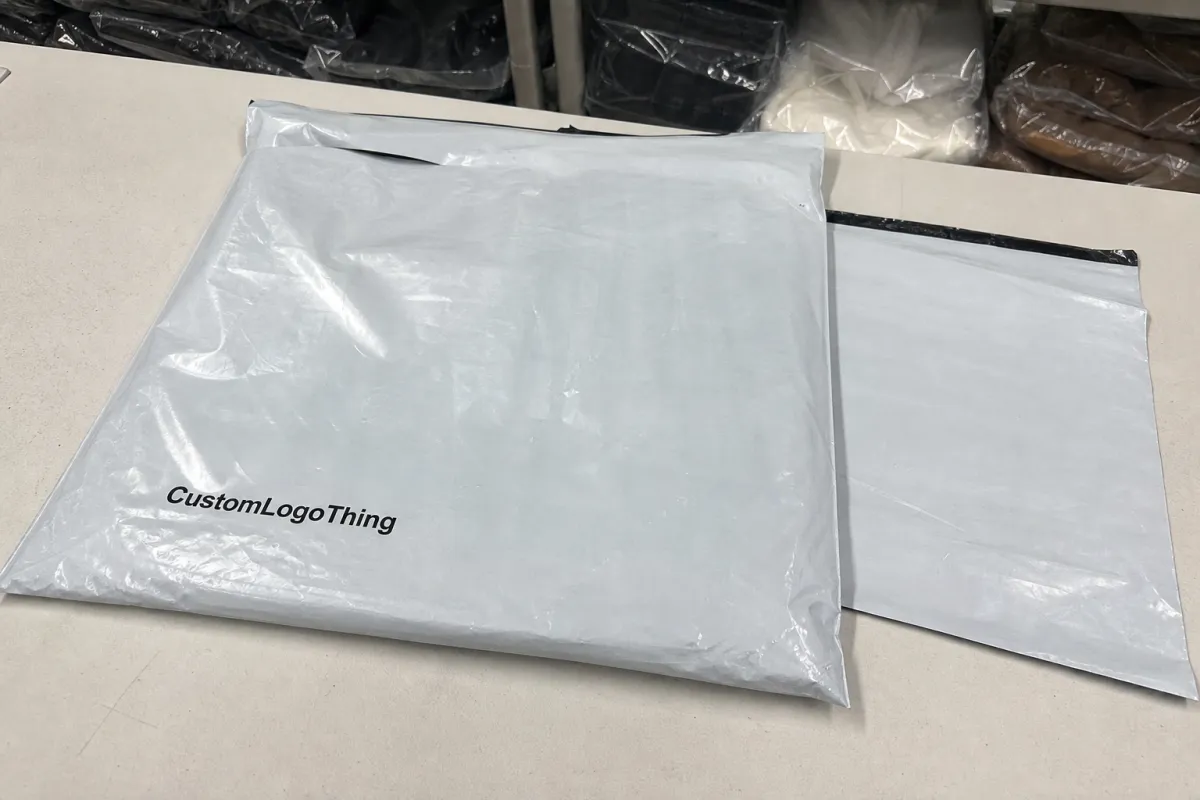
Buyers often assume bigger is safer, but that logic works better for rigid packaging than for film. A mailer that is too wide can raise dimensional weight, take up more warehouse space, and make packing slower. It does not need to hug the garment, but it should look intentional.
Apparel usually fits in a narrower range than teams expect. A standard tee often fits in a 10 x 13 inch or 10 x 14 inch mailer, depending on the fold and whether an insert is included. Hoodies, thicker knits, or multi-item packs usually need more room, often in the 14 x 17 inch to 14 x 19 inch range. Those are working ranges, not fixed rules. The right size depends on the folded stack height, flap depth, and how much pressure the seal can handle.
That fit affects more than appearance. Oversized bags consume more carton space, more inbound freight volume, and more shelf room at the packing station. For brands ordering 5,000, 10,000, or 50,000 units, even a small increase adds real cost across a season.
There is also a customer-facing effect. Apparel mailers are handled directly, so people notice the seal, print placement, and whether the contents shift around. A well-fitted bag feels deliberate. A loose one feels generic.
A mailer that fits a folded tee usually saves more than a fancier logo on a bag that is two sizes too large.
Recycled Poly Mailers are best for soft goods. They are not a substitute for rigid crush protection or padding. If the order includes hard accessories, framed inserts, or items that can puncture thin film, the packaging spec needs another layer of review.
If you already have a size in mind, compare it against the actual folded product rather than a competitor’s bag. Measure the folded stack, add the insert if there is one, and check the seal area before requesting a quote. For a practical baseline of format options, review Custom Poly Mailers before locking in a spec.
Material Choices for a Clothing Brand Recycled Poly Mailers Factory Quote
Material is where recycled-content mailers become less straightforward than the label suggests. Not every recycled film behaves the same way. Buyers often hear PCR, recycled blend, or post-consumer recycled content, but the actual structure behind those terms can vary a lot. A bag with a high recycled percentage may feel less glossy, print slightly softer, or show more opacity variation.
That is why sample approval matters. Two bags can share the same dimensions and still perform differently. One may seal more cleanly. Another may have a duller finish that changes how the logo reads. If the artwork depends on fine lines, small type, or pale colors, those differences matter.
Color choice also changes the result. White recycled film usually gives the clearest background for bright branding and small text. Gray and black hide scuffs better and can make darker brand systems feel more premium, but they reduce contrast for lighter artwork. Tinted films can add privacy for the contents, though they may flatten the logo if the design is too delicate. The right choice depends on route conditions, brand palette, and how much visual contrast the artwork needs.
| Film Option | Typical Use | Print Impact | Quote Impact |
|---|---|---|---|
| White recycled blend | Bright branding, retail-style presentation | Strong contrast for logos and text | Usually mid-range |
| Gray or black recycled blend | Streetwear, privacy, darker brand systems | Works well for bold art, weaker for pale tones | Often similar, sometimes slightly higher |
| Higher PCR content film | Brands emphasizing recycled-content claims | Can print a bit softer and look less glossy | May add cost if the spec is tighter |
| Blended film with standard recycled mix | Balanced cost and appearance | Reliable for most apparel mailers | Usually the best value |
If a supplier makes recycled-content claims, ask for the exact percentage and the film structure behind it. Ask what the recycled layer is doing in the build, whether the print surface is affected, and whether the supplier can hold color consistency from one batch to the next. For broader context on packaging testing and recycled-content practices, the EPA and ISTA are useful references.
Recycled content is not a performance guarantee. A mailer can meet sustainability targets and still fail in transit if the seal is weak or the film is too thin. Buyers should judge the package by shipping performance, not by one line in the spec sheet.
Sizing, Thickness, Adhesive, and Print Specs to Lock In
A useful clothing brand Recycled Poly Mailers factory quote depends on technical details that are easy to overlook. Start with flat width, length, flap depth, gauge, seal style, and intended contents. If the bag is for folded apparel only, say that. If it also needs to handle returns, insert cards, or cross-border shipping, say that too. A factory cannot price accurately if it is guessing how the bag will be used.
Thickness is one of the biggest performance drivers. For apparel mailers, common ranges often sit around 2.0 to 3.5 mil, depending on size and handling conditions. A thinner bag can lower cost, but if it opens in transit or tears at the corner seal, the savings disappear. The same logic applies to the adhesive. A single strip is enough for many orders. Dual adhesive supports returns or reclosure use, which is useful for brands that want reuse without moving to a box.
Print specs matter more than most buyers expect. Pantone targets, one-color or multi-color art, bleed limits, and safe zones should be settled before the quote is finalized. The same goes for barcode placement and return-address positioning. A logo, a website, a barcode, and a warning line all compete for limited space. Crowding them near the flap or side seam creates problems on press and in shipping.
Practical additions can improve the package without turning it into a design exercise:
- Tear strip for easier opening and a cleaner unboxing moment.
- Dual adhesive for returns or reclosure use.
- Suffocation warning text if required by the market or channel.
- Internal packing label space for warehouse marks or SKU codes.
If the mailers will move through multiple channels, align the spec with the strictest channel first. Marketplaces, wholesale programs, and warehouse workflows often have different expectations for labels, warnings, or flap design. A small change made early is cheaper than a revision after production has already started.
Pricing, MOQ, and Unit Cost Drivers That Move the Quote
Price is never a single figure. It is a stack of variables presented as one line. Size, gauge, recycled-content level, print complexity, adhesive type, carton pack count, and total quantity all move the number. Shipping terms do too. An attractive ex-works price can become a mediocre deal once freight, sampling, setup, and packaging are added.
MOQ follows the same logic. The more setup the factory needs to absorb, the higher the minimum usually climbs. A standard size with simple print can be ordered in smaller quantities. A custom size, special warning language, or tighter recycled-content requirement usually pushes the minimum upward. Smaller runs are possible, but unit cost rises because fixed setup work is spread across fewer bags.
| Quote Type | Typical MOQ | Typical Unit Price Range | Main Tradeoff |
|---|---|---|---|
| Blank recycled mailer | 1,000-3,000 pcs | $0.06-$0.10 | Lowest cost, no branding |
| One-color custom print | 3,000-5,000 pcs | $0.09-$0.16 | Good balance of cost and brand identity |
| Higher PCR content with custom print | 5,000 pcs and up | $0.13-$0.24 | Better recycled-content story, tighter spec |
| Thicker gauge, dual adhesive, special warnings | Usually 5,000 pcs and up | $0.15-$0.28 | More function, more setup cost |
Those ranges are directional, not universal. A 10 x 13 inch bag does not cost the same as a 14 x 17 inch bag. A 2.0 mil film and a 3.5 mil film also behave differently on the machine and in transit. If one supplier comes in far below the others, check what is missing. Plate charges, samples, cartons, and freight are common omissions.
Ask for a delivered-cost comparison instead of a loose ex-works number. Compare size, film type, print count, packing method, and destination on the same basis. If the factory only gives a lump sum, ask for the component breakdown. That is the only clean way to compare suppliers without guessing.
For broader packaging sourcing, it helps to review a supplier’s Custom Packaging Products range and check whether the mailer quote fits the rest of the packaging program. If one item is priced far outside the rest of the line, the quote deserves a closer look.
Production Steps, Proof Approval, and Lead Time Expectations
Production usually follows the same sequence: spec confirmation, artwork review, digital proof, material prep, printing, sealing, inspection, and shipment. Delays usually come from missing dimensions, late changes, or artwork files that are not ready for press. The earlier the spec is stabilized, the smoother the order tends to move.
Proof approval typically takes a few days if the artwork is clear and the dimensions are settled. Bulk production often runs around two to four weeks after approval, depending on quantity and complexity. A plain one-color bag can move faster than a multi-color mailer with special warnings, precise logo placement, and a tighter recycled-content target. Rush production can shorten the timeline, but it does not remove setup time or quality checks.
Common delay points are predictable:
- Artwork submitted without vector files.
- Late revisions to the bag size or flap depth.
- Color changes requested after the proof is nearly finished.
- Warning text added near the end of the process.
- Missing shipping destination or carton packing instructions.
If the shipment needs extra validation, ask what test method the factory uses. Packaging.org is a useful industry reference for broader packaging topics, while ISTA outlines transport testing methods that matter for packages moving through rougher routes. Not every apparel mailer needs a full lab program, but large runs and long distribution chains deserve more than a quick visual check.
A good proof should name the bag size, film spec, print colors, and carton count in one place. If the proof says 10 x 13 inch in one section and 10 x 14 inch in another, stop and fix it. That kind of mismatch sounds small, but it becomes expensive once production starts.
How a Factory Partner Keeps Branding Consistent at Scale
Brand consistency is not abstract. It shows up in repeat orders. If the film tone shifts, the logo drifts off-center, or the seal weakens from one batch to the next, the packaging stops feeling controlled. For apparel brands that rely on a consistent black or white mailer, even a modest color shift can change the look of the shipment.
The quality checks that matter most are practical and easy to verify:
- Film thickness checked against the approved spec.
- Adhesive performance tested for open and reseal behavior.
- Logo placement checked for registration and centering.
- Carton counts verified before shipment.
- Seal integrity reviewed for edge failures or uneven closures.
A competent factory flags substitutions before production, not after. If resin mix, print method, or packing format changes, that should appear in the approval stage. Hidden substitutions are a common reason repeat orders drift.
Paperwork matters more than it seems. Keep the approved spec sheet, proof sign-off, packing list, and invoice details aligned. If an order serves several channels, those records prevent confusion and make reorders easier. A good packaging program is not just about output. It is about repeatability.
That repeatability is the real test of a factory partner. The first run can look fine by accident. The second and third runs show whether the supplier can hold a standard. In packaging, consistency is usually more valuable than novelty.
Next Steps to Get an Accurate Factory Quote Fast
The best quote requests are short and specific. Send one clean brief rather than scattering details across several messages. Include bag size, quantity, recycled-content target, print colors, closure style, and destination country. If the garment type is known, mention that too. A lightweight tee and a 200 gsm hoodie create different packing demands, even if the branding is identical.
Artwork should be vector if possible. If you have a sample bag from another supplier, include the dimensions or a measured photo. That gives the factory a real reference point and reduces guesswork. “Similar to the last one” is not enough information for a production team to price accurately.
Ask for separate line items for these points:
- Unit price
- MOQ
- Sample cost
- Freight estimate
- Setup or plate charges
- Lead time
That structure makes supplier comparison much cleaner. It also keeps the clothing brand Recycled Poly Mailers factory quote honest, because the real cost is visible instead of hidden in a single number. A low unit price with high freight and setup charges is not a bargain. It is just a delayed expense.
The most useful move is to request two or three alternatives on the same spec and compare them side by side. Evaluate price, print quality, and lead time against the actual order, not against an idealized version of it. A good quote is not the cheapest number in the inbox. It is the one that matches the product, the route, and the brand standard without improvisation.
What should I include in a recycled poly mailer factory quote request?
Include bag size, quantity, recycled-content target, print colors, closure style, and ship-to country so the factory can quote the actual job. Ask for separate pricing on samples, freight, and any setup fees so supplier comparisons stay fair.
How much recycled content is normal for clothing brand mailers?
It depends on the supplier and the film structure, so ask for the exact PCR or blended-content percentage instead of assuming. Higher recycled content can change opacity and surface feel, which is why sample approval matters before bulk production.
What MOQ should I expect for custom recycled poly mailers?
MOQ usually depends on print setup, film width, and bag size, so there is no single number that fits every factory. Smaller MOQs are possible, but the unit price usually rises because setup costs are spread across fewer bags.
How long does production take after artwork approval?
Many orders need a few days for proof approval and roughly two to four weeks for bulk production, depending on complexity and volume. Rush schedules can shorten the timeline, but they leave less room for revisions and can increase the chance of mistakes.
Can recycled poly mailers still print sharp logos and barcodes?
Yes, as long as the artwork is simple, contrast is strong, and the factory uses the right print method for the film. Request a digital proof and, if the scan matters, a physical sample before approving the full run.


